
Solutions
 Breadcrumb: Home > Solutions > Biofilm Detection
 Updated:2026-11-16
 Views:
Hidden biofilm is a blind spot in pharmaceutical sterility control. It attaches to tubing, tank shells and equipment surfaces, and the protective matrix it builds makes routine disinfection and wiping far less effective than the cleaning record suggests. This article explains the detection principle - excitation at specific UV wavelengths makes residues fluoresce in the visible range - then lists where the method is used: raw materials, water generation, compounding and filling. It closes with a comparison against the main pharmacopoeias and GMP expectations, and shows how biofilm inspection can be folded into routine compliance work and what a positive reading means before cleaning validation is signed off.
Sterility control in pharmaceutical production leaves no room for error. Biofilm and microbial residue hiding in cleanrooms, process piping and water-for-injection (WFI) systems are a central, invisible risk behind batch rejection, audit findings and patient safety concerns. Conventional microbial culture needs 24-72 hours to return a result, which is too slow for on-the-spot risk control. The LUYOR biofilm UVA inspection lamp was developed for GMP compliance work: multi-wavelength UV fluorescence makes biofilm, bacteria and organic residue visible in real time, covering the gap left by conventional testing and giving quality teams a practical tool for hygiene control, audit preparation and risk response.
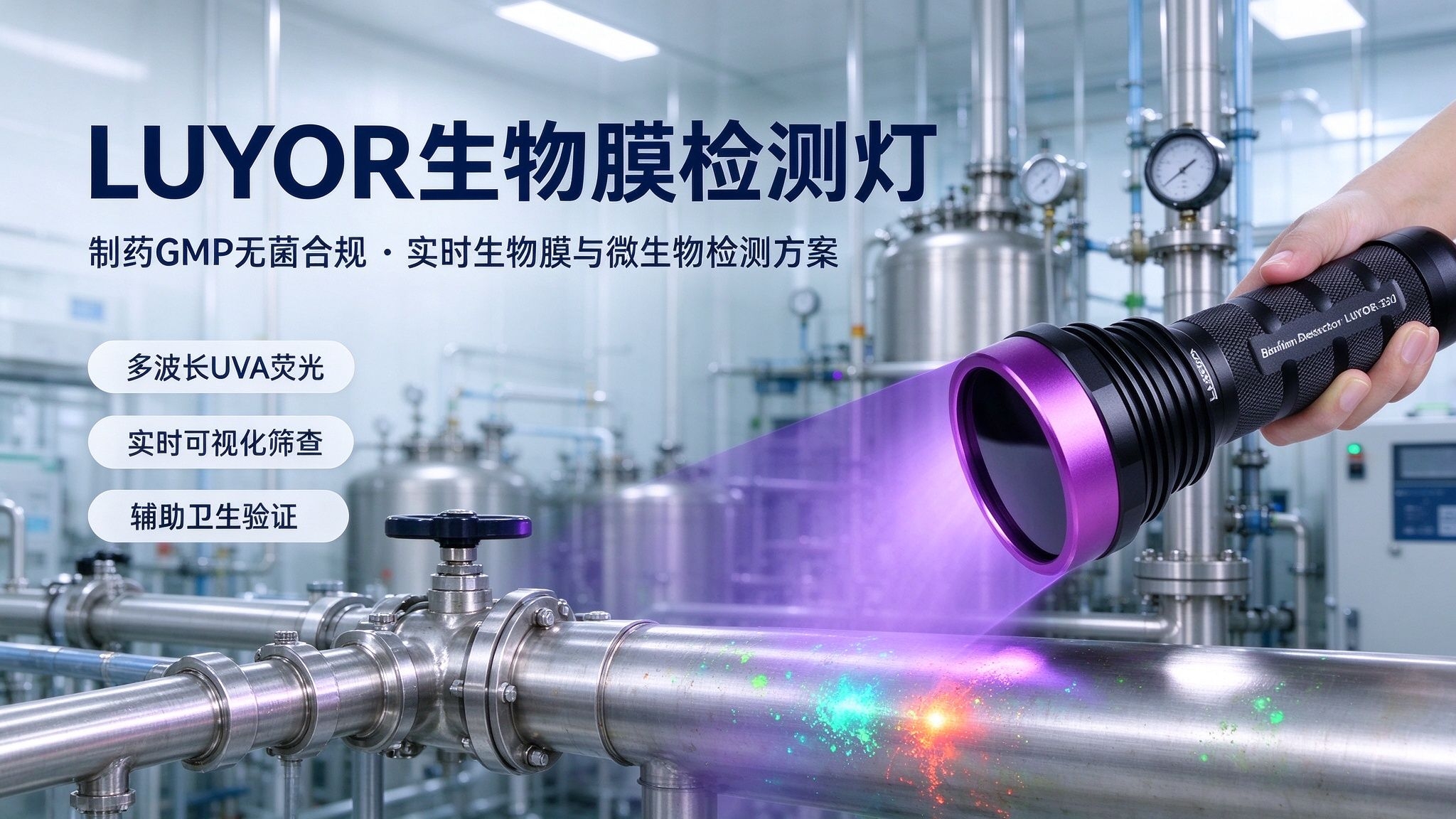
Green and blue fluorescence: bacterial biofilm and thin organic residue on stainless steel tanks and transfer lines
Red-orange fluorescence: fungal and mixed microbial populations in floor drains, filter housings and HVAC coils
Color zoning: hotspots are located in one pass and cleaned selectively, including corners that wiping tends to miss
Water system inspection: walking purified water and WFI loops, checking tanks and return piping for biofilm accumulation
CIP verification: confirming that piping and tanks come out of clean-in-place visually clean, with no hidden microbial residue left behind
Cleanroom environment control: checking walls, floor drains and core production equipment for microbial residue
Wear-part screening: inspecting filter housings, gaskets and seals, the places biofilm tends to start and routine checks tend to miss
It supports the FDA and EMA expectation that microbial risk in equipment and water systems is actively assessed and verified
It aligns with USP <1231> on pharmaceutical water and Ph. Eur. 2.6.27 on cleanroom monitoring
It supports real-time hygiene verification and early warning, and images can be archived for SOP rollout, operator training and audit review
Faster risk control: no 24-72 hour culture wait, with contamination identified in seconds on site and stopped before product moves on
Stronger compliance: a more complete microbial control picture for official inspections and internal audits
Better maintenance: early detection of biofilm keeps WFI systems running steadily and reduces remedial work
Lower exposure: fewer batch rejections, market recalls and regulatory penalties
Easier training: clean and contaminated states side by side in color, which raises hygiene awareness and hands-on skill on the line

Email: info@xinysun.com

Tel: 131-2093-6518

Address: 1525 Minqiang Road, Bldg 26, Songjiang, Shanghai

Copyright 2026 Xinysun Instrument (Shanghai) Co., Ltd. All rights reserved.
ICP:ICP-2026046447




 Industrial Test Instruments


