
Solutions
 Breadcrumb: Home > Solutions > Biofilm Detection
 Updated:2026-11-16
 Views:
In food and beverage production, equipment that has passed CIP or manual cleaning can still hold organic soil and biofilm in gaskets, joints, drain lines and fill ports, where it releases microorganisms, shortens shelf life and adds compliance pressure. The LUYOR biofilm detection lamp uses multi-wavelength UV-A excitation to make these residues visible as colored fluorescence, so hygiene teams can find hot spots in complex equipment before the problem spreads. This article explains the fluorescence reading, the applications in cleaning verification and hard-to-clean area inspection, the advantages and the limits of the method, and a three-step routine of zone scanning after cleaning, ATP checks at critical control points, and periodic swab culture or PCR confirmation.
In food and beverage production, cleaning equipment is fundamental to food safety, consistent product quality and brand reputation. Yet even after thorough clean-in-place (CIP) or manual washing, organic residue and biofilm that the eye cannot detect may remain on equipment surfaces, gaskets, joints, drain lines and fill ports. Once these hidden sources of contamination form, they release microorganisms continuously, raise the risk of product contamination, shorten shelf life, and can put compliance and brand trust under pressure.
The LUYOR biofilm detection lamp offers a rapid, non-destructive way to check for biofilm and organic residue. Multi-wavelength UV-A excitation makes surface contamination show up as colored fluorescence, which helps hygiene staff identify hot spots quickly in complex equipment and take targeted cleaning and verification measures before the problem spreads.
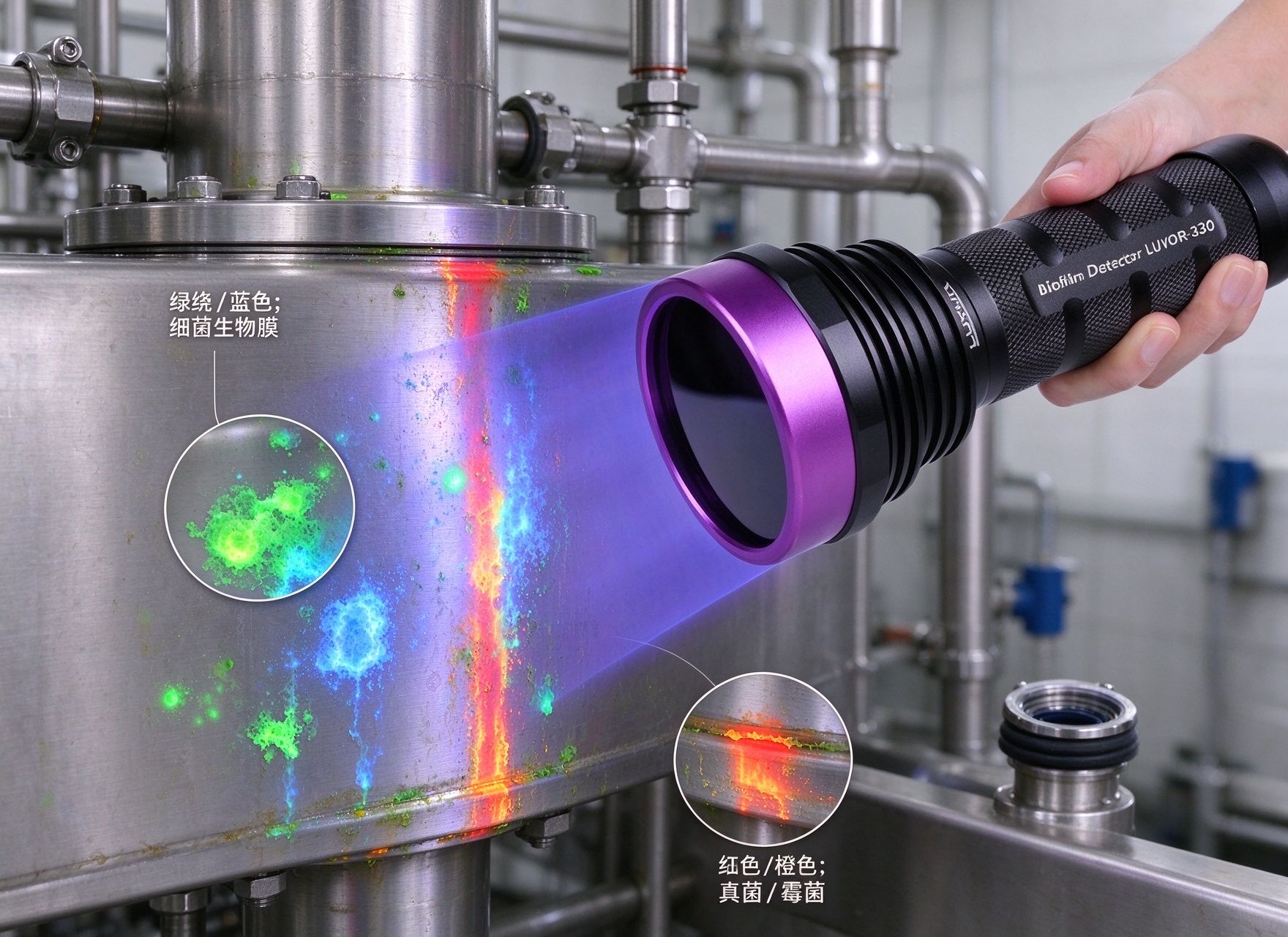
Many organic compounds, including proteins, fats, microbial metabolites and the biofilm matrix, fluoresce under UV-A. A properly cleaned surface usually shows little fluorescence, while areas with biofilm or organic residue appear as distinct glowing patches, streaks or films.
Different types of contamination may also fluoresce in different colors:
Green or blue glow: usually indicates bacterial biofilm or organic residue
Red or orange glow: may reflect fungal or mold growth in drain lines, gaskets or damp areas
Used this way, the check no longer depends on a single visual pass: cleaning blind spots become easier to see, and the team can judge whether a surface really meets the hygiene control requirement.
The LUYOR biofilm detection lamp is used at several key stages of food and beverage production:
Cleaning verification: a quick check for residue on equipment surfaces after CIP or manual washing
Inspection of difficult areas: close checks of gaskets, joints, drain lines, valves and fill ports where soil tends to collect
Hygiene training: visual results help staff understand where residue sits and what cleaning has to cover
Early risk identification: problems are found and handled before a biofilm hot spot leads to batch-wide contamination
Fast feedback: the result is visible immediately, with no wait for incubation
Portable and simple: suitable for use across lines, equipment areas and shifts
Non-destructive: surfaces are scanned directly, with no swabbing beforehand
Cost-effective: compared with complex molecular methods, it works well as a daily screening tool
It should be clear that the LUYOR biofilm detection lamp is an effective screening tool: it helps find residue and biofilm hot spots but cannot replace laboratory confirmation. In practice it should be combined with other methods:
ATP testing: for rapid verification of surface hygiene
Swab sampling and culture: to confirm pathogens and meet regulatory requirements
PCR/qPCR: for sensitive, pathogen-specific confirmation
Biofilm is a community of microorganisms that attach to a surface and are protected by a sticky extracellular matrix. Once biofilm forms in a food or beverage system, the risk of ongoing contamination rises. A three-step management routine is therefore recommended:
Step 1: after cleaning, scan equipment surfaces with the LUYOR biofilm detection lamp for a rapid visual check
Step 2: run ATP tests at critical control points to assess cleaning effectiveness
Step 3: carry out swab culture or PCR at intervals to confirm the absence of pathogens and meet compliance requirements
Lower risk of foodborne pathogen contamination
Less impact of microbial contamination on product quality
Help in extending product shelf life
Visual evidence for hygiene verification
Support for cleaning records and trend analysis
Better hygiene management on the production floor
Cleaning blind spots found quickly, with less re-cleaning
Shorter downtime between cleaning and the restart of production
More efficient hygiene patrols
Residue locations shown directly, so staff understand the cleaning priorities
Support for a hygiene culture on the production floor
Lower contamination risk from human oversight
Food and beverage companies cannot carry the safety risk and economic loss of hidden contamination over the long term. With UV-A fluorescence, the LUYOR biofilm detection lamp helps production teams find biofilm and organic residue hot spots that the eye can barely see, in real time. Combined with ATP testing, microbiological culture and PCR, it forms a more complete hygiene monitoring system that strengthens cleaning verification, supports compliance management, and helps protect consumer health and brand value.

Email: info@xinysun.com

Tel: 131-2093-6518

Address: 1525 Minqiang Road, Bldg 26, Songjiang, Shanghai

Copyright 2026 Xinysun Instrument (Shanghai) Co., Ltd. All rights reserved.
ICP:ICP-2026046447




 Industrial Test Instruments


