
Solutions
 Breadcrumb: Home > Solutions > Fluorescent Inspection
 Updated:2026-11-16
 Views:
Non-destructive testing (NDT) is a core quality control method for confirming the integrity of materials and structures without damaging the workpiece. It is used across aerospace, oil and gas, power generation, automotive and infrastructure work, and it is a common requirement in AS9100 audits. This article explains the role of UV lamps in fluorescent penetrant and magnetic particle inspection, the black light intensity and darkened-area conditions that have to be met, and the points that matter when a LUYOR inspection lamp is used in an NDT process, from beam coverage to the checks that keep a survey valid.
Non-destructive testing (NDT) is a core preventive quality control method: it confirms the reliability of materials, parts, structures and in-service maintenance work without damaging the workpiece. NDT verifies the structural integrity of parts in aerospace, oil and gas, power generation, automotive, manufacturing and infrastructure work, provides a reliable basis for equipment safety, and plays a key part in meeting system standards such as AS9100, AS9110 and AS9120.
NDT is an important element of a quality control system. It detects cracks, corrosion and other defects early, avoiding potential failure risks and preventing injury, production stoppages, expensive repairs and even catastrophic accidents.
Where products and infrastructure face demanding quality and safety requirements, NDT helps regulated companies meet higher industry standards and regulatory requirements.
The LUYOR 3100 series black light lamps were developed for fluorescent inspection professionals and meet NDT ultraviolet technical specifications such as RRES 90061, ASTM E3022 and Airbus AITM6-1001.
We supply UVA flood lamps and inspection lamps to component manufacturers, precision machining companies, service providers and NDT consultants. The products also suit maintenance, repair and overhaul (MRO) quality control teams who need in-service assets to follow good industry practice.
Aerospace: safety is the primary consideration, and inspection has to meet the higher industry standards of AS9100, AS9110 and AS9120. NDT is used to check turbine blades for cracks and other damage, and to find defects in landing gear, engine parts, structural components and other critical parts.
Oil and gas: UV black light is used to detect surface and subsurface defects such as cracks and porosity. Another key NDT task in oil and gas is the detection of hydrocarbon contamination inside oxygen vessels and their connected piping, since such contamination can cause a catastrophic explosion. Used with penetrant dyes, this NDT technique performs well on small surface defects; with magnetic particle inspection, defects are also easy to identify. Typical applications include pipeline integrity inspection, weld joint inspection, equipment inspection and hydrocarbon detection.
Power generation: NDT UV inspection confirms the integrity of parts and keeps turbines, piping and storage tanks running safely and steadily. Finding problems early reduces failure costs and downtime. NDT assessment is often a mandatory compliance requirement used to meet quality control standards.
Automotive and factory: beyond quality control of castings and weldments and the identification of surface defects, UV black light lamps with fluorescent dye efficiently detect leaks of engine oil, gearbox oil, power steering fluid, coolant, brake fluid and leaks in structural parts.
Manufacturing: NDT is widely used in production for detecting weld cracks and porosity, product conformity inspection, leak tracing and contaminant detection.
Infrastructure: for ferromagnetic materials such as iron and steel, fluorescent penetrant inspection and magnetic particle inspection identify surface and near-surface defects; they are also used to find cracks or discontinuities in other infrastructure components.
Electronics: UV lamps play a useful part in quality control of electronic components.
Food production: UVA lamps are used in egg inspection, mainly to screen for contamination and specific shell defects. Egg inspectors and wholesalers working with the Animal Health and Veterinary Laboratories Agency (AHVLA) of the UK Department for Environment, Food and Rural Affairs also use UVA light to spot-check eggs from illegal cage systems. UV light reveals the cage marking, identifying eggs that have been sold illegally as Grade A in the UK since 2012. Another food industry application is UVA inspection of citrus fruit. Black light inspection removes decayed fruit before packing, helping producers protect revenue and giving them a grading method to select high-quality Class 1 citrus for premium markets.
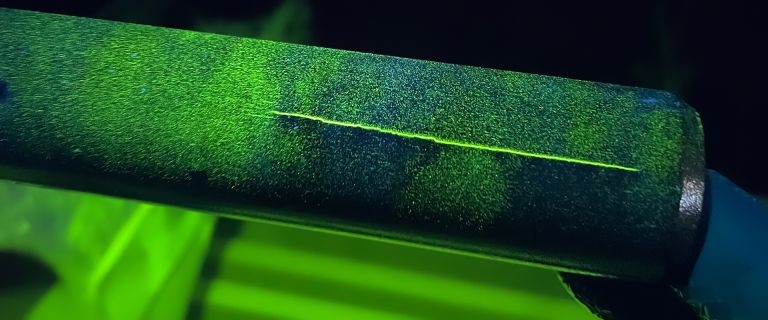
UV black light lamps, used with fluorescent penetrant and magnetic particle, reveal internal defects in metal and ceramic materials.
LUYOR products are designed in the United States and manufactured in China. We source raw materials and components from as many regions as possible to support stable supply and flexible service. All products meet current fluorescent penetrant and magnetic particle inspection specifications and are supplied with a manufacturer's certificate of conformity.
Selecting equipment for NDT crack and leak detection depends on the specific process requirements. The main points are:
UV wavelength - 365nm is commonly used for fluorescent inspection
Minimum UV irradiance - set by the work standard or the ambient lighting conditions
Inspection area - UV exposure must be confined to the working area
Effective coverage: the full inspection area is covered, reducing repeat inspection
Compliance with the applicable industry standards, such as RRES 90061, ASTM E3022 and Airbus AITM6-1001
Task-related health and safety risk assessment

Email: info@xinysun.com

Tel: 131-2093-6518

Address: 1525 Minqiang Road, Bldg 26, Songjiang, Shanghai

Copyright 2026 Xinysun Instrument (Shanghai) Co., Ltd. All rights reserved.
ICP:ICP-2026046447




 Industrial Test Instruments


