Supermarket lettuce salads, refrigerated sandwiches from breakfast shops and cold dishes supplied by central kitchens are all common ready-to-eat foods. From preparation to delivery, these foods need a stable cold chain and, in addition, sound environmental hygiene management.
One reason is that Listeria monocytogenes (hereafter LM) still multiplies at refrigeration temperature. Fresh produce, ready-to-eat meat products and dairy products all carry a risk of Listeria contamination. For food operators, control has to cover raw material management, equipment cleaning, environmental disinfection and site-wide monitoring, so that problems are found and solved before contamination reaches the finished product.
1. From raw material to equipment: where Listeria may hide
Listeria can enter a food plant on vegetables, soil, water and other raw materials, and then spread across the site through utensils, personnel and the flow of materials.
Taking fresh-cut vegetable and ready-to-eat production lines as an example, the key risk points include the seams of cutting machines, the underside of conveyor belts, the inside of dewatering equipment, the area around floor drains and standing water in chilling equipment. Damp areas, accumulated material residue and equipment that is hard to dismantle for cleaning all raise the probability that Listeria establishes itself and keeps recontaminating product. Environmental inspection therefore cannot stay at the surface: it has to reach blind spots and hidden structures, and bring hard-to-reach, easily overlooked points into routine cleaning control.
2. Listeria monocytogenes forms biofilm, which makes cleaning harder
Listeria monocytogenes attaches to surfaces very effectively and can colonize equipment surfaces to form biofilm. Published studies confirm that the species forms biofilm stably on stainless steel surfaces and secretes extracellular polymers to build a protective film. Such microbial communities on equipment become a persistent, hidden source of contamination and cause repeated cross-contamination of food.
Biofilm is a dense microbial community formed when microorganisms attach to a surface and combine with the extracellular substances they secrete. Cleaning therefore cannot stop at removing visible food residue; seams, dead corners and crevices that hold soil have to be examined, so that the cleaning and disinfection process covers every risk point.
If microbiological results are abnormal in the same area repeatedly, check how far equipment is dismantled for cleaning, the cleaning and disinfection conditions on site, standing water and defects in equipment design. Biofilm growth is a central factor to investigate, and so are the routes by which raw material introduces the organism and practices that allow contamination to recur.
3. Focus on LM control under the requirements of the State Administration for Market Regulation
The State Administration for Market Regulation has issued guidance on Listeria control that requires companies to wash fruit and vegetables thoroughly, keep raw and cooked utensils strictly separate, and modify production equipment so that it is easy to clean and disinfect. The administration has also published the standard method for the examination of Listeria monocytogenes in food.
The accompanying interpretation of the microbiological hygiene standard for food also sets out monitoring requirements and product risk characteristics for different categories of ready-to-eat food. Companies need to apply the monitoring and control measures that match their food category, product properties and the regulations in force.
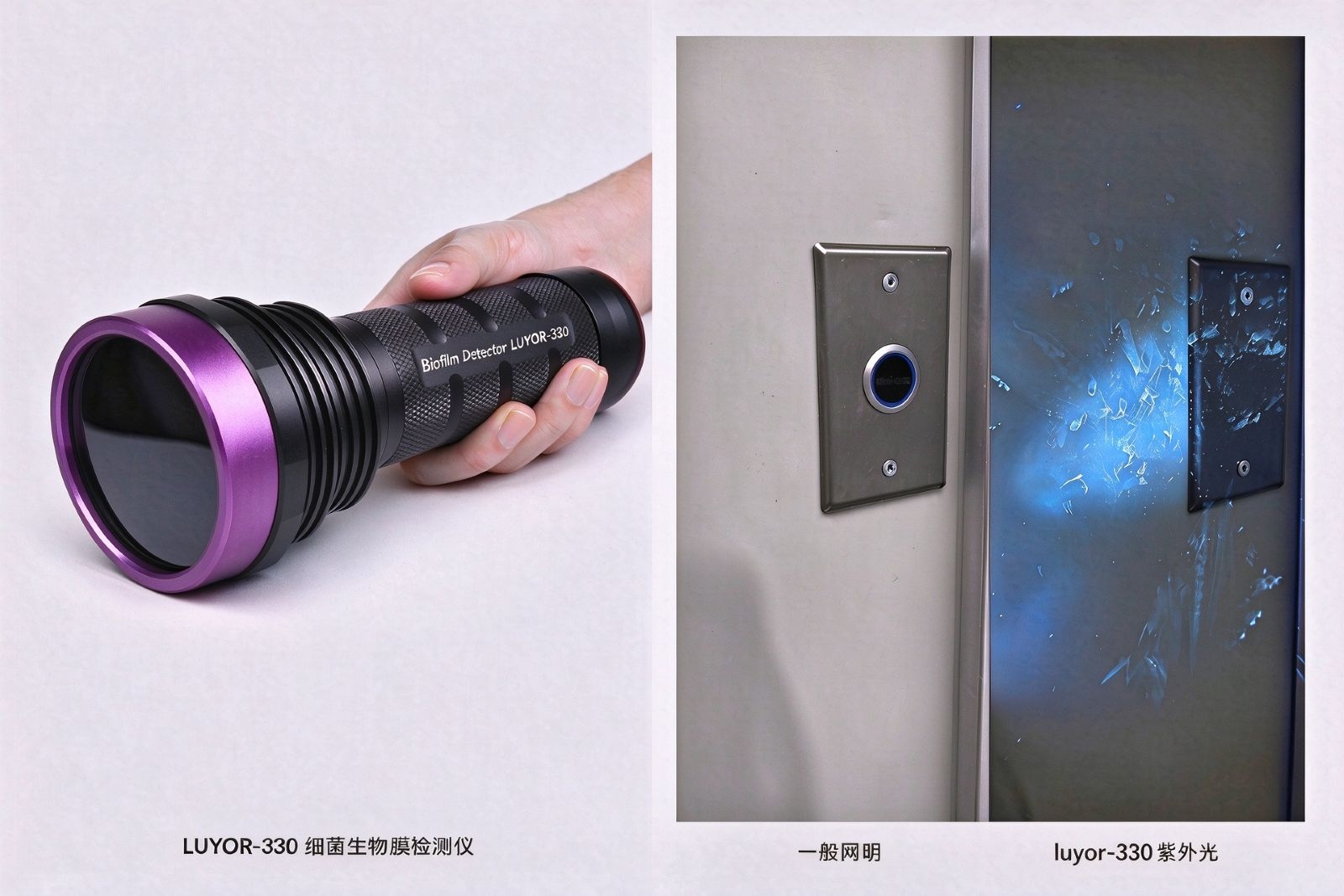
4. LUYOR-330 biofilm detection lamp: locating contamination instead of sampling blindly
The value of environmental sampling in a food plant depends on how precisely the high-risk points are chosen.
The LUYOR-330 biofilm detection lamp carries a multi-wavelength UV source that excites the natural fluorophores in bacteria and biofilm, so that hidden contamination and microbial residue invisible under ordinary white light become visible to the eye. The technique allows rapid inspection of large equipment surfaces and pinpoints the areas that need deeper cleaning, closer examination or targeted sampling.
If, for example, a seam or a dead corner shows an abnormal fluorescent response during a patrol, the point can be recorded on the spot and used as the basis for closer investigation and targeted sampling. This avoids the blind spot that comes from sampling the points that are easy to reach, and raises the precision of environmental monitoring.
The LUYOR-330 is used to locate contamination risks quickly and to identify high-risk areas; a fluorescent trace is a lead, not an identification of the species, and whether Listeria monocytogenes is present still has to be decided by microbiological testing. Areas with no fluorescence also remain subject to routine monitoring under the existing control plan, so that the whole production environment stays covered.

 Breadcrumb: Home > Solutions > Biofilm Detection
 Updated:2026-11-16
 Views:







 Industrial Test Instruments


