Products
PRODUCTS Breadcrumb: Home > Products > Industrial Test Instruments > Biofilm Detection Lights
 Overview
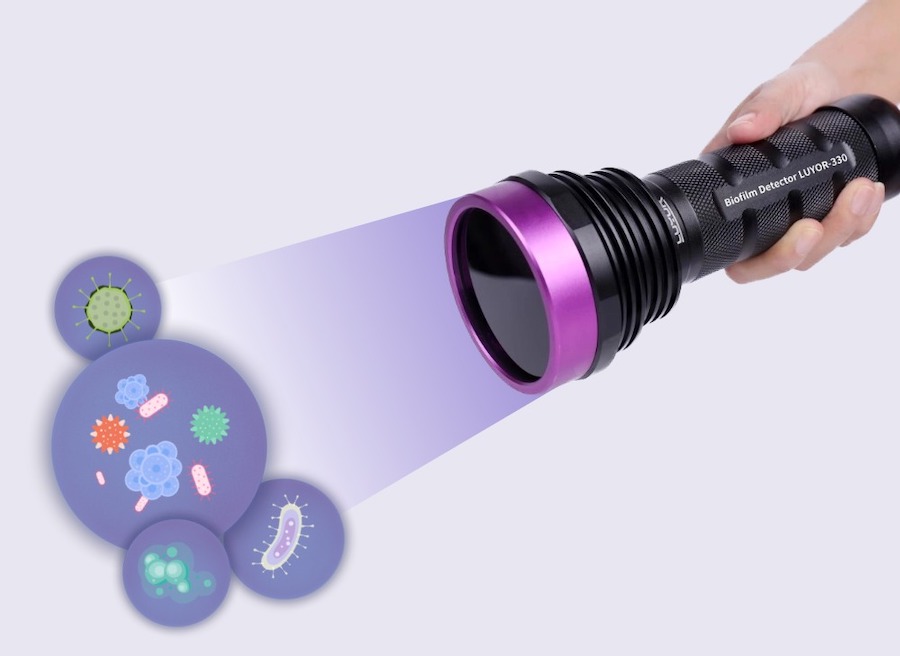
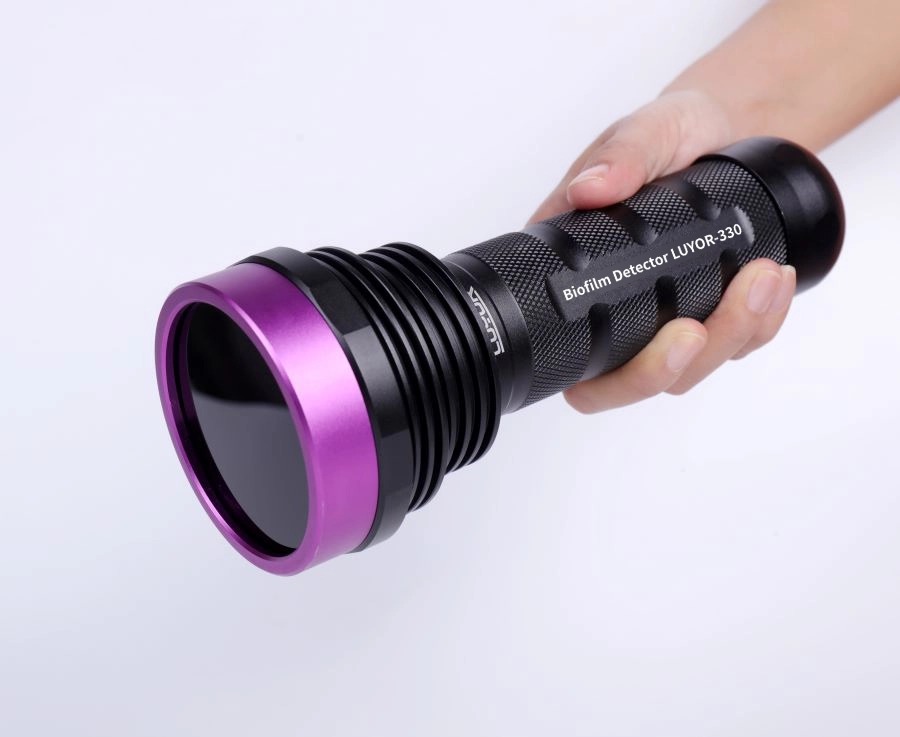
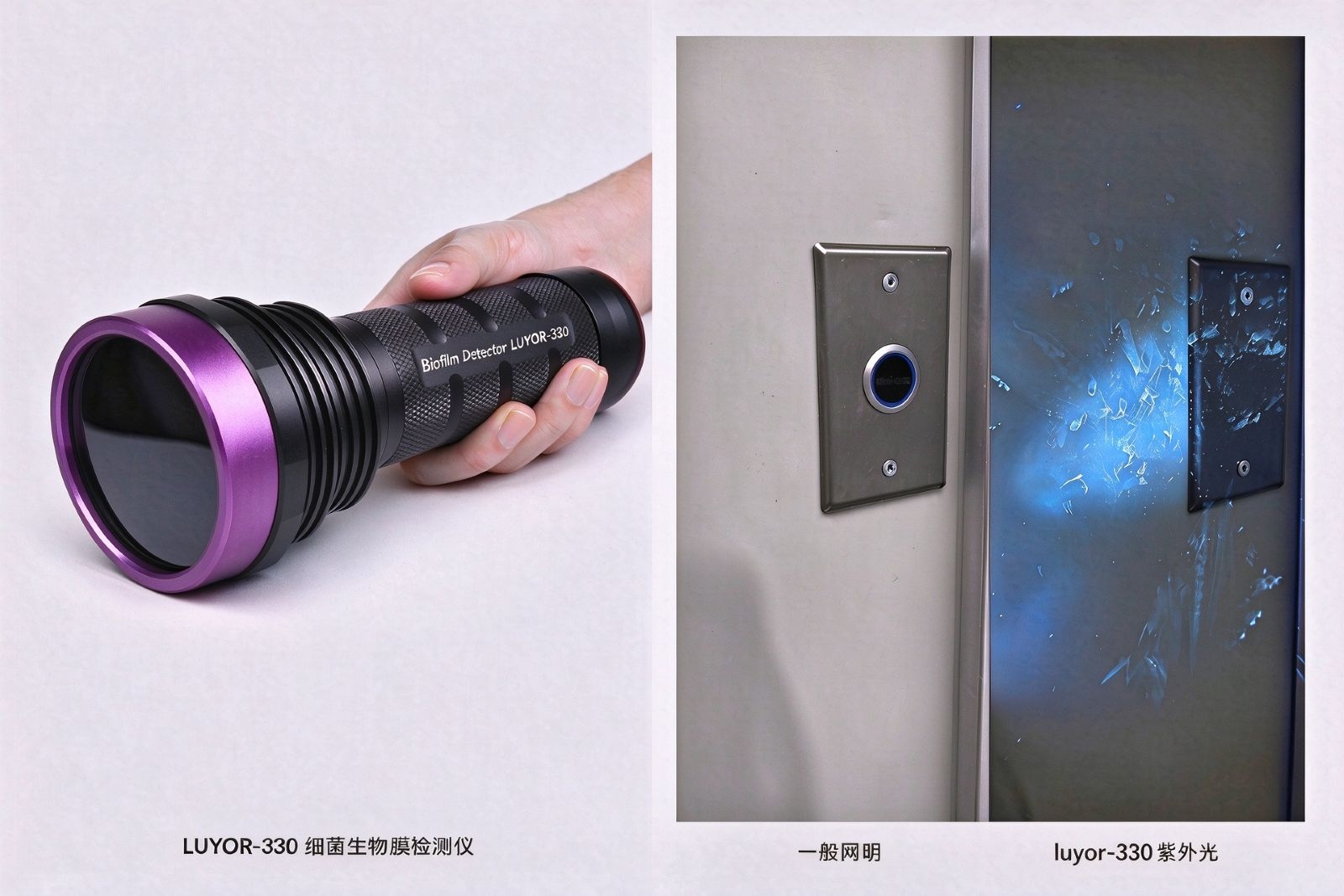
LUYOR-330 is a compact UV-A LED torch for biofilm and residue checks on food and pharma surfaces, giving fluorescence reading with no reagents or swabs.
In food and pharmaceutical production, a surface that looks clean is not necessarily clean. Bacteria that attach to damp surfaces which are hard to clean thoroughly secrete extracellular polymeric substances (EPS) and wrap themselves in a firmly adhering layer of biofilm. That layer causes two difficulties: it acts as a "protective shell" that routine rinsing and disinfectants penetrate poorly, and because it holds to the surface, a swab does not pick it up completely.
This is why ATP swab testing has blind spots - a low reading does not prove the surface is clean; it may mean the point was not sampled properly. When cleaning validation rests on spot sampling, a single missed biofilm site can keep acting as a contamination source in later batches.
LUYOR-330 reverses that order. It runs a full-surface UV sweep, so residue shows as fluorescence in a dark room and abnormal points are marked. ATP testing or laboratory microbiological confirmation then targets those points. Sampling hits the right place more often, and genuine risk areas are not missed the way fixed-point testing misses them.
The three techniques answer different questions, and a complete cleaning validation logic uses them together:
| Method | Question it answers | Limitation | Time on site |
|---|---|---|---|
| UV fluorescence survey (LUYOR-330) | Which locations carry residue, how it is distributed, and whether the surface improved after corrective work | Gives a relative reading of intensity, with no quantification and no species distinction | Seconds, with full-surface coverage |
| ATP swab testing | ATP residue at that point, as an approximate cleanliness value | Affected by sampling technique and by the biofilm barrier, so spot sampling misses sites easily | Minutes, with point-by-point sampling |
| Laboratory microbiological testing | Total colony count and qualitative or quantitative results for target species | Needs an incubation period, so no immediate on-site feedback | Days, at higher cost |
The recommended sequence is fluorescence survey to locate, ATP sampling at the bright points, laboratory confirmation where needed. This keeps the data chain that regulation requires while directing testing resources to the areas that actually have a problem.
| Sector | Typical objects | Points to prioritise |
|---|---|---|
| Food and beverage processing | Conveyor belts, filling heads, slicers, mixing tanks, crates, work surfaces | Belt joints and scrapers, filling valve interiors, weld seams, seal ring impressions, the floor around drains |
| Pharmaceutical and biological products | Cleanroom walls and floors, buffer tanks, filter housings, laminar-flow hood interiors | Tank walls near the liquid line, pipe connections, gasket edges, laminar-flow return grilles |
| Medical devices and hospitals | Endoscopes, surgical instrument trays, bed rails, treatment carts, washer-disinfectors | Instrument lumen connectors, hinges and joints, tray corners, high-touch surfaces on bed rails |
| Water treatment and piping | Storage tanks, tube sheets, membrane housing shells, cooling tower fill | Tank bottoms, stagnant sections, pipe elbows, flange seams |
| Laboratories and research | Biosafety cabinets, incubator interiors, shaker trays, clean benches | Inner corners of cabinets, fan grilles, seal strip channels |
What these points have in common is complex geometry, standing water, and poor brush access - the conditions that biofilm favours.
Confirm the battery is charged and the head lens is free of oil and dust. A dirty lens affects light uniformity noticeably, and that affects the reading.
Switch off or dim the site lighting so ambient light is as low as possible. The higher the fluorescence contrast, the easier it is to tell residue from reflection.
Complete cleaning with the existing procedure, then let the surface dry fully. A residual water film reflects light and disturbs the reading.
Hold the body so the head sits close to the surface and move it slowly across, slowing further at weld seams, seal rings, corners, and joints.
Areas of high, sheet-like fluorescence are the priority for corrective cleaning. Isolated spots are recorded and folded into routine re-checks. Mark points with labels or photographs.
Clean the marked points more thoroughly and sweep again after drying for comparison. If fluorescence falls clearly, take an ATP sample at that point to keep the data. A point that recurs suggests a design or cleaning-process fault.
LUYOR-330 is used to reveal a range of bacteria and microbial residue associated with biofilm risk, typically including:
Listeria monocytogenes
Salmonella spp.
E. coli
Staphylococcus aureus
Campylobacter jejuni
Bacillus cereus
Clostridium perfringens
Cronobacter spp.
Yeast
Bacillus spp.
Enterococcus spp.
Lactobacillus spp.
Staphylococcus spp.
Vibrio spp.
Enterobacter cloacae
Plus a range of organic residues and biofilm matrix
Residues differ in how they fluoresce under UV, so read against on-site comparison and repeatable results, and establish a reference on a known-clean surface and a known-contaminated surface before starting.
| Model | Form factor | Illumination | Typical application |
|---|---|---|---|
| LUYOR-330 | Portable torch format | Compact body with a large head face, easy to reach into tight spaces | Pipe interiors, equipment gaps, complex parts, surveys held one-handed for long periods |
| LUYOR-339 | Handheld detection lamp (higher-power version) | Higher power and a wider irradiated footprint | Fast sweeps of large benches, walls, and tank exteriors |
| LUYOR-0904 | Canopy lamp for visible-foreign-matter inspection | Inspection lighting configured to the standard | Visible-foreign-matter inspection stations for injectables |
Where the area is large and sweep efficiency matters, choose the LUYOR-339; where space is tight and flexible positioning matters, choose the LUYOR-330. The two can also be paired by zone.
The basic attributes below support an initial selection:
| Product type | Portable biofilm detection torch (UV fluorescence detector) |
| Light source | Long-wave ultraviolet (UV-A) LED |
| Power | Built-in rechargeable battery with a dedicated charger |
| Detection method | Non-destructive fluorescence detection; no chemical reagents and no consumables in use |
| Operation | One-handed hold, push-button switch, continuous scanning |
| Sectors | Food and beverage processing, pharmaceutical and biological products, medical devices and hospitals, water treatment, research laboratories |
| Supplied with | Main unit, dedicated charger, safety glasses (see the packing list shipped with the order) |
It is a complement. ATP testing returns a quantitative value from surface residue, but the EPS in biofilm obstructs sampling and reagent reaction, so sites are missed easily. LUYOR-330 sweeps with UV before sampling, marks the high-risk areas where fluorescence concentrates, and ATP or laboratory confirmation then follows at those points, which raises the relevance of the testing.
No. It is a purely physical UV fluorescence tool. It consumes no chemical reagents and needs no swabs or culture plates in use; day-to-day care is keeping the head and lens clean and charging on schedule.
No. It is a rapid screening and locating tool: it makes contamination that the eye cannot see visible and locates priority areas, and fluorescence intensity is a relative indicator of residue. The accepted practice is an on-site pre-screen, followed by ATP testing or laboratory culture at marked points as needed.
The 330 is a compact torch with a small body and a large head face, suited to tight spaces, pipe interiors, equipment gaps, and long single-handed surveys. The 339 is the higher-power version with a wider irradiated footprint and a larger area per sweep, suited to fast sweeps of large benches and tank exteriors. Choose the 339 for area and efficiency and the 330 for restricted access; the two can also be used together.
UV light must not be viewed directly, and the head must never be aimed at anyone's eyes. Wear UV safety glasses during work and avoid prolonged exposure of skin to direct light. Work in dimmed conditions, and switch off and disconnect the unit before cleaning or servicing it.
Judgement combines brightness, area, and position: high brightness in a sheet at weld seams, seal rings, dead corners, belt joints, or valve connections marks a priority for corrective cleaning, while isolated, low-brightness spots can go into routine re-checks. Record points and images each time to build a traceable cleaning validation file that allows before-and-after comparison.
Xinyisheng Instruments (Shanghai) keeps LUYOR instruments in stock and provides on-site demonstrations and survey planning advice. Call 131-2093-6518, or leave your sector, application, and contact details in the form at the bottom of the page.
It needs to be dry. A residual water film creates specular reflection that disturbs the reading and gives the impression that everything glows. Complete cleaning with the existing procedure and let the surface dry before sweeping; a damp surface serves for an initial check, and conclusions should rest on the dry result.
Yes, and noticeably. Oil and dust on the lens make the light uneven, creating bright and dark patches that are easily misread as contamination. Check the charge and the head lens before every survey and keep the lens clean; a reference on a known-clean and a known-contaminated surface also reduces misreading.
Not necessarily. Fluorescence intensity is a relative measure of residue, residues differ in response, and ambient light, angle of incidence, and surface material all affect what you see. Judge brightness together with area, shape, and position, and rely on repeatable results; for points judged low risk but recurring, take an ATP sample or send a laboratory sample.
A recurring point usually indicates geometry or process rather than cleaning execution. Check the design and the cleaning process at that point: whether it is a weld seam, a gasket impression, a dead corner, or poor drainage, and whether temperature, concentration, contact time, and brush access are adequate. Adjust the cleaning procedure or modify the part where needed, and photograph the point from the same angle before and after to keep a traceable record.
LUYOR-330 specification sheet and product manual
Biofilm detection and cleaning validation proposal
Selection table for the biofilm detection range
Stock in Shanghai, with on-site demonstration and trial evaluation
Selection advice, operator training, and survey procedure review
Manufacturer warranty, with long-term supply of parts and consumables
Previous:Full biofilm detection lamp range | Related reading:Biofilm in food and beverage: rapid detection for safer production
Send inquiry

Email: info@xinysun.com

Tel: 131-2093-6518

Address: 1525 Minqiang Road, Bldg 26, Songjiang, Shanghai

Copyright 2026 Xinysun Instrument (Shanghai) Co., Ltd. All rights reserved.
ICP:ICP-2026046447




 Products
 Applications
 Previous:
 Back to list

 Industrial Test Instruments


