
Products
PRODUCTS Breadcrumb: Home > Products > Industrial Test Instruments > Biofilm Detection Lights
 Overview
Non-contact UV fluorescence scanner finds bacteria, biofilm and detergent residue on food and pharma surfaces. 1.5 kg, 2 h runtime, no consumables.
Food, pharmaceutical, supplement and chemical plants face the same dilemma in bacterial and microbial contamination checks: every hour of production lost to cleaning is lost revenue, but starting a line on a surface that was not cleaned properly raises the risk of contaminated product. Judging whether cleaning was done right needs a fast, reliable method.
Many plants use ATP testing, which measures adenosine triphosphate as an indicator of actively growing microorganisms. The method works but has inherent limits: a swab covers a small area relative to the whole surface, so sampling can miss the spot where contamination actually sits, and sampling is fiddly and can introduce contamination itself.
The XEPU-1720 takes a different approach: do not sample, just illuminate. Based on UV fluorescence, it lights an entire production surface in seconds so bacterial contamination, biofilm and detergent residue show themselves, and you see visually where the contamination is and how far it extends. No culture wait, no reagent reaction: results in real time. What used to take hours now takes seconds.
This instrument appears under several names on our original page and in various documents.They all refer to the same XEPU-1720. They are listed here so you can match information from other sources and avoid assuming they are different products:
| Common name | Notes |
|---|---|
| Bacterial biofilm contamination scanner | The formal name used in the H1 of our original page |
| Bacterial and microbial contamination scanner | Another rendering of the same instrument, used repeatedly in the body text |
| Biofilm detector | A common name taken from the detection target (biofilm) |
| Microbial scanner / bacterial detector | Common names taken from the application |
| Bacteria and Biofilm Detector XEPU-1720 | The name used on the XEPU official English site |
Many plants start with a white flashlight or a standard UV lamp, then find that not much shows up. That is not surprising: seeing light and seeing contamination are two different things.
| Method | Principle | Limitation |
|---|---|---|
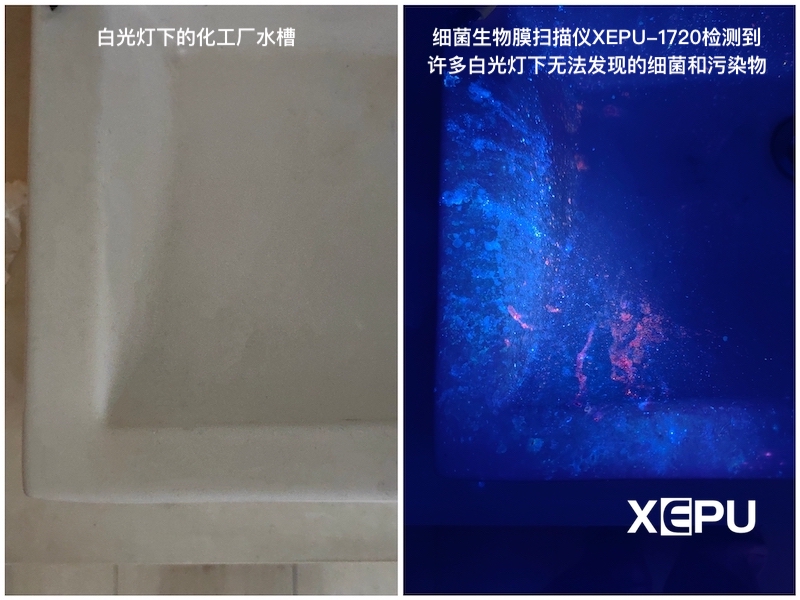
| White light | Ordinary illumination | Most bacterial contamination and detergent residue do not show; in the manufacturer's comparison, a white light showed nothing on a chemical plant sink |
| Ordinary UV lamp | Single-band UV fluorescence | Different contaminants respond at different wavelengths, so a single band excites only part of them and misses the rest |
| XEPU-1720 | UV fluorescence with a defined wavelength combination, broad detection | Recognizes more contaminant types; the same sink under the XEPU-1720 shows extensive residue clearly |
Beyond the wavelength combination, two differences are easy to overlook: the illuminated area, since the XEPU-1720 is designed for wide scans and lights a whole production surface rather than searching patch by patch like a flashlight; and the viewing conditions, since fluorescence contrast is highest in dim light, which is why the official procedure puts "wear goggles, illuminate as specified" first. Together these explain the much higher hit rate compared with flashlight-type approaches.
According to the manufacturer, the XEPU-1720 reveals a range of contaminants:
Listeria monocytogenes
Salmonella
E. coli (including O157:H7)
Pseudomonas
Staphylococcus aureus
Yeast
Detergent residue
Dust and particulates
Biofilm
Mould
Contaminants fluoresce under the specified wavelengths
Position and extent are judged visually
Seconds to cover a large surface
Clean, then rescan to confirm
Different food categories carry different microorganisms. The manufacturer compiled the organisms commonly isolated from each category that can form biofilm; all fall within the XEPU-1720's rapid identification range:
| Food category | Target organisms (biofilm-forming) |
|---|---|
| Milk and dairy | Listeria monocytogenes, Staphylococcus aureus, E. coli, Bacillus, Enterococcus, Cronobacter, Lactobacillus |
| Meat and meat products | Salmonella, Staphylococcus aureus, Listeria monocytogenes, E. coli, E. coli O157:H7, Campylobacter jejuni, Clostridium perfringens, Enterococcus, Enterobacter cloacae |
| Seafood | Listeria monocytogenes, Staphylococcus, Vibrio |
| Vegetables and fruit | E. coli, Salmonella, Listeria monocytogenes, Cronobacter, Bacillus cereus |
How to use the table: find your category and put the corresponding organisms on the cleaning validation watch list. Dairy plants watch Listeria, meat plants watch Salmonella and E. coli O157:H7, seafood plants watch Vibrio. The biofilm and residue those organisms form shows under the XEPU-1720, which makes priority cleaning areas obvious.
If the line already uses ATP, the XEPU-1720 does not compete with it; it makes ATP more accurate. The recommended three-step combination:
Sweep the table, sink, conveyor and tank with the XEPU-1720. This step uses no swabs and no sampling, and contamination shows directly under illumination, which solves the ATP problem of sampling blind and missing the contaminated area.
Use ATP swabs mainly on the areas the scan flagged, and record RLU values. The same number of swabs now lands where confirmation is actually needed, and wasted sampling drops sharply.
When cleaning is done, scan again: disappearing fluorescence means the cleaning worked; anything still fluorescing needs re-cleaning or a closer look. Rescanning costs no consumables, so it can be repeated freely.
The XEPU-1720 is designed to need no elaborate training; the official procedure has six steps:
This is a requirement, not a recommendation. UV sources pose a risk to the eyes, and goggles must be worn during operation. Write it into the cleaning validation work instruction so new staff do not skip it.
One key, on and measuring: no warm-up, no parameters, no mode selection.
Aim the light at the area to be checked. The head swivels, so tank interiors, the underside of conveyors and gaps behind equipment can be reached with a turn of the wrist instead of moving your body.
Look for fluorescing biofilm, bacteria or mould. The dimmer the ambient light, the better the contrast: for formal checks, switch off the lighting above the area or scan after shift or at night.
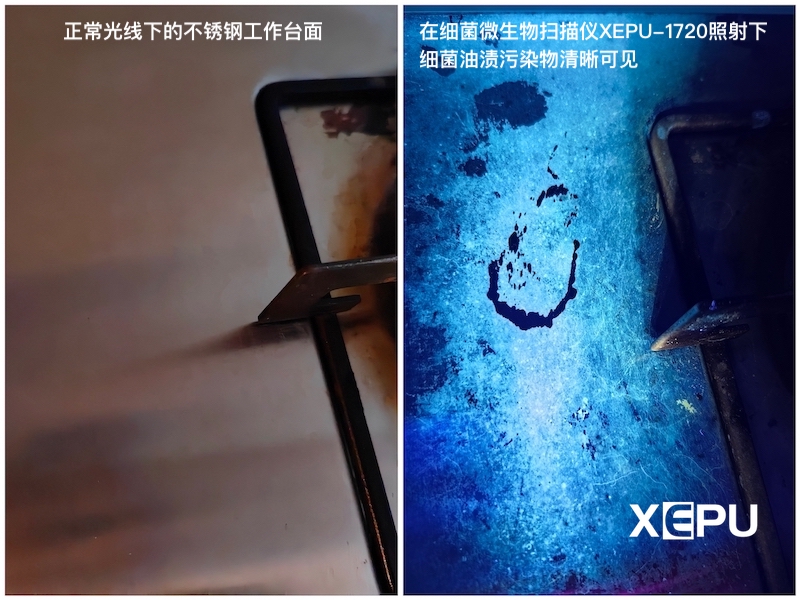
Clean the areas that fluoresce. Because position and extent are visible directly, cleaning can be targeted instead of redoing the whole area.
Rescanning uses no consumables and can be repeated. Disappearing fluorescence means the cleaning worked; anything still visible needs a closer look.
Site work has plenty of spots where the body reaches but the head does not: tank interiors, under conveyors, gaps behind equipment, corners inside sinks. A head that swivels means the whole hand does not have to follow, so scan speed and coverage both improve.
Two rechargeable XP-75 batteries are standard: one on the instrument, one on charge. About 2 hours of runtime and 1.5 hours of charging, with a swap that takes seconds, gives near-continuous work across long shifts and removes the problem of the battery dying mid-scan.
Nothing is consumed: no swabs, no reagents, no colour cards. The LED source is rated 50 000 hours, which at a few hours a day lasts many years, and the running cost is electricity.
All three point to the same thing: this instrument is designed to be used every day, by anyone, at a cost that allows it, not to be a precision instrument taken out of the metrology room occasionally. Cleaning validation is high-frequency, repetitive work that asks everyone to take part, and that is exactly what these traits suit.
By the manufacturer's positioning, the XEPU-1720 suits liquid food processing, supplements, pharmaceuticals, healthcare and petrochemicals, industries with hygiene and cleaning validation requirements. Common inspection points:
| Setting | Typical locations | Purpose |
|---|---|---|
| Food processing lines | Production tables, conveyors, sinks | Pre-shift check before starting; post-shift confirmation that cleaning is complete |
| Vessels and tanks | Inner walls of food tanks, cheese vats and similar | Biofilm and residue on tank walls (manufacturer case) |
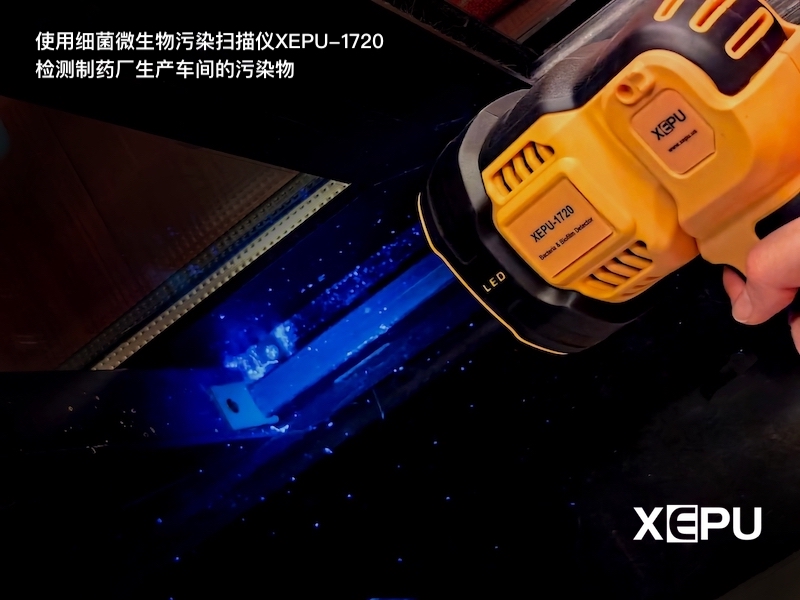
| Pharmaceutical workshops | Aseptic filling lines, equipment exteriors, high-touch surfaces | Cleaning validation with contamination made visible (manufacturer case) |
| Dairy and meat | Piping, valves, gaskets, filling heads | Residue screening for Listeria and other target organisms |
| General hygiene rounds | Door handles, control panels and other high-touch surfaces | Routine hygiene spot checks |
What these have in common: large areas, complex shapes, no time for long shutdowns, and a need to decide quickly whether the line can start, which is exactly what wide-area scanning does well.
"This year we started using the XEPU-1720 bacterial and microbial contamination scanner for bacterial checks on the line. It quickly finds Listeria, Salmonella and other bacterial and microbial contamination. The whole check does not touch the production surface and uses no chemical reagents, so it is easy to use and creates no secondary contamination. It really is a simple, efficient bacterial detector, and we are satisfied with the results."
"We used to rely on ATP to identify bacterial residue, sampling along the line, and sometimes we missed the contamination point. After learning about the XEPU-1720 microbial scanner... we scan the whole production surface first to locate bacterial contamination, then run ATP locally, which makes the whole result more complete and more reliable."
Our biofilm detection lamp section lists several products with different forms and positioning. The table maps them to needs:
| Model | Brand / origin | Form and positioning | For |
|---|---|---|---|
| XEPU-1720 (this page) | XEPU / China | Scanning detector · wide-area scan · no consumables · two batteries · trial available | Budget-conscious users focused on cleaning validation and line rounds who want to scan first, then run ATP |
| LUYOR-330 | LUYOR (USA) | Flashlight form · light · spot checks | Small-area quick checks, carry-on use |
| LUYOR-339 | LUYOR (USA) | Handheld higher-power model · wider coverage · about 5 h runtime | Whole-area rounds on large tables, walls and tank exteriors; long shifts |
The figures below are the published specifications, consistent across our original page and the XEPU official site:
| Item | Specification |
|---|---|
| Model | XEPU-1720 |
| Brand | XEPU (XEPU (Shanghai) Scientific Instrument Co., Ltd.) |
| Product type | Bacterial biofilm contamination scanner (biofilm detector / microbial scanner / bacterial detector) |
| Detection principle | UV fluorescence (defined wavelength combination, broad detection) |
| Detection method | Non-contact visual fluorescence, no reagents |
| Power | Rechargeable XP-75 battery, two supplied for rotation |
| Runtime | About 2 hours |
| Charging time | About 1.5 hours |
| Source life | 50 000 hours (long-life LED) |
| Weight | 1.5 kg |
| Head | Swivelling, for hard-to-reach areas |
| Start-up | One-key power on the handle |
| Supplied with | XP-100 safety goggles (must be worn during operation) |
| Consumables | None; minimal maintenance cost |
It detects whether a surface carries bacterial and biofilm contamination, but the result is a visual fluorescence image, not a live-cell count. When its UV light at the specified wavelengths reaches the surface, bacterial contamination, biofilm and detergent residue fluoresce, and the operator sees directly where contamination sits and how far it extends. Its role is scanning and locating: seconds to sweep a table, sink, conveyor or tank and show what is dirty. Counting live organisms is what laboratory culture or ATP testing does. The two are complementary, not substitutes: the XEPU-1720 finds the suspect area quickly, ATP or laboratory tests quantify it. If you need RLU or CFU per square centimeter, this instrument does not provide it, but it narrows the area you need to test.
The accurate description is complementary, not a replacement. ATP testing wipes a small area with a swab and measures adenosine triphosphate to indicate active microorganisms; it gives a number but has two inherent limits: the swab covers a small area relative to the surface, so a poor sampling point misses the contamination entirely; and the sampling itself is cumbersome and can introduce contamination. The XEPU-1720 covers exactly those gaps: no swabs, no reagents, one illumination of the whole surface shows the distribution, and it takes seconds to cover what ATP cannot wipe. A supplement plant in Zhengzhou uses it representatively, and this is the workflow we recommend: scan the whole production surface with the XEPU-1720 to locate contamination, then swab the suspect points for ATP. ATP sampling is no longer blind, results are more complete and reliable, and wasted sampling drops. If your line already runs ATP, the XEPU-1720 is the front-end tool that makes it accurate; if not, the scan-then-test workflow stands on its own.
Because seeing light and seeing contamination are two different things. Under white light, much bacterial contamination and detergent residue does not show at all; in the manufacturer's comparison on a chemical plant sink, white light revealed nothing while the XEPU-1720 showed extensive residue clearly. An ordinary UV lamp does excite some organic material, but it is usually single-band, and different contaminants (biofilm of different species, detergent residue, grease) respond at different wavelengths, so one band excites only part of them. The XEPU-1720 uses UV fluorescence with a defined wavelength combination for broad detection and recognizes more contaminant types than white light or a standard UV lamp. Its output is also designed for wide scans: one pass lights a whole production surface instead of searching patch by patch. Put simply, a standard UV lamp checks whether something glows; the XEPU-1720 brings more contaminant types into view over a much larger area.
Per the manufacturer: Listeria (L. monocytogenes), Salmonella, E. coli (including O157:H7), Pseudomonas and yeast, plus detergent residue, dust and other surface contamination. The range of biofilm-forming organisms common in food production is broad: for milk and dairy, Staphylococcus aureus, Bacillus, Enterococcus, Cronobacter and Lactobacillus; for meat, Campylobacter jejuni, Clostridium perfringens and Enterobacter cloacae; for seafood, Staphylococcus and Vibrio; for produce, Bacillus cereus. The limitation is equally clear: it detects contamination that fluoresces. If residue is very low, or a contaminant responds weakly under this excitation, it may not be visible, which is why the workflow pairs scanning with ATP quantification. Where quantified compliance data is required, send samples to a laboratory or use ATP.
No, and that is one of its clear advantages over swab methods. The XEPU-1720 is non-contact: the head does not touch the surface, no wiping or sampling is required, and no chemical reagent or dye is used, so there is no damage or contamination and no risk of secondary contamination as with sampling. It can therefore be used on product contact surfaces, aseptic filling lines and tank walls, with no cleaning afterwards and no delay to start-up. On consumables: none, no swabs, no reagents, no colour cards; running cost is electricity and maintenance is minimal. That is the structural cost difference from ATP: every ATP test consumes a swab, so more tests cost more, while more scanning with the XEPU-1720 lowers the cost per scan. One reminder: the supplied XP-100 safety goggles must be worn, which is standard for UV sources.
It is simple. The official procedure has six steps: wear the supplied XP-100 goggles; press the power key on the handle (one key, on and measuring); aim the light at the surface, adjusting the head angle for hard-to-reach areas (the head swivels); inspect visually for fluorescing biofilm, bacteria or mould; clean the surface where contamination shows; rescan with the XEPU-1720 until nothing shows. There are no reagents to prepare, no warm-up and no parameters, so a new operator learns it in one pass. Two working disciplines are worth adding: observe in the dimmest light available, since contrast improves as ambient light falls; and record the area and result of each scan so cleaning validation leaves a traceable record.
Both address common site problems. The swivelling head: sites have many spots where the body reaches but the head does not, such as tank interiors, under conveyors, gaps behind equipment and corners inside sinks. A head that swivels means the hand does not have to follow, so reach, scan speed and coverage all improve and you move your body less to hit an angle. Two batteries: two rechargeable XP-75 packs are standard, one in use and one charging, with about 2 hours of runtime and 1.5 hours of charge. This solves the mid-scan dead battery: swap and continue, charge the other in the gap, and the cleaning validation rhythm is not broken. For long scanning shifts, the rotation plus charging cycle covers continuous work; if both packs run down, charge them over a break.
The stated continuous runtime is about 2 hours with about 1.5 hours to charge, and two XP-75 packs are supplied. Whether that is enough depends on your rhythm: for pre-shift or post-shift cleaning validation, a scan usually takes well under an hour, so 2 hours is ample. For continuous rounds across a whole shift, use the rotation: one in use, one charging, roughly 2 hours of use against 1.5 hours of charge, which approaches continuous operation with a swap in between. Ways to extend runtime: switch off when not needed instead of leaving the lamp lit; plan a route by area to avoid repeat passes; keep the charger at a fixed station and put a depleted pack on it immediately, so a full pack is always at hand. The LED source itself is rated 50 000 hours, many years at a few hours a day, so the battery is the part to track; log it and replace it when runtime drops noticeably.
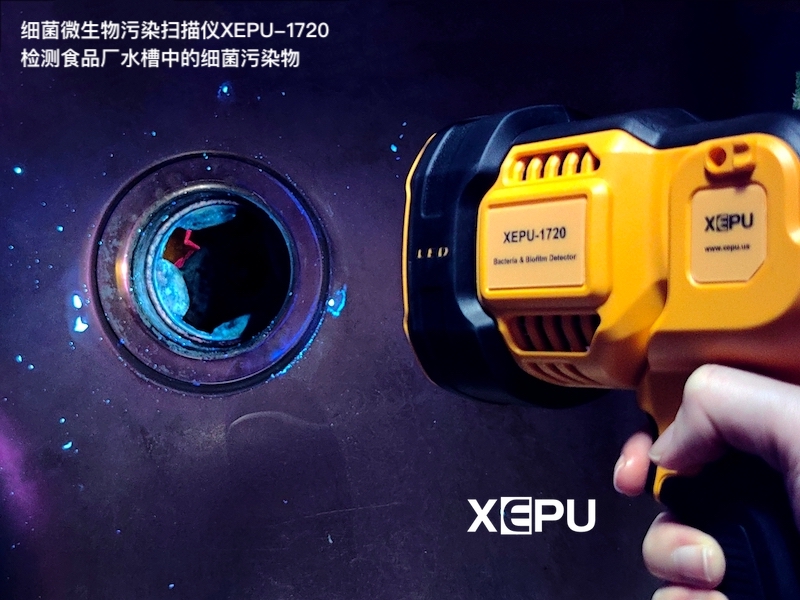
Per the manufacturer, the XEPU-1720 suits liquid food processing, dairy, supplements, pharmaceuticals, healthcare and petrochemicals, industries with hygiene and cleaning validation requirements. Typical locations include production tables and equipment exteriors, sinks (the food plant sink is a manufacturer case), conveyors, inner walls of food tanks and cheese vats, aseptic filling lines and high-touch surfaces such as door handles. By category, the manufacturer lists the priority organisms: for milk and dairy, Listeria monocytogenes, Staphylococcus aureus, E. coli and Cronobacter; for meat and meat products, Salmonella, E. coli O157:H7, Campylobacter jejuni and Clostridium perfringens; for seafood, Listeria, Staphylococcus and Vibrio; for produce, E. coli, Salmonella and Bacillus cereus. All are within the XEPU-1720's detection range. What these locations share: large areas, complex shapes, no time for long shutdowns, and a need to decide quickly whether the line can start.
Yes, and the requirement is simple: step 1 of the official procedure is to wear the supplied XP-100 safety goggles, a requirement rather than a recommendation. The instrument uses UV wavelengths, which pose a risk to the eyes; direct viewing or prolonged exposure can cause discomfort or injury, and the goggles exist for that reason. Beyond the goggles: do not look directly at a lit head; do not aim the source at anyone's face or bare skin at close range for extended periods; switch off and stow the unit when not in use so uninformed staff cannot switch it on; and if you demonstrate it to children or visitors, make sure they wear goggles or stay out of the beam. The inspection itself is non-destructive to the surface, but a UV source is equipment that needs basic protection, so write "wear XP-100 goggles" into the cleaning validation work instruction alongside the operating steps.
Our biofilm detection lamp section carries several products with different positioning. The XEPU-1720 is a Chinese XEPU scanning unit: strong value (our page describes the price as far below imported equivalents), wide-area scanning, no consumables, trial available, suited to budget-conscious users focused on cleaning validation and line rounds. The LUYOR-330 is a flashlight-form portable unit, light and handy for spot checks and small-area searches. The LUYOR-339 is the higher-power handheld with wider coverage and longer runtime (up to about 5 hours), for whole-area rounds on large tables, walls and tank exteriors and for long shifts. Two ways to choose: by budget and form - value and wide scanning point to the XEPU-1720, carry-on convenience to the LUYOR-330, longer runtime and coverage to the LUYOR-339. On brands: XEPU and LUYOR are different manufacturers, accessories are not interchangeable, so buy complete sets by brand.
Yes, and substantially. Fluorescence detection is about contrast between the emission from contamination and the background light: the brighter the ambient light, the more the weak signal is washed out. For formal checks, work in dim conditions: switch off the lighting above the area, close blinds, or scan at night or after shift. Where full darkness is impossible, shield the viewing direction with your body or a board and focus on areas with clear contrast. Other ways to improve contrast: keep your eye away from specular reflection (stainless surfaces mask fluorescence), viewing from the side rather than at the reflection angle; bring the head closer, since brightness falls with distance; and where an area is suspect but unclear, clean and rescan, then investigate anything still fluorescing. Writing dim-light scanning into the work instruction is the simplest way to get the full performance out of the instrument.
The XEPU-1720 is a visual fluorescence instrument; its results serve internal cleaning validation and hygiene rounds, finding contaminated areas in seconds and guiding cleaning and rechecks. To be clear: a visual fluorescence scan gives a qualitative answer, visible contamination or not, and does not replace the quantitative microbiological testing your regulations require. If your regulator or customer audit requires colony counts or RLU values, those still come from laboratory testing or ATP. The correct role in a quality system is front-end screening for cleaning validation: scan records (area, time, result, recheck) filed alongside ATP data and laboratory reports form a complete evidence chain of locate-then-quantify. That raises the chance of finding problems and strengthens the case for cleaning effectiveness at audit. The instrument is an XEPU brand product; confirm warranty and verification requirements with us at purchase.
Per our original page: the XEPU-1720 costs far less than imported equivalents for comparable detection results, and the official English site quotes a customer saying it is nearly half the price of other detection tools. On support: no consumables means no ongoing consumable spend and minimal maintenance; the LED source is rated 50 000 hours and needs essentially no service in long use; the original page describes nationwide warranty with one-to-one engineering support from XEPU. On trials: the original page states that a trial can be requested, which matters for biofilm detection because your surface materials, lighting and contamination types all affect real performance. Testing on your own line is more reliable than any specification table. If you want a trial or a quote, call 131-2093-6518 or leave a message through the form, telling us your industry, main inspection points and current cleaning validation method, and we will propose a configuration and trial arrangement.
XEPU-1720 product literature and official introduction
Food industry microorganism reference table (dairy / meat / seafood / produce)
Cleaning validation practice notes: scan sequence, dim-light viewing, rescan confirmation
The scan-then-ATP combined workflow
Trial requests and scheduling
Product selection advice by industry and inspection point
Cleaning validation workflow design and record forms
XP-75 batteries and other accessory planning
Troubleshooting weak on-site detection (ambient light / viewing angle / distance)
Volume and project pricing, lead time confirmation
Send inquiry

Email: info@xinysun.com

Tel: 131-2093-6518

Address: 1525 Minqiang Road, Bldg 26, Songjiang, Shanghai

Copyright 2026 Xinysun Instrument (Shanghai) Co., Ltd. All rights reserved.
ICP:ICP-2026046447




 Products
 Applications
 Previous:
 Back to list

 Industrial Test Instruments


