Solutions
 Breadcrumb: Home > Solutions > Biofilm Detection
 Updated:2026-11-02
 Views:
Mold is a persistent and easily hidden contaminant in buildings, food storage, healthcare and agricultural environments, and by the time a patch is visible to the eye the contamination has usually been spreading for some time. This article explains why different molds fluoresce differently, why the UV-A output of the LUYOR-330 is used for on-site screening, where the method applies and what it is typically used for, and what process should follow a screening round. The aim is to make fungal contamination that cannot be seen visible earlier, before remediation scope and cost grow.
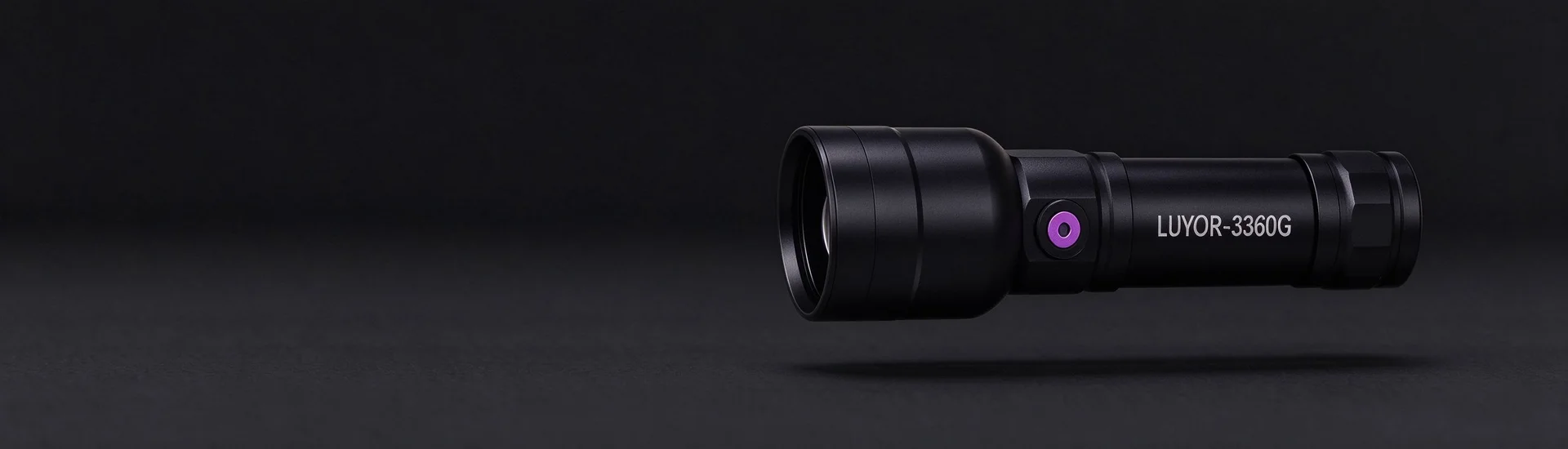
Xinysun Instruments (Shanghai) Co., Ltd. · LUYOR, USA Mold is a persistent and easily hidden contaminant in buildings, food storage, healthcare and agricultural environments: by the time a patch is visible to the eye, the contamination has usually been spreading for some time. This page explains how the portable LUYOR-330 biofilm detection flashlight uses UV-A fluorescence to make fungal contamination visible on site before it can be seen.
Traditional mold investigation relies on visual inspection, swab sampling and laboratory culture. The problem is that a mold colony has already been growing inside the material or at a hidden interface long before it becomes visible; the patch the eye can see is just the part of the contaminated area that has broken the surface. By the time the report arrives, the scope of remediation and its cost have both grown.
Many molds produce naturally fluorescent metabolites during growth (flavins and coumarin-type compounds, for example), and these emit visible fluorescence under long-wave ultraviolet (UV-A) light. The LUYOR-330 works on this principle: with the ambient light dimmed, the flashlight is swept over walls, suspended ceilings, shelving and the surface of a grain pile, and fluorescing points show up on the spot - an early warning before the mold is visible, so that remediation can start sooner and the area can be defined more accurately.
Molds of different genera differ in fluorescence color under UV-A, which allows a preliminary judgment on site:
| Fluorescence color | Possible genus | Usual location |
|---|---|---|
| Yellow-green | Aspergillus, Penicillium | Damp building walls, suspended ceilings, food surfaces |
| Blue or blue-white | Cladosporium, Fusarium | Ventilation systems, high-humidity interfaces, grain |
| Dark orange or reddish | Some Fusarium, Chaetomium | Timber, paper surfaces, areas that stay damp |
| Almost no fluorescence | Stachybotrys (the "black mold") | Gypsum board and cellulose materials after long water exposure |
An important limit: fluorescence screening is not species identification. Not every mold fluoresces strongly, and substrates such as timber, gypsum board and paper may have a fluorescence background of their own. Any point that fluoresces abnormally needs laboratory culture or DNA testing for confirmation.
The LUYOR-330 is a UV-A inspection lamp in handheld flashlight form, and it offers several practical advantages for mold screening:
It reaches confined spaces: inside ducts, behind cabinet backs, in equipment gaps and under the bottom shelf, where visual inspection and sampling are awkward, a flashlight body brought close to the surface is convenient;
Results in seconds: what is swept is seen, and one round covers a large area, unlike random sampling which reflects a few points;
Non-contact and non-destructive: signs of contamination inside a wall or a package can be found without cutting the board open or unpacking, which avoids unnecessary destructive investigation;
No reagents, no consumables: a built-in rechargeable battery is ready when needed, so routine inspection carries no ongoing consumable cost;
Photo evidence: fluorescent points can be photographed and kept, with one set before and one after remediation, so the result of the work is visible at a glance.
| Setting | What the LUYOR-330 is used for |
|---|---|
| Buildings and housing | Finding hidden mold in gypsum board, timber, insulation and ventilation systems, and locating damp areas caused by leaks |
| Food and storage | Screening fruit, vegetables, grain and packaging surfaces for mold, and routine inspection of cold chains and warehouses |
| Healthcare and cleanrooms | Locating fungal hotspots on damp walls, suspended ceilings and air handling units (HVAC) |
| Agriculture and grain storage | Early detection of Fusarium and Alternaria contamination in crops and grain silos |
| Remediation and insurance | Defining the area before remediation and verifying it afterwards, with fluorescence photographs as a process record |
Checking for mold with the LUYOR-330 follows the same procedure as a biofilm inspection, with a few key points:
Dim the ambient light: fluorescence contrast depends on ambient light, so drawing the curtains in daytime or working at night gives a better result;
Keep the surface dry: a water film produces reflections that interfere with reading, so wipe a damp area and wait briefly before irradiating;
Establish a baseline before the sweep: irradiate a surface confirmed to be mold-free and a known mold patch once each, to align the reading standard across the team;
Slow down at the key points: corners, window frames, weather seals, pipe penetrations and the bottom of shelving collect water and dust, so sweep them more slowly;
Photograph and mark: photograph each fluorescent point and record its position, as the basis for the remediation area and for later comparison.
In a mold management chain the LUYOR-330 provides initial screening and location: it answers "where mold may be, and how far it extends", not "which species, and how much". The standard process is: mark abnormal points by fluorescence screening, confirm the species by laboratory culture or molecular identification, carry out targeted remediation, then re-irradiate and compare to confirm the result. Conclusions that affect product release, insurance claims or regulatory compliance should rest on laboratory data.
One further caution: fluorescence varies with genus, and species such as Stachybotrys (black mold) fluoresce very little, so a negative fluorescence result does not by itself mean "no mold". In high-risk settings, fluorescence inspection is used together with conventional sampling and testing.
For instrument details, see the LUYOR-330 product page; for rapid pass-over inspection of large wall areas and tank exteriors, the higher-power LUYOR-339 can be used alongside it, and a selection comparison is given in 10 common questions on biofilm detection lamps. Xinysun Instruments holds stock in Shanghai, and a site demonstration can be arranged.
This article belongs to the biofilm detection section.
Other sections on the same product line include biofilm detection lamps (UV-A excited biofilm autofluorescence, which develops contamination the eye cannot see) and industrial test instruments (the entry point for four lines: UV inspection, tachometry, stroboscopic observation and surface inspection).
Models mentioned in this article: LUYOR-330, LUYOR-339, XEPU-1720. Ranges, accuracy and accessory lists for each model are given on the product pages.

Email: info@xinysun.com

Tel: 131-2093-6518

Address: 1525 Minqiang Road, Bldg 26, Songjiang, Shanghai

Copyright 2026 Xinysun Instrument (Shanghai) Co., Ltd. All rights reserved.
ICP:ICP-2026046447




 Industrial Test Instruments


