Applications
 Breadcrumb: Home > Applications > Lab Research
 Updated:2026-11-02
 Views:
In 2026, Horticulture Advances published an in planta transformation and genome editing system for citrus built around a wounded epicotyl, which shortens the interval from sowing to a transgenic plant. This article covers what the work achieved, where fluorescence screening sits in the workflow, why a dual-wavelength handheld light source fits that step, and which parameters can be reproduced. The figures are concrete: about 40 days from sowing to transgenic plants, six citrus genotypes validated, non-chimeric efficiency between 2.58% and 18.68%, and a weekly GFP/RFP screen with the LUYOR-3415RG. The workflow keeps chimerism low by cutting away non-fluorescent shoots at each round, so the earlier the screen starts the less confirmation work remains.
In October 2026, Horticulture Advances (open access, volume 4, article 37 of 2026) published online a study titled "A rapid and broadly applicable in planta transformation and genome editing system involving wounded epicotyls in citrus". The work establishes an in planta transformation and genome editing system for citrus built around a wounded hypocotyl, taking about 40 days from sowing to transgenic plants and validated across 6 citrus genotypes. Notably, the methods section states explicitly that, after transfer to light, regenerating tissue was screened weekly for GFP / RFP positivity with a handheld fluorescence detector (Luyor Instrument, Shanghai) - which is the typical application of the LUYOR-3415RG dual-wavelength fluorescent protein excitation source.
For teams working on plant transformation, genome editing and functional genomics, the value of this paper is that it sets out the parameters and the logic of the fluorescence screening step clearly: which wavelength is used for GFP, which for RFP, and why screening has to be repeated on the intact plant. This article takes the LUYOR-3415RG product characteristics and unpacks that screening scheme.
Conventional citrus genetic transformation depends heavily on in vitro tissue culture, which is laborious, slow, and strongly limited by the regeneration capacity of the genotype. The approach here is to cut transversely below the true leaves of a seedling, keep about 2-3 cm of hypocotyl as the wound site, and form a local agarose chamber with a 20 µL pipette tip, delivering the Agrobacterium suspension, the co-cultivation medium and the selection medium to the wound in sequence, so that transformation, regeneration and selection all take place in situ.
Co-cultivation: 0.35% agarose + 100 µM acetosyringone + hormones, 3 days in the dark;
Selection: 0.35% agarose + 50 mg/L kanamycin + hormones, 5 days in the dark;
Preferred hormones: 3.0 mg/L 6-BA + 0.05 mg/L NAA, giving 13.92% non-chimeric transformation efficiency in Carrizo citrange;
Broad applicability: transgenic shoots were also obtained in 5 further genotypes - sweet orange, Shatian pummelo, lemon, Ziyang xiangcheng and kumquat - with non-chimeric efficiency between 2.58% (pummelo) and 18.68% (Ziyang xiangcheng);
Genome editing: CRISPR/Cas9 driven by the YAO promoter was used to target CsLMI1 and CsZFP7, and one edited line showing loss of oil glands and apparently free of exogenous T-DNA integration was recovered.
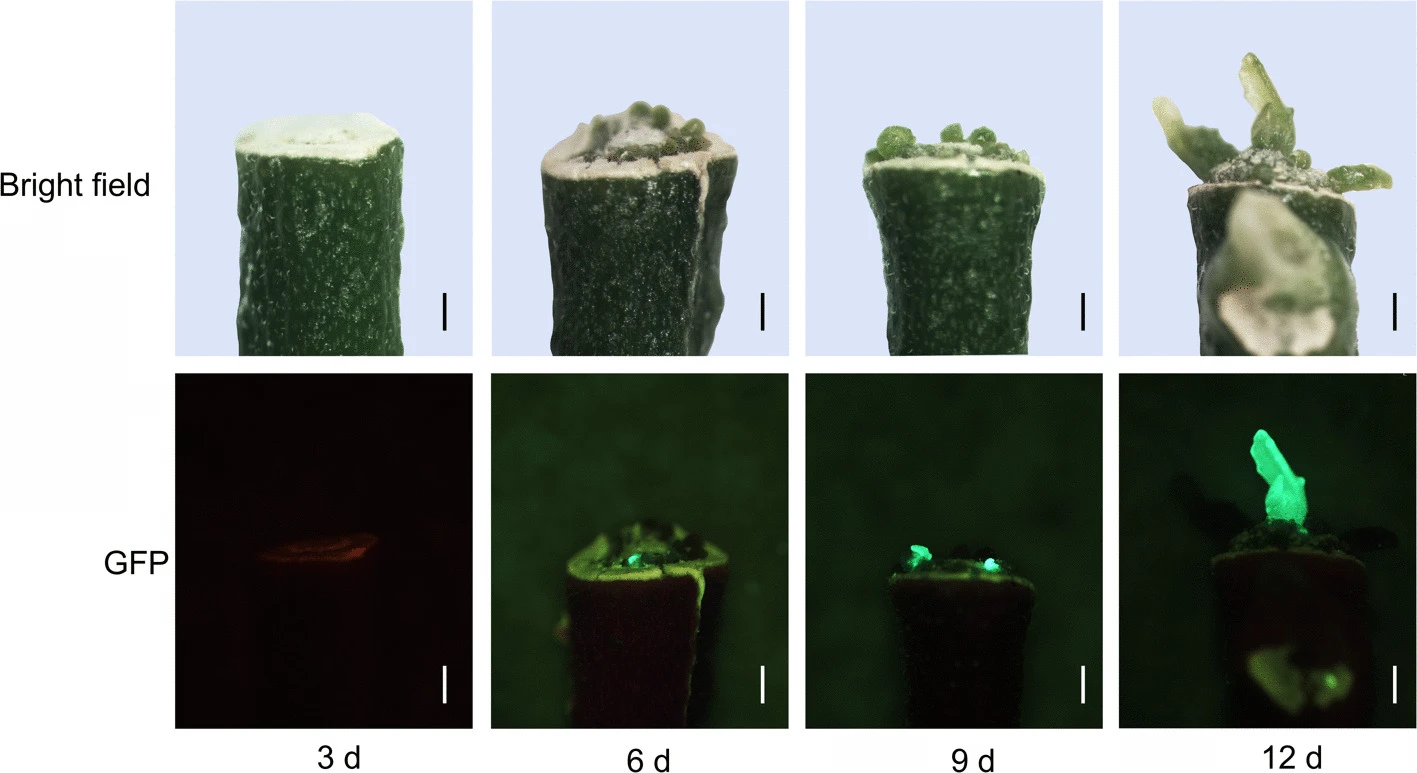
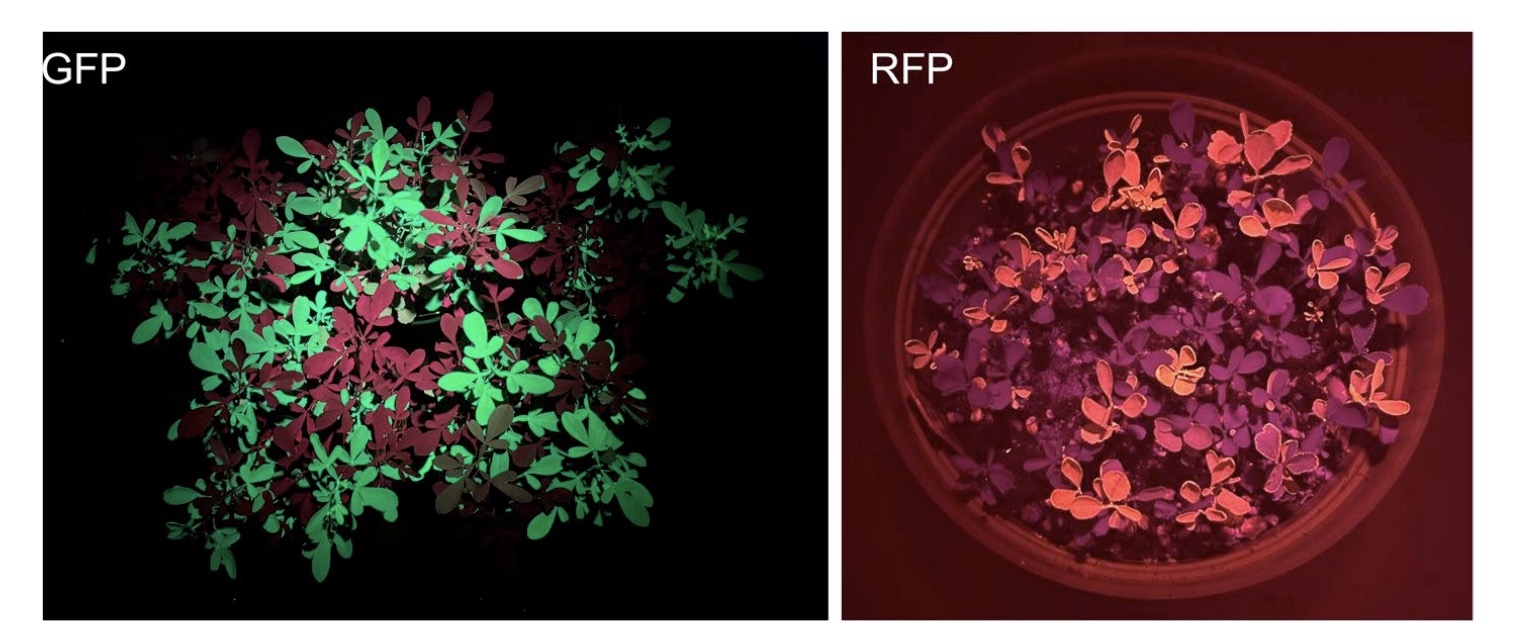
The reason in planta transformation can keep chimerism low lies in the selection step. Once regenerating shoots appear, the study observed GFP or RFP signal with the handheld fluorescence detector every week, cut away shoots that did not fluoresce (that is, untransformed or chimeric ones), and kept the non-chimeric shoots with stable fluorescent protein expression. The paper also notes that GFP fluorescence appears green while chlorophyll autofluorescence appears red, and the two can be told apart clearly under the handheld detector, which helps in judging whether a signal is genuine.
In other words, fluorescence screening is not a single glance but an enrichment step repeated every week: the earlier a false positive is identified and removed, the less molecular confirmation work remains later. What this step asks of a light source is that it excite and resolve both GFP and RFP markers steadily in a greenhouse or on a culture rack, where some ambient light is always present.
This study uses two fluorescent markers, GFP and RFP (DsRed), so the light source has to cover both excitation bands. The LUYOR-3415RG is supplied with two fixed bands, RB (royal blue, 440-460 nm) and GR (green, 510-540 nm): RB matches GFP / eGFP excitation and GR matches DsRed / tdTomato / mCherry excitation. One switch selects one wavelength, which meets the practical requirement of seeing both markers in the same batch of material.
What matters more is the format: handheld, about 0.9 kg net weight, 27 W total power, an irradiation diameter of about 180 mm at 150 mm from the lamp, and excitation under ambient light without a dark room. That means a researcher can take it into the greenhouse or the growth room and screen intact seedlings plant by plant, instead of carrying material to a microscope in a dark room.
| Step | Conditions in the paper |
|---|---|
| Culture temperature and photoperiod | 26 °C, 16 h light / 8 h dark |
| Wound treatment | Transverse cut below the true leaves, keeping 2-3 cm of hypocotyl |
| Fluorescence screening frequency | Once a week after transfer to light, non-fluorescent shoots removed continuously |
| Signal reading | GFP green, chlorophyll autofluorescence red, distinguished under the handheld detector |
| Target efficiency | Non-chimeric transformation 2.58%-18.68%, shoots in about 40 days |
These numbers can be reproduced directly: copy the hormone ratio, the kanamycin concentration and the length of dark culture, then replace the fluorescence screening with a dual-wavelength handheld light source, and a similar in planta transformation workflow can be run on your own citrus material, or on other woody species.
The system transfers well because it takes the bottleneck of in vitro regeneration capacity out of the workflow and moves the demand onto wound delivery plus fluorescence enrichment. For a laboratory, the latter is a much lower barrier: a handheld light source that reads GFP / RFP steadily, together with routine Agrobacterium work, is enough. The discussion also suggests that the framework could be extended to other perennial woody plants, which would make fluorescence screening a routine step in functional genomics work on such species.
Back to the instrument itself: the LUYOR-3415RG dual-wavelength fluorescent protein excitation source covers the two mainstream marker groups, GFP and DsRed / RFP, in its standard RB + GR configuration, and two of five available light sources (R / C / G / V / U) can be fitted at the factory for CFP, BFP, DAPI and further applications. 12 LEDs give a large irradiation area, the lamp life is 50000 hours, and an optional bracket allows fixed mounting, so the unit suits both handheld screening plant by plant and batch observation at a fixed station. For a plant transformation team that needs fluorescence screening to become a steady, repeatable daily operation, it is a choice that has been listed as an experimental tool in the formal literature and can be cited traceably.
If you are setting up an in planta transformation platform for citrus or woody plants, list the fluorescent protein types before ordering, and fix the band combination of the LUYOR-3415RG from that list; the bands are set at the factory, so confirming before ordering avoids changing lamps later. We can also help turn the screening parameters in this study into an SOP, or compare single-wavelength and dual-wavelength light sources for your case.
This article belongs to the laboratory research techniques section.
Other sections on the same product line include GFP fluorescence flashlights (models sorted by GFP/RFP/DsRed band, handheld and benchtop) and life science instruments (the entry point for fluorescence imaging, UV crosslinking, UV transmission and cell irradiation).
Models mentioned in this article: LUYOR-3415RG, LUYOR-3421, LUYOR-3260RB. Ranges, accuracy and accessory lists for each model are given on the product pages.

Email: info@xinysun.com

Tel: 131-2093-6518

Address: 1525 Minqiang Road, Bldg 26, Songjiang, Shanghai

Copyright 2026 Xinysun Instrument (Shanghai) Co., Ltd. All rights reserved.
ICP:ICP-2026046447




 Industrial Test Instruments


