
Products
PRODUCTS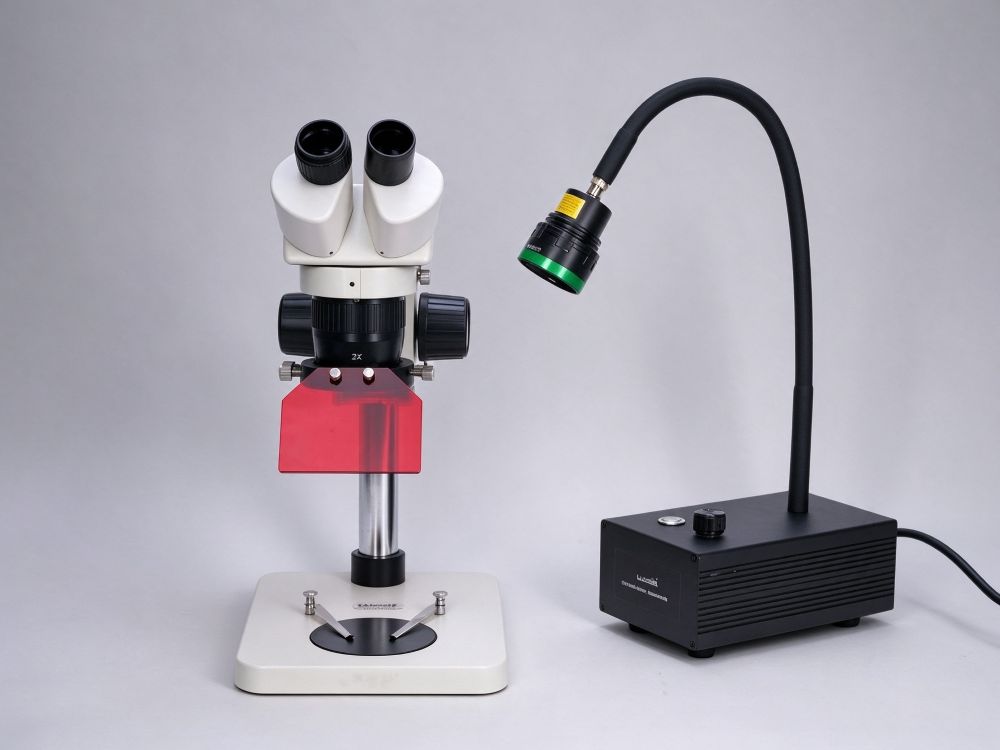
 Overview
LUYOR-3421 adds fluorescence to a stereo microscope with a 20W LED head and six quick-change modules covering BFP, CFP, GFP, YFP and RFP.
Anyone running fluorescent protein experiments knows the situation: the stereo microscope on the bench shows morphology, not fluorescence. To confirm fluorescence expression in Drosophila, zebrafish, C. elegans, or seedlings under the eyepiece, you either book time on a shared-platform fluorescence microscope or commit to a dedicated fluorescence stereo microscope, while what routine screening actually needs is to see the fluorescence clearly and pick out the positives.
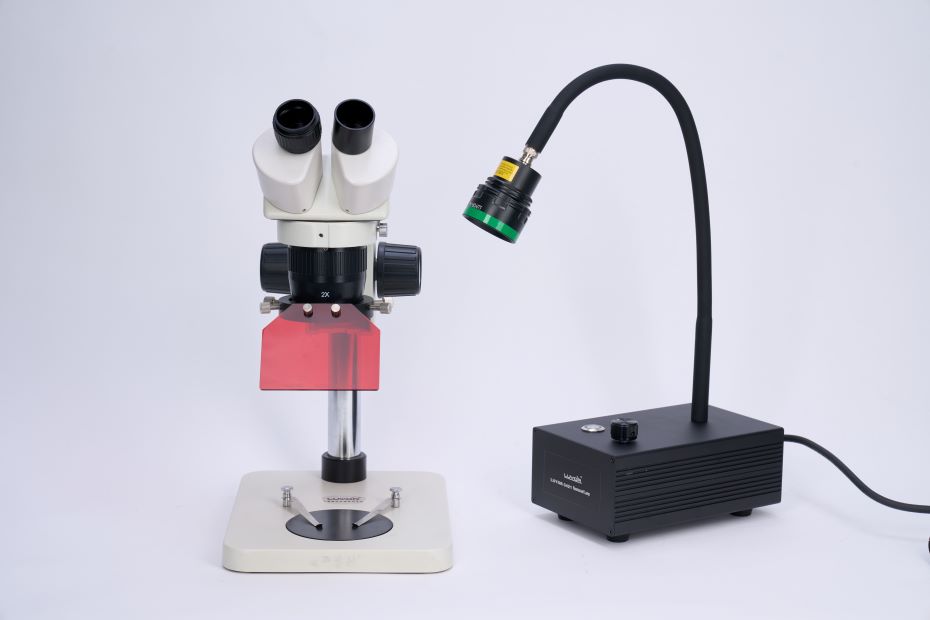
LUYOR-3421 takes another route: it leaves your existing microscope in place and adds fluorescence capability to it. The LED head delivers excitation from the side on a flexible gooseneck, a barrier filter sits below the objective, emitted fluorescence reaches the eyepiece, and reflected excitation light is blocked outside. Setup takes a few minutes, an ordinary stereo microscope gains fluorescence observation, and the unit can be removed to restore the original setup at any time.
It is also a stand-alone bench excitation source. Lift the head off the stand and the 500mm flexible gooseneck can illuminate Petri dishes, plates, or a full tray of colonies at any angle. That is why LUYOR positions 3421 as a microscope fluorescence adapter plus bench excitation source: one budget, two uses.
Fit the adapter ring to the stereo microscope column, insert the barrier filter into the light path below the objective, and bring the LED head over the stage on the gooseneck. Excitation light strikes the sample at an angle, and fluorescence enters the optical path vertically. Reflected excitation is stopped by the barrier filter, so sample fluorescence alone reaches the eyepiece. A filter shield around the sample blocks ambient light and improves contrast further.
This configuration suits work where you look and handle at the same time: fluorescence-guided dissection, microinjection, genotype confirmation of transgenic Drosophila and zebrafish under the eyepiece, and GFP expression mapping in seedling roots.
Lift the head off the microscope and it becomes a 20W bench excitation source: bend the flexible gooseneck to the sample position, set brightness on the dimmer knob, and observe through matching viewing glasses. It suits work that needs speed rather than magnification: fluorescence screening of colonies on plates, positive selection across a full tray of seedlings, and quick pre-checks before samples go to confocal imaging.
| Item | Specification |
|---|---|
| Brand | LUYOR, USA |
| Product type | Stereo microscope fluorescence adapter and bench fluorescent protein excitation source (upgrade of LUYOR-3420) |
| Light source | 20W high-power LED, large illuminated area, even spot, high irradiance |
| Wavelength modules | 6 options: UV, VI, RB, RB-GO, CY, GR, changed through a BNC quick connector |
| Official wavelengths | 365nm, 405nm, 450nm, 488nm, 505nm, 530nm (mapping in the module table below) |
| Dimming | Dimmer included as standard, continuous brightness adjustment on the knob |
| Light arm | 500mm flexible gooseneck, bends and holds any illumination angle |
| Power | 110-220V AC, 50/60Hz, international plug set |
| Microscope mounting | Adapter ring fits the existing stereo microscope column; no modification, seconds to fit or remove |
| Filter system | Each module ships with a matching barrier filter and filter shield |
| Photography | 67mm photo filter mounts directly on an SLR camera; the adapter ring includes a round filter thread |
| Expansion | Additional wavelength modules (3421SLM series) can be ordered separately at any time |
This table is the core of selecting a LUYOR-3421. The module is fixed at order, and additional modules can be bought at any time, so confirm which fluorescent protein the current project needs, then set the initial configuration:
| Module model | Excitation color | Excitation band | Emission filter | Fluorescent protein / dye observed |
|---|---|---|---|---|
| LUYOR-3421RB | Royal blue | 440-460nm | 495nm longpass | GFP, eGFP, fluorescein FITC |
| LUYOR-3421RB-GO | Royal blue, green emission | 440-460nm | 500-560nm bandpass | GFP, eGFP - better contrast where the red autofluorescence background is high |
| LUYOR-3421GR | Green | 510-540nm | 590nm longpass | DsRed, tdTomato, mCherry, and other RFP variants |
| LUYOR-3421CY | Cyan | 490-515nm | 550nm longpass | YFP, Venus, Lucifer Yellow |
| LUYOR-3421VI | Violet | 400-415nm | 450nm longpass | CFP |
| LUYOR-3421UV | Ultraviolet | 360-380nm | 415nm longpass | DAPI, Hoechst, and other nuclear dyes |
GFP alone: take the RB module, which is the normal order volume. If the sample has strong red autofluorescence (red flesh, red stems, mature tissue), step up to RB-GO
GFP plus RFP two-color projects: order the body with RB and add a GR module later; the two modules swap in seconds
Nuclear localization plus expression: RB for expression and UV for DAPI nuclear stain, again added as needed
Unsure of the band: send us the fluorescent proteins and material types involved, and we will confirm a combination with the factory
| Module code | Excitation color | Excitation band | Emission filter |
|---|---|---|---|
| 3421SLM-UV | Ultraviolet | 360-380nm | 415nm longpass |
| 3421SLM-VI | Violet | 400-415nm | 450nm longpass |
| 3421SLM-RB | Royal blue | 440-460nm | 495nm longpass |
| 3421SLM-RB-GO | Royal blue, green emission | 440-460nm | 500-560nm bandpass |
| 3421SLM-CY | Cyan | 490-515nm | 550nm longpass |
| 3421SLM-GR | Green | 510-540nm | 590nm longpass |
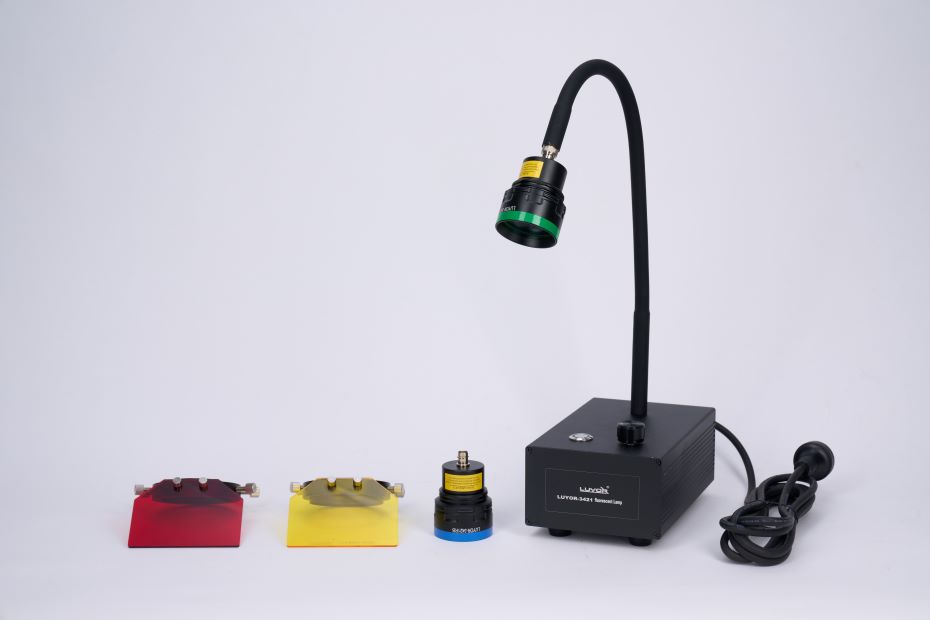
Each additional module is a complete set: LED head, microscope adapter ring, barrier filter, filter shield. Changing fluorescent protein is a matter of changing one module, with excitation and filtration always matched, so the awkward case of the right light with the wrong filter does not arise.
Group requirements change: GFP this year, mCherry labeling next year, and perhaps YFP as an energy acceptor the year after. The modularity of LUYOR-3421 is built for that change: the body (gooseneck stand plus power supply) stays, while wavelength is added or removed module by module:
The head and module connect through a BNC quick connector. Unplug and replug to complete the change, with no tools and no realignment, so changing samples or bands does not interrupt the experimental rhythm.
Each module includes its own adapter ring, so it can move from one stereo microscope to another; several labs sharing one set of modules is also straightforward.
The adapter ring clamps onto the column, with no drilling and no structural change; it comes off in minutes when not needed, leaving the microscope as it was.
Buy the module set for the current project at the start and spend the budget where it counts; a newly funded group does not need to buy the full range at once.
Changing fluorescent protein requires one more 3421SLM module, while the body, gooseneck, dimmer, and power supply are all reused.
Each module carries its own barrier filter and filter shield, so changing the module changes the whole light path and light and filter cannot mismatch.
Phenotype confirmation of transgenic and genome-edited lines is high-frequency work at the microscope: anesthetize onto a plate, check fluorescence under the eyepiece, pick the positives. The excitation level of 3421 lets weakly expressing lines be judged directly under the eyepiece without occupying research-grade fluorescence microscope time.
Picking positives from large batches: seedlings, colonies, and fish eggs grouped quickly by presence or absence of fluorescence. In bench configuration with plates or culture dishes, one dish after another is screened far faster than mounting each sample.
Where you must see fluorescence and work at the same time, such as dissecting specific tissue, injecting specific sites, or micromanipulation, a handheld lamp occupies one hand. The gooseneck of 3421 holds the light at the required angle and leaves both hands for the work.
Confocal time is expensive. Run candidates through 3421 before booking, and send just the individuals that genuinely express to the imaging session, which saves cost and queue time.
Routine fluorescence confirmation, grouping, and inspection go to 3421, while fluorescence stereo microscopes and confocals are kept for the quantitative and imaging work that needs their performance. Each instrument does its own job and booking time no longer collides.
GFP observation and model-organism demonstrations in undergraduate and graduate courses: no dedicated fluorescence microscope purchase is needed, since 3421 with an ordinary stereo microscope is enough to run the class, and the modular design lets several benches share one unit.
Flexible gooseneck stand (with dimmer control circuit)
Power adapter: 110-220V AC, 50/60Hz, international plug set
Stereo microscope adapter ring
LED excitation head (selected wavelength module)
Barrier filter
Filter shield
67mm photo filter (accepts SLR cameras)
LED excitation head (specified band)
Stereo microscope adapter ring
Barrier filter (matched to the band)
Filter shield
Module code: 3421SLM-UV / VI / RB / RB-GO / CY / GR
Viewing glasses are supplied to match the wavelength (for example the yellow LUV-30A series for GFP) and are used for direct visual observation; microscope observation forms its image through the barrier filter and does not depend on glasses. If you need a spare head, filter, or extra glasses, note it with the order.
Within the LUYOR fluorescence observation line these three are often compared. The difference is not quality but working situation:
| Item | LUYOR-3421 bench | LUYOR-3415RG handheld | LUYOR-3280 handheld |
|---|---|---|---|
| Form | Bench: gooseneck stand with microscope adapter | Handheld: two-wavelength integrated lamp | Handheld: single-wavelength lamp |
| Bands | 6 modules, changeable and expandable | Any two, fixed at the factory | Single band, fixed at the factory |
| Microscope mounting | Yes (stereo microscope adapter) | No | No |
| Light source | 20W high-power LED | 18W per wavelength / 27W total | 20W high-power LED |
| Typical use | Screening under the eyepiece, dissection and injection, plate sorting | Plant-by-plant inspection in greenhouse and field, two-color observation | Large-area single-color screening in field and greenhouse |
| Power | 110-220V AC | Rechargeable battery, 0.9kg portable | Dual battery, about 4 h continuous |
In short: if the work happens at the microscope or the bench, choose 3421; if it happens in a greenhouse, a tunnel, or a trial field, choose a handheld. Many groups run both: 3421 fixed on the bench for confirmation and sorting under the eyepiece, and a handheld at the greenhouse door for daily inspection, each covering what the other does not.
Detailed information on the other two: the two-wavelength handheld is described in LUYOR-3415RG two-wavelength fluorescent protein excitation source, the single-wavelength handheld in LUYOR-3280 fluorescent protein viewing torch, and the US-made portable models in NIGHTSEA Xite-RB / Xite-GR. Field practice for choosing a handheld is also described in the LUYOR-3415RG application notes.
LUYOR-3421 is the upgrade of the 3420 fluorescence adapter: LED power rises to 20W, the illuminated area is larger, and irradiance is higher. Wavelength modules keep the BNC quick-change design, and with more official wavelengths available, modules can be added as projects require. If you already own a 3420, it remains fine to use; for new purchases, 3421 is the recommended choice, with more headroom for weakly fluorescent samples.
LUYOR-3421 mounts on the microscope column through an adapter ring, and the official design target is the common range of stereo microscopes, including mainstream Olympus, Nikon, Zeiss, and Leica models. Tell us your microscope brand and model when ordering, and we will confirm the ring specification with the factory before shipping, so the unit does not arrive and fail to fit.
Yes, and that is the difference between 3421 and an ordinary fluorescence adapter. The LED head sits on a 500mm flexible gooseneck fixed in a stand with a dimmer; with the adapter ring and filter set aside, it is a high-power bench excitation source that illuminates at any angle, directly onto culture dishes, plates, full trays of colonies, or seedlings, viewed through the matching glasses.
Choose by the fluorescent protein: RB (royal blue 440-460nm) for GFP, eGFP, and FITC; GR (green 510-540nm) for DsRed, tdTomato, and mCherry; CY (cyan 490-515nm) for YFP and Venus; VI (violet 400-415nm) for CFP; UV (ultraviolet 360-380nm) for DAPI and Hoechst nuclear stains. Choose RB-GO where red autofluorescence is strong and GFP contrast is poor. Send us your fluorescent protein list and we will help set the modules.
Yes, and that is the point of the modular design. Each wavelength module contains an LED head, adapter ring, barrier filter, and filter shield as a self-contained set (3421SLM series), connects to the head through a BNC quick connector, and changes in seconds. Buy the bands the current project needs and add modules separately when the fluorescent protein changes, without replacing the whole instrument.
Both use the same excitation band (440-460nm); the difference is the filter. RB carries a 495nm longpass filter with high signal transmission and is the normal choice for GFP. RB-GO carries a 500-560nm bandpass filter that passes the green band and blocks red autofluorescence outside the eyepiece. With red flesh, red stems, or mature tissue that emits red light itself, RB shows a reddish background, and RB-GO gives clearly better contrast.
The barrier filter sits below the microscope objective and passes sample fluorescence into the light path while blocking reflected excitation light; without it the eyepiece shows a bright blue field. The filter shield surrounds the sample to block ambient light, reduces stray light entering the eyepiece, and keeps excitation light out of the operator's eyes. Both are included as standard, which is why modules ship as complete sets.
No. The 20W high-power LED provides enough excitation that an ordinary lab can observe with the curtains drawn in daytime; for weak samples, the filter shield plus switching off room lights lowers the background further. This is the practical advantage of 3421 over lower-power fluorescence adapters: no dedicated dark room has to be cleared for observation.
Microscope observation forms its image through the barrier filter and does not depend on glasses. For direct visual observation as a bench source, glasses matched to the wavelength are needed, for example the yellow LUV-30A series for GFP. Glasses can be ordered with the unit; if you already have glasses for the same band they can be used directly, and we can check compatibility against the band when you order.
Yes. 3421 includes a 67mm photo filter that mounts directly on an SLR lens; through the round filter thread on the adapter ring, a camera can also be attached to the microscope output to record fluorescence images. For phone photography, a phone clamp combined with the filter is enough. The key to good images is the same as for observation: hold the camera steady and keep ambient light low.
A dimmer is included as standard, and the knob on the stand adjusts output brightness continuously. Suitable excitation levels vary widely between samples: strongly expressing material needs little, while weak material needs higher output. Increase from low brightness and stop at a clear fluorescence image, since excessive brightness raises background and photobleaching and reduces contrast.
An LED source has no bulb in the sense of a mercury lamp. Normal use runs for tens of thousands of hours with essentially no maintenance, and there is no warm-up wait and no mercury disposal. LED output decays slowly; if the same sample suddenly looks visibly dimmer, check the dimmer knob and the power supply before anything else, then contact us to judge whether service is needed.
Look at working distance and task: for observation under the eyepiece, dissection, injection, or micromanipulation, or for wide illumination of a whole tray of samples, choose the bench 3421; for carrying into a greenhouse, tunnel, or trial field for plant-by-plant inspection, choose the handheld LUYOR-3415RG (two wavelengths) or LUYOR-3280 (single wavelength). Many groups keep both: 3421 fixed on the bench and 3415RG at the greenhouse door.
The 3280 is a single-band handheld lamp: lower cost, portable, with a large illuminated area, suited to field screening for one fluorescent protein. The value of 3421 lies in three points: it mounts on a stereo microscope, its wavelength modules can be changed and added, and it brings dimming plus a complete filter system. If observation happens under a microscope or on the bench and the fluorescent protein may change later, choose 3421; for single-color field screening, 3280 is more economical.
Price is confirmed by configuration: a body plus one wavelength module is the base configuration, and the module band, any additional modules, and whether a photo filter is needed all affect the quotation, so please ask us for a price. Warranty and service follow the official LUYOR commitment. Xinysun Instruments (Shanghai) Co., Ltd. ships from Shanghai and supports configuration confirmation, adapter matching, operating guidance, and later module purchases; project pricing is available for volume orders.
LUYOR-3421 product document and official specification notes
Cross-reference table of the six wavelength modules and fluorescent proteins
Stereo microscope adapter ring compatibility list (checked by brand and model)
Barrier filter and filter shield instructions
Photo filter and camera adapter options
Quotation for the 3421SLM series additional modules
Module configuration recommended from your fluorescent protein combination
Microscope brand and model compatibility check before ordering
Advice on viewing glasses and photo filters
Troubleshooting guidance when fluorescence observation is weak
Support for later module purchases and upgrades
Volume purchase and group-level pricing
Send inquiry

Email: info@xinysun.com

Tel: 131-2093-6518

Address: 1525 Minqiang Road, Bldg 26, Songjiang, Shanghai

Copyright 2026 Xinysun Instrument (Shanghai) Co., Ltd. All rights reserved.
ICP:ICP-2026046447




 Breadcrumb:
 Products
 Applications
 Previous:
 Back to list

 Industrial Test Instruments


