Products
PRODUCTS
 Overview
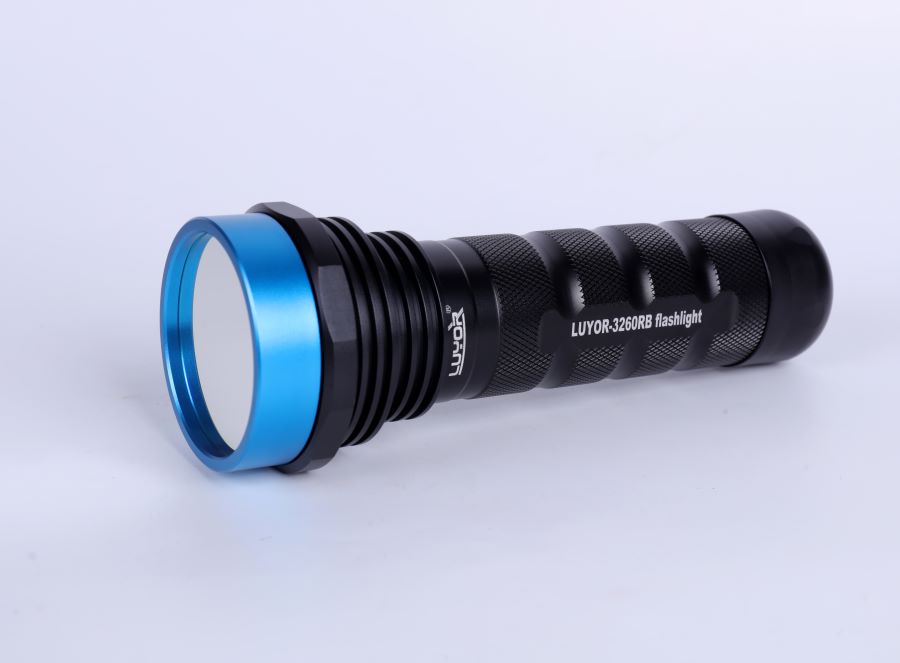
LUYOR-3260RB is a handheld 450 nm LED light for GFP and green fluorescence screening in plants, with 9 x 3W LEDs and a 150 mm spot at 30 cm.
Once you have transgenic or gene-edited material, the next question is simple:does this plant, this seed, this plate actually express the construct. A fluorescent marker turns that question into a visible-or-not decision, provided you have the right excitation light.
Green fluorescent protein such as GFP emits visible green light when excited in a specific band; a white flashlight or room lighting carries little energy in that band and produces almost no response. At the same time, the excitation light is strong and reaches the eye along with its reflection, swamping the weak fluorescence - so besides the light source you need a pair of filter viewing glasses.
A confocal or fluorescence microscope will show the signal, but it answers questions about fine structure and localization: the instrument is fixed, samples need preparation, and throughput is limited. With hundreds of seeds, hundreds of seedlings, or dozens of plates, carrying each one to the microscope is impractical and may damage the material. The LUYOR-3260RB fills that layer:handheld, contact-free, a batch in tens of seconds, and screened material remains usable.
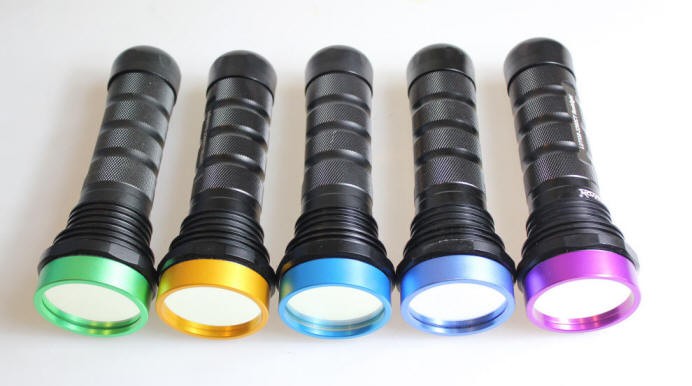
LUYOR-3260 is a series of single-wavelength handheld excitation sources, where one band matches one class of fluorescent label. The suffix letter gives the excitation color; specify it by the fluorescent protein you will observe, and pair it with viewing glasses of the matching cut-on wavelength.
| Model | Excitation color | Excitation band | Viewing glasses | Typical targets |
|---|---|---|---|---|
| LUYOR-3260UV | UV | 365nm | 415nm long-pass | UV-excited labels such as DAPI and Hoechst |
| LUYOR-3260RB | Deep blue (Royal Blue) | 440-460nm (nominal 450nm) | 500nm long-pass / optional 500-560nm band-pass | GFP, eGFP, fluorescein, calcein, Lucifer Yellow |
| LUYOR-3260LB | Light blue | 488nm | Long-pass filter glasses | Green fluorescent proteins, some algal pigments |
| LUYOR-3260CY | Cyan | 505nm | 550nm long-pass | Yellow fluorescent proteins such as YFP and Venus |
| LUYOR-3260GR | Green | 520nm | 600nm long-pass | Red fluorescent proteins such as DsRed, tdTomato, and RFP |
Most groups working with green fluorescent protein (GFP) are served by the RB band. If your material also carries a red fluorescent protein, add a GR unit or choose a two-band LUYOR-3415RG dual-wavelength excitation source.
| Item | Specification | Notes |
|---|---|---|
| Model | LUYOR-3260RB | 3260 series single-wavelength handheld, RB deep-blue band |
| Excitation band | 440-460nm (nominal 450nm) | Matches green fluorescent proteins and green dyes |
| Light source | 9 × 3W high-power LEDs | Multi-point array, even spot, on instantly with no warm-up |
| LED life | About 10000 hours | Estimated at normal use; no routine emitter replacement |
| Beam size | About 150mm diameter at 30cm from the lamp | Covers a seedling, a seed cluster, or a dish in one pass |
| Viewing glasses | 500nm long-pass filter glasses (optional 500-560nm band-pass) | Block reflected excitation light, pass the fluorescence |
| Battery | 12V 2600mAh lithium battery | Replaceable, with 110-260V AC adapter |
| Runtime | About 2-4 hours | Charge time about 2-6 hours; carry a spare battery for long field days |
| Dimensions | Head 70mm diameter, tail 45mm diameter, about 250mm long | One-hand grip, with lanyard and carry case |
| Weight | About 455g (with battery) | Low fatigue over long handheld screening |
| Detection | Direct illumination and viewing, no substrate staining | Contact-free and non-destructive, can view through clear containers |
Fluorescence viewing depends not on how bright the light is but on separating excitation from emission. Excitation is far stronger than the fluorescence the sample emits; if both reach the eye together you see a field of blue and no green signal.
The 3260RB emits 440-460nm deep blue, close to the excitation peak of GFP and similar green labels, for efficient use of energy.
The excited protein emits green light at a longer wavelength, visible to the eye but far weaker than the excitation.
500nm long-pass glasses block reflected excitation below 500nm and pass green fluorescence, which creates the contrast.
In the configuration list, then, viewing glasses are not an accessory but a necessity: order extra pairs when several people screen at once, and fit the camera lens with a filter of the same specification for imaging. Where background fluorescence is strong (plant leaves have autofluorescence, for example), 500-560nm band-pass glasses suppress it better; choose by material type.
| Label | Excitation peak | Emission color | RB band fit |
|---|---|---|---|
| GFP / eGFP | About 488nm | Green | Yes, standard configuration |
| Fluorescein | About 490nm | Yellow-green | Yes |
| Calcein | About 495nm | Green | Yes, common for fish and coral marking |
| Lucifer Yellow | About 430nm | Yellow-green | Yes |
| YFP / Venus | About 515nm | Yellow | Partly, the CY band is recommended |
| DsRed / tdTomato | About 555nm | Red | No, choose the GR band |
The table is a reference for common pairings; actual excitation efficiency also depends on expression level, tissue depth, and background autofluorescence. If your label is not listed, send us the name and we will confirm the band from its excitation and emission spectra.
Confirm the battery is full and the lenses are clean and unscratched before you leave. A low battery dims the spot and can be misread as "no fluorescence".
Before the main run, expose a known positive and a known negative sample and note the difference between "bright" and "not bright"; this reduces misreads noticeably.
Hold the head about 20-30cm from the target and keep it steady, sweeping plate by plate in batches; when a bright point appears, move in for a second look to avoid missing a dim edge.
Transfer and label positives immediately; for records, photograph with a filtered camera or phone and note distance and exposure so batches can be compared.
Safety:Do not look into the lamp head and do not aim the beam at anyone's face. For extended viewing, wear the supplied UV and blue-light protective glasses. Keep the unit out of reach of children.
| Model | Format and bands | Beam characteristics | Better for |
|---|---|---|---|
| LUYOR-3260RB | Handheld, single wavelength, RB deep blue | About 150mm spot at 30cm, 455g | Mobile GFP screening: seeds, seedlings, colonies, plates |
| LUYOR-3415RG | Handheld, two wavelengths, RB + GR switchable | 27W total, 180mm diameter at 150mm | Groups running green and red proteins together |
| LUYOR-3421 | Benchtop excitation source | Fixed station, stable exposure | Batch work at the bench with both hands free |
| LUYOR-3124RB | Large-area suspended type | Covers a whole tray, mounts overhead | Whole-tray tissue culture and large bench screening |
| NIGHTSEA Xite-RB / Xite-GR | Handheld, with flashing mode | About 255g, light and portable | Field sampling where low weight and flashing view matter |
In short: mainly GFP and moving around, 3260RB; both green and red proteins, 3415RG; fixed at the bench, 3421; whole trays, 3124RB.
Seeds, seedlings, and roots of rice, wheat, maize, soybean, cotton, and Arabidopsis, screened for positive individuals in the greenhouse or at the bench without damaging the material.
Judge whether bacterial, yeast, or fungal colonies express a fluorescent marker without picking them; view through the lid and the plate keeps growing.
Whole-body or tissue-level fluorescence viewing in zebrafish, mice, and other models, with pre-dissection screening that avoids unproductive sampling.
Checking calcein marks in fish otoliths and larvae, and surveying coral larvae and settlement substrates; the handheld format suits field and at-sea work.
Illuminate through the clear culture vessel to judge expression, avoiding the contamination risk of opening it, which suits tracking batches of cultured material.
Demonstrate fluorescence directly and let students observe it in everyday materials and natural samples; safe to handle and ready on switch-on.
LUYOR-3260RB excitation source (with lanyard)
Filter viewing glasses matched to the band
12V 2600mAh lithium battery
Charger and cable (110-260V)
Manual and warranty card
Aluminum carry case
Spare battery (long field days)
Extra viewing glasses (several screeners)
62mm photo filter and phone camera filter
Adjustable stand (fixed exposure, hands free)
Other band versions (UV / LB / CY / GR)
LUYOR-3260 is the series name; the suffix gives the excitation color and band: UV for ultraviolet, RB for deep blue, LB for light blue, CY for cyan, GR for green. RB stands for Royal Blue, with an excitation band of 440-460nm (nominal 450nm), the standard configuration for green fluorescent protein labels. In other words, the 3260RB is the single-wavelength version of the 3260 series configured for GFP work.
The RB band targets the green fluorescent group: GFP, eGFP, and similar proteins, plus common green dyes such as fluorescein, calcein, and Lucifer Yellow. For red proteins such as DsRed, tdTomato, or mCherry, choose the GR band (510-540nm); for DAPI and Hoechst, look at the UV band.
The two have different roles. A microscope answers "what do the cells and substructure look like", with high magnification and fine localization, but it is fixed, samples must be prepared, and throughput is limited. The 3260RB answers "does this plant, this seed, this plate express", handheld and non-destructive, a batch in tens of seconds, which suits large-scale screening and field checks. It does not replace the microscope; it moves the coarse screen that precedes microscopy out to the bench.
No dark room is needed, but the darker the surroundings the stronger the contrast and the easier the read. Green fluorescence is usually still distinguishable under normal room lighting; where light is strong, close the blinds, hang a dark cloth locally, or improvise a dark enclosure from a box or bag. Night-time field viewing is often better.
A 150mm spot fits the scale of a seedling, a cluster of seeds, or a single dish, and batch screening can proceed plate by plate at good throughput. For whole trays of cultured seedlings, large benches, or long fixed exposure, look at the LUYOR-3124RB large-area suspended source in the same series, or mount the 3260RB on an adjustable stand.
The 3260RB ships with one pair of 500nm long-pass filter glasses matched to the band, which block reflected excitation and pass green fluorescence; this is the part that decides whether you see the signal. Extra pairs can be ordered for the number of screeners, and 500-560nm band-pass versions are available when background fluorescence is strong.
Yes. When shooting with a camera or phone, fit a filter of the same specification as the viewing glasses in front of the lens, or the image will be a field of blue reflection. The 3260 series offers a 62mm photo filter, and there is a filter option for phone cameras. If you plan to record images, tell us your camera before ordering so the kit is complete.
The standard 12V 2600mAh lithium battery runs about 2-4 hours on a full charge and charges in about 2-6 hours. An afternoon of screening is covered; for a full day or long field use, add a spare battery or top up between stops. The pack is replaceable and does not hold up the day's work.
About 10000 hours is the estimated source life under rated conditions; at 2 hours a day and 250 days a year that is a service period on the order of twenty years, so routine emitter replacement is not a concern. Actual life depends on use and cooling, and continuous operation accelerates output decay.
Yes. It is designed for handheld mobile use: battery powered, with a lanyard, and it packs into an aluminum case for greenhouses, fields, and sampling vessels. Note that the 3260 series is not intended for underwater use or for exposed work in heavy rain; in the field, keep it dry, avoid drops, and wipe it down before storing.
Yes. Fluorescence excitation is contact-free and non-destructive, needs no substrate, and does not touch the medium, so you can illuminate through clear culture vessels, tubes, or dishes without opening them or sampling, which avoids contamination and suits cultured seedlings and material that must keep growing.
Its value is turning "sample, prepare, image" into "one look tells you". In seed sorting, for example, you wear the glasses and sweep seed by seed: glowing seeds stay, non-glowing ones are culled in batches, with no marking and no damage, and the sorted seed can still be planted. For screening at the thousand-seed scale the gain is clear, with detailed verification of positives afterwards.
Yes. The 3260 series offers five bands: UV, RB, LB, CY, and GR, specified at order by the protein you will observe. Because the band is set by the emitters and filter, it cannot be switched on one unit the way the dual-wavelength 3415 can; if you later need a second band, order a second unit, or choose the LUYOR-3415RG, which takes two wavelengths.
Four causes cover most cases: the wrong band (a red protein excited by RB is inefficient); no glasses or the wrong glasses, so reflected excitation swamps the signal; too much ambient light, giving poor contrast; or low expression in the sample, or a time point before expression starts. Work through these four in order, or send us the protein, material type, and a site photo and we will help.
Price depends on configuration (band, number of glasses, stand, and photo filter). Send your protein and application through the page form or by phone and we will quote the matching configuration. The product carries warranty and service support, ships from stock in Shanghai, and a demo can be arranged; common accessories and spare batteries can be quoted together.
LUYOR-3260 series product literature and official specifications
"LUYOR-3260 Excitation Source Quick Guide"
"LUYOR-3260 Series FAQ"
Band and protein selection chart (UV / RB / LB / CY / GR)
Viewing glass and photo filter part-number list
Field notes for GFP fluorescence screening
Band recommendation by protein and dye
Glasses and photo filter matching advice
Accessory selection: stands, spare batteries, and more
Troubleshooting when the view is poor
Manuals and specification sheets on request
Volume and project quotes, lead time confirmation
Send inquiry

Email: info@xinysun.com

Tel: 131-2093-6518

Address: 1525 Minqiang Road, Bldg 26, Songjiang, Shanghai

Copyright 2026 Xinysun Instrument (Shanghai) Co., Ltd. All rights reserved.
ICP:ICP-2026046447



 Breadcrumb:
 Products
 Applications
 Previous:
 Back to list

 Industrial Test Instruments


