Products
PRODUCTS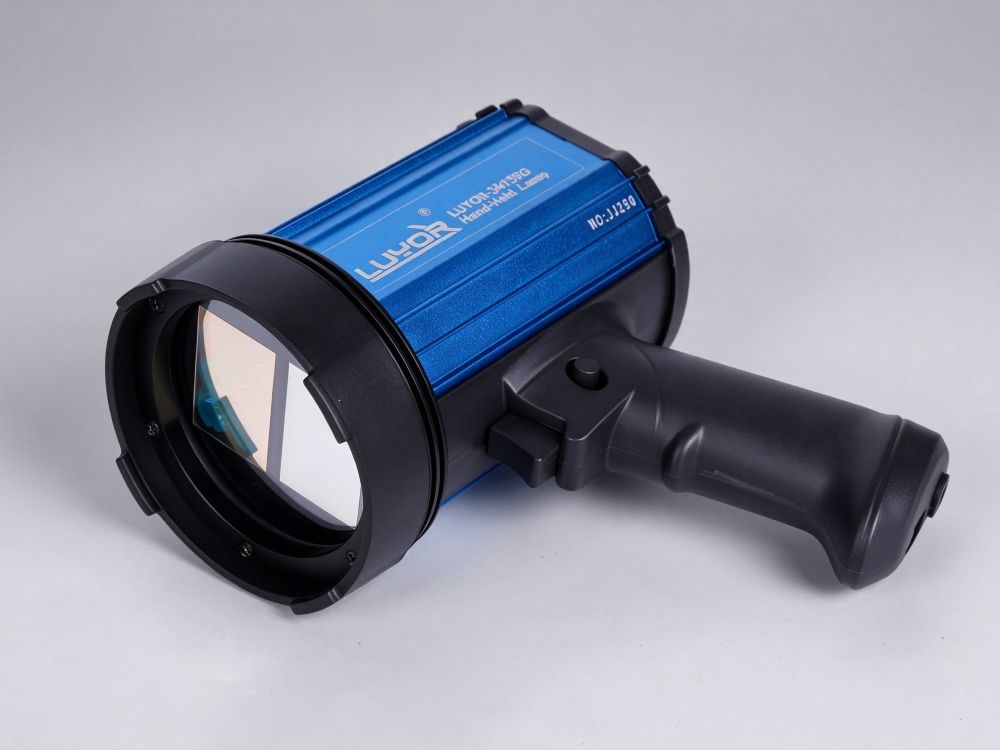
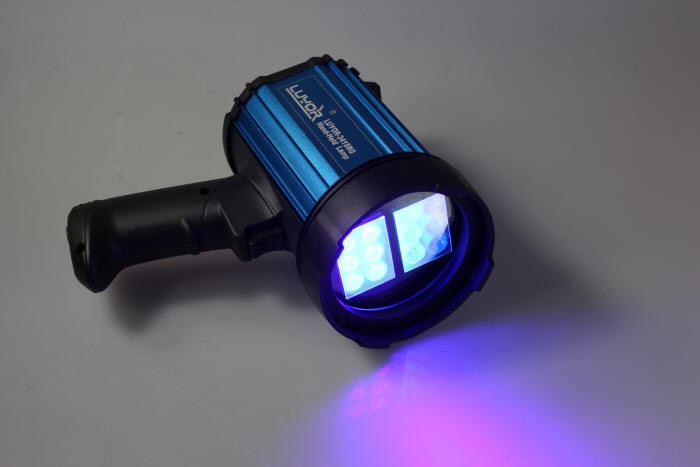
 Overview
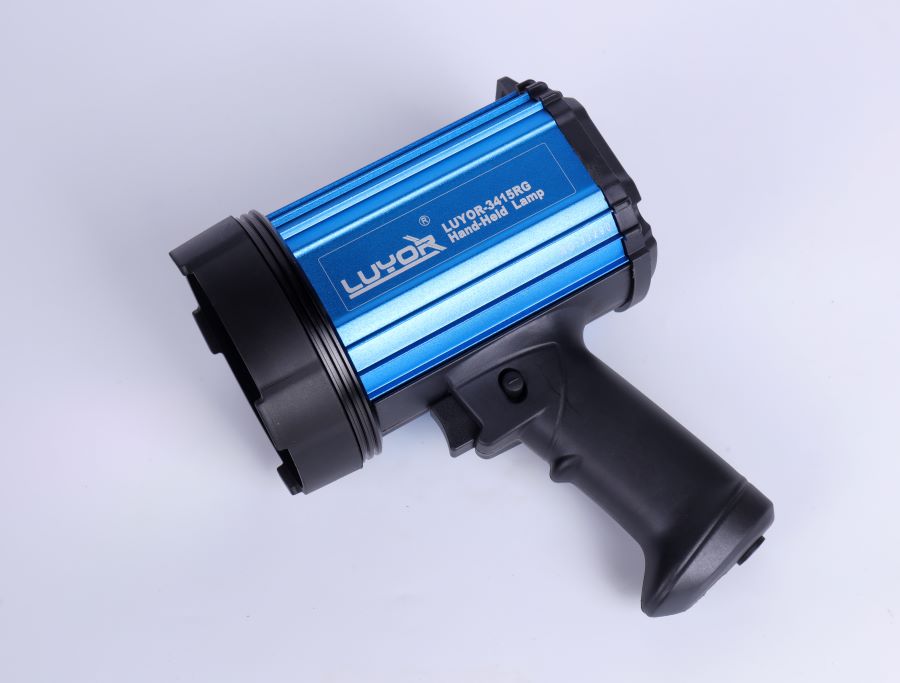
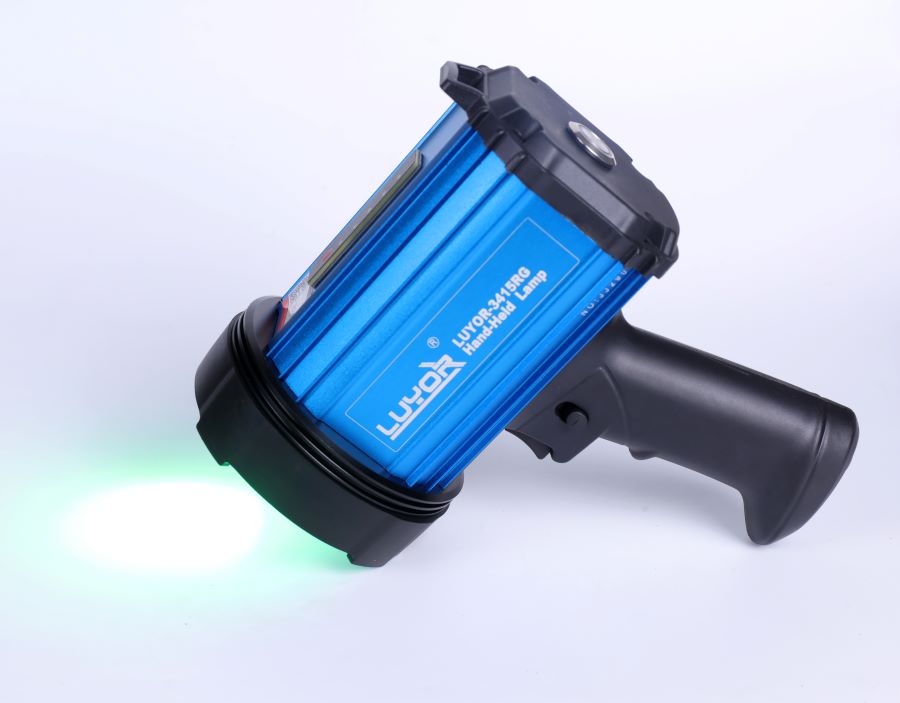
Handheld dual-wavelength source: RB 440-460nm excites GFP, GR 510-540nm excites DsRed. 27W, 0.9kg, 180mm spot at 150mm, no darkroom needed.
Anyone running transgene or gene-editing experiments meets the same practical problem quickly: several lines are in the lab at once, each marked with a different fluorescent protein. Today you check GFP seedlings, tomorrow you sort DsRed seeds, the day after you look at mCherry roots. With only a single-wavelength source on the bench, that means either buying two units or changing equipment every time the material changes.
LUYOR-3415RG is built for that situation: two excitation wavelengths in one housing, each with its own switch, ready as soon as you pick it up. The standard build pairs RB-Royal Blue (440-460nm) with GR-Green (510-540nm), which covers the two most common research needs: green fluorescent protein (GFP, eGFP) and red fluorescent protein (DsRed, tdTomato, mCherry).
It is not limited to the standard pair. Any two of the five light sources R, C, G, V and U can be combined into a custom unit, so a project based on CFP or DAPI can be matched with a suitable configuration. That is why the 3415RG/3415GR series is described as a dual-fluorescent-protein observation source built to order.
The selection logic for the LUYOR-3415RG/3415GR series is simple: pick two of the five light sources below and they are assembled into your dual-wavelength configuration. The standard LUYOR-3415RG is R (Royal Blue) plus G (Green):
| Code | Excitation | Emission | Fluorophore / application |
|---|---|---|---|
| R (Royal Blue) | 440-460nm | 500nm | GFP, eGFP, fluorescein |
| C | 490-515nm | 550nm | YFP, Venus, Lucifer Yellow |
| G (Green) | 510-540nm | 600nm | DsRed, TdTomato, mCherry |
| V (Violet) | 400-415nm | 460nm | CFP, BFP |
| U (Ultraviolet) | 360-380nm | 415nm | DAPI, Hoechst |
R + G (standard LUYOR-3415RG) - GFP plus DsRed/mCherry, covering the broadest range of transgenic screening work. This is also the default shipping configuration.
R + V - GFP plus CFP/BFP, for experiments that must separate two blue-green markers.
U + R - DAPI nuclear stain plus GFP expression, for nuclear localization combined with expression checks.
C + G - YFP/Venus plus DsRed/mCherry, for yellow-red two-color work.
| Item | Specification |
|---|---|
| Brand | LUYOR (USA), Laboratory Instruments Division |
| Model | LUYOR-3415RG (standard: RB Royal Blue + GR Green) |
| Wavelength | Any 2 selectable: 365nm, 400nm, 450nm, 485nm, 520nm |
| Source code system | R / C / G / V / U, any two combined |
| R source | Excitation 440-460nm, filter 500nm, for GFP, eGFP, fluorescein |
| G source | Excitation 510-540nm, filter 600nm, for DsRed, TdTomato, mCherry |
| LED configuration | 6 x 3W LEDs per band, 12 total in dual-band units |
| Power | 18W single band, 27W total |
| Illumination area | 180mm spot diameter at 150mm from the lamp |
| Net / gross weight | 0.9kg / 4kg |
| Lamp body | 180×200mm (length × height), head diameter 120mm |
| Case size | 400×300×150mm (L × W × H) |
| Input | AC 100-260V, 50/60Hz (rechargeable battery pack) |
| LED life | 50000 hours |
| Operation | Two switches on the housing, one per excitation band |
| Standard package | Main unit, LUV-30A viewing glasses, LUV-50A viewing glasses, charger, manual, warranty card, aluminum carrying case |
| Optional accessories | Adjustable stand, LUV series photo filters (67mm direct-fit for SLR), phone photo filter, light shield (supplied with the unit) |
| Warranty | Three years on the lamp body, excluding damage from misuse |
The product has been on the market since 2019, with more than 200 units installed in Chinese plant science. The comments below are published customer feedback, each from a different workflow:
We used to screen samples one by one under a fluorescence microscope. Now one pass with the LUYOR-3415RG shows the result, with the exact position clearly visible, which removes a great deal of tedious work and makes the experiment easier. We had been struggling to inspect plantlets inside culture vessels; now we can check them and keep the plantlets uncontaminated and growing. Two problems solved at once.
We use the LUYOR-3415RG to sort rice seeds with red fluorescence. The output is strong and the view is clear, which makes sorting more accurate. The unit runs for long periods on its rechargeable battery, and with the stand both hands are free, which matches the workload of large manual sorting runs.
Compared with checking GFP under a fluorescence microscope, the portable source is quicker and simpler. No tissue collection is needed; we observe living plants directly without damaging valuable material, which saves us a lot of time and effort. It is small and easy to carry into the field, the battery capacity is generous, and it covers ordinary experimental needs. Against imported products of the same type, the LUYOR price is much lower for comparable results. We also bought the LUV-520 plant photography filter, and image quality improved substantially, up to the standard of high-level SCI journals. The viewing glasses supplied with the unit are useful: they let us see plant fluorescence and protect us from the excitation light.
It is very convenient to use. Notably, it can be taken into the field to photograph transgenic fluorescent plants, and it solved the narrow field-of-view problem of fluorescence microscopy. Roots from transient transformation also photograph well with the 3415RG. The unit sees red fluorescence better than the lab fluorescence microscope, which suits transgenic experiments.
Every GFP or RFP line used to go through Western blot to find positives. Now we irradiate first and run Western only on the positives, and the images are good enough to keep for publication. Just as important, after checking with the excitation source we know where we stand before starting the experiment.
Irradiating Arabidopsis seedlings with the LUYOR-3415RG shows green fluorescence in the roots. Irradiating Arabidopsis seeds carrying red fluorescent protein makes transgenic seeds easy to pick out, and the later homozygous selection becomes much easier, saving a lot of time and moving the project forward faster. Once seedlings have grown, they can be checked directly to confirm that the initial seed selection was right.
Write down every fluorescent protein involved: GFP, eGFP, DsRed, mCherry, tdTomato, YFP, Venus, CFP, BFP, DAPI and so on. This step determines the light source combination.
R covers the GFP group (440-460nm); C covers the YFP group (490-515nm); G covers the DsRed group (510-540nm); V covers CFP/BFP (400-415nm); U covers DAPI/Hoechst (360-380nm). Two fluorescent proteins means the two matching sources. With three or more, decide which are the primary observation targets.
The standard combination ships with LUV-30A (GFP) and LUV-50A (RFP). For GFP in green tissue, add LUV-30AG, which blocks chlorophyll red fluorescence interference. If you need images for records, confirm the filter thread (67mm direct-fit for SLR; other threads need an adapter) or choose the phone photo filter.
Field and greenhouse inspection: handheld is enough, no stand. Seed sorting or large plate screening with hours of continuous work: add the adjustable stand; freeing both hands is a clear gain in throughput.
Barrier glasses decide whether fluorescence observation works. Excitation light reflected back swamps the fluorescence; the glasses block the excitation and pass only the emission. The LUYOR LUV series maps as follows:
| Model | For viewing | Matched source | Notes |
|---|---|---|---|
| LUV-30A | GFP, eGFP | R Royal Blue (440-460nm) | Supplied with the standard configuration |
| LUV-30AG | GFP in green tissue | R Royal Blue | Blocks chlorophyll red fluorescence; better contrast for GFP in leaves and stems |
| LUV-50A | RFP, mCherry, DsRed, tdTomato | G Green (510-540nm) | Supplied with the standard configuration |
| LUV-20A | CFP, BFP | V Violet (400-415nm) | Optional |
| LUV-40A | YFP | C Cyan (490-515nm) | Optional |
| LUV-10A | DAPI, Hoechst | U Ultraviolet (360-380nm) | Optional |
Covers rice, wheat, maize, soybean, cotton, Arabidopsis and other major crops. Documented work includes transient GFP expression in tobacco leaves and roots, GFP in transgenic soybean roots and hairy roots, GFP in poplar plantlets and callus, and RFP in cucumber tissue. Seed screening is where it saves the most time: Southwest University uses it to pick transgenic Arabidopsis seeds carrying red fluorescent protein, and Hunan Hybrid Rice Research Center sorts red-fluorescent rice seeds with it, using the stand for large manual sorting runs.
This is a distinctive use of the LUYOR-3415RG: irradiating plantlets straight through the culture vessel. You can judge positive or negative without opening it, so the plantlets stay uncontaminated and keep growing. Zhejiang A&F University's School of Forestry described the method as solving two problems at once. The same approach suits Petri dishes and sealed containers that are awkward to open.
At 0.9kg with battery power, it is barely limited by location. Huazhong Agricultural University took it into the field to photograph transgenic fluorescent plants and solved the narrow field of view of fluorescence microscopy: a microscope resolves detail but covers little area, while a handheld source covers a whole plant, or a whole patch, in one pass. The two are complementary.
Used for initial fluorescence screening of transgenic lines in mice, rabbits, monkeys, zebrafish and other species. Documented cases include sorting GFP-positive zebrafish, observing DsRed expression in zebrafish and mosquitoes, YFP expression in C. elegans, and GFP expression in mice. There are methodological uses as well: when punching the mouse nucleus accumbens for later biochemical analysis, researchers located the correct punch site quickly by observing co-transfected fluorescence; others have used it to locate the GFP-marked dorsal striatum in mouse brain, making dissection more accurate.
Used for fluorescence-marked screening of bacteria, fungi and yeast, including direct observation and picking of colonies on plates. One case used GFP as the marker gene for rapid on-plate identification of gene-deletion strains of Mycobacterium tuberculosis; others observed GFP-transfected colonies. It also verifies whether staining worked, for example Alexa Fluor 488 Phalloidin labeling.
Detection of tissue-specific expression of GFP and DsRed; sample pre-screening, dissection guidance and coral research. In coral work the fluorescent proteins come from coral in the first place, so using the source to observe natural fluorescence is a natural fit.
Since 2019, nearly 200 papers have been published using the LUYOR-3415RG/3415GR excitation source, in journals including Nature Plants, The Plant Cell, Plant Science and Microbial Cell Factories. A selection of verifiable references:
| Institution | Journal and year | Topic |
|---|---|---|
| China Agricultural University | Nature Plants 6, 466-472 (2020) | DMP-triggered in vivo maternal haploid induction in the dicotyledonous Arabidopsis |
| China Agricultural University | The Plant Cell (2020) | CK1 regulation of plant cytorhabdovirus infection |
| Institute of Botany, Chinese Academy of Sciences | Plant Science 296 (2020) 110469 | High-efficiency expression of CELI endonuclease in N. benthamiana for detecting mutations and gene-editing events |
| Zhejiang A&F University | Notulae Botanicae Horti Agrobotanici Cluj-Napoca 48(2), 572-587 (2020) | Somatic embryo induction and Agrobacterium-mediated transformation of embryogenic callus in the endangered tree Phoebe bournei |
| Shanxi Agricultural University | Microbial Cell Factories 19, 112 (2020) | Cry1Ia signal peptide improves eGFP or mCherry expression and fluorescence in E. coli and B. thuringiensis |
| Yunnan Agricultural University | Frontiers in Plant Science (2024) | New tobacco VIGS method, tracking GFP movement from root to stem and leaf |
LUYOR-3415RG main unit × 1 (dual wavelength, assembled to order)
LUV-30A viewing glasses × 1 (GFP / eGFP)
LUV-50A viewing glasses × 1 (RFP / mCherry / DsRed)
Charger × 1
Manual × 1, warranty card × 1
Aluminum carrying case × 1
Light shield (for field observation)
Adjustable stand - holds the lamp and frees both hands; essential for long or high-volume screening
LUV series photo filter - 67mm direct-fit for SLR lenses; other threads need an adapter
Phone photo filter - clips onto a phone camera for fluorescence images
LUV-30AG glasses - for GFP in green tissue, blocking chlorophyll fluorescence
Other viewing glasses - LUV-20A (CFP/BFP), LUV-40A (YFP), LUV-10A (DAPI)
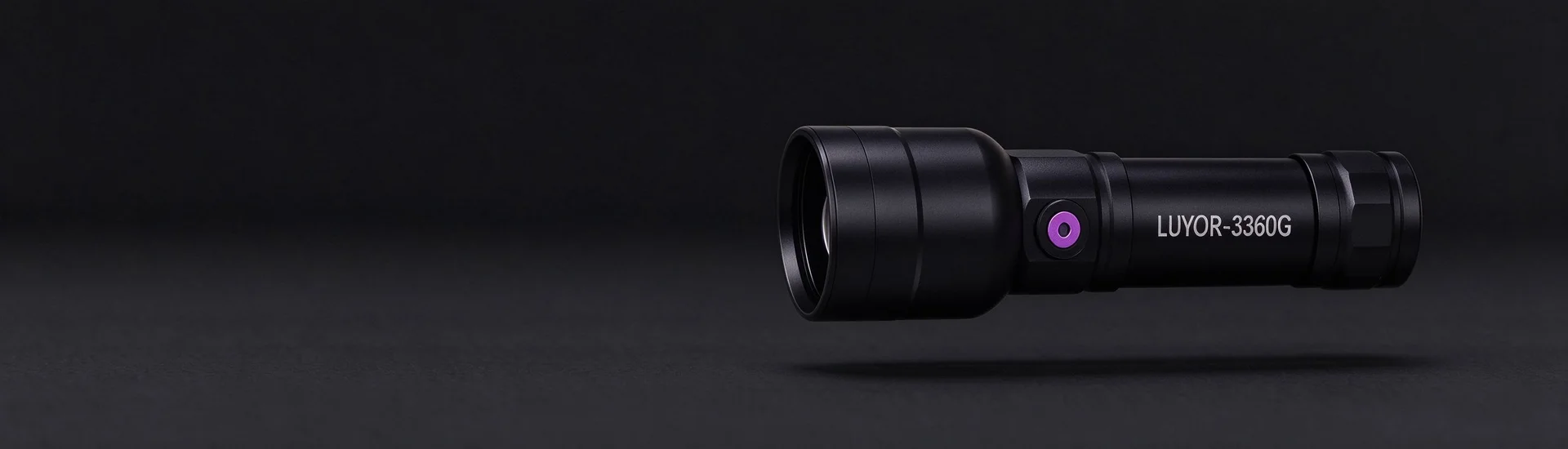
The core differences are the number of wavelengths and the form factor. The LUYOR-3415RG is a dual-wavelength handheld lamp with two excitation bands in one housing (standard: RB Royal Blue 440-460nm plus GR Green 510-540nm), switched by two toggles, so green fluorescent protein (GFP) and red fluorescent protein (DsRed) can be observed in the same session. That is why it is called a dual-fluorescent-protein observation lamp. The LUYOR-3280 is a single-wavelength flashlight with one band per unit, fixed at order. Choosing: if the work uses one fluorescent protein, the 3280 is more economical; if you need two at once (most often GFP plus RFP), the 3415RG replaces two units, with no lamp changes and no second flashlight to carry. In form, the 3280 is a flashlight while the 3415RG is a 180×200mm lamp body with a head, 0.9kg net, usable handheld or on a stand.
The standard LUYOR-3415RG carries only the RB-Royal Blue and GR-Green excitation assemblies. RB excites at 440-460nm with a 500nm filter, for GFP, eGFP, fluorescein and other green fluorescence; GR excites at 510-540nm with a 600nm filter, for DsRed, tdTomato, mCherry and other red fluorescent proteins. In other words, the standard unit covers the two most common classes, green and red. For other colors (CFP, BFP, YFP, DAPI), choose another source combination; see the selection table.
Any two of the five sources can be assembled into a dedicated LUYOR-3415RG/3415GR dual-fluorescent-protein source. The codes map as follows: R excites 440nm, emits 500nm, for GFP and fluorescein; C excites 510nm, emits 550nm, for YFP, Venus and Lucifer Yellow; G excites 540nm, emits 600nm, for DsRed and TdTomato; V excites 400nm, emits 460nm, for CFP and BFP; U excites 360nm, emits 415nm, for DAPI. On the physical side, any two of 365nm, 400nm, 450nm, 485nm and 520nm can be selected. GFP plus CFP means R plus V; DAPI plus GFP means U plus R. Tell us which fluorescent proteins you need at ordering and we will fix the combination.
High output is one of the design points of the LUYOR-3415RG, and it excites fluorescence without a darkroom. It uses 12 LEDs across two bands (6 x 3W per band) for 27W total, enough to see fluorescence with ambient light present. Actual results still depend on ambient illumination: under ordinary room lighting the fluorescence is usually obvious; in a greenhouse or field under direct midday sun, contrast drops. In that case work in shade, early morning or late afternoon, under a shade screen, or use the light shield supplied for field work. Practical rule: avoid light where you can, and the unit still works where you cannot. That convenience is the main difference from fixed solutions that require a dark room or dark box.
A 180mm spot means that at 15cm the beam covers a circle 18cm across, enough for a whole seedling, a cluster of seeds, a Petri dish or a patch of leaves in one pass. For transgenic screening, where material is checked piece by piece, covering a whole seedling at once matters: you can judge positive or negative without moving the lamp, and batch throughput rises. Hunan Hybrid Rice Research Center reports strong output and a clear view when sorting red-fluorescent rice seeds; Zhejiang A&F University's School of Forestry irradiates plantlets through the culture vessel and judges positives without opening it, leaving the plantlets uncontaminated.
LUV-30A is for GFP and eGFP fluorescence and pairs with the RB Royal Blue source; LUV-50A is for RFP, mCherry, DsRed and tdTomato and pairs with the GR Green source. Both come with the standard LUYOR-3415RG (RB plus GR), matching the two sources. Optional glasses: LUV-20A for CFP and BFP; LUV-40A for YFP; and LUV-30AG, which blocks chlorophyll red fluorescence while viewing GFP, markedly improving contrast where green tissue would otherwise turn the background red.
The stand is an adjustable optional accessory that holds the lamp and frees both hands, mainly for long, high-volume sorting. Seed sorting is the typical case: maize, wheat, rice or Arabidopsis transgenic runs of hundreds to thousands of seeds. Handheld, one hand holds the lamp and one turns the seeds, which is slow and tiring and unrealistic over several hours. With the lamp fixed over a work area, both hands sort. Hunan Hybrid Rice Research Center makes this point in its feedback: long runtime on the rechargeable battery plus the stand frees both hands for large manual sorting workloads. If your volume is small and the work is field or greenhouse inspection, skip the stand; handheld is enough.
Yes, the LUYOR-3415RG supports fluorescence imaging with an optional photo filter. The 67mm LUV series filter mounts directly on a 67mm SLR lens; for other threads, contact us for the matching adapter. A phone photo filter clips onto a phone camera for fluorescence images. Customers report on the value: Nanjing Agricultural University's College of Horticulture notes that adding the LUV-520 plant photography filter raised image quality substantially, up to the standard of high-level SCI journals. General points for imaging: fit a filter matched to the excitation wavelength, lock exposure and white balance manually, turn off the flash, fix the lamp and camera, and lengthen exposure as needed.
50000 hours is the rated service life of the source, that is, the cumulative on-time before output has degraded to a defined level, not a limit on a single session. At 8 hours a day that is roughly 17 years of use, but the practical point is that long continuous sessions are supported: the documentation states the system is stable for extended use. With the rechargeable battery pack you can run while charging or rotate packs, which suits a full day of batch sorting. Users mention this repeatedly: Hunan Hybrid Rice Research Center notes long runtime on the rechargeable battery, and the Guangdong Academy of Agricultural Sciences Vegetable Research Institute notes that instead of running Western blots on every GFP or RFP line, they now irradiate first and blot only the positives, saving a large amount of work.
The design goal is both lab and field: 0.9kg net, rechargeable battery pack, aluminum case, so greenhouses, growth rooms and field plots are all reachable. A light shield is supplied for field observation. Huazhong Agricultural University took the LUYOR-3415RG into the field to photograph transgenic fluorescent plants and solved the narrow field of view of fluorescence microscopy; Nanjing Agricultural University's College of Horticulture notes that no tissue collection is needed, so living plants are observed without damage. The main outdoor limit is ambient light: contrast drops under direct midday sun, so choose early morning, late afternoon, overcast conditions or shade, and shield the area if needed. The unit charges from AC 100-260V, so check the battery level before heading out.
The advantages come down to speed, living material and portability. Speed: no slide preparation, no searching for a field of view, one pass shows the result; Zhejiang A&F University's School of Forestry reports that work once screened one by one under a microscope is now visible in one pass with the position clear, removing much tedious work. Living material: plants are observed intact, with no tissue collection and no damage, and plantlets can be checked through the culture vessel without contamination. Portability: field, greenhouse and growth room all work, with no microscope bench required. One comparison from Huazhong Agricultural University is worth noting: the unit sees red fluorescence better than the lab fluorescence microscope and solves the narrow field of view. The limit is resolution and magnification: for cell-level detail, high-magnification imaging or quantitative analysis, a microscope is still required. The usual workflow is fast pre-screening with this unit, then microscope confirmation of the targets that matter.
The standard workflow has three steps: a fast sweep of the whole batch with the 180mm spot at 150mm, picking out fluorescent material quickly; local confirmation of suspect items at close range; then downstream work on positives only. The value shows downstream. The Guangdong Academy of Agricultural Sciences Vegetable Research Institute reports that instead of blotting every GFP or RFP line, they now irradiate and blot only the positives, and the images are publication-ready. Southwest University reports that irradiating Arabidopsis seeds carrying red fluorescent protein makes transgenic seeds easy to pick, which simplifies later homozygous selection and saves a lot of time. The point is not only saving observation effort but concentrating downstream resources on material that is genuinely positive.
Published cases cover a wide range: transient GFP expression in tobacco leaves and roots, GFP in transgenic soybean roots and hairy roots, GFP in poplar plantlets and callus, RFP in cucumber tissue, green fluorescence in Arabidopsis seedling roots and sorting of Arabidopsis seeds carrying red fluorescent protein, sorting of red-fluorescent rice seeds, maize and wheat seed screening, sorting of GFP-positive zebrafish, DsRed expression in zebrafish and mosquitoes, YFP expression in C. elegans, GFP expression in mice, observation of GFP-transfected colonies, and rapid on-plate identification of recombinant and gene-deletion strains of Mycobacterium tuberculosis. It also verifies staining, for example Alexa Fluor 488 Phalloidin labeling. Methodological cases exist too: when punching the mouse nucleus accumbens for biochemical analysis, researchers found the correct punch site quickly by observing co-transfected fluorescence; others used the source with barrier glasses to dissect the GFP-marked dorsal striatum from mouse brain, likening the search to picking one specific flake from a bowl of oatmeal.
Since 2019, nearly 200 papers have been published using the LUYOR-3415RG/3415GR excitation source, in journals including Nature Plants, The Plant Cell, Plant Science and Microbial Cell Factories. Examples: China Agricultural University in Nature Plants 6, 466-472 (2020) on a DMP-triggered in vivo maternal haploid induction system in the dicotyledonous Arabidopsis; China Agricultural University in The Plant Cell (2020) on CK1 regulation of plant cytorhabdovirus infections; the Institute of Botany, Chinese Academy of Sciences, in Plant Science 296 (2020) 110469 on CELI endonuclease; Zhejiang A&F University in Notulae Botanicae Horti Agrobotanici Cluj-Napoca 48(2); Shanxi Agricultural University in Microbial Cell Factories 19, 112 (2020) on the Cry1Ia signal peptide. A Yunnan Agricultural University team also used the source in a new tobacco VIGS method in Frontiers in Plant Science (2024) to track GFP movement from root to stem and leaf. The product appears as a routine experimental tool in published papers, so citing it in Methods is straightforward.
Price depends on configuration: the 3415RG/3415GR series accepts any two-wavelength combination, and the source pair plus stand and photo filter affect the quote, so ask us for a configuration quote. The lamp body carries a three-year warranty excluding damage from misuse, the manufacturer's stated term; procurement notices from Yangzhou University and other institutions also list warranty and service terms. Xinysun Instruments (Shanghai) ships from Shanghai and provides selection advice, documentation and technical support, including the LUYOR-3415RG excitation source quick operating guide and the FAQ document. Volume purchases (multiple research groups, seed-company screening lines) can be quoted at better rates. For reference, comparable imported single-wavelength units (NIGHTSEA Xite) retail at roughly CNY 6,000 per set; the dual-wavelength 3415RG sits above that.
LUYOR-3415RG product literature and official specifications
LUYOR-3415RG excitation source quick operating guide
LUYOR-3415RG excitation source FAQ
Source code to fluorescent protein selection table (R / C / G / V / U)
LUV series viewing glasses and photo filter quick reference
LUYOR-3415RG/3415GR citation list (nearly 200 papers)
Light source configuration advice by fluorescent protein combination
Viewing glasses and photo filter matching
Stand and accessory selection
Troubleshooting guidance when fluorescence looks weak
Citation information and operating guides on request
Volume and project pricing, lead time confirmation
Send inquiry

Email: info@xinysun.com

Tel: 131-2093-6518

Address: 1525 Minqiang Road, Bldg 26, Songjiang, Shanghai

Copyright 2026 Xinysun Instrument (Shanghai) Co., Ltd. All rights reserved.
ICP:ICP-2026046447




 Breadcrumb:
 Products
 Applications
 Previous:
 Back to list

 Industrial Test Instruments


