Applications
 Updated:2026-11-20
 Views:
A 2026 Nature Communications study on soybean RIN2 wrote a portable fluorescent lamp into its hairy-root and callus screening workflow. This article follows that protocol: how GFP-positive roots were selected after Agrobacterium rhizogenes K599 infection, how the RICE callus system was used to compare RIN2 promoter haplotypes, and where molecular confirmation takes over. It also maps the published LUYOR-3415 lamp to the current LUYOR-3415RG dual-wavelength configuration, with practical notes on band choice, weak-positive calls and documentation for reproducible lab work.
Turning a wild-soybean allele into a usable breeding trait starts with controlled functional validation. The 2026 Nature Communications paper "Identification and deployment of a wild soybean FD allele for high-density planting and increased yield" (DOI: 10.1038/s41467-026-79322-x) does exactly that: it maps RIN2 on chromosome 4, tests the wild RIN2ZYD06 allele against the cultivated RIN2SN14 allele, and follows the trait through field density trials. In the middle of that chain sits a practical step that is easy to overlook: selecting GFP-positive hairy roots and callus with a handheld excitation lamp.
Using chromosome segment-substitution lines derived from cultivated soybean SN14 and wild soybean ZYD06, the team identified the dwarf line CSSL71 with shorter internodes and the same node number. Map-based cloning narrowed the locus to RIN2, which encodes the bZIP transcription factor FDc1. The wild allele RIN2ZYD06 suppresses internode elongation more strongly than RIN2SN14. Promoter haplotype analysis across 1,781 accessions showed that H1 (RIN2ZYD06) and H2 drive higher expression than H3-H5, with an A-to-T substitution at position -325 linked to the difference.
Mechanistically, RIN2 binds ACGT cis-elements in the STF1 and STF2 promoters and activates their expression, promoting gibberellin catabolism in the shoot apex and shortening internodes. Dt1 physically interacts with RIN2 and attenuates this transcriptional activation, placing STF1/2 downstream of the Dt1-RIN2 complex. In field trials, lines carrying RIN2ZYD06 kept per-plant yield stable under high density, with plot yields 30-40% higher at intermediate density and 40-50% higher at the high density tested. The favorable haplotypes were frequent in wild accessions, dropped to 1.2% in landraces and were absent from cultivars, suggesting they were lost during domestication.
The lamp is named in two method sections. In the RICE (root-induced callus expression) system, the paper states:
After hairy root induction, the positive hairy roots were screened based on GFP fluorescence using a portable fluorescent lamp (LUYOR-3415, LUYOR), and were transferred to callus induction medium...
In the separate hairy-root transformation experiment, it states:
Transgenic hairy roots were screened based on GFP fluorescence using a portable fluorescent lamp (LUYOR-3415, LUYOR). Positive hairy roots were collected for qRT-PCR analysis.
In practical terms, the lamp is used after hairy-root induction and before callus culture or molecular assays. It does not change the experimental design, but it decides which material enters the next stage: roots without the marker are removed early, so qRT-PCR and Western blot run on candidate samples rather than on every induced root.
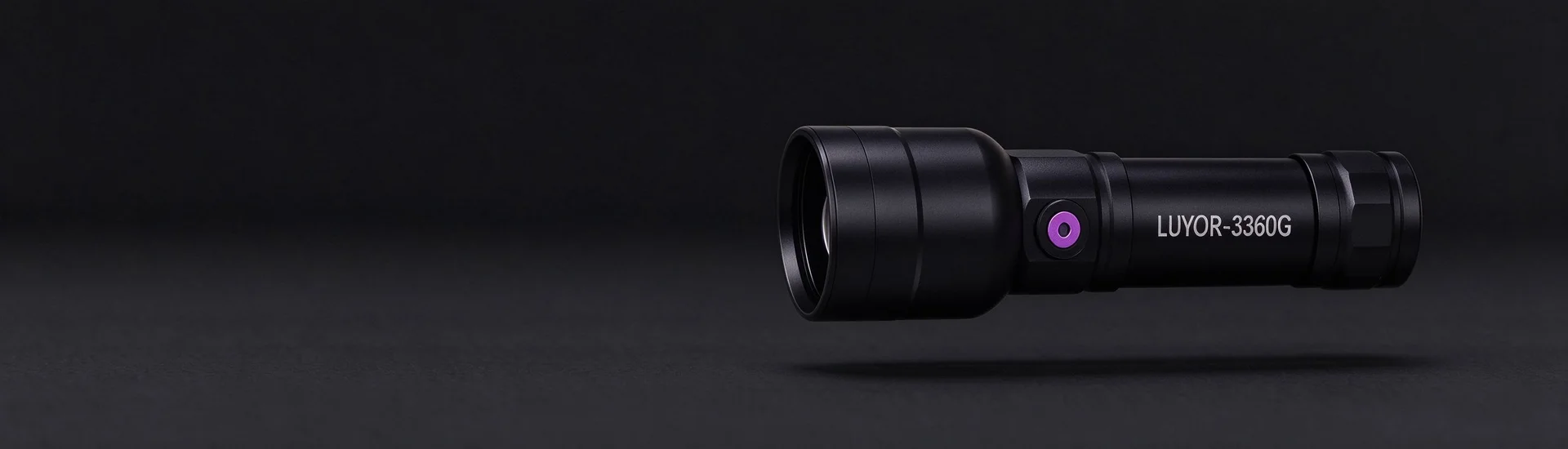
A note on naming: the paper writes LUYOR-3415 and does not add an RG suffix. The current dual-wavelength configuration is the LUYOR-3415RG fluorescence protein excitation lamp, with RB 440-460 nm for GFP and GR 510-540 nm for DsRed-type red proteins. This study scored GFP, so the RB band is the relevant one.
The published workflow breaks down into six steps:
RIN2H1-RIN2H5 promoter-driven RIN2-3xFLAG and 35S-driven GFP were placed in one vector, with GFP serving as an internal control. The construct was introduced into Agrobacterium rhizogenes K599.
Sterilized soybean seeds were germinated for 7 days. Expanded cotyledons were wounded with a scalpel, inoculated with K599 suspension, kept at 28 C in the dark for 3 days, then moved to 25 C under light for 14 days.
Induced roots were illuminated directly with the portable lamp and observed in the RB band for green fluorescence. Fluorescent roots were kept as positive candidates; non-fluorescent roots were discarded. No sectioning or destructive sampling was needed.
Primary positives were transferred to callus induction medium containing 2,4-D and 6-BA, cultured for 14 days and subcultured until callus formed, ready for promoter-activity comparison.
Transgenic callus was analysed by qRT-PCR and Western blot for RIN2-3xFLAG transcript and protein levels, with GFP as the internal control. This step supports the conclusion about promoter haplotype activity.
Three-day-old seedlings were inoculated at the hypocotyl wound site, kept at high humidity in the dark for 4 days, then transferred to vermiculite at 25 C under a 16 h / 8 h light regime. Emerging hairy roots were screened by GFP fluorescence and positive roots were collected for qRT-PCR.
Transgenic screening balances accuracy against throughput. Molecular assays are reliable but slow and costly per sample; visual screening is fast but needs live, intact material. A handheld excitation lamp sits between them: it does not replace PCR, but it reduces the number of samples that reach PCR.
| Item | LUYOR-3415RG configuration | Value for hairy-root and callus screening |
|---|---|---|
| Excitation bands | RB 440-460 nm and GR 510-540 nm | Use RB for GFP as in this study; switch to GR for DsRed, tdTomato or mCherry |
| LED and power | 12 x 3 W LEDs; about 15 W per band, about 27 W total | Signals remain visible through a plate lid or culture vessel |
| Irradiation area | About 180 mm diameter at 150 mm distance | A dish of roots or several vessels can be scanned together |
| Power supply | Built-in rechargeable lithium battery, constant-current output | Usable in growth chambers, greenhouses and temporary benches |
| Size and weight | About 0.9 kg; about 180 x 200 mm, 120 mm head | Handheld operation; an optional stand helps during long sessions |
| Filtering | Band-matched filter goggles | Removes excitation background and improves green-signal contrast |
The authors describe selection "based on GFP fluorescence", which is an in situ, non-destructive read. That matters here: the screened roots continue into callus induction medium, so they cannot be cut up or left under bright ambient light during selection.
GFP uses RB; red fluorescent proteins use GR. Add a stand for high daily throughput and a camera adapter when publishable images are needed. Bands are fixed at the factory, so list every fluorophore in the project before ordering.
Room lighting is usually acceptable. When overhead light is strong, close a shading cloth or switch it off and the contrast improves immediately.
Plate lids and culture bottles attenuate both excitation and emitted light. Shorten the distance and wear matched filter goggles to avoid calling a weak positive negative.
Low-expression roots may show faint fluorescence. Hold them in a separate group and run qRT-PCR rather than discarding them on sight.
The paper still ran qRT-PCR on selected roots and Western blot on callus. Log the excitation band, distance and number of positive roots separately from the molecular results so the workflow can be reproduced.
LUYOR-3415 is the series name used in the methods. The current dual-wavelength configuration, LUYOR-3415RG, provides RB 440-460 nm and GR 510-540 nm. For work with GFP alone the RB band is sufficient; choose the dual-band configuration when red fluorescent proteins are also in use.
The dual-expression vector in the RICE system carries 35S-driven GFP as an internal control. GFP marks tissues that were successfully transformed, so the RIN2 promoter haplotypes can then be compared at transcript and protein level.
No. Selected hairy roots in the paper were still collected for qRT-PCR, and callus was analysed by Western blot. Primary screening reduces the number of samples entering molecular assays; it does not replace them.
RICE stands for root-induced callus expression. Hairy roots are induced initially, then positive roots move onto callus induction medium. This let the team compare RIN2-3xFLAG expression under RIN2H1-H5 promoters without waiting for stable whole-plant transformation.
Chlorophyll autofluorescence raises the background. Hairy roots and callus cause less interference; for green leaves, lower ambient light and use band-matched filter goggles, then confirm ambiguous signals by microscopy.
LUYOR-3415RG dual-wavelength fluorescence protein excitation lamp: full specifications, band combinations and accessories for in vivo primary screening of GFP and red fluorescent proteins.
The useful lesson from this study is the clear division of labour: screen material initially, then confirm it molecularly. For hairy roots, callus, seeds and seedlings, a handheld excitation lamp filters out the large negative population early; qRT-PCR, Western blot and microscopy then verify the candidates.
For a GFP hairy-root project, match the excitation band to the fluorophore, add a stand or camera adapter according to daily throughput, and keep primary screening records separate from molecular confirmation. Contact Xinysun Instruments (Shanghai) for band-combination advice or hands-on selection guidance.

Email: info@xinysun.com

Tel: +86-131-2093-6518

Address: 1525 Minqiang Road, Bldg 26, Songjiang, Shanghai

Copyright 2026 Xinysun Instrument (Shanghai) Co., Ltd. All rights reserved.
ICP:ICP-2026046447




 Industrial Test Instruments


