
Applications
 Breadcrumb: Home > Applications > Lab Research
 Updated:2026-11-02
 Views:
Rice self-pollinates, its natural outcrossing rate is very low, and hybrid breeding has long depended on manual emasculation, so scale-up stalls at seed production. A team at the Hunan Hybrid Rice Research Center put fertility control and visual sorting into one vehicle, so that seed can be split into sterile and fertile before sowing on the strength of fluorescence alone. The device that performs the sorting is the LUYOR-3415RG dual-wavelength fluorescent protein excitation source. This article follows the published paper through the DMS-TD system - the p5126 promoter driving TDR, the endosperm-expressed DsRed2 marker, the 1 : 1 seed segregation and the 32.63 ± 7.51% natural outcrossing rate - then gives the four-step field procedure.
Rice is a typical self-pollinating crop with a very low natural outcrossing rate, and hybrid breeding has long depended on manual emasculation: the labor is heavy, incomplete emasculation produces false hybrids, and scale-up therefore stalls at the seed production stage. The answer from the team at the Hunan Hybrid Rice Research Center was to put fertility control and visual sorting into one vehicle, so that seed can be divided into sterile and fertile before sowing on the strength of fluorescence alone - and the device that performs the sorting step is the LUYOR-3415RG dual-wavelength fluorescent protein excitation source. This article follows the published paper through the workflow and sets out the field procedure in a form that can be reproduced.
The work was published in aBIOTECH under the title "DMS-TD: A powerful genetic tool for outcross breeding in rice". The system has two modules: an anther-specific promoter, p5126, drives ectopic expression of the tapetum development regulator TDR, so that plants show complete and stable dominant male sterility across genetic backgrounds; and an endosperm-specific red fluorescent protein, DsRed2, acts as a marker tightly linked to the sterility trait.
Sterile plants need no emasculation - they set seed from foreign pollen carried by wind or gravity;
In the outcrossed progeny, red-fluorescent and non-fluorescent seed segregate at about 1 : 1; the fluorescent seed all develop into male-sterile plants, and the non-fluorescent seed are fertile plants free of the transgenic construct;
The natural outcrossing rate in the field is about 32.63 ± 7.51%, and the hybrid seed produced has an intact glume, better resistance to mildew and higher vigour;
The system has been used to create near-isogenic lines by backcrossing, to build multi-parent genetic populations and for large-scale recurrent selection breeding.
For the breeding workflow, the real bottleneck sits before sowing: only once the two seed classes are separated can the sterile line enter large-scale seed production as a pollen recipient. The accuracy and throughput of this sorting step decide whether the system can leave the trial plot.
| Item | Figure in the paper | What it means for sorting |
|---|---|---|
| Fertility control | p5126 promoter driving ectopic TDR expression | Sterility is stable and does not depend on genetic background |
| Fluorescent marker | Endosperm-specific DsRed2 | Readable at the seed stage, with no need to grow the plant on |
| Segregation ratio | Fluorescent seed : non-fluorescent seed ≈ 1 : 1 | Sorting results feed straight into segregation counts and line verification |
| Natural outcrossing rate | 32.63 ± 7.51% | Seed set stays reliable without manual emasculation |
| Seed quality | Intact glume, better mildew resistance, higher vigour | Sorting is non-destructive and does not affect subsequent sowing |
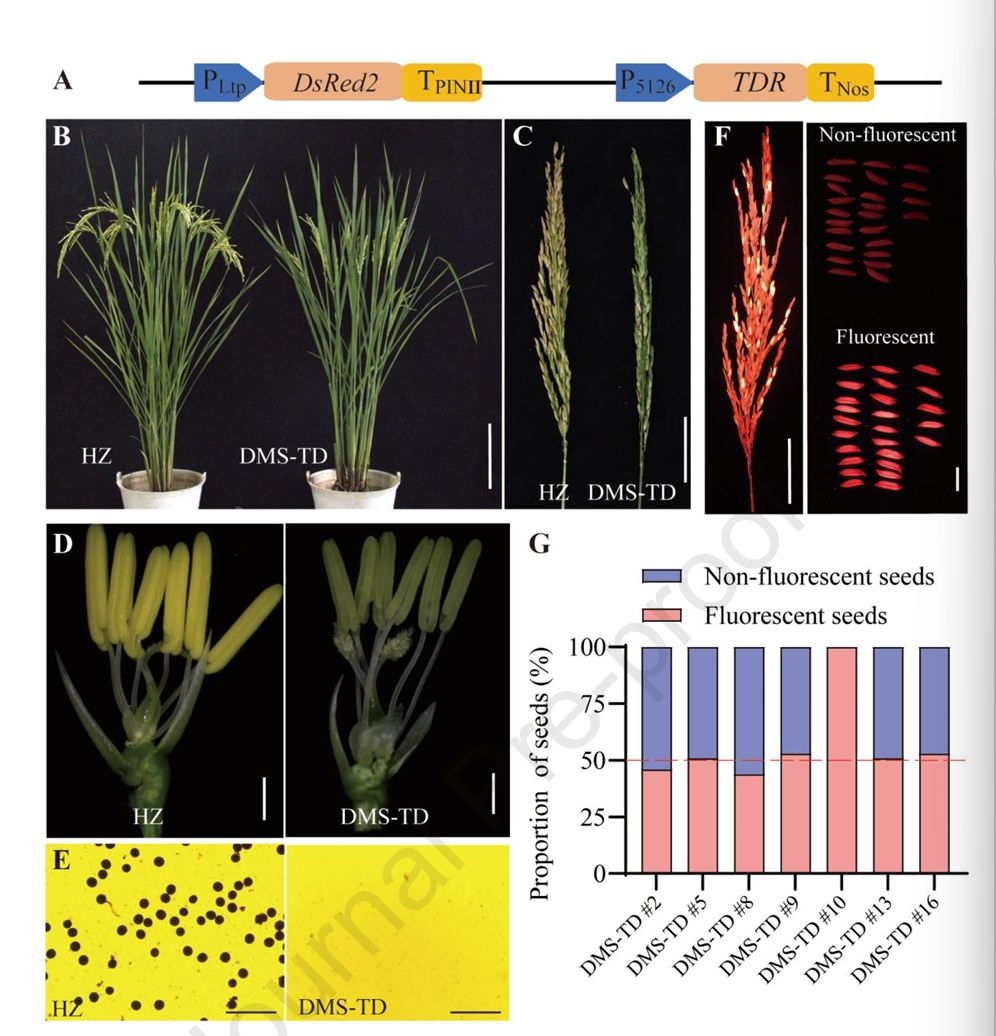
Figure: results of the DMS-TD rice smart sterile system
A: schematic of DMS-TD construct assembly;
B: plant phenotype of wild-type HZ and DMS-TD;
C: panicle phenotype;
D: comparison of anther morphology;
E: pollen viability by iodine staining;
F: DsRed fluorescence in seed (fluorescent versus non-fluorescent seed);
G: segregation ratios of fluorescent and non-fluorescent seed across lines.
A red fluorescent protein such as DsRed2 emits visible fluorescence only under excitation at the right wavelength; under daylight the difference cannot be seen by eye. Breeding work adds two hard constraints: samples run to thousands of seeds, so nothing can be mounted slide by slide, and the seed goes straight to sowing after sorting, so it cannot be stained or have its embryo damaged. That leaves few workable options.
| Approach | Throughput | Effect on the sample | Where it fits |
|---|---|---|---|
| Fluorescence microscope | Low, limited by the number of sample stages | Requires mounting, so the material is not fit for direct sowing | Detailed imaging of a few samples |
| Single-wavelength handheld lamp | Medium | Non-destructive | Projects that run one fluorescent marker only |
| LUYOR-3415RG dual-wavelength | High, whole trays can be irradiated in one pass | Non-destructive; seed can be sown directly afterwards | GFP and DsRed material side by side, large-scale primary screening |
What the paper did at the large-scale hybrid seed screening step was exactly this: irradiate the seed population directly with a portable excitation source and sort by eye, scoring red-fluorescent seed as transgenic male-sterile and non-fluorescent seed as fertile seed without the construct.
DsRed, tdTomato and mCherry are red fluorescent proteins and correspond to the GR band (510 - 540 nm); if the same batch also carries a GFP marker, switch to the RB band (440 - 460 nm). Two switches on the body control the two bands, so no equipment change is needed part way through.
LUV-30A and LUV-50A viewing glasses are supplied; their job is to filter out the excitation light and lift the fluorescent signal (the paper's methods record it as the LUV-50A filter, the same naming we use). The device itself needs no darkroom, but seed is a weak-signal sample, so pairing it with the supplied light-blocking cloth to cut ambient light makes reading distinctly steadier.
Spread the seed in a thin layer so that grains do not stack and shade each other. At about 150 mm from the sample the illuminated diameter is about 180 mm, and the lamp height can be adjusted to the batch: raise it for a larger field when the batch is big, lower it for more brightness when the signal is weak.
Seed with a weak fluorescent signal can be soaked in water or dehulled before viewing, which raises legibility noticeably. After sorting, count fluorescent and non-fluorescent seed separately and work out the segregation ratio, for line verification and for planning the next sowing.
| Item | Specification |
|---|---|
| Excitation bands | RB 440 - 460 nm for GFP; GR 510 - 540 nm for DsRed / mCherry |
| Configuration | Any two of five source types - R, C, G, V and U - combined |
| Illuminated area | About 180 mm diameter at 150 mm from the lamp |
| Unit | Net weight 0.9 kg, total power 27 W, powered by a rechargeable battery pack |
| Source life | LED, about 50000 hours |
| Standard items | Main unit, LUV-30A viewing glasses, LUV-50A viewing glasses, charger, manual, warranty card, aluminium carry case |
| Options | Adjustable stand, LUV series photographic filter (67 mm, mounts directly on an SLR), phone camera filter, light-blocking cloth |
| Operating conditions | No darkroom needed; screening can be done in the laboratory or the greenhouse |
If a project uses one marker for the long term, a single-wavelength model is enough; but as soon as GFP and DsRed lines coexist in the collection, two wavelengths saves buying two lamps or swapping equipment every time. Transgenic and gene-editing projects usually run both, which is why this model appears in a good deal of published work.
Not compulsory, but strongly advised. Excitation light is far more intense than the fluorescent signal, and without filtering it a weak signal is easily swamped - especially on a sample like rice seed, where the glume contributes a fairly high autofluorescence background.
Yes - the device is specified to work without one. The stronger the ambient light, however, the harder it is to read weakly fluorescent seed. When sorting temporarily in a greenhouse or in the field, use the supplied light-blocking cloth or work in shade, and consistency improves markedly.
This is non-destructive observation, and sorted material can be sown directly; that is the main advantage over mounting and staining. It is still sensible to avoid holding one batch close to the lamp for a long unbroken period - work through it in batches.
Seedlings, hairy roots, callus and plants in tissue-culture vessels can all be viewed under direct irradiation, and the handheld design suits in-situ screening in the greenhouse and the field without the size limits of a sample stage.
It is the same accessory. The methods section follows English usage and calls it a filter; the product page and the packing list call it the LUV-50A viewing glasses. When ordering and checking the delivery, go by the packing-list name.
LUYOR-3415RG dual-wavelength fluorescent protein excitation source: the subject of this article, RB / GR bands selectable, net weight 0.9 kg;
GFP fluorescence torch: the full range of fluorescent protein excitation sources, selected by wavelength and illuminated area;
LUYOR-3421 bench fluorescent protein excitation source: fits a stereo microscope and is used alongside a handheld lamp for fine imaging;
LUYOR-3124RB large-area hanging excitation source: batch screening of whole trays of seedlings and plant trays;
LUYOR-3280 fluorescent protein observation torch: single-wavelength rapid screening for GFP transgenics;
LUYOR-3260RB fluorescent protein excitation source: handheld GFP observation, suited to projects that work mainly in green fluorescence;
High-throughput primary screening of GFP / RFP transgenics in vivo: a comparable approach for tissue-culture vessels and in-field observation;
LUYOR-3415RG excitation source application cases: more scenarios for fluorescence viewing of plant material;
Life science instruments: an overview of laboratory UV and fluorescence equipment.
The whole article in one sentence: fertility is handled by TDR, seed identity is handled by the DsRed2 fluorescent marker, and how efficiently that marker can be read depends on whether the excitation wavelength is right and the illumination even enough. What the LUYOR-3415RG contributes to this workflow is not imaging in place of a microscope, but turning pre-sowing sorting from slide-by-slide work into batch visual screening. If you want to check the wavelength configuration, working distance and accessory list against your own material, or assess whether an existing sorting workflow can be speeded up, please contact us.
Reference: Dong H, Pan Y, Zhou T, et al. DMS-TD: A powerful genetic tool for outcross breeding in rice [J]. aBIOTECH, 2026. DOI:10.1016/j.abiote.2026.100099 (smart sterility technology team, Hunan Hybrid Rice Research Center; related patent CN118703523A)
This article belongs to the laboratory research techniques category.
Other categories on the same product line are GFP fluorescence torches (models split by GFP / RFP / DsRed band, handheld and bench types both available), semiconductor particle inspection (grazing illumination to locate, fluorescence to identify organics, counting for concentration - three complementary methods) and life science instruments (the single entry point for fluorescence imaging, UV crosslinking, UV transmission and cell irradiation).
Models mentioned: LUYOR-3415RG, LUYOR-3421, LUYOR-3124RB. Range, accuracy and accessory lists for each model are given on the product pages.

Email: info@xinysun.com

Tel: 131-2093-6518

Address: 1525 Minqiang Road, Bldg 26, Songjiang, Shanghai

Copyright 2026 Xinysun Instrument (Shanghai) Co., Ltd. All rights reserved.
ICP:ICP-2026046447




 Industrial Test Instruments


