Applications
 Breadcrumb: Home > Applications > Fluorescent Leak Testing
 Updated:2026-11-02
 Views:
Inspection technicians and maintenance crews meet the same problem: the toolbox holds a few bottles of reagent, two flashlights and one pair of scratched goggles, and when the job finally comes up the kit will not come together - the lamp is flat, the cleaner is missing, and nobody remembers how much additive went in last time. This article explains why industrial sites are better served by a complete kit, which water systems the 6802 suits, and it gives the full workflow from opening the case and dosing through scanning to reinspection.
Equipment inspection technicians and maintenance crews all run into the same problem: the toolbox holds a few bottles of reagent, two flashlights and one pair of scratched goggles, and when the job comes up the kit will not come together - the lamp is flat, the cleaner cannot be found, and nobody remembers how much additive went in last time. Fluorescent leak detection should be simple, yet it often burns half an hour before anyone leaves the workshop.
A complete kit such as the LUYOR-6802 is aimed at exactly that stretch of the job: it packs everything one water-based leak survey needs into a single case - a 365 nm LED leak detection lamp, 240 ml of LUYOR-6200 water-based leak detection additive, UV protective goggles, a carrying case and dosing labels. Open the case and work starts; when the job ends everything goes back where it came from. This article follows real industrial usage to set out which systems the kit suits, how one complete job runs, and why "ready to check" affects downstream maintenance cost more than "checked more precisely".
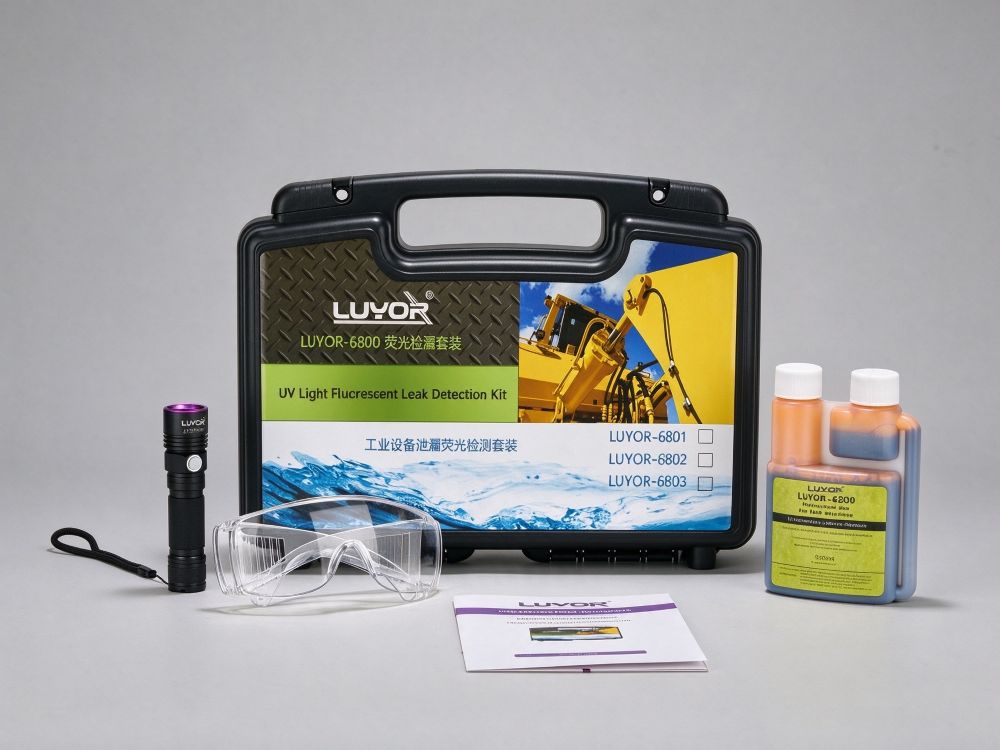
The technical threshold of fluorescent leak detection is not high: dose, circulate, illuminate, locate - four steps anyone can remember. What actually decides whether it gets done is continuity of preparation. The difference between the two approaches is easy to see:
| Stage | Piecemeal purchasing | Complete kit |
|---|---|---|
| Preparation before departure | Check the lamp charge, hunt for the additive, confirm the additive type matches the medium | Lift one case and go; accessories are fixed in place and nothing is left behind |
| Model matching | Easy to buy an oil-based additive and put it into a water circuit, where it fails | The additive in the case is already matched to the duty, so mixing is avoided |
| Eye protection | Often overlooked; long exposure carries a UV exposure risk | LUV-10 protective goggles come in the case |
| Job records | Dose and date depend on memory and do not match at review | Five hanging dosing labels; writing one and hanging it on the equipment completes the record |
| Handover and storage | Accessories scatter and cannot be found after a shift change | The case holds everything and the handover list is clear |
That difference is magnified without limit on small leaks: the better hidden the leak, the more visits it takes to illuminate the spot again. If the kit has to be assembled from scratch every time, many people stop bothering by the third visit - and it is precisely during those visits that the leak gets confirmed.
The kit is supplied with a water-based additive, LUYOR-6200, which fluoresces yellow-green. The rule is simple: the system carries water or a water-based fluid. Common industrial targets include:
Machine tool spindle cooling, inverter water cooling, injection molding machine cooling, welder and laser cooling, compressor coolers and similar circuits. Leaks in these systems usually show up as slow seepage at fittings, condensation on pipe walls that confuses the picture, or damp patches on the floor with no obvious source. After dosing, run the system for ten minutes or so and illuminate along the pipe run and fittings section by section and the glowing points appear.
These include central air conditioning cooling tower loops, process circulating water and cleaning line tanks. Such systems are large and heavily branched, so the difficulty is not technical but a matter of "which section to start from". A practical approach is to work upstream from the damp patch: water runs downhill, so the leak is often not directly above the patch. Illuminate section by section while moving up the pipe run, and the point where fluorescence appears is the actual leak.
Gaskets on plate heat exchangers and the expanded tube joints on shell-and-tube units are frequent sites of slow seepage. These locations are often covered by insulation, so start by observing the insulation seams and weep holes, which are usually where the seepage escapes.
Fill the test item with dosed water, let it stand or hold it under pressure for a period, then illuminate the outer surface. Fluorescence indicates a through-leak path. Compared with watching whether the pressure gauge drops, this method points directly to the leak location rather than merely showing that a leak exists.
The soap solution method requires a clean, accessible surface; on site many pipe runs are high up, obstructed or close to energized equipment. UV illumination needs no contact, can be read from a distance, and does not require the system to be taken apart.
Begin by confirming that the system really carries water or a water-based fluid. If the same machine has both a hydraulic oil circuit and a cooling water circuit, the two must be separated before dosing - an oil circuit needs the oil-based LUYOR-6801 kit or LUYOR-6100 bought separately. A water-based additive dosed into oil separates out; it will not find the leak and may force an oil change.
The starting dilution for LUYOR-6200 is 1000:1 (1 ml of concentrate per liter of water). Where the leak is very small or the water itself is dark, the ratio can be raised to 500:1. The key point is to dilute and mix the concentrate in a small amount of water before pouring it into the system, so that the concentrate does not form locally strong pockets while the rest of the system stays pale.
Systems with a circulation pump need ten minutes or so of running; static systems are filled and left to stand, with gentle agitation if needed. The larger the system, the slower the distribution, and for large circulating water systems running for half an hour or more before reading is advisable. This step cannot be rushed - uneven distribution leads people to conclude wrongly that "this section does not leak".
Dim the workshop lighting and illuminate along the pipe route with the 365 nm LED lamp from the kit, section by section, concentrating on fittings, flanges, valve packing, welds and hose crimps. Wear the supplied LUV-10 protective goggles: they protect the eyes and also make the yellow-green fluorescence clearer in view.
When a leak is found, start by writing the system name and dosing date on one of the hanging dosing labels in the kit and hang it on the equipment panel or valve; then mark the specific leak and assign a priority. After repair, no new dose is needed - the tracer already in the system is still there. Run the system for a while and check the same location again; no fluorescence means the repair is sound.
Taking a purple spot for fluorescence: a UV lamp forms a purple spot on a surface that looks much like a fluorescent point. The test is simple - shift the lamp slightly; the fluorescent point stays where it is, while the purple spot moves with the lamp.
Taking antifreeze or cleaner for a leak: some water systems contain fluorescent antifreeze, corrosion inhibitor or cleaner that glows on its own. When in doubt, draw a cup of the neat water and compare it under the lamp to establish the background before reading.
Taking old residue for a new leak: residue from the previous survey, or additive splashed during maintenance, can remain on the surface. Wipe the location clean with water, let it dry and illuminate again; a location that still glows is an active leak.
In many plants leak detection is an after-the-event activity: the floor gets wet, product gets damp, an equipment alarm goes off, and the search begins after that. By that point downtime losses are usually already on the books. The cost structure of fluorescent leak detection suits the reverse approach -
the additive is dosed in proportion and the quantity is very small, so one dose costs far less than one unplanned shutdown;
the tracer stays in the system for a long period and can be rechecked at any time after maintenance without re-dosing;
the kit lives on site, which turns "should we check?" into "just take a look".
A practical and effective routine is to add the survey to the monthly inspection plan: pick one circuit a month, dose it and inspect it, gradually covering the plant's water systems; record the location, date and treatment of every leak found in the equipment ledger. After a few cycles, which type of fitting, which hose brand and which weld position are the frequent failure points will surface by itself - and that is worth more than any one-off "full sweep".
At 1000:1 it treats roughly 240 liters of test water; raised to 500:1 it treats about 120 liters. A small equipment cooling circuit, a single machine tool or one heat exchanger loop is usually covered by a single dose; for a large circulating water system, a larger pack of concentrate should be ordered to match the actual water volume.
At the recommended concentration it can continue in circulation and, once the survey is finished, handled according to the site's water quality rules. Where the system has strict water quality limits, such as precision equipment cooling water or electronics industry water, a water change after testing is advisable.
The lamp in the kit is a 365 nm LED unit powered by a rechargeable battery. For long storage, top up the charge every few months to avoid over-discharge; confirming the charge before leaving is far cheaper than discovering a flat battery on site.
It is not recommended. Industrial leak detection additives are intended for equipment and industrial water systems; drinking water and food-contact lines should use dedicated products per the relevant regulations, or be flushed thoroughly and have water quality confirmed after testing.
Both are water-based kits; the difference is the fluorescence color: the 6802 uses LUYOR-6200 and glows yellow-green, while the 6803 uses LUYOR-6300 and glows blue. Where a plant has one water system, the 6802 is enough; where several water circuits run in parallel and the leak needs to be assigned to one of them, distinguishing by color saves effort - see the LUYOR-6803 product page.
LUYOR-6802 industrial water-based fluid system fluorescent leak detection kit: full notes on the kit contents, mixing ratios and suitable systems;
LUYOR-6200 water-based fluorescent leak detection additive: the same additive as in the kit, available separately to match system water volume;
LUYOR-6801 oil-soluble fluorescent leak detection kit: the configuration for hydraulic, lubrication, fuel and gearbox oil circuits;
How to find equipment leaks in a paper mill: field practice for hydraulic, lubrication and cooling water circuits on paper machines.
How well industrial leak detection goes rarely depends on how advanced the instrument is; it depends on two things: whether the tools can be produced at any time, and whether each result is written down. The LUYOR-6802 settles the former - lamp, additive, goggles and labels each in their place; the second depends on the site consistently filling in and hanging that dosing label. If your workshop has several water systems that need an inspection sequence, or you need to work out additive volumes from system water volume, send us the equipment list and water quality data and we will help arrange it.
This article belongs to the fluorescent leak detection technology section.
Other sections in the same product line include fluorescent leak detection (add a tracer, find the leak with a UV lamp, locate before dismantling) and industrial test instruments (the entry point for UV inspection, speed measurement, stroboscopic observation and surface inspection).
Models mentioned in this article: LUYOR-6200, LUYOR-6802, LUYOR-6801. Ranges, accuracy and accessory lists for each model are given on the product pages.

Email: info@xinysun.com

Tel: 131-2093-6518

Address: 1525 Minqiang Road, Bldg 26, Songjiang, Shanghai

Copyright 2026 Xinysun Instrument (Shanghai) Co., Ltd. All rights reserved.
ICP:ICP-2026046447




 Industrial Test Instruments


