
Products
PRODUCTS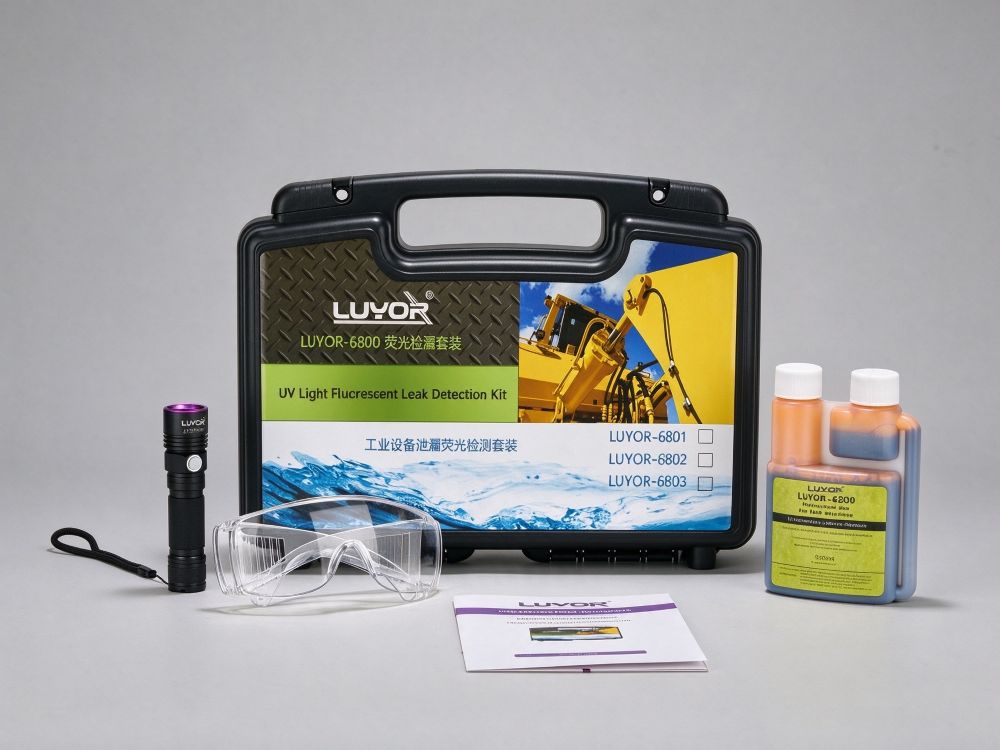
 Overview
LUYOR-6802 is a water leak kit with a UV lamp, yellow-green water-based dye, safety glasses and case; 240 ml of concentrate dilutes from 1000:1.
Leaks in water-based systems differ from oil circuits. Oil leaves a viscous film, while water usually leaves a damp ring that spreads slowly, dries quickly, and stains little. Cooling water lines often run above ceilings, inside pipe shafts, or behind equipment where nothing is visible, and by the time a leak shows, the water has traveled a long way. Tracing it with a paper towel or the back of a dry hand still depends on an experienced technician.
LUYOR-6802 makes the job simpler: add a little water-based fluorescent dye to the water, and wherever the water seeps, the UV lamp shows yellow-green light. It is intended for industrial water and water-based fluid systems, including equipment cooling circuits, circulating water, water-based hydraulic systems, and heat dissipation systems.
| Part | Specification | Function |
|---|---|---|
| 365nm LED fluorescent leak detection lamp | High intensity, rechargeable battery | Excites the fluorescence; leaks glow bright yellow-green |
| LUYOR-6200 water-based dye | 240 ml, yellow-green fluorescence | Mixes with water at any ratio and traces the flow |
| UV safety glasses LUV-10 | Clear lens | Blocks UV so you can observe close up for longer |
| Plastic carry case | Holds the whole kit | Transport to site |
| Documents and labels | Instructions, certificate, warranty card, 5 hangable dosing labels | Record the dosing and recheck dates |
Note that 6802 ships with LUYOR-6200, which emits yellow-green fluorescence. If several water circuits in the same workshop have to be told apart, switch to the blue-fluorescing LUYOR-6803; used together, the two colors are clearly distinct.
| Application | Method | What it solves |
|---|---|---|
| Equipment cooling circuits | Mix at 1000:1 into the cooling water tank, run, then inspect section by section | Finds seeps at radiators, pipe joints, and water jackets |
| Circulating water systems | Add the dye, run the pump, and observe the flanges and valves | Traces the source of damp patches on walls and floors from long-term seepage |
| Heat dissipation and heat exchange systems | Dilute and fill; standing or circulating both work | Quick screening of leaks at tube sheets, gaskets, and welds |
| Seal performance testing | Fill the test piece with treated water and pressurize it or let it stand | Shows whether the test piece has a through leak |
| Hydrostatic testing | Add the dye to the test water | Finds seeps during the pressure hold, with no need to wait for a pressure drop |
Oil circuit testing usually requires the oil to circulate, because oil does not flow on its own. Water is different: fill the system with treated water and let it stand, and gravity and capillary action still carry water out through the leak, so a water system that cannot be run can still be tested. That is useful for equipment waiting for maintenance.
The starting dilution for LUYOR-6200 is 1000:1 (1 ml of concentrate to 1 liter of water). For a very small leak or dark water, raise the concentration to 500:1. Dilute the concentrate in a small amount of water and stir, then pour it into the system, so no local pocket of concentrate forms.
A system with a circulating pump needs about fifteen minutes of running. A static system is filled and left to stand, with gentle agitation if needed. The larger the system, the longer the distribution takes.
Water runs downhill, so the leak is often not directly above the damp patch. Work from the damp area upstream, section by section, along pipes, joints, valves, and flanges. The point where the fluorescence appears is the leak.
Mark the position and repair it by the usual procedure. The tracer stays in the system, so run it again and inspect the same spot to confirm the repair.
No. 6802 contains a water-based dye that is not miscible with oil; added to hydraulic or gear oil it separates and traces nothing. Choose LUYOR-6801 for oil systems, or buy LUYOR-6100 on its own.
At the recommended concentration it can keep circulating. After the test, handle it under the site water management rules. If the system has strict water quality limits, such as ultrapure water in electronics, change the water after the test.
At 1000:1 it makes about 240 liters of test water; at 500:1 it makes about 120 liters. For a large circulating system, order a larger pack of concentrate sized to the actual volume.
Stored sealed and away from light, it can be used again. If it turns cloudy, develops an odor, or changes color noticeably, mix a fresh batch.
Most water systems show no noticeable fluorescence of their own, but antifreeze and some cleaning agents do. In a doubtful case, take a cup of the untreated water and check it under the UV lamp to establish the background before reading the result.
If you need the dose calculated from your system volume, or want to confirm whether water quality affects the reading, send us the system data and we will help assess it.
Send inquiry

Email: info@xinysun.com

Tel: 131-2093-6518

Address: 1525 Minqiang Road, Bldg 26, Songjiang, Shanghai

Copyright 2026 Xinysun Instrument (Shanghai) Co., Ltd. All rights reserved.
ICP:ICP-2026046447




 Breadcrumb:
 Products
 Applications
 Previous:
 Back to list

 Industrial Test Instruments


