Applications
 Breadcrumb: Home > Applications > Semiconductor Cleanroom
 Updated:2026-11-02
 Views:
On wafers, precision parts and cleanroom surfaces the problem is usually not a design flaw but contamination you cannot see: silicone oil, flux, adhesive, residual grease and fiber, where one killer particle can ruin a whole lot. This article explains why 365 nm ultraviolet makes organic residue light up, the four inspection points in semiconductor work, and how the parameters of a portable source map to each task. It then sets out a repeatable inspection flow - dim the room, wear UV goggles, scan at a fixed 38 cm, mark and re-check - and shows how models at the same wavelength divide the work.
On wafers, precision parts and in cleanrooms, trouble in manufacturing is often not a design flaw but contamination you cannot see - silicone oil, flux, organic adhesive, residual grease, fiber and dust. Once these sit on a surface, they may affect the uniformity of coating and etching, and in the worst case cause a chip to fail outright. The industry has a vivid name for it, killer particle: one fatal particle can ruin a whole lot of yield.
The difficulty is that existing inspection methods are awkward at both ends. Under white-light visual inspection, small particles merge into the background and the eye can hardly tell them apart; sending parts to offline scanning equipment gives enough resolution but is costly, slow and out of step with the line. Between the two there has always been a fast, inexpensive route - using 365 nm ultraviolet to make contamination "glow by itself", which is fluorescence cleanliness inspection by eye. This article sets out the principle, the limits and the operating method, and on the equipment side it comes down to a 365 nm portable source such as the LUYOR-365L wide-area fluorescence leak-detection flashlight.
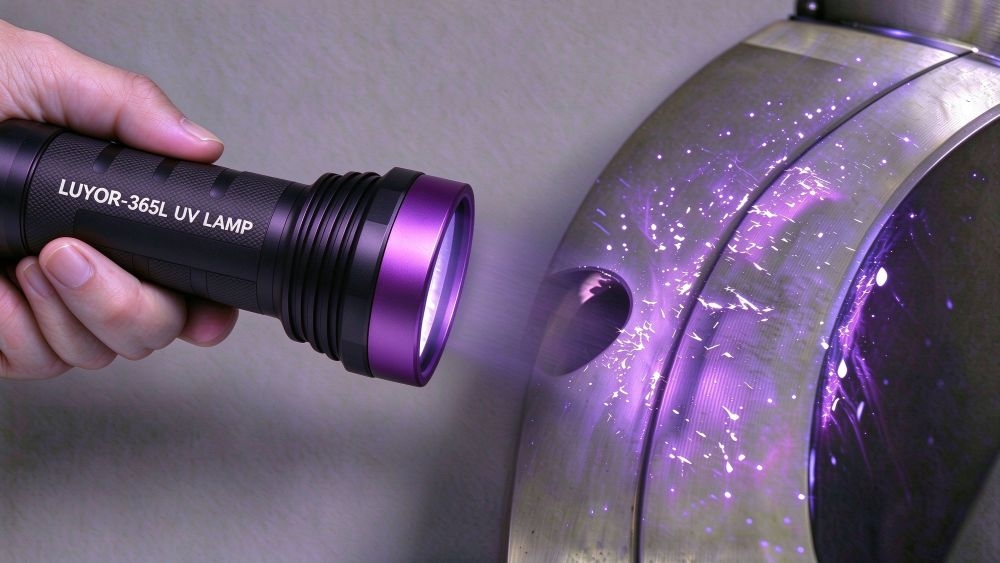
Many of the substances that cause trouble in cleanliness inspection share one property: they contain components that fluoresce under long-wave ultraviolet excitation. Silicone oil, cutting fluid, rust-preventive oil, flux, organic adhesives and fingerprint grease show yellow-green fluorescent patches under 365 nm UVA; many fibers and flakes of skin also glow. Clean areas keep the natural color of the material, and every place with residue lights up at once - position, size and distribution are obvious at a glance.
That gives cleanliness judgment a simple, repeatable visual criterion:
Irradiate before cleaning: a fluorescent patch means organic residue - mark it and rework;
Irradiate after cleaning: no fluorescence means the surface is clean - release it.
This criterion can go straight into the standard work instruction for incoming acceptance and finished-goods delivery, and the check takes about thirty seconds per workpiece, which fits the pace of a production line.
Why 365 nm rather than the common 395 nm UV flashlight? The key is background interference. At 365 nm, at the short end of the UVA band, the light is almost invisible to the eye, so no visible light mixes into the illuminated surface and the contrast of the fluorescence signal stays clean; 395 nm sits close to the edge of visible light, the violet background is obvious, and weak fluorescence is easily washed out. The 365L keeps its band at 360-370 nm with a 365 nm peak, and contains no UVB or UVC, which is friendlier to both the inspected material and the operator.
| Point | What is checked | Action |
|---|---|---|
| Incoming acceptance | Rust-preventive oil and cutting fluid residue on precision parts | Reject or request re-cleaning if fluorescent patches are obvious |
| Between processes | Oil, adhesive marks and fingerprints after machining | Mark before cleaning, verify after cleaning |
| Cleaning validation | Whether organic residue is fully removed from parts leaving the cleaning line | Release if there is no fluorescence; return to cleaning if there is |
| Cleanroom patrol | Contamination and fiber dust on equipment surfaces, fixtures, packaging and transfer containers | Locate the source and trace the path in from gloves, wipes and packaging |
The value of the "cleaning validation" point alone can cover the equipment cost: when the cleaning agent itself contains fluorescent components (some water-based cleaners have this problem), irradiation also reveals cleaner residue - something white-light visual inspection cannot do at all.
| Property | Parameter | What it means for inspection |
|---|---|---|
| Wavelength | 365 nm peak, 360-370 nm band, no UVB/UVC | Dark background, high contrast; weak fluorescence is not masked by visible light |
| Illuminated area | About 200 mm effective area at 38 cm | Covers a large workpiece or a whole tray in one pass, with fewer sweeps |
| Irradiance | About 6500 μW/cm² at the center at 38 cm | Even faint residue excited into recognizable fluorescence |
| Cold light source | LED source, low surface temperature in long runs | No baking and no damage to the inspected surface |
| Ready to use | LED needs no warm-up | Pick it up and measure, matching the rhythm of a patrol |
| Power | 11.2 V replaceable lithium battery pack, about 3-5 hours of continuous work | No cable tether; one spare battery covers a full shift |
| Weight | About 0.36 kg net, about 0.53 kg with battery | Comfortable to hold for long periods and easy to carry in and out of a cleanroom |
Two further notes: large area is an underrated advantage here - cleanliness inspection is about sweeping a whole surface, not finding a single point, and a small-spot flashlight needs many passes across a wafer carrier, with the risk of a missed area rising with each pass; illuminated area and irradiance are measured figures that may differ between batches and measurement conditions, so for selection or internal approval that needs exact numbers, ask us for the official specification sheet.
Prepare the environment: inspect in a shaded or low-light area where possible, draw the blinds or use a non-production period in the cleanroom; the darker the ambient light, the more visible weak fluorescence.
Put on protective goggles: use LUV-10 UV protective goggles - they filter the violet excitation light and pass the fluorescence, which raises contrast noticeably while protecting the eyes. Keep the lenses clean and scratch-free, since a dirty lens swallows weak signals.
Scan at a fixed distance: use about 38 cm as the reference distance, sweep the spot evenly across the surface, and keep the scanning speed steady; a distance that varies will change intensity and is easily misread as "suspected residue here".
Mark and verify: mark the position of any fluorescent patch; after cleaning, irradiate the same area again to confirm it has gone out, and keep the record as a closed loop.
Manage battery charge: confirm the battery is full before setting out - a low battery dims the spot, weak fluorescence becomes hard to see, and the surface is easily misjudged as "already clean". Carry a spare battery for long sessions.
A 365 nm source is not one flashlight for everything; dividing the work by inspection target is more sensible:
| Model | Role | Suited to |
|---|---|---|
| LUYOR-365L | Wide-area high-intensity handheld UV lamp | Parts cleanliness acceptance, wide-area fluorescence leak detection, penetrant scanning |
| MNT-365A | Cleanroom particle inspection flashlight | Routine patrol of surface particles and organic contamination in cleanrooms |
| LUYOR-3103D | Portable magnetic-particle inspection black light | High-intensity spot checks such as particle residue after cleaning semiconductor equipment |
How to combine them: the 365L handles the surface - incoming goods, cleaning validation and delivery acceptance, where a whole area has to be swept and intensity matters; MNT-365A handles the routine - frequent, light patrols of cleanroom benches, fixtures and packaging; where records or traceability are needed, a high-intensity lamp such as the 3103D fills the gap. The cost of the three together is usually less than the loss from a single batch rejection.
Yes, but be clear about what it inspects. Among cleanliness problems on a semiconductor line, organic residue accounts for a high share - oil, silicone oil, flux, adhesive marks, fingerprints, fiber - and these are exactly the blind spot of white-light visual inspection and a serious enemy of coating and bonding processes. The fluorescence method closes that blind spot; purely inorganic particles are then covered by strong white light or a particle inspection lamp, working on both fronts.
The difference is mainly contrast. A 395 nm flashlight carries obvious violet visible light, the background is bright, and weak fluorescence is easily diluted; 365 nm has almost no visible output, so fluorescent patches "jump out" against a dark background. Where the judgment has to be written into an acceptance standard, specify 365 nm directly.
That is the center intensity at 38 cm, on the higher side for handheld UV lamps. Intensity decides whether faint residue can be excited into recognizable fluorescence: with too little intensity, a thin oil film may not show at all. Keep the inspection distance near 38 cm to work at that intensity level.
Not in normal use. 365 nm is long-wave UVA and contains no UVB or UVC; the LED is a cold source with a low working temperature that does not bake the inspected surface. The one thing to watch is not to irradiate photosensitive materials (such as undeveloped photoresist areas) at close range for long periods; handle such workpieces to the process specification.
LUV-10 UV protective goggles meet the need for routine inspection; avoid staring into the source with the naked eye for long periods. The risk from 365 nm UVA is far lower than from short-wave ultraviolet, but wearing goggles to specification both protects the eyes and improves observation contrast.
Yes, and this is a common use of fluorescence cleanliness inspection. The standard should state four elements: the source model and wavelength (365 nm), the inspection distance (38 cm reference), the ambient lighting condition (shaded), and the decision criterion (presence or absence of fluorescent patches). With an objective criterion and a repeatable action, both parties inspect under the same conditions and the result can be arbitrated.
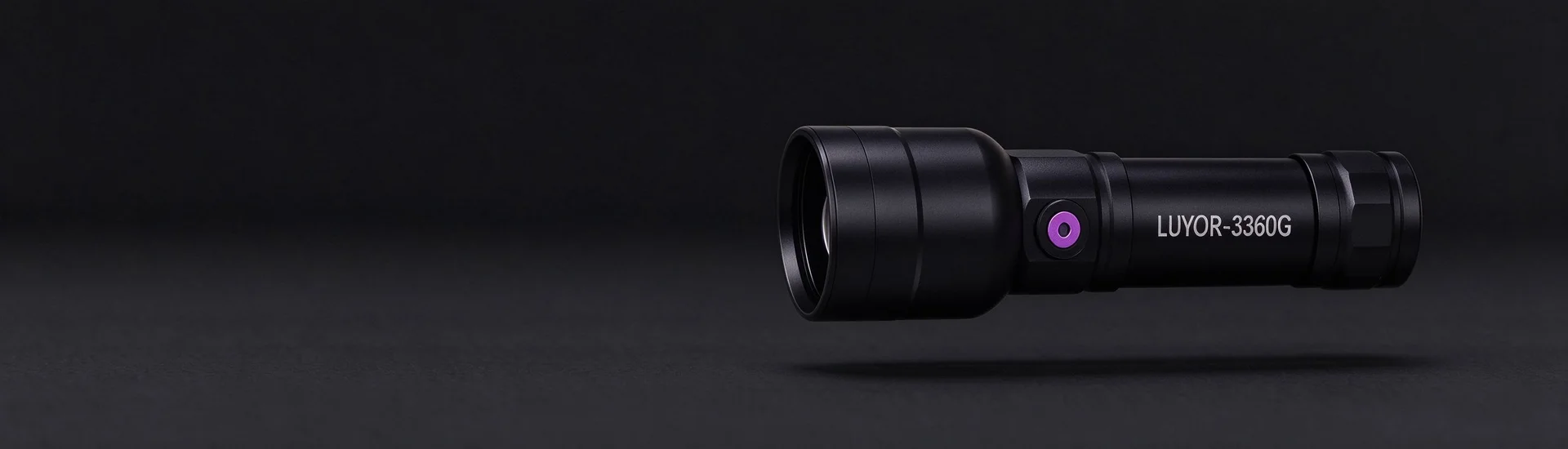
LUYOR-365L wide-area fluorescence leak-detection flashlight: 365 nm, about 200 mm illuminated area at 38 cm, 6500 μW/cm²
365 nm black light section: the full range of UV flashlights, inspection lamps and cleanroom inspection lamps
Cleanroom particle inspection: how to use the UV fluorescence method
The wattage of a UV lamp misleads you: what different inspections need in μW/cm²
This article belongs to the semiconductor cleanroom section.
Other sections on the same product line include UV radiometers (measuring mW/cm² intensity and J/cm² accumulated energy, the basis for judging whether a lamp is compliant), 365 nm black lights (the UV surface source shared by penetrant testing, leak detection and fluorescence inspection, judged by irradiance rather than wattage), and life science instruments (the entry point for fluorescence imaging, UV crosslinking, UV transmission and cell irradiation).
Models mentioned in this article: LUYOR-365L, MNT-365A, LUYOR-3103D. Ranges, accuracy and accessory lists for each model are given on the product pages.

Email: info@xinysun.com

Tel: 131-2093-6518

Address: 1525 Minqiang Road, Bldg 26, Songjiang, Shanghai

Copyright 2026 Xinysun Instrument (Shanghai) Co., Ltd. All rights reserved.
ICP:ICP-2026046447




 Industrial Test Instruments


