
Products
PRODUCTS Breadcrumb: Home > Products > Industrial Test Instruments > UV Flashlights
 Overview
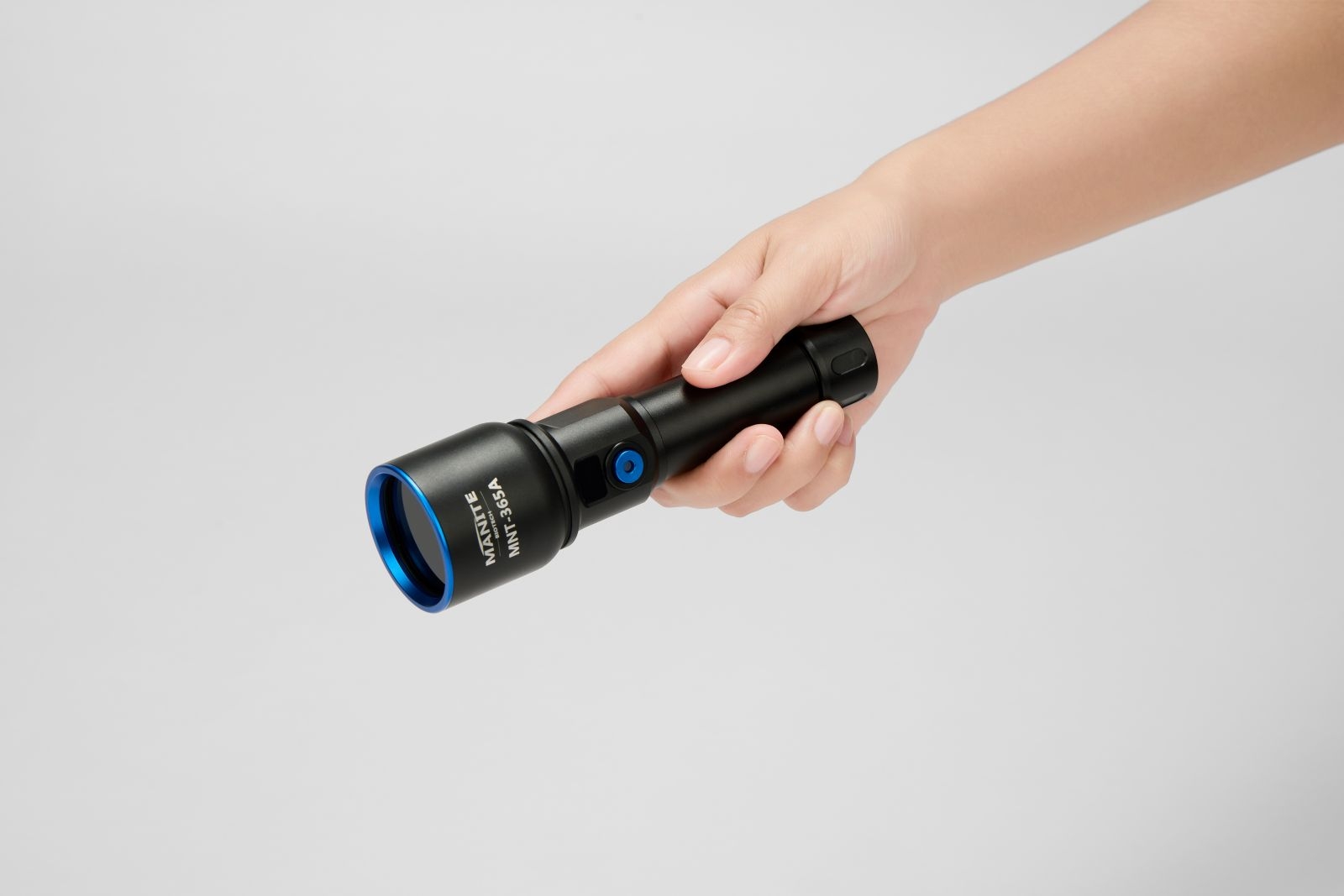
MNT-365A is a 365nm UV-A flashlight designed for cleanroom particle inspection. Four-core LED, 14 mW/cm2 centre irradiance at 38cm, 10cm spot, smooth dust-free aluminium body and 21700 battery.
A cleanroom cannot be inspected reliably with an ordinary UV flashlight. The MNT-365A is a 365nm UV-A flashlight built for cleanroom particle detection: four LED cores deliver 14 mW/cm2 centre irradiance at 38cm over a 10cm spot, so organic particles fluoresce clearly against a dark background. Its smooth, dust-free aluminium barrel, immediate start and digital battery readout make it a practical tool for routine contamination walks. This page covers what it detects, how to use it, and its full factory-rated specifications.
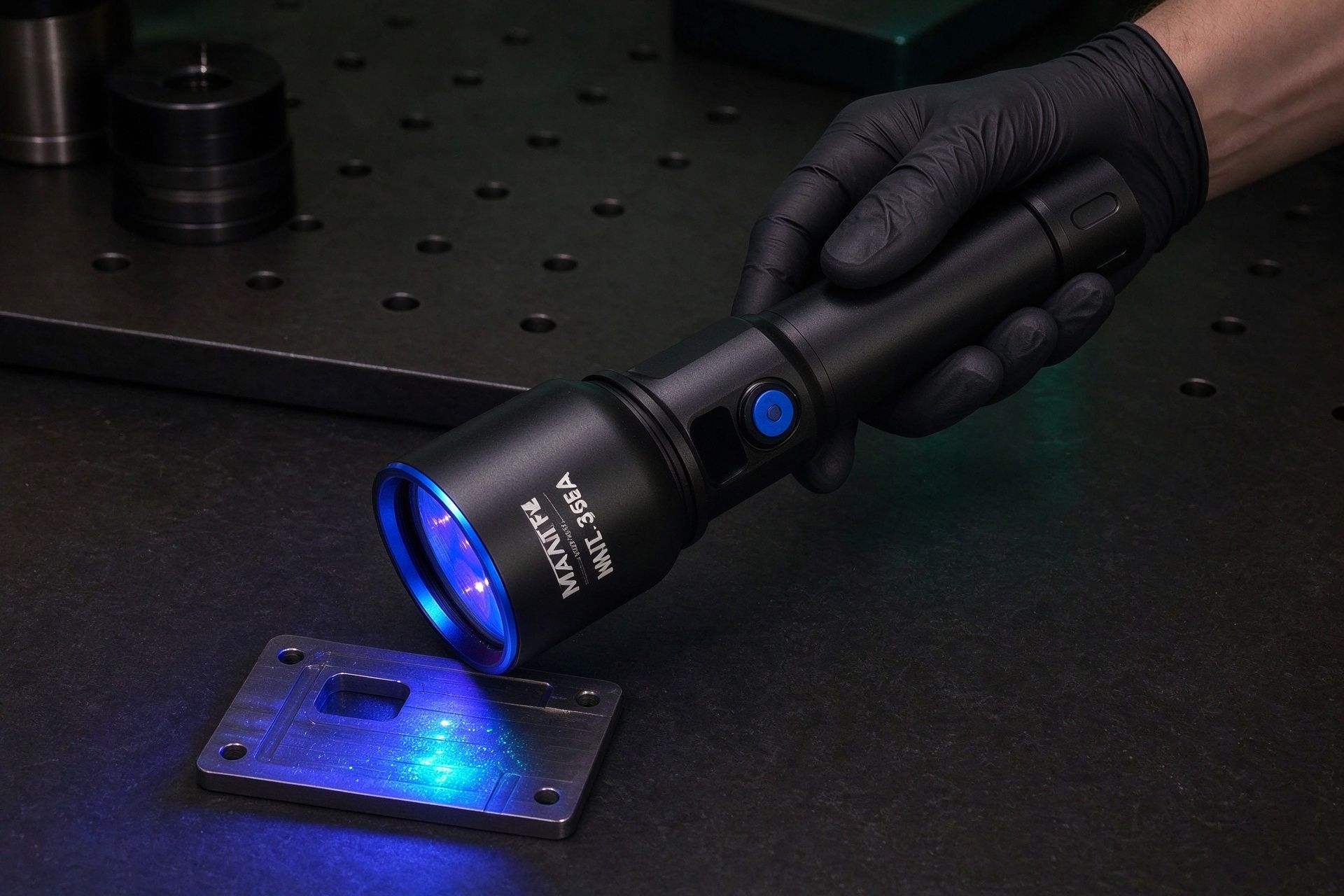
Many contaminants in a controlled environment - skin oils, residues, cleaning films, fibres - are nearly invisible in normal light. Under 365nm UV-A they fluoresce, turning a transparent film into a visible pattern. That is the entire principle behind a UV inspection walk: you are not measuring the particle, you are making it announce itself.
The MNT-365A uses a four-core 365nm LED rather than a mercury lamp. It reaches working output instantly, needs no warm-up, and has a rated life of 20,000 hours, which suits repeated short inspections across a shift.
General-purpose UV lights are often built with knurled grips, exposed seams and cooling openings that shed or trap particles. The MNT-365A uses smooth, aircraft-grade aluminium with a black anodised finish: no knurling, no fan, no crevice for dust to collect. The surface can be wiped and disinfected using your facility's approved procedure.
Follow your site's material-entry protocol before bringing any tool into a controlled area. Wipe the flashlight with an approved cloth and allow it to reach the room temperature before inspection.
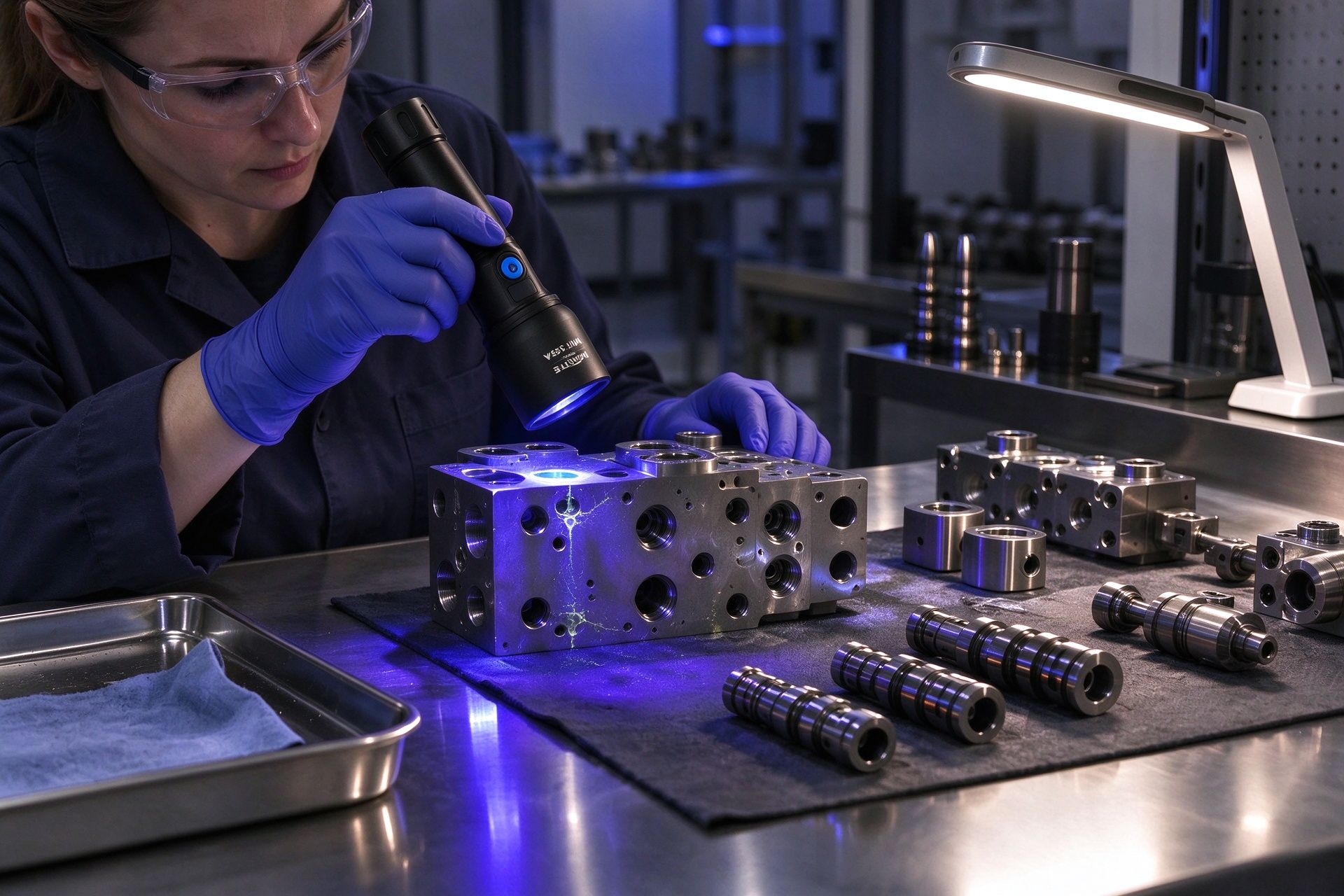
Use the MNT-365A to locate organic residues on work surfaces, tools and gloves, to check cleaning effectiveness, and to screen components before assembly. Typical users are semiconductor, pharmaceutical and precision-optics facilities, as well as laboratories that need a portable fluorescence source.
Hold the light roughly 30-40cm from the surface and scan slowly in overlapping passes. Fluorescence is a qualitative signal: it tells you where to look, not what the contaminant is. Confirm with the analytical method your quality system requires.
Dim the area if possible, switch the light on and allow your eyes a moment to adapt, then sweep the surface at a steady distance. Mark fluorescent spots for follow-up. Because the spot is about 10cm at 38cm, move in overlapping strokes rather than jumping between points. Switch off between passes to preserve battery and reduce unnecessary UV exposure.
First, the body is smooth and easy to wipe. Second, the battery is a standard 21700 cell with Type-C charging and a percentage display, so you know the output will not fade mid-walk. Third, the side button can be operated without changing grip. Together these details reduce the friction of repeated inspection in a gowning environment.
UV-A at 365nm is not visible to the eye, but it can harm skin and eyes with prolonged exposure.Wear UV-rated eyewear, avoid directing the beam at people, and do not use the light as a general-purpose torch.
| Parameter | Specification |
|---|---|
| Model | MNT-365A |
| Light source | LED, 4-core |
| Wavelength | 365nm |
| LED life | 20,000 hours |
| Centre UV irradiance | 14 mW/cm2 at 38cm |
| Effective spot diameter | 10cm at 38cm |
| Battery | 21700 lithium-ion, 3500mAh |
| Voltage | 4.2V |
| Charge time | 3-4 hours |
| Charging port | Type-C |
| Dimensions | Length 140mm; head diameter 46mm; barrel diameter 30mm |
| Weight | 260g |
| Switch | Side push button |
| Battery display | Digital percentage readout |
| Material | Aircraft-grade reinforced aluminium |
| Finish | Black anodised |
| Housing | Smooth, dust-free surface with no knurling; easy to wipe and disinfect |
| Detection principle | UV fluorescence excitation; organic particles fluoresce |
| Operation | Handheld mobile scanning; instant on, no warm-up |
| Environment | Cleanroom / dust-free workshop |
The smooth, dust-free housing is designed for that environment, but entry always depends on your facility's contamination control rules. Wipe it with an approved cloth and follow gowning and material-transfer procedures before use.
It reveals organic material that fluoresces under 365nm UV - skin oils, residues, cleaning films and some fibres. Inorganic particles such as metal fragments do not fluoresce and need other inspection methods.
Both figures are measured at a distance of 38cm: centre irradiance 14 mW/cm2 and effective spot diameter 10cm. Irradiance changes with distance, so compare tools only at the same working distance.
It is a rated service life, not a warranty that output stays constant for that period. Output declines gradually with use. For applications that depend on a known irradiance, verify periodically with a calibrated UV meter.
At 260g and 140mm it is light enough for mobile walks, and the 21700 cell with Type-C charging supports repeated use. The percentage display lets you check remaining charge before starting a route.
Wear UV-rated eye protection, do not shine the beam at people, and avoid prolonged skin exposure. Use the lowest practical exposure time and treat fluorescence as an inspection cue rather than a quantitative result.
Send inquiry

Email: info@xinysun.com

Tel: 131-2093-6518

Address: 1525 Minqiang Road, Bldg 26, Songjiang, Shanghai

Copyright 2026 Xinysun Instrument (Shanghai) Co., Ltd. All rights reserved.
ICP:ICP-2026046447




 Products
 Applications
 Previous:
 Back to list

 Industrial Test Instruments


