
Products
PRODUCTS Breadcrumb: Home > Products > Industrial Test Instruments > UV Flashlights
 Overview
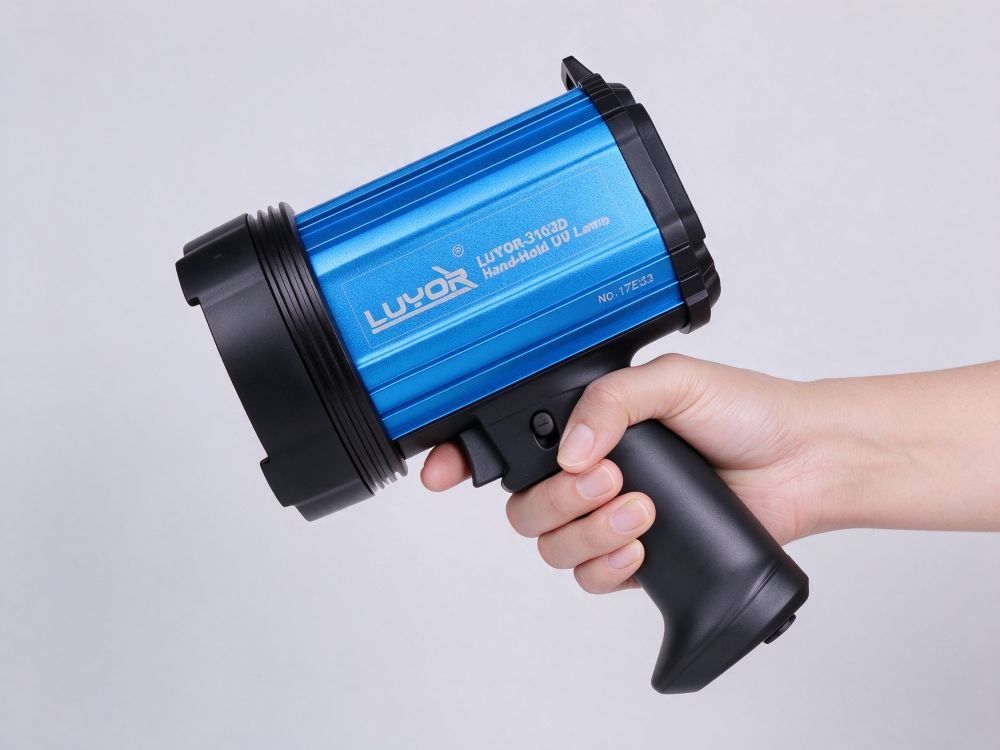
LUYOR-3103 and 3103D handheld MT lamps deliver 4500 uW/cm2 at 380 mm over a 200 mm spot, with a white LED for marking indications in a dark room.
Magnetic particle inspection lamps are 365 nm UV-A illuminators used in fluorescent magnetic particle testing (MT) to excite the indications. The reading surface must reach the UV-A irradiance required by the standard while ambient white light stays low. LUYOR-3103 / 3103D are handheld MT lamps: 4500 μW/cm² at 380 mm, a spot of about 200 mm, and a built-in white LED that helps mark indications.
The form of an MT lamp follows the working condition. Two situations are typical. One is a fixed reading station where the part comes to the lamp and a hanging lamp such as the LUYOR-3115 provides continuous light. The other has the lamp following the probe: a yoke or a magnetising fixture sits on the part while the inspector magnetises with one hand and watches for indications with the other. That second case calls for a portable lamp that is light, bright enough, and able to run for long periods, and the LUYOR-3103 / 3103D are designed for it.
The optical path is simple and reliable: three 365 nm high-power UV-A LEDs with a black filter at the front that blocks visible light and passes black light. Center intensity at 380 mm is 4500 μW/cm², more than 4 times the 1000 μW/cm² reading threshold in the ASTM E3022 / ISO 3059 framework. The effective area on the part is about 200 mm in diameter at 380 mm, which corresponds to a flange face, a short weld, or a local area of a casting - a sensible field of view for one observation with a portable lamp.
In the model naming, the 3103 ships with a 24 V power adapter for mains operation and the 3103D with a 24 V lithium battery pack for work away from a socket. Choose the 3103 for a fixed bay in the shop, and the D for field work, tank interiors, and work at height.
The data below follows LUYOR technical documentation and has been cross-checked against values published through several channels. This is the table to cite in selection, tenders, and process documents.
| Item | Data |
|---|---|
| Model | LUYOR-3103 (mains version) / LUYOR-3103D (battery version) |
| UV source | 3 × high-power UV-A LED (365 nm) |
| White light | 1 × 3 W white LED (separate switch, for marking indications) |
| Peak wavelength | 365 ± 5 nm |
| UV-A output | 4500 μW/cm² (center value at 380 mm from the lamp head) |
| Irradiated area | Approx. 200 mm (effective coverage at 380 mm) |
| Filtration | Black filter (blocks visible light, passes black light) |
| Power | P: 24 V power adapter; D: 24 V lithium battery pack |
| Housing | Aluminum alloy (effective heat dissipation) |
| Protection | Rubber bumper at the front (resists knocks and rolling) |
| Standard accessories | 2 pairs of safety glasses |
| Warranty | 3 years |
| Compliance | ASTM E3022, GB/T 5097-2020, GB/T 15822, ASTM E2297 |
| Typical use | Routine MT work: reading and marking indications in fluorescent magnetic particle testing, with small-area fluorescent penetrant testing (PT) sweeps |
The four models differ in power and filter: the 3103PL / 3103DL are the versions rated at 4000 μW/cm² UV-A output with a black filter as standard, and the remaining data matches the 3103 / 3103D. Where a process document requires the filter fitted at the factory, specify the PL / DL; where the parameters on this page apply, with the black filter included as standard, order the 3103 / 3103D.
Comparisons of portable lamps tend to stop at the intensity figure, but intensity, distance, and covered area have to be worked out together. The 4500 μW/cm² figure is the center value at 380 mm. Inspection often happens closer, which raises irradiance on the part and narrows the covered area at the same time.
| Working condition | Recommendation |
|---|---|
| Reading a local indication | Hold the lamp 200 to 300 mm from the surface for higher center intensity and a covered area of 100 to 150 mm, which suits point-by-point confirmation of an indication |
| Sweeping a whole area | Keep the lamp at about 380 mm, which covers roughly 200 mm, and work area by area rather than lighting a single spot |
| Surveying a large part | Where the 3103 does not cover enough, move to the BB series or the 3115 hanging lamp rather than backing the lamp off - irradiance falls quickly with distance |
| Irradiance acceptance | Measure a center point and an edge point at the actual reading position with a UV radiometer and record the values in the equipment inspection sheet |
On "why 38 cm is the measuring datum" and "how μW/cm² requirements differ between inspection tasks", the site carries a dedicated article: The wattage on a UV lamp misleads you: μW/cm² requirements across inspection methods.
Fluorescent magnetic particle testing runs in dim conditions or in a dark room. Once an indication appears, the inspector has to scribe a mark, take a photograph, and complete the record, and those actions are hard under black light alone; the usual answer is a separate white lamp or working by feel. The 3103 puts one 3 W white LED inside the lamp head on a separate switch:
When an indication is found, switch to white light, illuminate the spot, and mark, photograph, and record it directly;
The white LED is independent of the UV path, so switching does not change the black light state, and the sweep resumes once the record is complete;
No second work lamp to carry, which frees a hand and removes an item to hold.
Note that the white light is for marking and recording, not for reading. White light must be off while fluorescent indications are observed, and the lower the ambient white light, the better the contrast. That on-off rhythm, together with continuous power from the D version, works well in fully dark spaces such as tank bottoms and the interior of spherical tanks.
The LUYOR-3103 series meets ASTM E3022 (UV-A LED lamps for fluorescent penetrant testing) and GB/T 5097-2020 (non-destructive testing - black lights), and covers the UV source requirements of GB/T 15822 (magnetic particle testing) and ASTM E2297. For purchasing and audits, the following items are worth preparing in advance:
| Audit focus | What to prepare |
|---|---|
| Source compliance | Product specification and factory test report (365±5 nm, 4500 μW/cm² at 380 mm) |
| White light leakage and filtration | Fitting instructions for the black filter; comparative data for the PL / DL versions |
| Irradiance at the station | Measured records for the station (UV radiometer readings with the distance and point noted) |
| Equipment condition | Periodic inspection records, visual check of the LEDs, integrity check of the filter |
| Operator protection | Issue records for the 2 pairs of safety glasses supplied and the IEC 62471 risk assessment note |
For the full ASTM E3022 requirements on type testing and unit test reports, see ASTM E3022-26 in depth; for common questions, see ASTM E3022-26: twelve quick answers.
The 3103 is the compact model in the handheld portable family. If its coverage or power arrangement does not fit, compare the other models in this section on three axes - part size, working position, and power availability:
| Model | Form | Characteristics | Suits |
|---|---|---|---|
| LUYOR-3103/D | Handheld | 4500 μW/cm² at 38 cm, approx. 200 mm spot, built-in white LED | General MT lamp for local reading and marking |
| LUYOR-3180 | Handheld spot | About 40000 μW/cm² at 38 cm, tight high-intensity spot | Locating fine penetrant bleed-out, long-distance checks |
| LUYOR-2130L | Handheld flood | Wide spot, three brightness levels, for degreasing checks | Oil-free degreasing acceptance for oxygen piping |
| LUYOR-BB series | Handheld wide spot | 8 LEDs, BBH/BBM/BBL versions, IP68 | Wide-area fluorescent penetrant reading |
| LUYOR-3115 | Hanging | 15 LEDs, 9500 μW/cm² at 38 cm, 250×500 mm | Fixed-station continuous lighting, two-handed reading |
Put simply, choose an MT lamp by form: a hanging lamp (3115) for a fixed station, the BB series for wide-area sweeps, the 3180 for fine bleed-out location, and the 3103 as the lamp you carry. Power is the choice between mains and battery, which is the difference between P and D.
| Setting | How to use it |
|---|---|
| Bearing and fastener MT | After magnetising with a yoke, hold the lamp to inspect grooves and end faces; the 200 mm spot of the 3103 covers most bearing ring sizes in one pass |
| Field weld MT | With the 3103D battery version, follow the yoke along the weld seam section by section, without a cable limiting work at height |
| Tank and sphere interiors | The built-in white LED earns its place in total darkness: black light to find the indication, white light to mark it, one lamp for both |
| In-process machining checks | The mains 3103 stays on at the station; the inspector picks it up as needed and the 24 V adapter is plug-and-play |
| Field and service inspection | The D version runs from a lithium battery pack, and the rubber bumper resists knocks, which suits travel |
Use note: the filter is a glass part, and after a drop or a knock it should be checked for cracks even when it looks intact - a crack lets visible light into the path and lowers fluorescence contrast. Inspect the filter and the rubber head bumper visually before each use.
The ASTM E3022 / ISO 3059 framework calls for UV-A of at least 1000 μW/cm² on the reading surface in fluorescent magnetic particle inspection, and ASTM E1444 sets related visible-light and UV limits for MT. The 3103 gives 4500 μW/cm² at 380 mm, about 4 times the threshold, with more margin at closer inspection distances. Measure and record the value at the real reading distance with a UV radiometer during acceptance.
It can be used for small-area fluorescent penetrant (PT) sweeps, with attention to the spot: the 3103 measures about 200 mm in diameter at 380 mm, which suits section-by-section work. To cover a large penetrant indication in one view, use a wide-spot BB series lamp or the 3115 hanging lamp. For fine PT indications, the spot version 3180 fits better.
Power is the difference. The P version uses a 24 V adapter and runs from mains, which suits a fixed station and in-process checks at a machine. The D version uses a 24 V lithium battery pack and suits field welds, tank interiors, and work at height where a socket is not at hand. UV-A output and the optical path are identical: 4500 μW/cm² at 38 cm.
The 3180 is a spot version at about 40000 μW/cm² at 38 cm, with a small, long-reaching beam for fine penetrant indications. The 3103 gives 4500 μW/cm² over a flood spot of about 200 mm and adds a white LED for marking. Choose the 3180 to locate fine bleed-out in PT, and the 3103 for MT sweeps and reading.
White light must be off while fluorescent indications are read. The white LED has its own switch and is used for scribing, photography, and records after an indication is found. The normal rhythm is black light to find the indication, black light off and white light on to mark it, then back to black light for the sweep.
No. The series ships with a black filter fitted. Where a process document calls for a 4000 μW/cm² version with the filter as standard, specify the 3103PL / 3103DL derivative.
Runtime depends on battery pack capacity and ambient temperature, and the manufacturer does not publish a fixed number of hours. Carry a spare pack per shift, or use the 3103 mains version at a long-duration station. The LED source itself is rated for continuous operation, and the lamp places no duty-cycle limit on it.
Three items: 1. each shift, check the filter for cracks and the rubber bumper for damage; 2. at set intervals, measure irradiance at a fixed distance with a UV radiometer, record it, and send the lamp for service when the reading falls clearly; 3. wipe the filter and the aluminum heat-dissipating surface with a soft cloth, so that developer powder does not build up on the heat sink.
For MT lamp selection, three details are enough: part size, working position, and power availability. Further reading: Using UV inspection lamps correctly: 365 nm fluorescence reading and selection. Send them to us and we can check the P / D choice and whether a derivative model is needed.
Send inquiry

Email: info@xinysun.com

Tel: 131-2093-6518

Address: 1525 Minqiang Road, Bldg 26, Songjiang, Shanghai

Copyright 2026 Xinysun Instrument (Shanghai) Co., Ltd. All rights reserved.
ICP:ICP-2026046447




 Products
 Applications
 Previous:
 Back to list

 Industrial Test Instruments


