Applications
 Breadcrumb: Home > Applications > Semiconductor Cleanroom
 Updated:2026-11-02
 Views:
Particle contamination on the inner walls of wafer carriers comes from four routes: carried in on the wafer, human contact, cleaning and drying residue, and the environment or packaging. This article compares what four inspection methods can each reveal, then focuses on two of them: how grazing light at a narrow spot angle brings particles, scratches and water marks out of the slot grooves, and how 365 nm UV fluorescence makes fibers, skin flakes and fingerprints visible. It closes with an executable seven-step inspection sequence that takes three to five minutes per carrier, and expands the carrier chapter of the semiconductor particle series.
Semiconductor particle detection series collects the full method system for particle inspection: method selection, post-PM recheck SOPs and interpretation of cleanliness classes; this article expands the carrier inspection step within it.
FOUP and cassette are the layer of container that stays against the wafer throughout its movement inside the fab. A wafer spends minutes to hours inside a tool, but days inside a carrier - queuing, temporary storage, moving between floors, waiting for the next step - and during that time it depends almost entirely on the cleanliness of the carrier cavity.
The trouble is that cleaning validation for a carrier is far harder than for a tool. The structure is closed, the slots are dense, the inner walls carry ribs and locating pins, a wipe cannot reach inside, a particle counter cannot sample, and a surface particle scanner cannot be inserted. By the time particles have transferred to the wafer and a defect map appears, the investigation usually has to go back through several days of logistics records.
This article covers three things: where contamination on carrier inner walls comes from, which methods can see it, and how to confirm cleanliness after cleaning.
Particles on carrier inner walls do not appear from nowhere; sources fall into four routes, and each calls for a completely different response. Starting to intensify cleaning without knowing the source often means washing many times while the problem recurs.
A wafer comes out of an upstream process with particles already on its surface, and some transfer to the slot contact faces and inner walls as it enters and leaves. This route is characterized by contamination concentrated at the slot lips and support ribs - the places the wafer actually touches - while other inner surfaces stay comparatively clean.
Upstream particles are mostly inorganic (silicon debris, oxide fragments, abrasive residue from polishing slurry). UV fluorescence does not detect this class of contaminant, so grazing light is needed.
Glove fingerprints, fibers from cuffs, contact when the door is opened. The FOUP door handle, the latch mechanism and the outer handle are high-frequency contact areas, and the relative position of fingers and door frame when the door opens determines that contamination lands near the door seal.
Contaminants on this route are almost entirely organic: skin flakes, glove oils, fibers. Under 365 nm UV the fluorescence response is clear, which is where UV methods have the most room.
The drying step after a carrier washer is often overlooked. Water marks, cleaner residue and hazy traces left by incomplete blow-drying form a thin organic film on the inner wall - it may not count as particles itself, but it becomes an adhesive for later particles, turning the inner wall from non-tacky into tacky.
Some water-based cleaners contain fluorescent components themselves, which is exactly why a UV lamp incidentally reveals cleaner residue. Uniform, faint fluorescence on the inner wall after cleaning is good evidence of cleaner or water-mark residue rather than particle contamination.
Cleanliness of the carrier storage area, material shedding from the inner surface of the outer bag, dust on the trolley deck. The distribution signature of this contamination is concentration on the outer walls and the base; contamination found on inner walls has usually been carried in when the door was opened or during transfer.
With the four routes clear, troubleshooting has a direction: slot contamination on inner walls points to routes 1 and 2, uniform film-like residue on inner walls points to route 3, and contamination on outer walls and the base points to route 4.
| Method | What it can see | Suitability for carriers | Limitations |
|---|---|---|---|
| White-light visual | Obvious debris, large stains | Usable directly on outer walls and open inner walls | Tiny particles and pale fibers are all but invisible |
| Grazing-light inspection | Particles, scratches and water marks on inner walls and slots | Suitable; reaches into slots if a narrow spot angle is chosen | Deep groove bottoms are shadowed and need a change of angle |
| 365 nm UV fluorescence | Fibers, skin flakes, oils, fingerprints, cleaner residue | Suitable; scanning slot by slot is efficient | Inorganic particles do not fluoresce and cannot be detected |
| Wipe sampling + laboratory | Particle count and ionic residue at defined points | Open surfaces and reachable slot lips | Deep slots cannot be sampled; slow turnaround |
Three of the four can give a conclusion on site within ten minutes, and the fourth needs a sample sent away. The recommended order in practice is: grazing light to find whether something is there, UV to tell what it is, and wipe sampling for quantitative confirmation at key points.
One point to stress: grazing light and UV are not substitutes. Carrier contamination is a mix of organic and inorganic, and using one alone will miss part of it. Upstream carriers lean inorganic (silicon debris, abrasive residue), downstream carriers lean organic (adhesive, fingerprints, packaging material debris). The emphasis differs, but both lamps belong in the tool cabinet.
Particles become visible not because the surface is lit up but because of the brightness difference between particle and background. Diffuse, even lighting brightens the whole surface and particles a few micrometers across all but vanish against a bright background; gather the light into a beam with one direction and strike the surface at a low angle, and particles scatter light into the eye while the background stays dark, so contrast appears.
The difficulty in carrier inspection is the closed structure. Ribs between slots block light entering from the side and create shadow zones. There are two ways around it:
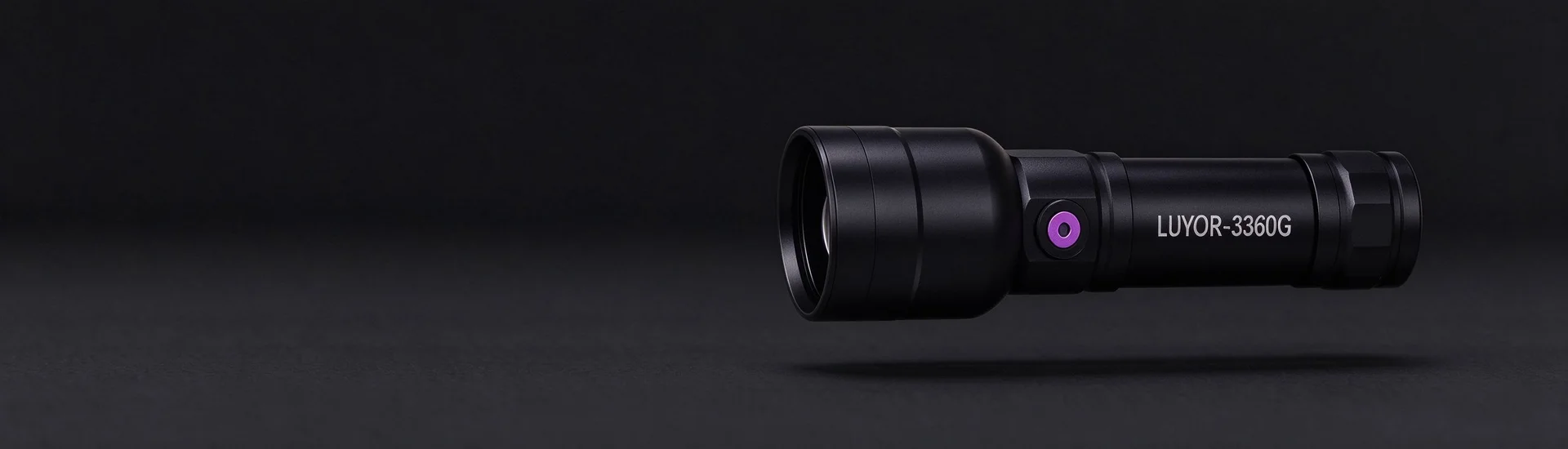
LUYOR-3360G uses its sliding zoom for exactly this switching between sweeping and judging: a 20 W laser source is zoomed a second time through a lens to give a near-collimated beam, about 280,000 lux in a 5 cm spot at 40 cm, and monochromatic output at 500-600 nm keeps the background clean. It is 160 mm long and weighs 340 g with the battery, so one hand can reach into the open face of a carrier and scan close to the surface without fatigue over long sessions - which in carrier inspection matters more than peak brightness, because the job is a repeated action of sweeping dozens of slots with one lamp.
If inspection happens near a yellow-light area, note that both white spectrum and UV affect photoresist; work in a yellow-light area should switch to yellow output at 530-670 nm (3360Y).
Under 365 nm long-wave UV, skin flakes, oils, fingerprints and most synthetic fibers emit visible fluorescence while the background does not. Inside the dark plastic cavity of a carrier the contrast of a fluorescent patch is high - a single fiber a few hundred micrometers long is very clear against the dark field.
The scanning technique along the slots matters: do not sweep at an angle, move slot by slot along the slot length. An angled sweep crosses several slots, the eye cannot follow it, and the two slots in the middle are easily missed. The right way is to fix the carrier in a fixture, start at slot 1 and advance one slot at a time, finishing each before moving on, at an even rhythm. A lamp with a large illuminated area (such as LUYOR-365L, about a 200 mm illuminated area at 38 cm) is good for an initial whole-face pass to frame suspicious regions, followed by small-spot equipment for a close check.
Bringing equipment into a clean area carries hard requirements of its own. Most industrial UV flashlights have knurling or deep grooves on the barrel for grip, and those textures are defects in a cleanroom: they trap dust, are hard to wipe clean, and disinfectant residue is difficult to remove, while repeated wiping can also shed coating - the lamp becomes a particle source itself. MNT-365A uses a smooth one-piece housing with no knurling or deep grooves, so the surface can be wiped and disinfected directly, and it can be brought in after the cleanroom item entry procedure is followed.
Three limits of the UV method have to be written into the SOP, otherwise wrong conclusions follow easily:
The value of inspection goes beyond "can this batch be released"; it exposes defects in the cleaning process. Several typical patterns map to clear causes:
| Fluorescence / reflection pattern | Likely cause | Direction of adjustment |
|---|---|---|
| Uniform faint fluorescence at the base of every slot | Incomplete drying or cleaner residue | Extend blow-dry time, raise sweep air temperature, switch to a low-residue cleaner |
| Bright patch in one or two slots, the rest normal | Physical damage or a stagnant dead zone in that slot | Scrap or rework the individual carrier; do not return it to pattern-wafer use |
| Fluorescence on slot lips, clean inner walls | Repeated friction transfer as wafers enter and leave | Check wafer cleanliness itself and the alignment accuracy of the transfer mechanism |
| Fluorescence in the door-seal imprint | Fingerprints and seal-face contamination when the door is opened | Standardize the door-opening action or use an opening fixture; wipe the door seal more often |
| Scattered point highlights on inner walls, random distribution | Fibers and skin flakes carried in by people | Review glove change frequency and exposure time in the storage area |
| Dust on outer walls and base, inner walls normal | Contamination in the storage area or on the trolley deck | Clean the storage area, add a mat to trolleys, shorten open-face exposure |
The point of the table is to break the vague conclusion "it will not come clean" into several situations that can be handled separately. In practice, many recurring contamination problems trace back not to the washer but to drying, to the door-opening action, or to exposure time in the storage area.
Turning the above into actions, the seven steps below are worth fixing in place. The procedure takes three to five minutes per carrier and suits routine recheck after carrier cleaning.
Under normal lighting, look at outer walls, latches, handles and base, and record obvious stains and damage. A dirty outer wall means the storage environment has a problem; deal with the environment before discussing inner walls.
Move the carrier to a shaded station or switch local lights off. In carrier inspection this step matters more than usual, because the cavity is itself dark and external lighting enters through the open face at an angle, destroying fluorescence contrast.
From the open face, sweep slot by slot, with the spot closed to about 5 cm, the barrel inside the cavity and the angle along the base of the slot. The aim of this pass is to find where particles are, not to judge what they are.
Repeat along the same path with 365 nm UV, looking for fibers, fingerprints and oils. Compare with the previous pass: something that lights up under UV alone is organic contamination; something bright under grazing light but dark under UV is an inorganic particle.
Use removable labels, or record contamination type and distribution by slot number directly in the inspection record. Slot numbers are the natural coordinate system of a carrier and say more than a photograph about "which slot, which rib". Photographs serve as a supplement for later comparison.
Judge the cause from the patterns in the table in section 5, then choose individual re-wash, scrapping or a process change. Do not apply blanket intensified cleaning to a whole batch - it hides the real cause and wastes time and consumables.
After treatment, re-sweep at the same angle and the same distance. Fluorescence gone and particles absent is evidence that cleaning worked. If the same slot recurs after two treatments, treat it as a structural defect and retire it from circulation.
Differences in read-out between people and between shifts are a major source of uncertainty in this method. To make conclusions comparable, establish a site-wide baseline before the method goes into routine use:
With those three things done, carrier inspection moves from "whoever looks decides" to "judged against a reference", and the result is easier for audit and traceability to accept.
Do not conclude yet. Uniform faint fluorescence is more likely cleaner residue or a thin water film than particle contamination. Judge by distribution: particle contamination is scattered - points, streaks, discrete patches; cleaner residue is uniform, continuous and follows the structure. Re-check under grazing light - if there is no granular feel, call it residue, and the response is drying and cleaner choice, not harder scrubbing.
Yes, but in combination with grazing light. Upstream carriers are dominated by inorganic particles, yet fibers and fingerprints brought in by people, and the organic film from cleaning residue, are still there, and those are exactly the blind spot of white-light visual inspection. In practice, run both lamps and let each cover its own part.
Two options: close the spot down and adjust the angle of incidence so light enters the slot bottom at a slant rather than straight at the opening; or tilt the carrier in a fixture to change the relative angle between slot and source and expose the area the ribs were shadowing. If a slot cannot be reached whatever you try, it is a structural dead zone and should get targeted cleaning or a shorter service cycle in the process.
Grade it by how the carrier is used. For pattern-wafer carriers that go through a washer, run a UV recheck after every cleaning cycle with grazing-light spot checks; for non-pattern or particle-insensitive steps, batch sampling is enough. The criterion is not "how often" but "did this cleaning work" - the recheck is itself the validation of cleaning effectiveness.
At minimum: carrier ID, slot number, contamination type (organic/inorganic), distribution pattern, action taken, recheck result. With those five items, positions can be compared later when wafer defects appear. Without the slot number, the record largely loses its traceability value.
It is worth noting that grazing light for inorganic particles is not limited to a flashlight: the parallel-light surface inspection lamp LUYOR-3320 sweeps a bar of parallel light at 8 degrees vertical and 60 degrees horizontal across the surface, covering 30cm in one pass, which suits continuous scanning of wafers, glass and polished surfaces; the 3360G yellow-green flashlight does point rechecks, and the two together are more efficient.
Particle contamination on carrier inner walls is hard to eliminate in one go because it is constantly being reintroduced: carried in on wafers, brought in on hands, left behind by incomplete drying, drifted in from the storage environment. The effective response is not to run the washer harder, but to make every cleaning cycle produce a verifiable result - see where it is dirty, know why it is dirty, and confirm that it is clean.
Grazing light pulls inorganic particles out of a dark background, 365 nm UV makes organic residue show, and with the two lamps together a carrier recheck is a matter of minutes. What that buys is not having to reconstruct several days of logistics records from a wafer defect map. For a fuller account of how five methods divide the work and combine, see Semiconductor particle detection: the applicable boundaries of five methods and how to combine them.
To have an inspection plan drawn up for your carrier models and process steps, to request official datasheets for the LUYOR-3360G and MNT-365A for internal approval, or to arrange an on-site demonstration, contact Xinyisheng Instruments (Shanghai); stock is held in Shanghai, with selection advice and demonstration support.
This article belongs to the semiconductor cleanroom section.
Other sections on the same product line include surface inspection lamps (low-angle side light that pulls particles, scratches and fingerprints out of the background), 365nm blacklights (UV area sources for flaw detection, leak detection and fluorescence inspection - look at irradiance, not wattage) and industrial test instruments (the entry point for UV inspection, speed measurement, stroboscopic observation and surface inspection).
Models mentioned in this article: LUYOR-3360G, MNT-365A, LUYOR-365L. Ranges, accuracy and accessory lists for each model are given on the product pages.

Email: info@xinysun.com

Tel: 131-2093-6518

Address: 1525 Minqiang Road, Bldg 26, Songjiang, Shanghai

Copyright 2026 Xinysun Instrument (Shanghai) Co., Ltd. All rights reserved.
ICP:ICP-2026046447




 Industrial Test Instruments


