
Products
PRODUCTS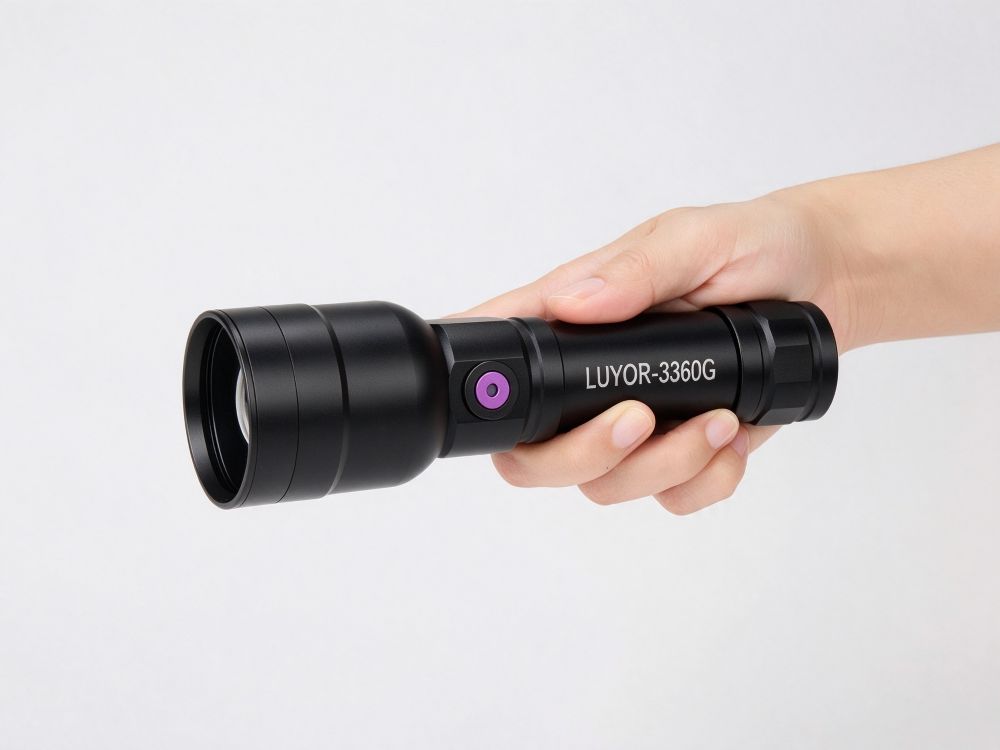
 Overview
LUYOR-3360G is a handheld yellow-green surface inspection light with a 20W laser source and zoom optics. 280,000 lux at 40cm reveals particles, scratches and contamination on glass, coated and polished surfaces.
The LUYOR-3360G is a handheld yellow-green surface inspection light built around a 20W laser source with secondary zoom optics that shape the beam into a near-collimated, wide footprint. Unlike diffuse lighting, its directional beam makes particles, fine scratches and residues stand out against a dark background. At 40cm it delivers up to 280,000 lux in a 5cm spot, giving the contrast needed to find defects on glass, coated optics and polished metal. This page covers how to use it, how the G / W / Y variants differ, and how it fits into a cleanroom workflow.
You see a defect not by lighting the surface, but by the brightness difference between the defect and its background. Even diffuse light raises the whole surface together, so scattering defects such as particles, scratches and fingerprints lose contrast. A directional beam struck at a shallow angle scatters off the particle into your eye while the background stays dark - the defect appears immediately.
The LUYOR-3360G packages exactly this kind of directional light in a flashlight form factor: a 20W laser source reshaped by secondary zoom optics into a near-collimated wide beam. Stray light is greatly reduced, which means less eye strain over long shifts and a cleaner background on glossy surfaces, where real defects would otherwise be washed out by reflections.
Its form is a green inspection flashlight: 52mm head diameter, 160mm barrel and 340g including battery. Surface inspection is rarely a single glance - you sweep the workpiece at changing angles - so weight and grip directly determine how long and how carefully you can work.
This is the key operating point: particles and fingerprints versus scratches require two different illumination angles. Use the wrong angle and the defect is invisible even at arm's length.
During grazing inspection the barrel is nearly horizontal and light travels far across the surface - it can reach a nearby workstation or your own line of sight. Confirm the positions of people around you and aim away from faces before starting.
In practice, run both angles: grazing answers "is something there", perpendicular answers "what is it". Concluding after a single-angle sweep is the most common cause of missed defects.
All three share the same power, battery and housing. The only difference is the output spectrum. Spectrum determines background interference, defect contrast, and whether the light can be used in a yellow-light area.
The push-pull barrel is not cosmetic. Extending it widens the footprint for fast area scanning; retracting it concentrates the beam to inspect a suspected spot closely. Because focus is changed mechanically without swapping parts, you can move from survey to confirmation without interrupting the pass.
At 40cm the spot adjusts across roughly 5cm, 10cm and 50cm. The tight setting concentrates the full output for maximum contrast on micro-defects; the wide setting covers more area for first-pass screening.
The aluminium barrel dissipates heat quickly, so the light stays comfortable during long inspections, and its smooth surface is easy to wipe down. It is designed to the requirements of cleanroom use: no loose knurling to trap particles, and a finish that tolerates routine cleaning.
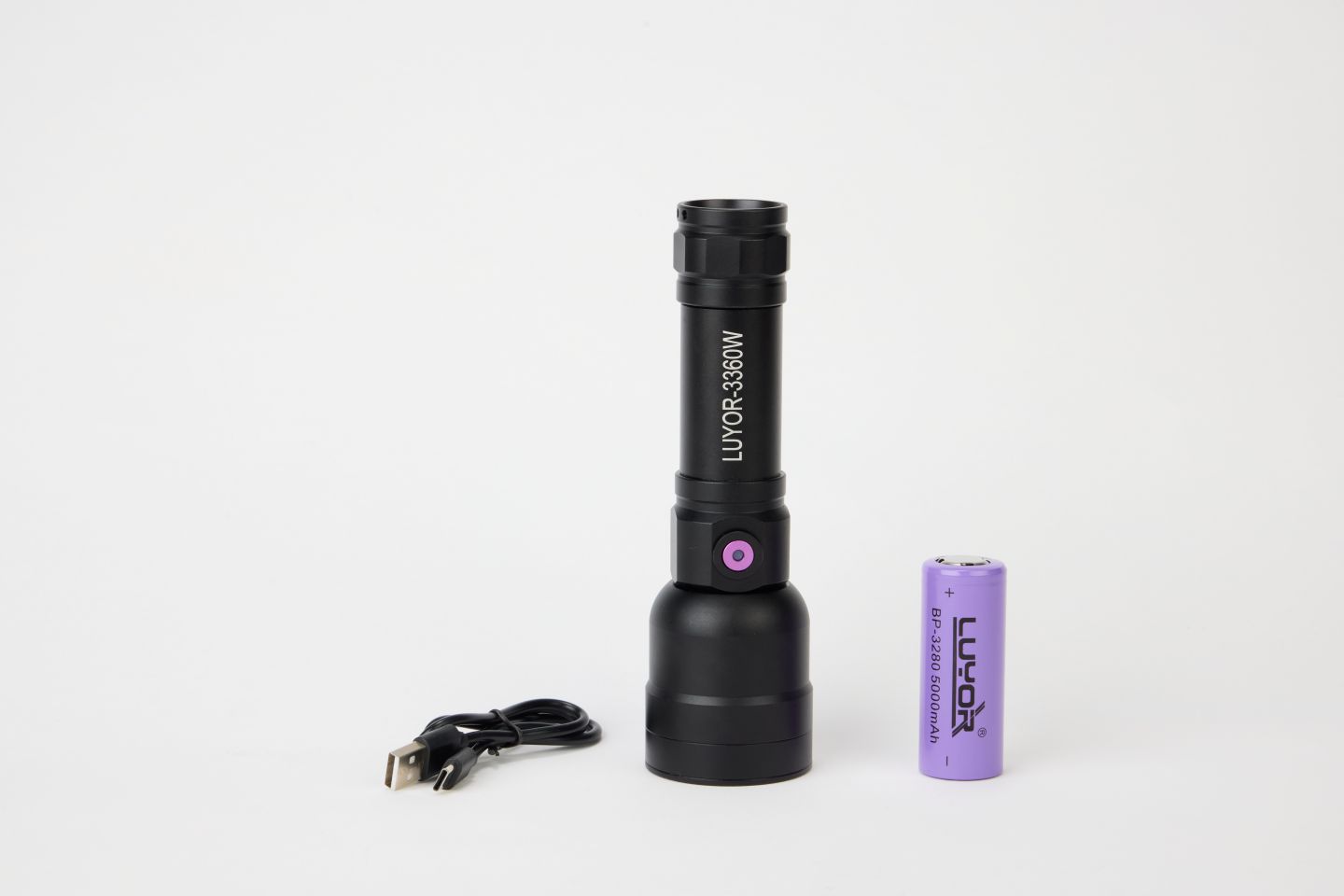
The 5000mAh battery runs 3-4 hours continuously and recharges in 5-6 hours. Two batteries ship in the case so one can be used while the other charges - enough for a full shift of intermittent inspection.
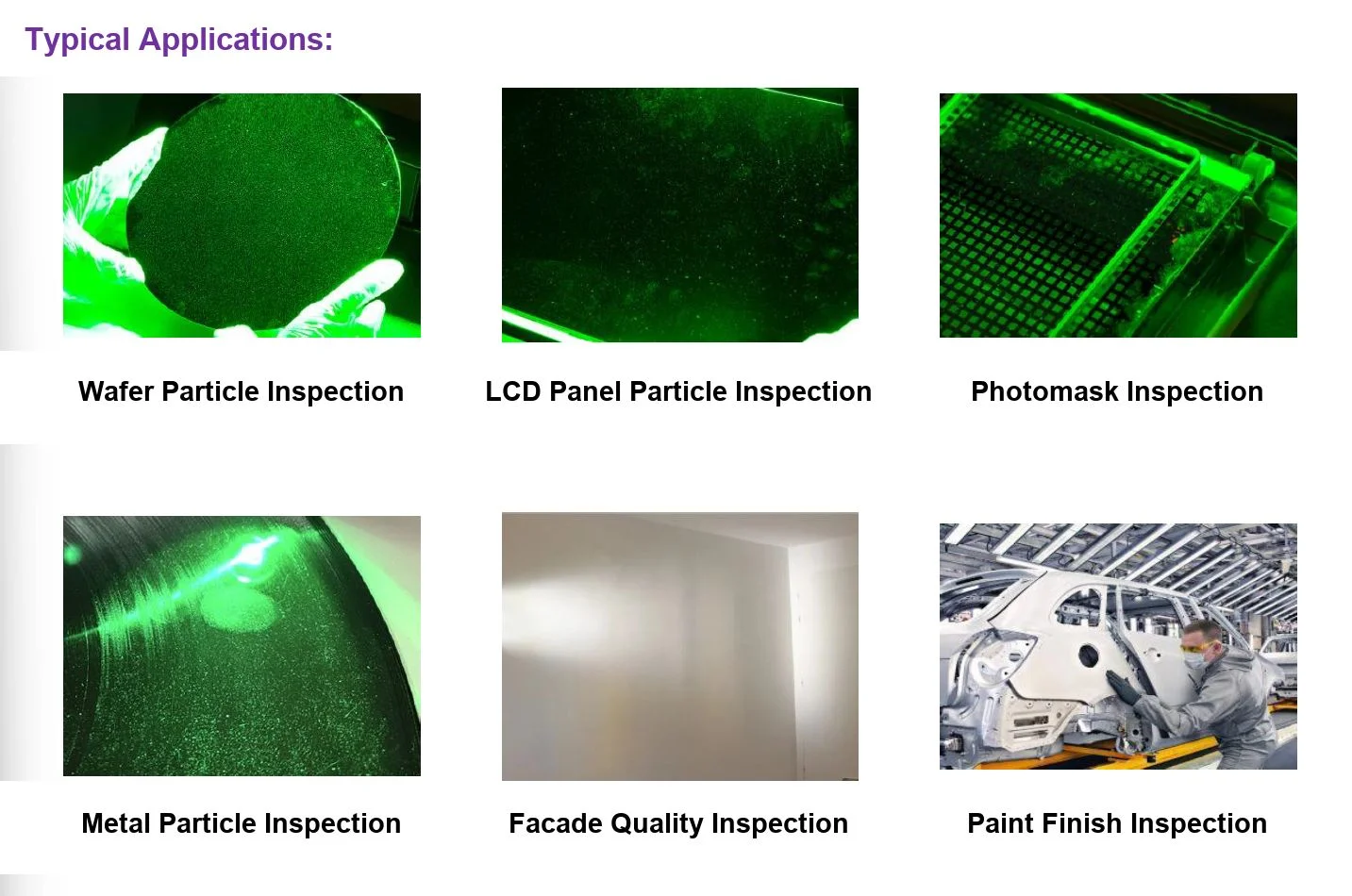
On glass and coated optics, use grazing light to find dust and fibres, then perpendicular light to read fingerprints and coating marks. On polished metal, a shallow angle reveals machining marks and pits through their edge scattering. On painted and plated parts, the yellow-green band suppresses the substrate colour so contamination reads clearly.
The 280,000 lux figure is specified at 40cm with a 5cm spot. Contrast at other distances and spot sizes will differ - compare measurements only under the same geometry.
The 3360G is a visible-light inspection tool; a UV flashlight such as the MNT-365A or LUYOR-2130L is a fluorescence excitation tool. Use the 3360G to find physical surface defects by scattering. Use UV when you need a contaminant to fluoresce - for example residues, oils or cleaning-agent films. The two methods answer different questions and are often used together in one inspection flow.
Keep the front lens clean - a smudged lens destroys the contrast the beam is designed to create. Wipe the barrel with a lint-free cloth, store both batteries in the supplied aluminium case, and avoid dropping the head, which holds the zoom optics. Do not stare into the beam at close range; although it is visible light, the concentrated spot is very bright.
| Parameter | Specification |
|---|---|
| Model | LUYOR-3360G (yellow-green) / 3360W (white) / 3360Y (yellow) |
| Light source | 20W laser source with secondary zoom optics (listed as 20W LED power in the sample spec sheet) |
| Wavelength | 3360G: 500-600nm; 3360W: 400-760nm; 3360Y: 530-670nm |
| Spot | Zoom focus; approx. 5cm / 10cm / 50cm at 40cm |
| Illuminance | Up to 280,000 lux at 40cm, 5cm spot |
| Battery | 5000mAh rechargeable lithium battery |
| Runtime | 3-4 hours continuous operation |
| Charge time | 5-6 hours |
| Dimensions | Head diameter 52mm; barrel length 160mm |
| Weight | 340g including battery |
| Body | Aluminium alloy, fast heat dissipation; smooth finish for cleanroom wiping |
| Switch | Metal push button with battery-level indicator |
| Operating temperature | 0-40 C |
| Filters | Optional filters available |
| Standard kit | Inspection light, 2 batteries, AC charger, aluminium case |
All three share the same body, power and battery. 3360G is the yellow-green model for general defect contrast and is preferred where a dark-adapted eye or a yellow-light environment matters. 3360W is a white-light version for true-colour inspection; 3360Y is a yellow variant. Choose by the background and the defect you need to reveal, not by brightness.
The product uses a 20W laser source shaped by secondary zoom optics; some distributor sheets record the drive power as 20W LED power. Both refer to the same 20W-class source in the 3360G. The measured specification that matters for inspection is 280,000 lux at 40cm in a 5cm spot.
The output is visible light, not UV, but the concentrated spot is extremely bright. Avoid looking directly into the beam, especially with the tight focus, and never aim it at another person's eyes. Use the lowest comfortable intensity setting for close inspection and take normal breaks during long sessions.
Illuminance falls with distance and spreads as the spot widens. Quoting lux without the distance and spot size is meaningless. These three numbers together define the test geometry and let you compare the light against other tools fairly.
No. The 3360G reveals surface topology by scattering visible light; degreasing and residue checks rely on UV-induced fluorescence. For that job use a UV flashlight such as the MNT-365A. The two are complementary in a single inspection routine.
Yes. The smooth aluminium barrel has no knurling to trap particles and can be wiped and disinfected. Follow your facility's cleaning protocol before entry, and note that the light is not designed for sterile or wash-down areas.
Datasheets, manuals and specification tables are provided by the manufacturer for reference only; specifications follow the documents supplied with the product and the latest manufacturer data.
Send inquiry

Email: info@xinysun.com

Tel: 131-2093-6518

Address: 1525 Minqiang Road, Bldg 26, Songjiang, Shanghai

Copyright 2026 Xinysun Instrument (Shanghai) Co., Ltd. All rights reserved.
ICP:ICP-2026046447




 Breadcrumb:
 Products
 Applications
 Previous:
 Back to list

 Industrial Test Instruments


