Solutions
 Breadcrumb: Home > Solutions > Fluorescent Inspection
 Updated:2026-11-17
 Views:
Questions about fluorescent inspection lamps usually reduce to two sentences: which brand to buy, and whether LED can replace mercury. The former has no standard answer; the latter already has one in most situations. This article works through 14 frequent questions and sets out the criteria before the products: how to recognize a brand that really builds inspection lamps, where imported and domestic brands differ, and how to rank models within one brand. It then lands on three tiers - the LUYOR-BB series, the LUYOR-3103/3103D and the LUYOR-365L - and closes with what to write into a purchase order and how to check a delivery.
Questions about choosing a fluorescent inspection lamp (UV-A black light) usually reduce to two sentences: which brand to buy, and whether LED can actually replace mercury. The former has no standard answer; the latter has a clear one in most situations. This article works through 14 frequent questions, setting out the criteria before the products and then landing on three specific tiers: the LUYOR-BB series, the LUYOR-3103/3103D and the LUYOR-365L.
There is none. An inspection lamp is not a consumer product; its value depends on three things: whether the light source meets its specifications, whether the reports are complete, and whether a failed unit can be brought back into service quickly. The same brand may suit an aerospace NADCAP project and yet be expensive and clumsy at an ordinary workshop magnetic particle station.
A more useful question is: for this operation of mine, what intensity, what spot size, what power form do I need, and who can give me verifiable reports and local support. Filter in that order and the brand list narrows to two or three.
Check four documents; if one is missing, ask why:
| Item to verify | Why it matters | How to check |
|---|---|---|
| Type test report | Shows that the design of this model meets the standard, covering spectrum, filter transmittance, temperature stability, current ripple and the remaining items | Request it from the manufacturer; make sure the model on the report matches the model being purchased |
| Unit test report | Shows that the unit you received meets the standard. LED devices vary from unit to unit, so wavelength and irradiance differ between machines of the same model | Should be delivered with the goods; includes peak irradiance, peak wavelength and full width at half maximum |
| Declaration of conformity | States which edition of which standard is met, rather than a vague "meets international standards" | ASTM E3022 (UV-A LED lamps), ISO 3059, GB/T 5097-2020 and similar |
| Radiometer and calibration service | A lamp has to be managed over years; without a traceable UV radiometer, intensity decay cannot be judged | Ask for the radiometer model, the calibration interval and where it is sent for calibration |
One background point is easy to overlook: testing and certification to standards such as ASTM E3022 is carried out by the manufacturer, with no mandatory independent third-party oversight; the auditing body (NADCAP, an ISO auditor) samples a subset. The buyer therefore has to verify the authenticity and completeness of the reports. Details are in the site article twelve questions on ASTM E3022-26.
The difference is in accumulated experience, not in principle. International brands (Spectroline and Magnaflux in the US, LUYOR, Karl Deutsch in Germany) have a longer service history in audit-heavy industries such as aerospace and nuclear power, with more mature process documentation and audit-response experience; the price is higher cost, longer lead times and slower service response.
The domestic channel of an imported brand such as LUYOR takes another route: the light source and optics follow the same standards system and reports are issued to ASTM E3022, but spares, calibration and radiometer support are handled domestically, with fast response and lower total cost of ownership. For the great majority of workshop-level magnetic particle and penetrant stations that route is sufficient.
What does deserve caution is a rebadged lamp: it looks like an inspection lamp and the data sheet reads like one, but no type test report can be produced, the filter is ordinary UV glass rather than a white-light blocking type, and after six months the visible leakage grows and reading contrast quietly falls, with nothing visible from the outside.
Three variables: how large the inspected surface is, how far the inspection distance is, and how the lamp is powered. Settle those and the model settles itself. Chosen the other way round, purely by which lamp is brighter, the usual result is a strong lamp with a spot too small, where a single weld needs a dozen repositions and efficiency drops.
Yes, and in some older lines and older process documents they still are. The advantage of mercury is historical inertia: a strong 365nm line in the spectrum, high power per lamp, and standards and process documents written around it. If the existing process document specifies mercury and the equipment is in good condition, there is no reason it must be replaced.
But new projects and new purchases rarely choose mercury now. The reason is not that LED is more fashionable, but the hard differences below.
| Item | High-pressure mercury | UV-A LED |
|---|---|---|
| Start-up | Needs warm-up, commonly 5-15 minutes to stable output | Instant on, no waiting |
| Spectrum | Strong 365nm main line, but with visible light and some short-wave UV that a filter must suppress | Narrow-band output, typically 365±5nm, with visible leakage further reduced by the filter |
| Life and decay | Relatively short tube life, periodic replacement; output falls with hours of use | Much longer life, slow decay; but poor thermal design causes early decay |
| Heat and orientation | Hot body, some models restrict mounting orientation, and a restart needs a cooldown after shutdown | Cold light source, any orientation, no cost to frequent switching |
| Maintenance and compliance | Contains mercury, disposed of as hazardous waste; the tube is a consumable | No mercury; maintenance is mainly checking the filter and the emitters |
| Power form | Mostly mains; portable versions are heavy | Can be battery powered, with weight down to the 1-2kg class |
These are differences in technical direction, not evidence that "LED is inherently compliant". Compliance depends on the measured performance and reports of the specific product, and has no necessary link to the light source type.
Three practical reasons. Cycle time: penetrant and magnetic particle inspection usually moves through several stations, and a mercury lamp that waits 5-15 minutes at every start adds up to a real time cost over a day, while LED is ready when picked up. Mobile work: inside tanks, up towers, on field pipelines there is no mains supply, and a battery LED is close to the sole workable answer today. Management cost: a mercury tube is a consumable with a hazardous-waste disposal step, while LED converts that cost into the simple routine of measuring illuminance and checking the filter periodically.
Four, all common ways to lose points in purchasing and use:
The methods for recognizing these four are described in more field detail in another site article, five common mistakes in UV-A fluorescent inspection.
The BB series is the fixed station, large area, high intensity solution. 8× 365nm LEDs in an array with a white-light blocking filter produce an effective spot 26-28.5cm across (bounded by readings above 1000 μW/cm²), covering one working face in a single pass, so a full circumferential weld or a whole flange needs no repeated repositioning.
The model code reads directly: the third character H/M/L is the intensity tier, and the last character A is AC power while B is battery.
| Intensity tier | AC / battery | Center intensity at 38cm | Effective spot | Battery runtime | Suited to |
|---|---|---|---|---|---|
| High, BBH | BBHA / BBHB | 17000 μW/cm² | 26.5 cm | About 5 h | Long-distance illumination, dark or rough surfaces, bright ambient light on site |
| Medium, BBM | BBMA / BBMB | 9000 μW/cm² | 28.5 cm | About 6 h | Routine PT/MT workhorse, balancing coverage and contrast |
| Low, BBL | BBLA / BBLB | 4000 μW/cm² | 27.5 cm | About 7 h | Fine reading in a darkroom, long continuous shifts |
One counterintuitive point: BBM has about half the center intensity of BBH, yet its effective spot is the widest of the three. For routine inspection where every point must be read, the efficiency gain from spot width often outweighs center intensity. The whole BB range is IP68 with penetrant-resistant sealing and can be washed as a unit, so penetrant does not accumulate in housing seams and form false fluorescence; weight is 1.2kg (AC) or 1.7kg (battery).
The 3103 series is the portable, single-station, magnetic particle and penetrant general-purpose workhorse. 3× 365nm high-power LEDs behind a black filter glass give 4500 μW/cm² at 380mm from the lamp, a spot of about 200mm and a wavelength of 365±5nm. The head also carries 1× 3W white LED on a separate switch - use it as a work light in the darkroom to find and mark indications, and switch it off when reading fluorescence.
The difference between P and D is just power: the 3103 uses a 24V adapter (mains), the 3103D a 24V lithium pack (cable-free). For fully dark environments such as tank bottoms and the inner wall of a spherical tank the D version is handier; at a fixed bench station the P version is simpler. The series meets ASTM E3022 and GB/T 5097-2020, and also covers the UV source requirements of the GB/T 15822 and ASTM E2297 systems; the 3103PL/3103DL are 4000 μW/cm² versions supplied with black filter glass as standard.
Its limits should be stated too: 4500 μW/cm² is the center value at 380mm, so at a shorter working distance the irradiance is higher but the coverage narrows. When coverage is insufficient, move to the BB series or the overhead 3115 rather than backing off and scanning wide - the greater the distance, the faster the irradiance falls. The full penetrant workflow is described in using a black light in fluorescent penetrant inspection.
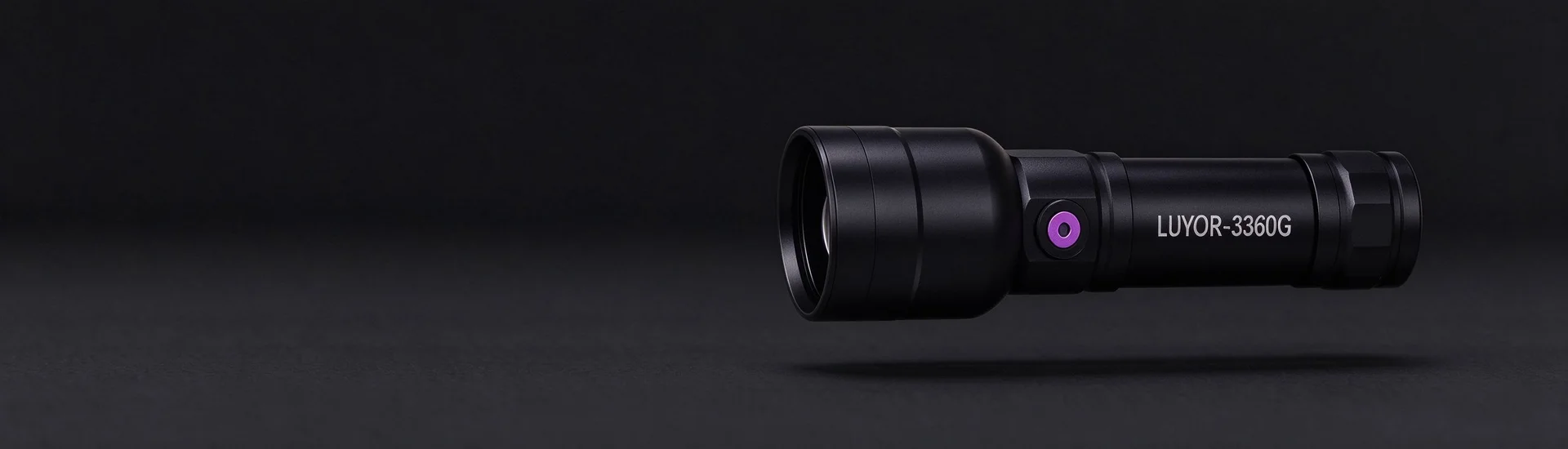
365L has a different role: it is a large-area handheld fluorescent leak-detection and rough-location lamp, not a reading lamp. Multiple high-power 365nm LEDs in the 360-370nm band give about 6500 μW/cm² at 38cm center and an effective illuminated area of about 200mm, so a whole pipe run, a whole unit or a reactor can be swept in an evening, the suspicious locations found, and then confirmed with a 3103 or a BB.
Parameters: one 11.2V lithium pack, about 3-5 hours of continuous work, 2-5 hours to charge; net weight 0.36kg, 0.53kg with battery; head diameter 70mm, length 220mm, with a tactile switch that works through a glove. Output is instant, it emits no UVB or UVC short-wave UV, and when used with LUV-10 UV protective glasses the glasses also filter stray reflections and make the fluorescence stand out more clearly.
| Model | Intensity (center at 38cm) | Spot | Power / weight | Positioning in one line |
|---|---|---|---|---|
| LUYOR-BB series | 4000 / 9000 / 17000 μW/cm², three tiers | 26.5-28.5 cm | AC 1.2kg / battery 1.7kg | Fixed-station large-area reading, IP68, washable |
| LUYOR-3103 / 3103D | 4500 μW/cm² | About 200 mm | 24V adapter / 24V battery | Portable lamp for magnetic particle and penetrant work, built-in white LED |
| LUYOR-365L | About 6500 μW/cm² | About 200 mm | 11.2V battery, 3-5h, 0.53kg | Large-area handheld leak search and rough location |
The usual combination: sweep the area with a 365L, read suspicious points close-up with a 3103, and use a BB at a fixed bench or for large batches, selecting H/M/L by how much light the workpiece absorbs. All three sit in the same standards system, so reports and radiometer work can share one management process.
Four acceptance steps: 1. measure center intensity at the specified distance with a traceable UV radiometer and record the reading; 2. measure along both cross directions of the spot to the edge, confirming that readings inside the effective area are all above the threshold with no dark streaks; 3. measure ambient white light in the darkroom to confirm that reading conditions hold; 4. inspect the filter visually for scratches and discoloration, and the emitters for dark spots that do not light.
Routine maintenance is three things: measure illuminance periodically at a fixed distance, in a fixed tier, on a fixed form, and keep the records; clean the filter separately, without an abrasive cloth; and store battery versions at half charge when unused for long periods. Once "the background gets brighter and the fluorescence fainter", suspect filter ageing before the penetrant or the workpiece surface - that order saves a lot of wasted troubleshooting.
There is no default answer on brand: a brand that can produce type test and unit test reports and can support calibration and spares locally is a brand worth talking to; for the light source, choose LED on most new projects unless an old process document specifies mercury; and the model follows from three variables - how large the working face is, how far away it is, and how the lamp is powered. For large-area fixed stations look at the LUYOR-BB series, for portable magnetic particle and penetrant work at the LUYOR-3103/3103D, and for large-area leak search at the LUYOR-365L.
Brand and purchase channel: LUYOR China sales channel (handheld LED black lights, UV flashlights and UV radiometers), and the full 365nm black light range.
On the inspected surface, not at the lamp aperture. The standard says that at the specified inspection distance the UV-A irradiance on the inspected surface is not less than 1000 μW/cm², and 38cm is the industry reference distance. When the working distance differs from the reference, the reading has to be measured on site; the lamp's rated figure cannot be converted directly.
Probably not. Intensity falls roughly with the inverse square of distance, so at 60cm the reading is just about forty percent of the 38cm value and easily drops near the 1000 μW/cm² threshold. Measure with a radiometer before moving back; if it is short, choose a higher intensity tier or bring the distance in. Do not judge by "the lamp is still lit".
They can be used. Where an older line and an older process document specify mercury and the equipment is in good condition, there is no reason it must be replaced. But new projects and new purchases almost all go to LED: instant start with no 5-15 minute warm-up, battery versions for tanks and towers, no mercury, and no tube consumable or hazardous-waste disposal step.
No, they are fixed intensity tiers set at the factory. Choose the tier by how much light the workpiece surface absorbs, the inspection distance and the ambient light: BBH for long-distance illumination and dark or rough surfaces, BBM as the routine PT/MT workhorse, BBL for fine darkroom reading and long continuous shifts.
Not advisable. The white-light blocking filter is itself part of the compliance specification; a self-fitted part has no transmittance evidence and the report no longer matches the hardware. When "the background gets brighter and the fluorescence fainter", suspect filter ageing, contact the manufacturer for the same model of original part, and keep the record.
Not advisable. An inspection lamp is designed for narrow-band 365nm output with low white light leakage, while curing depends on matching wavelength to power density; the two have different performance targets. Using an inspection lamp as a curing lamp long-term runs it outside its intended duty, decay arrives earlier, and reading performance fails before the housing does.
This article belongs to the frequently asked questions section.
Other sections on the same product line include 365nm black lights (UV area sources for inspection, leak detection and fluorescence, judged on irradiance rather than wattage) and industrial test instruments (the entry point for UV inspection, speed measurement, stroboscopic observation and surface inspection).
Models mentioned in this article: LUYOR-3103, LUYOR-BBMA, LUYOR-365L. Ranges, accuracy and accessory lists for each model are given on the product pages.

Email: info@xinysun.com

Tel: 131-2093-6518

Address: 1525 Minqiang Road, Bldg 26, Songjiang, Shanghai

Copyright 2026 Xinysun Instrument (Shanghai) Co., Ltd. All rights reserved.
ICP:ICP-2026046447




 Industrial Test Instruments


