
Products
PRODUCTS Breadcrumb: Home > Products > Industrial Test Instruments > UV Flashlights
 Overview
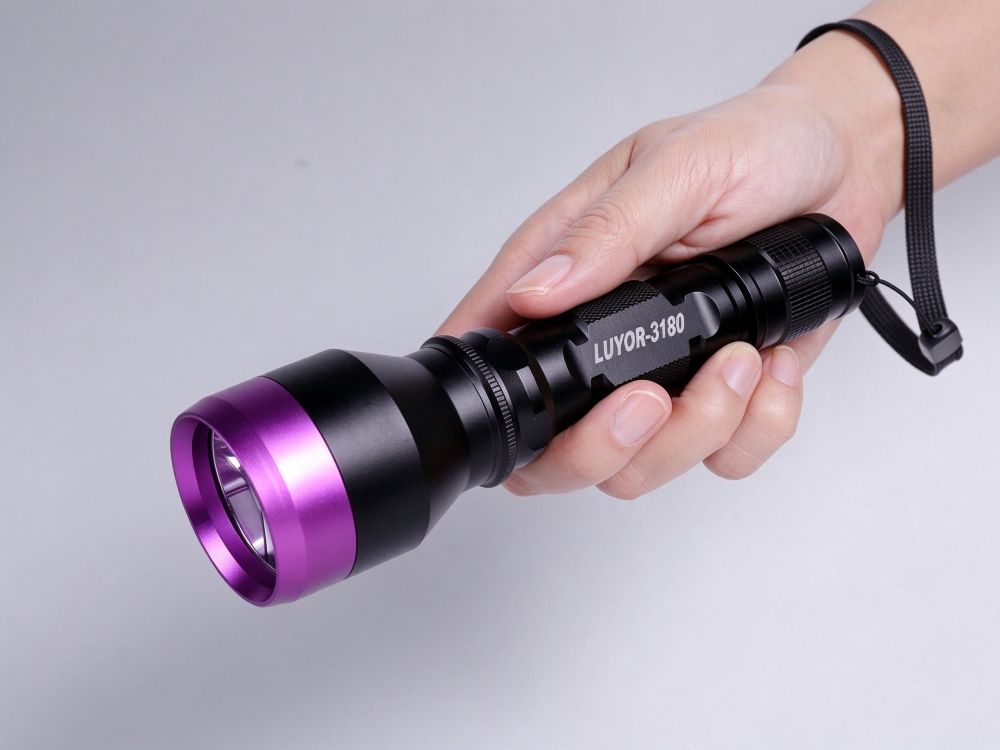
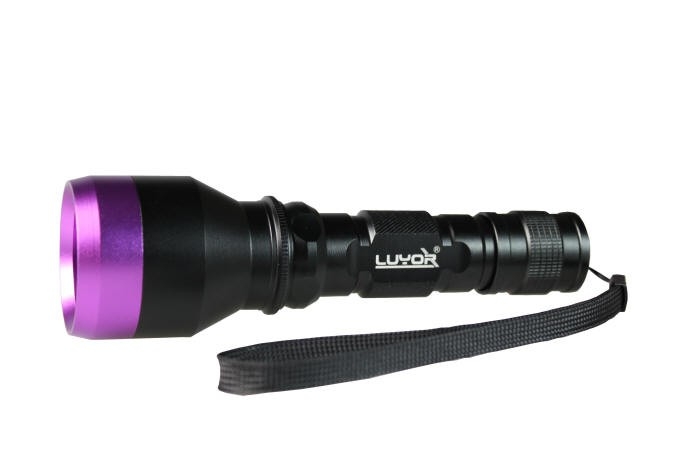
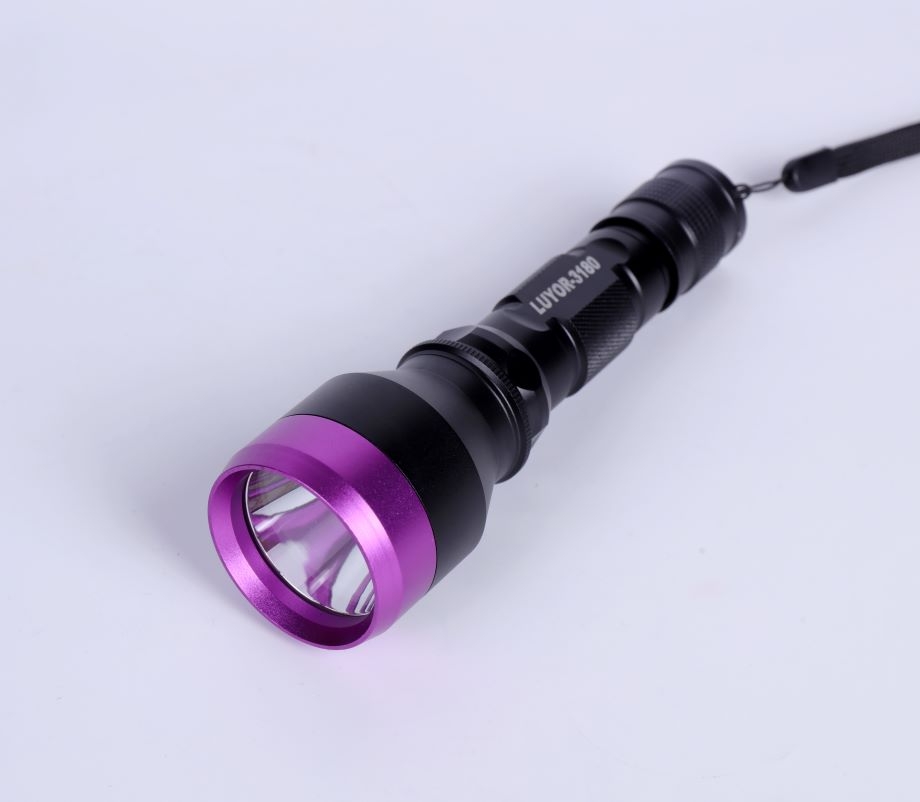
LUYOR-3180 spot UV flashlight delivers 30000-40000 uW/cm2 at 38 cm with a 30 mm beam center, 365 nm UV-A LED, 50000 h life and IP65 housing.
UV Flashlight is a handheld UV inspection tool built around a 365 nm UV-A LED, used for fluorescent leak detection, fluorescence observation in penetrant and magnetic particle inspection, degreasing checks, and mineral or fluorescent tracer inspection. The LUYOR-3180 is a spot-type UV flashlight: 30000-40000 μW/cm² at 38 cm, with a Ø30 mm beam center.
The original page listed this lamp's uses as a very long inventory, which made the priorities hard to see. On site it solves three problem types, and all three share one trait: the target is small, the light is weak, and it is often somewhere you cannot reach.
| Task | What you look for | Where it gets hard | What the lamp must do |
|---|---|---|---|
| Fluorescent leak detection | Fluorescent traces seeping from a leak point after tracer dye is added to refrigeration, hydraulic, oil or water systems | Leak points are often pinhead-sized and hidden behind fittings, under welds, or inside equipment | High single-point intensity and a tight beam, so fluorescence can be driven out of a narrow gap |
| Fluorescent penetrant / magnetic particle inspection | Fluorescent indications left at discontinuities in penetrant testing and magnetic particle testing | These indications are the basis for judging defects; fluorescence brightness and sharpness directly affect the call | Pure wavelength, low visible leakage, stable output, so reading conditions stay controlled |
| Degreasing / cleanliness checks | Oil film, cleaning residue, and residue from cleaning validation on part surfaces | Residue levels are very low and completely invisible under white light | Flexible working distance: fine detail up close, fast sweep from farther back |
Spread one source over a large surface, then concentrate the same light into a small point: the energy per unit area differs greatly. Whether fluorescence is visible depends on the UV irradiance the target receives per unit area, not on the total output of the lamp.
Beam center diameter approx. Ø30 mm, full beam approx. Ø70 mm (at 38 cm)
Intensity at 38 cm 30000-40000 μW/cm²
Energy is concentrated in the center, which suits precise location of small targets
The trade-off: each pass covers a small area, so full inspection means moving the lamp repeatedly
At 150 mm from the lamp head, effective spot diameter approx. 100 mm, intensity approx. 25000 μW/cm²
Lights a flange face, a full pipe circumference, or a vessel wall in one pass
Suits full-coverage work where every spot must be lit
The trade-off: lower single-point intensity, so tiny targets are less clear than with a spot type
So this is not a question of which is better, but of matching the lamp to the way you work:
Scanning full inspection ("Is there oil anywhere around this circumference?") - needs a large spot, so choose the large-area type; the risk is missing a spot
Targeted locating ("Where exactly is the leak?") - needs high single-point intensity, so choose the spot type; the risk is not seeing it
This is the part the original page tends to skip, and where orders go wrong: the same flashlight comes in clear filter, black filter and white light versions, with different intensity and different uses. The original specification paragraph actually quotes 3180B figures (30000 μW/cm² / below 10 lux) while the product title says LUYOR-3180, so the two do not match. Confirm the version before ordering.
| Model | Wavelength band | Filter | Visible light at 38 cm | UV intensity at 38 cm | Main use |
|---|---|---|---|---|---|
| LUYOR-3180 | 360-370 nm | Clear filter | below 20 lux | approx. 40000 μW/cm² | Leak detection, dust inspection - where fluorescence must be driven bright |
| LUYOR-3180B | 360-370 nm | Black filter | below 10 lux | approx. 30000 μW/cm² | Fluorescent inspection, trace evidence - where a dark background and pure fluorescent color matter |
| LUYOR-3180W | 400-760 nm | - (white light) | white light | - | White-light reference check at the same location |
First, a common question: why do all makers rate at 38 cm (15 in)?
Because 38 cm is the customary reference measuring distance for UV lamps in nondestructive testing. Every maker rates intensity at that same distance, which is what makes comparisons meaningful. Lamp A at "25000 μW/cm² at 150 mm" and lamp B at "30000 μW/cm² at 38 cm" cannot be compared as raw numbers; check the distance first. So the first thing to confirm about any intensity figure is the distance behind it.
UV intensity falls off quickly with distance (roughly inverse square). For a given target, the farther the lamp is, the harder the target is to see. Conversely, a lamp that delivers over 30000 μW/cm² at 38 cm usually still has usable intensity farther out, and that is the real value of high output: it reaches the spots you cannot easily get close to.
In fluorescent penetrant and magnetic particle testing, the industry sets requirements for UV irradiance on the inspected surface (a common requirement is at least 1000 μW/cm² with white light held below 20 lux); confirm the actual limits in the inspection standard and process documents you work to. Against that benchmark, the 3180 series has a large margin at 38 cm, so it can work at greater distance, or still produce a usable signal where ambient light is slightly brighter. But whether it is enough should be judged on the irradiance measured on the inspected surface at your actual working distance, not on the nominal figure. We can help with a measurement method.
Refrigeration, hydraulic and oil circuit leak detection is the typical use. The procedure is simple, but each step has a precondition that affects the result.
Add tracer for the matching system at the ratio recommended for the system volume and by the tracer maker, and circulate to mix. The precondition is that you must use the matching tracer - plain mineral oil and refrigeration oil have very weak native fluorescence, so shining a UV lamp without tracer usually shows nothing.
Run the system at design conditions for a period (tens of minutes to several hours, sometimes overnight, depending on the system and leak size) so the tracer circulates with the working fluid and seeps out at the leak. Insufficient run time is a common reason for "nothing shows up", and it is not the lamp.
Switch off nearby lighting or hang a light-blocking cloth. The lamp's own white leakage is already low (below 20 lux for the 3180, below 10 lux for the 3180B), but ambient white light comes from shop lighting, not from the lamp, so darkening the area is a required step.
First pass over the suspect area quickly at a slightly greater distance (about 38 cm or more, using the Ø70 mm full beam) to find where fluorescence appears; then bring the lamp to 10-25 cm and use the Ø30 mm high-intensity center to confirm the exact location and shape of the leak.
Seeping tracer forms a yellow-green fluorescent trail that smears in the direction of the leak, while a wiped surface shows only random smears. Once confirmed, photograph the location so the same spot can be rechecked after repair. Watch for interference: cotton fibers, dust, some cleaners and rust-preventive oils also fluoresce under UV. The way to tell: wipe with a clean, oil-free white cloth - foreign material comes off, a leak trace does not and keeps its smeared pattern.
The original page says the lamp "meets inspection standards and suits fluorescent penetrant and fluorescent magnetic particle inspection". The direction is right, but inspection is work governed by standards, so the boundaries need to be clear. This way your customers will not take a nominal intensity into a judgment that requires a report.
Correct wavelength band: 365 nm pure UV-A, no UVB/UVC, which meets the band requirement for the excitation source in fluorescent testing
Dark background: the 3180B with black filter has visible leakage below 10 lux at 38 cm, giving high contrast between fluorescent indication and background
Magnetic field resistance: fluorescent magnetic particle inspection sites have strong magnetizing fields; this design keeps the lamp working stably near magnetizing equipment
Whether irradiance meets the standard: standards set a minimum UV irradiance on the inspected surface; confirm it by measurement at the actual working distance
Whether white light is controlled: the reading area also has an upper limit on ambient white light
Intensity check records: lamps used for inspection usually need periodic intensity check records; build this into equipment management
Standard basis: follow the inspection standard you work to (e.g. ASTM E3022, ASTM E1417, ISO 3059) and your process documents
| Item | LUYOR-3180 (this page) | LUYOR-2130L |
|---|---|---|
| Beam pattern | Spot, beam center approx. Ø30 mm | Large area, spot diameter approx. 100 mm at 150 mm |
| Nominal intensity | 30000-40000 μW/cm² at 38 cm | approx. 25000 μW/cm² at 150 mm from the lamp head |
| Runtime | approx. 6-8 h with two batteries alternating | approx. 2-5 h (three brightness levels) |
| Form and weight | 15.9 cm long, approx. 211 g with battery, light to carry | 220 mm long, net weight approx. 600 g |
| Core job | Finding points: leaks, fluorescent inspection indications, tiny residue | Covering surfaces: flange faces, full pipe circumference, vessel walls |
| Typical industries | Refrigeration / hydraulic / oil circuit leak detection, NDT, trace evidence | Degreasing checks in air separation and industrial gas, chemical construction, and medical gas projects |
The rule is simple: if you fear missing a spot (every area must be lit), choose the 2130L; if you fear not seeing it (a tiny target must be lit), choose the 3180. Leak detection and inspection teams often carry both: locate the suspect area with the 3180, confirm the whole surface with the 2130L; or sweep the area first and recheck each point with the 3180.
The figures below come from official product data. Model differences are listed separately; confirm the version before ordering:
| Model | LUYOR-3180 (variants LUYOR-3180B and LUYOR-3180W also available) |
| Product type | Compact spot-type UV flashlight (LED blacklight, fluorescent leak detection lamp) |
| Light source | UV-A LED |
| Peak wavelength | 365 nm |
| Wavelength range | 360-370 nm (pure UV-A, no UVB or UVC) |
| Beam distribution | Spot |
| Beam diameter | Beam center approx. Ø30 mm; full beam approx. Ø70 mm (at 38 cm) |
| UV intensity | At 38 cm (15 in): 3180 approx. 40000 μW/cm²; 3180B approx. 30000 μW/cm² |
| Visible light leakage | At 38 cm: 3180 below 20 lux; 3180B below 10 lux |
| Drive mode | Constant-power drive, continuous stable output |
| Source life | approx. 50000 hours |
| Start-up | Instant start, no warm-up |
| Interference resistance | Resists magnetic fields; works in strong magnetic environments |
| Switch | Tail-mounted to prevent accidental activation |
| Battery | 2 lithium batteries (one spare), 3.7 V; capacity is given as 2600 mAh in some documents and 2200 mAh in others |
| Runtime | approx. 6-8 h with two batteries alternating; approx. 2-3 h per battery |
| Charging time | 1 A charge current, about 2 h to 90%, full charge about 8 h |
| Charger | 100-240 VAC charger, charges two batteries at once; 12 V car charger included |
| Ingress protection | IP65 (first digit 6 = dust-tight; second digit 5 = splash-proof, not immersible) |
| Dimensions | Length approx. 15.9 cm (6.3 in) |
| Weight | approx. 166 g without battery; approx. 211 g with battery |
| Standard package | 1 UV LED flashlight, AC charger, car charger, two lithium batteries (one spare), holster, UV safety glasses, carrying case, instruction manual |
| Typical applications | Fluorescent leak detection (refrigeration / hydraulic / oil / water systems); fluorescence observation for penetrant and magnetic particle inspection; degreasing and oil contamination checks; cleaning validation (e.g. riboflavin checks of pharmaceutical equipment cleaning); dust and micro-residue inspection; fluorescence examination of marks and documents |
Do not look into the lamp head, and do not use your eyes to check whether the lamp is on. 365 nm is UV-A, which the eye barely sees, but the exposure is real
Wear UV safety glasses during work (supplied as standard); for long sessions also protect exposed skin
Do not shine the lamp at anyone's eyes or skin
Do not aim UV at mirrors, polished metal or other highly reflective surfaces, so reflected light cannot reach the eyes
Wash hands after work; return the lamp to its case when not in use to keep the window and filter free of contamination and scratches
Charging: use the 100-240 V universal charger, which charges two batteries at once; for field work use the supplied 12 V car charger
Battery management: alternate the two batteries; charge the spare before heading out, and remove batteries for separate storage during long idle periods
Filter and window: clean only with a soft cloth, never solvents or abrasives; scratches degrade beam uniformity and visible leakage
Ingress protection: IP65 handles dust and splashing, but do not immerse it; check the battery compartment seal regularly and replace it when needed
Intensity checks: for inspection or reportable testing, measure and record at a fixed distance on a regular schedule (see next section)
Do not disassemble: the interior holds LED and optical assemblies; for repair, send the unit to a service center or the LUYOR China service center
For a UV lamp used in inspection or reportable testing, intensity has to be managed.LEDs degrade slowly with use, fluorescence weakens, and operators often do not notice, which causes missed indications while the records look normal.Two controls are worth setting up:
Fixed measurement conditions: standardize the distance (e.g.
All three are the same flashlight with different filters.The LUYOR-3180 has a clear filter, about 40000 μW/cm² at 38 cm with visible light below 20 lux, the higher UV output of the two, suited to fluorescent leak detection and dust inspection where fluorescence must be driven bright.The LUYOR-3180B has a black filter, about 30000 μW/cm² with visible light below 10 lux, giving up some intensity for lower visible leakage; the background is darker and the fluorescent color purer when reading, which suits fluorescence observation in penetrant and magnetic particle inspection and trace evidence.The LUYOR-3180W is the 400-760 nm white light version for white-light reference checks at the same location.Rule of thumb: 3180 for brightness, 3180B for a dark background and pure fluorescent color.State the version when ordering.
Because 38 cm (15 in) is the customary reference measuring distance for UV lamps in nondestructive testing.Every maker rates intensity at that distance, which is what makes comparison possible.Lamp A at 25000 μW/cm² at 150 mm and lamp B at 30000 μW/cm² at 38 cm cannot be compared as raw numbers; check the distance first.Fluorescent penetrant and magnetic particle testing set clear requirements for UV irradiance on the inspected surface and for ambient visible light (a common industry requirement is at least 1000 μW/cm² on the surface with white light below 20 lux); confirm the actual limits in the standard and process documents you work to.Whether a lamp is adequate depends on the irradiance measured on the inspected surface at your actual working distance.
That is a high-output class among portable UV lamps.What it really means is distance margin: if it delivers over 30000 at 38 cm, it will usually still exceed the common threshold for inspection work farther out.In other words, the lamp does not only work close up; it can also drive fluorescence at one to two meters, which is useful for high spots, equipment interiors and places that are hard to reach.Note that intensity drops quickly with distance, so whether it meets your process requirement depends on the irradiance measured on the inspected surface at the actual working distance, not on the nominal figure.We can help with a measurement method.
Constant-power drive means output power stays the same as the battery drains, so brightness does not fall with it.That matters in inspection: if a lamp dims as the battery runs down, the operator may conclude "there is no fluorescence here" when in fact the lamp is no longer bright enough, a classic source of missed indications.Constant-power drive keeps reading conditions the same from full charge to the cutoff point.It only addresses consistency within one charge cycle; for long-term LED degradation, keep checking with a meter on a schedule.
Yes, for fluorescence observation in both methods.It has three relevant characteristics: 365 nm pure UV-A output with no UVB/UVC, meeting the band requirement for the excitation source in fluorescent testing; the 3180B version with black filter has visible leakage below 10 lux, and the dark background helps when reading fluorescent indications; and the magnetic-field-resistant design keeps it working near strong magnetizing fields at magnetic particle inspection sites.Conditions to note: inspection is governed by standards that set requirements for UV irradiance on the inspected surface, ambient white light, and the lamp intensity check interval.Confirm the figures against the standard you work to (e.g.ASTM E3022, ASTM E1417, ISO 3059) and your process documents, and keep intensity check records.We can help put a measurement plan together.
The principle is tracer dye plus UV light.For a refrigeration system: add fluorescent tracer at the specified ratio, run the system long enough for the tracer to circulate with the refrigerant and seep to the leak, then inspect suspect areas with the UV lamp.The leak shows as a distinct yellow-green fluorescent spot that is easy to locate even in tight spaces or where the line of sight is limited.Oil circuits, hydraulic systems and water systems work the same way with the matching tracer.Two conditions apply: you must use the matching fluorescent tracer, because oil contamination alone has very weak fluorescence; and ambient light should be as low as possible, which is exactly what the lamp's low white leakage is designed for.
That statement is imprecise and carries compliance risk; we have corrected it on this page.365 nm is in the UV-A band.It is not strongly absorbed by the atmosphere and cornea the way UVB/UVC is, but UV-A exposure does have cumulative effects on eyes and skin, and prolonged or close direct viewing can cause discomfort and injury.The package itself includes UV safety glasses; if the lamp were truly harmless, no glasses would be needed.The accurate statement: the spectrum is pure with no UVB/UVC, and the lamp is safe to use when safety glasses are worn as instructed and the lamp head is not viewed directly.
In IP65, the first digit 6 means dust-tight (no dust ingress) and the second digit 5 means splash-proof (water projected from any direction has no harmful effect).So the lamp handles shop dust, normal rain and washdown.Two caveats: a rating does not mean it can be submerged, so do not take it underwater or leave it soaking; and the rating covers the housing, while an aged battery compartment seal lets sealing performance drop, so check the gasket periodically in long service and replace it when needed.The manual supplied with the unit takes precedence.
Sources do differ, and the original page itself states it two ways.The reasonable reading: capacity is given as 2600 mAh in some documents and 2200 mAh in others; one battery runs about 2-3 hours continuously; two batteries are supplied (one spare), giving about 6-8 hours when alternated.Charging is 1 A, about 2 hours to 90% and about 8 hours to full.This site uses "approx.2-3 h per battery, approx.6-8 h with two alternating".For figures to put in a tender, ask LUYOR for a formal datasheet or measure with your own duty cycle.
By beam pattern and task.The LUYOR-2130L is a three-LED large-area type with an effective spot about 100 mm across at 150 mm, suited to full-coverage work where every area must be lit, such as flange faces, full pipe circumferences and vessel walls in oxygen line degreasing checks.The LUYOR-3180 is a spot type with a beam center of only about 30 mm but higher intensity, suited to targets that are small, distant or hard to find, such as leak points, inspection indications and micro-residue.The rule: if you fear missing a spot and need full coverage, choose the 2130L; if you fear not seeing it and need it lit, choose the 3180.Many leak detection and inspection teams carry both.
Periodic checks are recommended, especially for inspection or reportable testing.LEDs degrade slowly with use, fluorescence weakens, and missed indications can follow without the operator noticing.The method: measure center intensity at a fixed distance (e.g.always 38 cm) with a UV meter, record it, and set a threshold for replacement or service.We can provide a check plan in your own record format.
Xinysun Instruments (Shanghai) keeps the LUYOR-3180 series in stock.Batteries, chargers, car chargers, holsters, UV safety glasses and other parts are available on an ongoing basis.We can help with model comparison, a UV lamp intensity check plan and operating notes.Call 131-2093-6518 or leave a message in the form at the bottom of the page.
It can, so scan by keeping the head close and overlapping passes sideways: hold the lamp head near the surface, move the spot row by row, and keep about one third of a spot width of overlap between passes.Slow down and make extra passes at complex features (welds, threads, corners, sealing faces).The advantage of a spot type is high single-point intensity and penetration of tracer at greater distance; the cost is small coverage per pass, which a disciplined scan pattern compensates for.
No.Choose the tracer for the medium being checked: refrigerant systems use a tracer compatible with the refrigeration oil, and hydraulic oil, lubricating oil and water-based systems each have their own grades.Fluorescent penetrant testing uses a penetrant and developer system, a completely different process that cannot serve as a leak detection tracer.Choose the grade per the equipment and dye maker's instructions, and confirm its excitation wavelength matches this lamp's 365 nm output.
The product uses a built-in rechargeable battery and comes with a charger; charge fully before heading out and bring the charger or a car charging option.For multi-day field work, carry a second lamp so the job does not stop when one unit runs down.Batteries are consumables; if runtime drops noticeably, contact us for a replacement original battery.
LUYOR-3180 series official manual and specification data
Comparison notes for the 3180 / 3180B / 3180W versions
Standard package list (flashlight, charger, car charger, two batteries, holster, safety glasses, case)
UV lamp intensity check record plan (with recommended distance and thresholds)
In stock in Shanghai with the full standard package (two batteries and car charger included)
Selection comparison and operating notes for leak detection and fluorescent inspection
Ongoing supply of batteries, chargers, holsters, UV safety glasses and other parts
Original factory warranty; for repair, send the unit to a service center or the LUYOR China service center
Related reading: Fluorescent inspection blacklight selection overview | LUYOR-2130L large-area degreasing inspection blacklight | Checking lamp intensity output with a UV meter
Send inquiry

Email: info@xinysun.com

Tel: 131-2093-6518

Address: 1525 Minqiang Road, Bldg 26, Songjiang, Shanghai

Copyright 2026 Xinysun Instrument (Shanghai) Co., Ltd. All rights reserved.
ICP:ICP-2026046447




 Products
 Applications
 Previous:
 Back to list

 Industrial Test Instruments


