
Products
PRODUCTS Breadcrumb: Home > Products > Industrial Test Instruments > UV Flashlights
 Overview
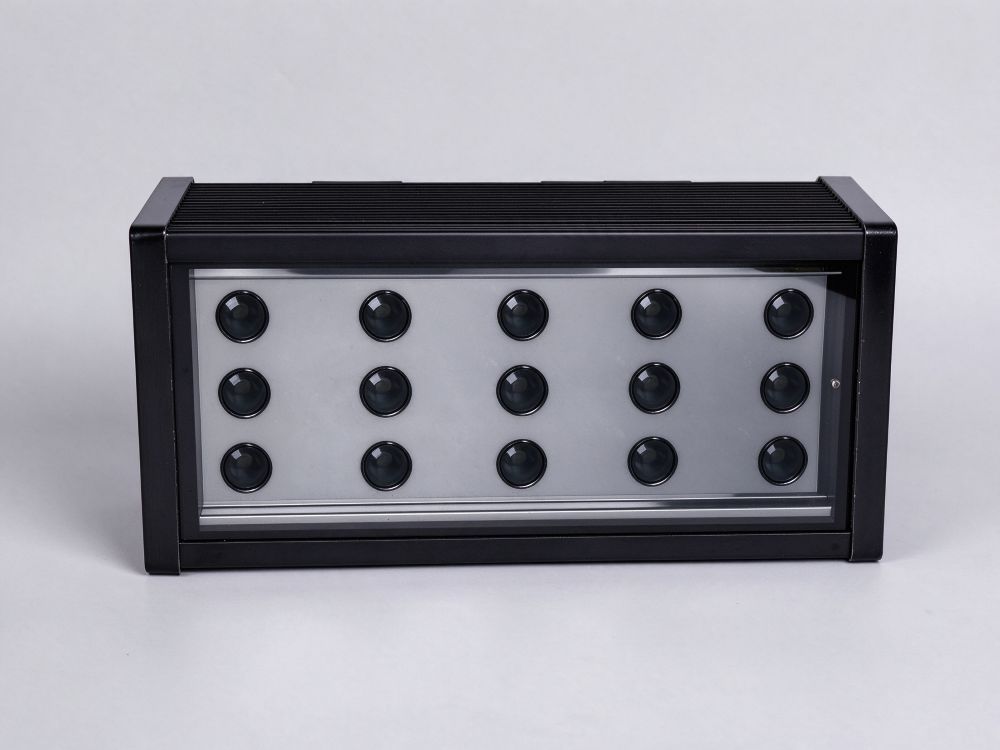
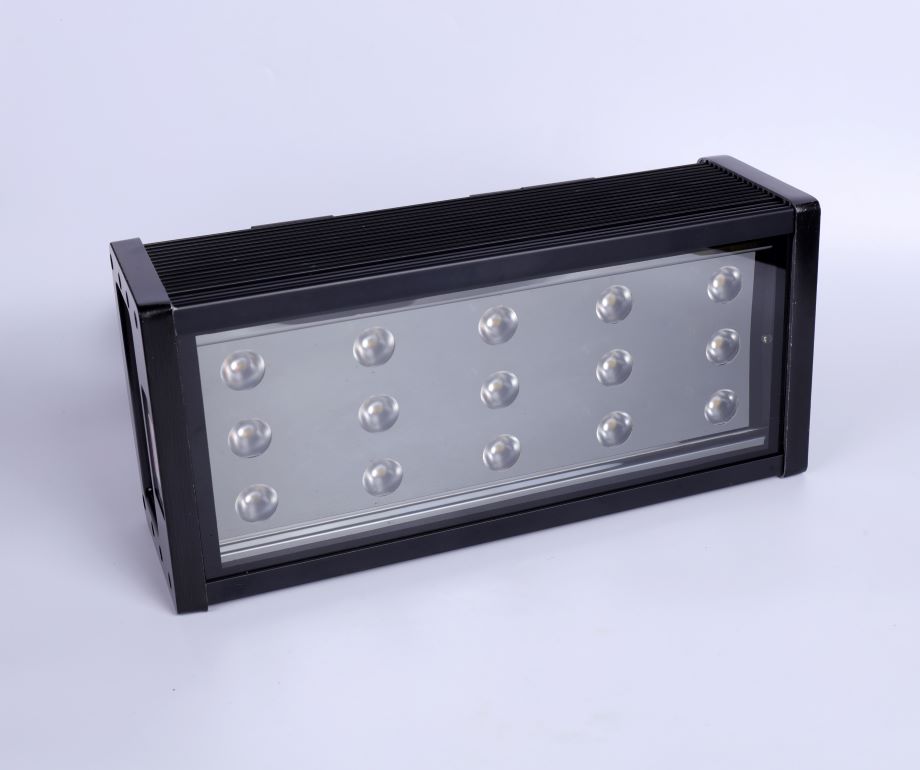
LUYOR-3115 is an overhead 365 nm UV-A lamp giving 9500 uW/cm2 at 380 mm over 250 x 500 mm, with fanless cooling and IP65 for PT and MT stations.
Fluorescent inspection lamp here means a 365 nm UV-A source used for reading fluorescent penetrant testing (PT) and fluorescent magnetic particle testing (MT). The figures that matter are the UV-A irradiance on the test surface (μW/cm²), the effective coverage area, and the level of white-light leakage. LUYOR-3115 is the overhead version in this range, intended for continuous illumination of a fixed production station.
Choosing a fluorescent inspection lamp starts with the reading step itself. Reading in fluorescent penetrant (PT) and fluorescent magnetic particle (MT) testing runs into one unavoidable conflict: the hands must be free to mark, record, and turn the part, yet the lamp must keep lighting the test surface. A handheld lamp satisfies the second need at the cost of one hand, and after two hours of continuous reading the quality of the reading clearly drops.
The overhead form solves exactly this. The lamp is fixed above the station or to the side of the bench, and an adjustable arm puts the light at the required angle, leaving both hands free to mark and record while looking. It gives up portability in exchange for a stable light field, a repeatable angle, and the same reading conditions every time - the three things a process document and an audit care about.
LUYOR-3115 is the mid-size model built on this approach: 15 UV-A LEDs, about 9500 μW/cm² at the center 380 mm from the lamp, and a coverage area of about 250 × 500 mm. That footprint matches the reading of one weld run or one small to medium flange face, in a single pass with no repeated repositioning.
The data below follows LUYOR technical documentation and has been cross-checked against values published through several channels. For selection, tenders, and process documents, use this table rather than the range statements on a brochure page.
| Item | Data |
|---|---|
| Model | LUYOR-3115 (overhead mounting / Overhead) |
| UV source | 15 UV-A LED emitter groups |
| Peak wavelength | 365 ± 5 nm (factory calibrated; nominal 360 to 370 nm) |
| UV-A output | About 9500 μW/cm² (center value at 380 mm from the lamp) |
| Coverage area | About 250 × 500 mm (at 380 mm) |
| UV-B / UV-C radiation | 0 W/m² |
| White light leakage | Below 22 lux (about 2 footcandles) |
| EM06 risk group | Group 2 (DGZfP EM06) |
| LED life | About 50000 hours |
| Cooling | Fanless passive cooling |
| Input voltage | 24 V power adapter (adapter on mains supply) |
| Duty cycle | Continuous duty (no duty-cycle limit; can run all day) |
| Ingress protection | IP65 (dust-tight, splash-proof) |
| Mounting | Overhead or bracket mounted, adjustable illumination angle |
| Expansion | Can be combined in a line or back to back |
One point needs saying: the public description gives the wavelength as 360 to 370 nanometres, while the data sheet gives 365 ± 5 nm. These are two ways of stating the same figure. Any claim of a 355 to 375 nm broad spectrum does not apply to this model.
Wattage misleads when choosing a UV inspection lamp: with the same 15 LEDs, optical design alone can differ several-fold in output. What decides whether a reading is possible is the UV-A irradiance on the test surface (μW/cm²), not the lamp power.
| Reading condition | Requirement | LUYOR-3115 |
|---|---|---|
| UV-A irradiance | Typically not below 1000 μW/cm² on the test surface (ASTM E3022 / ISO 3059 framework) | 9500 μW/cm² at 380 mm, about nine times the threshold |
| Effective coverage | The whole test area must meet the requirement, not just the center | Coverage about 250×500 mm at 380 mm |
| White light leakage | The lower the ambient and lamp visible light, the better the fluorescent contrast | Below 22 lux, close to darkroom reading conditions |
| Emitter condition | Confirm no failed LED before use | A 15-emitter array leaves a dark patch when one fails, which is easy to see |
A rough conversion makes it clearer: if the station layout puts the lamp face about 500 mm from the work, the inverse-square estimate brings center intensity down to around 5000 μW/cm², still above the threshold; at 1 m it is close to the limit. Mounting height is not arbitrary: calculate the irradiance for the actual working distance at installation and confirm it with a UV radiometer.
After installation, take a set of readings: put the part in its normal reading position and measure at the center of the spot and at each corner with a UV radiometer, confirming that the whole area is at or above the threshold. This catches an unsuitable bracket angle or height before production starts.
Once an overhead lamp is installed it is usually lit all day, which is nothing like a handheld lamp. In continuous duty the thermal design decides three things: how fast output falls, how much noise the lamp makes, and whether it blows dust onto the work.
Fanless passive cooling matters in three ways:
The reading area stays quiet. A fan is clearly audible in a quiet shop and adds to fatigue over a long shift;
No dust is raised. A fan lifts developer powder and dust around the station, and it settles on the test surface as false indications;
The penetrant is not disturbed. Some penetrant steps are sensitive to air movement, which affects how the penetrant dwells and how it is observed.
Together with a continuous duty rating, the lamp can stay lit all day without resting. That has real value for production line stability: no extra condition such as stopping for cooling every two hours has to be written into the process document.
IP65 protection answers the real conditions of an inspection shop: penetrant spray, emulsifier, developer dust, and splash from the wash station. Dust rating 6 means dust is fully excluded; water rating 5 means water projected from any direction is withstood. The housing surface can be wiped, or even washed, during cleaning without concern about moisture entering.
LUYOR-3115 meets the UV source requirements of the ASTM standards for fluorescent penetrant and fluorescent magnetic particle testing, which is also one of the items checked in NADCAP audits in aerospace and pressure vessel work. The following questions usually come up, and having the paperwork ready saves time:
| What the auditor asks | What to prepare |
|---|---|
| Is the light source compliant | Product specification sheet and factory test report; state the 365±5 nm wavelength and white light leakage below 22 lux |
| Does irradiance meet the requirement | Station measurement record (UV radiometer readings with the measurement distance and points noted) |
| Is the equipment in good working order | Periodic calibration records and visual emitter check records |
| Is the radiometer itself in calibration | Calibration certificate for the radiometer (ISO 17025 or equivalent) |
| Operator protection | Records of safety glasses issue and the IEC 62471 risk assessment |
On where the irradiance threshold comes from, why 38 cm is the measurement basis, and how emitter ageing and partial array failure let a reading drift down quietly, there is a separate article on this site: Lamp wattage misleads you: μW/cm² requirements across inspection types. For the full requirement on type testing and individual unit test reports, see ASTM E3022-26 in depth.
The LUYOR-3100 overhead range has seven models, differing mainly in LED count and coverage area. The right order is work out the test surface size, then find the model that covers it, rather than reaching for the highest output.
| Model | LEDs | Coverage at 380 mm | Test surfaces it suits |
|---|---|---|---|
| LUYOR-3103 | 3 | About 160 × 140 mm | Small parts, single-point reading |
| LUYOR-3106 | 6 | About 250 × 250 mm | Small to medium parts, short welds |
| LUYOR-3109 | 9 | About 300 × 300 mm | Square parts, flange faces |
| LUYOR-3115 | 15 | About 250 × 500 mm | Long weld runs, small to medium flanges, connecting rods |
| LUYOR-3118 | 18 | About 300 × 500 mm | Medium structures, wide welds |
| LUYOR-3121 | 21 | About 250 × 650 mm | Long welds, longitudinal shell seams |
| LUYOR-3124 | 24 | About 300 × 650 mm | Large-area reading, whole-bench illumination |
Another capability that is easily missed is combined mounting: several 3115 units can be joined in a line or back to back. In a line they extend the covered band, for example along a full longitudinal shell seam; back to back they light from two directions at once, reducing the shadows and glare that single-side lighting creates. This is practical when upgrading an existing station: start with one unit and add more as needed, instead of buying a large model up front.
| Industry | Typical parts and operations | Suggested configuration |
|---|---|---|
| Aerospace | Fluorescent penetrant testing of skins, frames and stringers, fittings, and landing gear parts | One 3115 at a fixed station, with the reading area shielded from light |
| Pressure vessels | PT / MT of longitudinal and circumferential shell seams, heads, and nozzle fillet welds | Units joined in a line, or mounted on a track along the seam |
| Automotive parts | Magnetic particle testing of castings, forgings, connecting rods, and gears | Side-mounted on the bench, with a rotating fixture for the part |
| Rail transit | Fluorescent magnetic particle testing of wheelsets, axles, and bogie frames | Two lamps back to back, covering both sides of the axle body |
| Machinery and power | Steam turbine blades, fan shafts, bearing rings | A darkroom station with light-blocking curtains to control ambient light |
Two points when mounting overhead: the bracket must lock its angle reliably, because any drift in lamp position during reading changes the irradiance conditions directly; and keep UV from spilling onto the neighbouring station - IP65 protects against water and dust, not against UV, so operators at the next station still need protection.
They describe different sides of the same kind of source: black light refers to the 365 nm UV-A band itself; fluorescent inspection lamp refers to its use for reading fluorescent penetrant (PT) and fluorescent magnetic particle (MT) indications; UV torch refers to the handheld form. Whether a lamp can be used for inspection depends on the UV-A irradiance on the test surface, the coverage area, and the white-light leakage, not on the name. The LUYOR-3115 on this page is an overhead fluorescent inspection lamp.
The two differ in form and use. The 3115 is overhead and lights a fixed station continuously, leaving both hands free to mark and record, which suits routine reading on a production line; the 3180 is a focusing torch rated about 40000 μW/cm² at 38 cm, suited to finding small leaks on equipment, climbing, and tank entry. Choose the 3115 for a line station and the 3180 for field inspection and repair; they do not replace each other.
Estimate with the inverse-square relation: at twice the distance, 760 mm, irradiance falls to about a quarter, around 2400 μW/cm², still above the 1000 μW/cm² threshold; beyond that it has to be calculated. After installation, measure at the actual reading position with a UV radiometer, at the center and at each corner, to confirm the whole area is at or above the threshold.
No. The 3115 uses UV-A LEDs, and the optical path holds white light leakage below 22 lux without an added filter. Some versions can be supplied with a built-in black light filter for work with tighter white-light leakage limits; state this at the time of purchase.
Yes. The lamp is rated for continuous duty with no duty-cycle limit, and with fanless passive cooling it is designed for that condition. Routine care is to wipe the lamp face and the heat-dissipating surfaces on a schedule so that dust does not reduce cooling efficiency.
Yes, in a line or back to back. In a line they extend the covered band for long welds; back to back they light from two sides and reduce the shadows and glare of single-side lighting. After combining, re-measure the irradiance to confirm that the overlap is not overexposed and that the edges are not underlit.
Three items: 1. each shift, check visually that the spot is even and has no dark area, which is how a single failed LED shows; 2. on a schedule, measure irradiance with a UV radiometer at a fixed distance and fixed points, record it, and send the lamp for service when the reading falls clearly; 3. wipe the lamp face and body on a schedule to remove penetrant residue and dust.
Choosing an overhead fluorescent inspection lamp comes down to stating three numbers clearly: test surface size, reading distance, and ambient light level. Further reading: How to use a UV inspection lamp correctly: 365 nm fluorescent reading methods and model selection. Send us the part type and station dimensions, and we can work through the model and mounting height with you.
Send inquiry

Email: info@xinysun.com

Tel: 131-2093-6518

Address: 1525 Minqiang Road, Bldg 26, Songjiang, Shanghai

Copyright 2026 Xinysun Instrument (Shanghai) Co., Ltd. All rights reserved.
ICP:ICP-2026046447




 Products
 Applications
 Previous:
 Back to list

 Industrial Test Instruments


