Products
PRODUCTS Breadcrumb: Home > Products > Industrial Test Instruments > UV Flashlights
 Overview
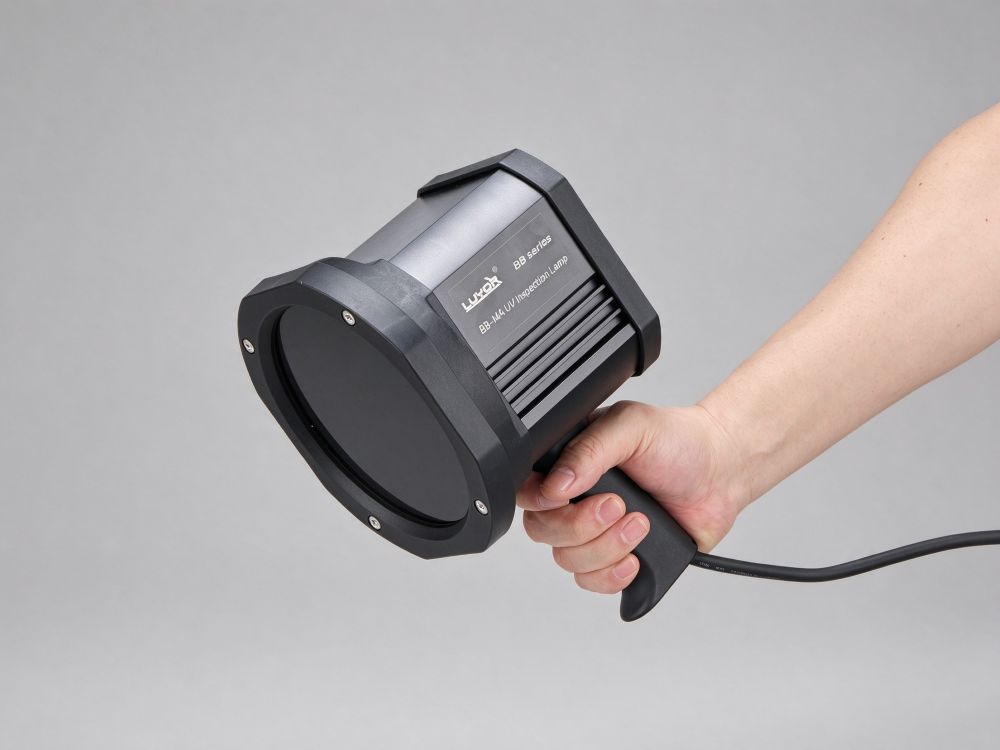
LUYOR-BBMA is a mains 365 nm UV-A inspection lamp rated 9000 uW/cm2 at 38 cm, with white-light filter and IP68 sealing for penetrant test benches.
The letters in the LUYOR-BB series are not arbitrary, and once you can read them you do not need the data sheet every time. The code has two parts, intensity grade plus power source: the leading BB is the series, the third letter H, M, or L marks high, medium, or low intensity, and the final letter A means AC mains supply, B means battery.
| Grade | Mains version | Battery version | Center intensity at 38 cm | Effective spot (>1000 μW/cm²) | Battery runtime |
|---|---|---|---|---|---|
| High BBH | BBHA | BBHB | 17000 μW/cm² | 26.5 cm | approx. 5 h |
| Medium BBM | BBMA | BBMB | 9000 μW/cm² | 28.5 cm | approx. 6 h |
| Low BBL | BBLA | BBLB | 4000 μW/cm² | 27.5 cm | approx. 7 h |
The product on this page is LUYOR-BBMA, the mains version of the medium BBM grade. It is identical to the battery BBMB in light source, optics, and ingress protection; the difference is power: the A type runs from the mains and weighs 1.2 kg, the B type carries a built-in battery, weighs 1.7 kg, and goes anywhere without a cable.
That difference decides not which lamp is the better one but how the work is done: for a fixed station or continuous reading on a bench, take the A type; for climbing, tank entry, and work across areas, take the B type. A common arrangement in one shop is an A type on the main bench with one or two B types for mobile work.
Reading fluorescent penetrant and fluorescent magnetic particle indications depends on the glow of the fluorescent indicator left in the defect. Whether that reading is valid depends on a UV field on the test surface that is bright enough, even enough, and large enough - and all three carry equal weight; lose any one and the risk of a missed indication rises.
Compact LED inspection lamps commonly pack three to five UV LEDs a few millimetres apart into a small housing. The direct result is concentrated heat: junction temperature climbs, output falls faster, and service life is shortened. The harder problem is observability: with a small housing and densely packed emitters, a failed LED still leaves light coming out, but that patch darkens quickly and the operator can barely see it from the outside.
ASTM E3022 requires that failed LEDs and other critical parts be replaced before use. If a failed emitter cannot be noticed, that requirement cannot be met - the record looks fine while the reading conditions no longer hold.
The BB series takes the opposite approach and spreads the UV energy out: eight quality UV LEDs in an array behind a white-light blocking filter produce an effective spot 26 to 28.5 cm across, measured where the reading stays above 1000 μW/cm². Three benefits follow:
One work surface in a single pass, so a full weld circumference or a whole flange does not need repeated repositioning and the reading conditions stay consistent across the area;
Wider emitter spacing and enough heat-dissipating area, so junction temperature is lower and long-term output decays more slowly;
A failed emitter is easier to spot, because the spot is built from eight independent sources and a dark patch stands out against an even background.
The three grades match three working distances and reading needs. Choose wrongly and you get one of two familiar problems: the lamp looks bright but the indication still cannot be read, or the indication reads fine but the work is slow.
| Grade | Center intensity at 38 cm | Effective spot | Work it suits |
|---|---|---|---|
| BBH high | 17000 μW/cm² | 26.5 cm | Long inspection distance and strong penetration: remote PT on large structures, dark or rough surfaces, brighter shop light |
| BBM medium | 9000 μW/cm² | 28.5 cm (the widest of the three) | The general PT/MT workhorse: balanced coverage and contrast, production line takt inspection |
| BBL low | 4000 μW/cm² | 27.5 cm | Fine reading in a dark room or controlled lighting, long continuous shifts (longer runtime) |
One result is counter-intuitive: BBM center intensity is about half that of BBH, yet its effective spot is the widest of the three. This comes from the optical design, which puts more energy into the edges so the whole area stays above 1000 μW/cm². For routine inspection, where every point has to be read, the throughput gain from a wider spot usually outweighs the contrast gain from a higher center value.
Conversely, if the surface absorbs a lot of light (castings, dark coatings) or must be lit from a distance, BBH center intensity is what matters. That is why all three grades remain in the range rather than a single model.
The difficulty of fluorescent reading is fundamentally a question of contrast, not of brightness alone. The fluorescent indicator in a defect emits weakly, and if the excitation light carries visible white light, that white light brightens the part surface and lifts the background, compressing the difference between indication and background until reading becomes hard.
Every BB lamp carries a white-light blocking filter that removes the visible light the LEDs leak, so the output is as close to pure UV as practical. It has a further property that is easy to miss: it does not bleach under sunlight. An ordinary filter exposed to UV and daylight slowly loses blocking power, may yellow, and lets more white light through - with nothing visible from the outside; the reading or the inspection result simply gets worse.
To judge whether a lamp still does the job, look at white-light leakage as well as UV intensity. If the background seems to brighten and the fluorescence to fade, suspect the filter before blaming the part or the penetrant.
With eight LEDs packed closely, poor optical design also leaves bright and dark bands in the beam from the individual emitters. The BB series is built for an even beam profile with no shadows or dark points from the LEDs - a local reading that passes while the gaps between emitters are dark is a difficult source of missed indications to catch.
An inspection shop is not kind to a lamp: penetrant spray, emulsifier, developer dust, splash from the wash station, and oil on the bench. The problem with an ordinary lamp is not that it fears water; it is that penetrant creeps into housing seams and stays there - penetrant is itself fluorescent, and residue around the lamp head creates a ring of false fluorescence that interferes with reading.
All BB models are IP68 rated with penetrant-resistant sealing. That means two things:
The lamp can be washed as a whole, with no worry about moisture entering the body after cleaning;
Penetrant does not readily collect in the housing seams, which cuts false fluorescence and cleaning time.
On weight, the mains version is 1.2 kg and the battery version 1.7 kg. At a station where the lamp is held in one hand for long reading sessions, that difference is felt clearly after a few hours - one reason the A type is preferred on the bench.
The BB series meets the requirements of ASTM E3022 for LED UV inspection lamps and is assessed under IEC 62471 as risk group 3 (as with all high-intensity UV sources, wear eye protection rated for the wavelength and avoid direct viewing and prolonged exposure). This is also one of the items looked at in NADCAP audits in aerospace and pressure vessel work.
| Requirement | What it says | What to do on site |
|---|---|---|
| UV intensity | UV-A on the inspection surface not below 1000 μW/cm² (ASTM E3022 / ISO 3059 wording) | Measure at a fixed distance on a schedule; the 38 cm effective spot diameter of the BB series corresponds to that threshold |
| Visible light leakage | Limit ambient and lamp white light to preserve fluorescent contrast | Fit the white-light blocking filter; keep direct strong light off the reading area |
| Emitter condition | Confirm no failed LED before use | Check visually that the spot is even and has no dark area; rely on scheduled readings |
| Records | Keep intensity readings and inspection records | Fixed distance, fixed grade, fixed record form |
On why the μW/cm² figure matters more than lamp wattage, and how requirements differ by industry, there is a separate article on this site: Lamp wattage misleads you: μW/cm² requirements across inspection types. It covers where the 38 cm measurement basis comes from and how emitter ageing and partial array failure let a reading drift down quietly.
Light source, optics, and ingress protection are identical, and both are rated 9000 μW/cm² center intensity with a 28.5 cm effective spot. The difference is power and weight: BBMA runs from the mains at about 1.2 kg; BBMB has a built-in battery, weighs about 1.7 kg, and runs about 6 hours. Choose the A type for a fixed station and the B type for mobile and overhead work.
It is well above the common threshold. Under ASTM E3022 and ISO 3059 the inspection surface is usually required to be no lower than 1000 μW/cm²; the BBM center value at 38 cm is nine times that, and the 28.5 cm effective spot is the area where the reading still exceeds 1000 μW/cm². If the working distance is longer or the surface absorbs a lot, consider the BBH grade.
The two figures come from different conventions: the range describes the series as a whole and is written wide, while the per-model data sheet gives the specific value. Use the per-model table for selection and tenders: BBH 17000, BBM 9000, BBL 4000 μW/cm², all measured at the center 38 cm from the lamp face.
In a spot built from eight LEDs, a single failure leaves a dark patch on an even background, which is easier to notice than in a compact small-housing lamp. Even so, measure and record with a UV radiometer at a fixed distance and fixed grade on a schedule; when the reading falls by more than about 20 percent, send the lamp for service or replace it - the eye is not sensitive to a 10 to 20 percent drop.
Yes. The BB series is a 365 nm UV-A source and works for leak detection as well, with the advantage of a large spot that sweeps a long pipe run quickly. Leak detection usually wants a higher single-point intensity to light up a tiny leak; if leak detection is the main job with flaw detection secondary, consider the focusing LUYOR-3180, and if flaw detection dominates with occasional leak checks, the BBM grade is sufficient.
IEC 62471 assesses this series as risk group 3. Wear UV safety glasses rated for the band while working, avoid looking into the lamp head, and avoid prolonged close exposure; on a bench, keep UV from spilling onto the neighbouring station.
If you need help choosing among the three grades, or want UV reading conditions written into a process document, send us the part type, inspection method, and working distance, and we will check the model and configuration with you.
Send inquiry

Email: info@xinysun.com

Tel: 131-2093-6518

Address: 1525 Minqiang Road, Bldg 26, Songjiang, Shanghai

Copyright 2026 Xinysun Instrument (Shanghai) Co., Ltd. All rights reserved.
ICP:ICP-2026046447




 Products
 Applications
 Previous:
 Back to list

 Industrial Test Instruments


