
Products
PRODUCTS Breadcrumb: Home > Products > Industrial Test Instruments > UV Flashlights
 Overview
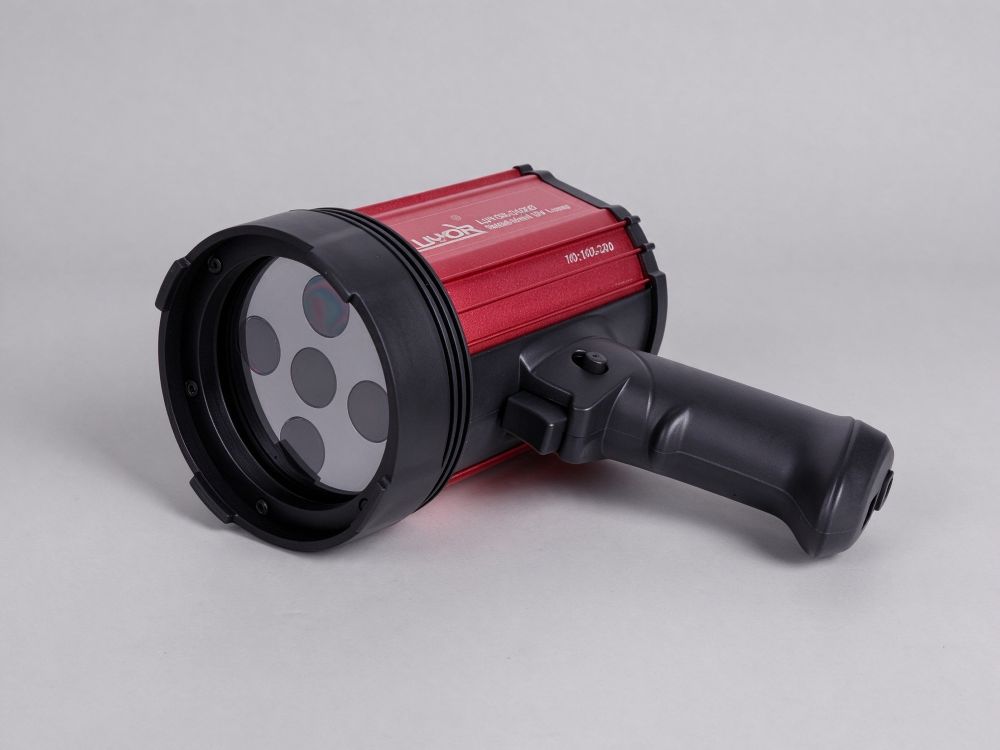
LUYOR-3105 inspection black light: five 365 nm UV-A LEDs give 7000 uW/cm2 at 38 cm and 150 mm coverage, under 10 lux visible light for penetrant testing.
Inspection black light is the common shop-floor name for a 365nm UV-A inspection lamp in industrial nondestructive testing. It works with fluorescent penetrant or fluorescent magnetic particles to excite a fluorescent indication at a defect under darkened conditions. The LUYOR-3105 / 3105D is a portable inspection black light with 5 LEDs and a center intensity of 7000 μW/cm² at 38 cm.
The LUYOR-3105 / 3105D is the "white light removed, intensity added" version of the 3104 series: all five 365nm high-power UV-A LEDs are devoted to exciting fluorescence, with no white illumination built in. Center intensity at 38 cm is 7000 μW/cm², above the 6000 of the 3104. The effective area at 38 cm is about 150 mm in diameter, the band runs 360 to 370nm with a 365nm peak, and there is no UVB or UVC.
It suits two kinds of workstation. One is a penetrant or magnetic particle line where the reading area already has fixed white lighting and no work light is needed on the lamp. The other is inspection that calls for higher UV-A intensity: weakly fluorescing materials, color contrast penetrant rechecked as fluorescent, or a station that wants to shorten the time spent on each point.
On model naming, the 3105 ships with a 24 V power adapter (100 to 260 V AC) and the 3105D with a 24 V lithium battery pack (about 6 hours of continuous work per charge). Like the 3104, the bulky power box is gone, so the unit stays light and works as soon as it is plugged in.
The data below follows LUYOR technical documentation and was cross-checked against the manufacturer catalog PDF. Use this table for selection, tenders, and process documents.
| Item | Specification |
|---|---|
| Model | LUYOR-3105 (adapter version) / LUYOR-3105D (battery version) |
| UV source | 5 high-power UV-A LEDs (365nm) |
| White light | None |
| Peak wavelength | 365 ± 5 nm (360 to 370nm), no UVB / UVC |
| UV-A output | 7000 μW/cm² (center value at 38 cm) |
| Effective irradiation area | Approx. 150 mm (at 38 cm) |
| Visible light level | Below 10 lux |
| Power supply | 3105: 24 V adapter (100 to 260 V AC); 3105D: 24 V lithium battery pack |
| Battery runtime | 3105D about 6 hours, charging about 6 hours |
| Source life | 20000 hours or more |
| Housing | Aluminum alloy, good heat dissipation |
| Filter | Clear quartz optical lens as standard, black filter optional |
| Export packaging | 36 x 25 x 19cm, about 2.5kg |
| Standard accessories | Main unit, LUV-10 clear safety glasses, LUV-30 fluorescence enhancing safety glasses, charger (3105D), manual, certificate of conformity, warranty card, aluminum carry case |
| Warranty | 3 years (excluding human factors) |
| Compliance | ASTM E3022, GB/T 5097-2020 / ISO 3059, GB/T 15822, ASTM E2297, US MIL standard |
The two lamps share the same structure and accessories, and the differences sit in white light and intensity:
| Comparison | LUYOR-3104 / 3104D | LUYOR-3105 / 3105D |
|---|---|---|
| UV LED count | 4 | 5 |
| Center intensity at 38 cm | 6000 μW/cm² | 7000 μW/cm² |
| White light | 1 × 3 W LED (5700 K, separate switch) | None |
| Visible light level | Below 10 lux with UV on (measured 5.45 lux) | Below 10 lux |
| Suitable station | Inspection points that mark, photograph, and record on site | Stations with existing lighting that want higher UV output |
| Power | 3104 adapter / 3104D battery pack about 6 h | 3105 adapter / 3105D battery pack about 6 h |
If you are unsure, judge by whether anyone records at the site: an inspector who also marks and photographs takes the 3104; a station with a dedicated recorder or with fixed lighting takes the 3105 and its higher UV intensity.
Higher intensity is not automatically better. What matters is the match to the part under test:
| Condition | Recommendation |
|---|---|
| Weak fluorescent indications | 7000 μW/cm² lifts the indication from weakly fluorescing materials and shortens the observation time per point |
| Routine penetrant / magnetic particle | Well above the 1000 μW/cm² reading threshold; at 40 cm the lamp still leaves ample illuminance |
| Area-by-area scanning | About 150 mm coverage at 38 cm, advanced panel by panel; for large-part surveys consider the BB series or the 3115 pendant lamp |
| Aerospace large-area scanning | Choose the wide-beam 3105F / 3105DF: wider coverage, 4500 μW/cm² at 38 cm |
Two related topics are covered in dedicated articles on this site: why 38 cm is the measuring reference, and how μW/cm² requirements differ between inspection types: The wattage on a UV lamp misleads you: μW/cm² requirements across inspection types.
Two filter choices: the standard clear quartz lens has high UV transmission; a black filter cuts stray light and raises fluorescence contrast, but blocks about 30% of the UV, so intensity drops accordingly. Unless the process document requires otherwise, buy the standard version;
Two power options: the 3105 with its 24 V adapter suits a fixed reading area; the 3105D lithium pack runs about 6 hours and suits tank interiors, work at height, and mobile field jobs;
Instant start: the LEDs light at once with no mercury lamp warm-up, and the aluminum housing carries heat away in time, so output stays stable over long sessions;
Two pairs of glasses: LUV-10 clear safety glasses protect against knocks, and LUV-30 enhancing glasses raise indication contrast. Wear the LUV-30 for reading.
The LUYOR-3105 series meets the viewing-condition requirements of ASTM E3022 and GB/T 5097-2020 / ISO 3059, and also covers GB/T 15822 (magnetic particle testing), ASTM E2297, and the US MIL standard system. For an audit, have the following ready in advance:
| Audit focus | What to prepare |
|---|---|
| Lamp compliance | ASTM E3022 declaration of conformity and factory inspection report |
| Illuminance verification | Site records from a UV radiometer: UV-A intensity and ambient white light at the reading position |
| Personnel protection | Confirmation that both the LUV-10 and LUV-30 glasses are in use |
| Equipment log | The intensity, wavelength, and filter condition of each 3105 / 3105D on the periodic check sheet |
| Model | Configuration and differences |
|---|---|
| LUYOR-3105 | 5 UV LEDs, narrow-beam lens, clear filter, 24 V adapter power, 7000 μW/cm²@38cm |
| LUYOR-3105D | Same, with an internal lithium battery pack for sites without mains power |
| LUYOR-3105F | Wide-beam lens, wider coverage, 4500 μW/cm²@38cm, designed for aerospace |
| LUYOR-3105DF | Wide-beam lens plus lithium pack, common for aerospace field inspection |
They are three names for the same class of 365nm UV-A source. Inspection black light stresses the band and the task, fluorescent inspection lamp stresses service to fluorescent penetrant and magnetic particle reading, and UV flashlight stresses the handheld form. For selection, watch three numbers - UV-A illuminance on the inspected surface, spot coverage diameter, and white light leakage - then look at power and whether a white LED is built in.
Fit a fixed white work lamp in the reading area, or choose the 3104, which puts a 3 W white LED in the head with a separate switch.
About 6 hours of continuous work per full charge, with about 6 hours to charge. For an 8-hour shift, plan a top-up partway through or carry a spare pack; a fixed station is better served by the adapter version, the 3105.
Inspection reading calls for at least 1000 μW/cm²; the upper end is governed mainly by the filter and the viewing distance. At 38 cm, 7000 μW/cm² leaves ample margin, and viewing through LUV-30 enhancing glasses stays comfortable.
The clear quartz lens transmits more UV and slightly more visible light; the black filter cuts stray light better but blocks about 30% of the UV, taking 7000 down to around 5000. Processes with strict contrast requirements can specify black.
Three items: 1. check the filter visually for cracks every shift; 2. measure illuminance at a fixed distance with a UV radiometer on schedule and log it, sending the lamp for service when readings fall noticeably; 3. wipe the filter and the aluminum heat-dissipating surface with a soft cloth so developer dust does not affect cooling.
To select an inspection black light, state four things clearly: part size, working position, power available, and whether white light is needed. Further reading: How to use a UV inspection lamp correctly: 365nm fluorescence reading methods and selection. Send them to us and we can check the adapter and battery versions and the focusing versus wide-beam lens pairing with you.
Send inquiry

Email: info@xinysun.com

Tel: 131-2093-6518

Address: 1525 Minqiang Road, Bldg 26, Songjiang, Shanghai

Copyright 2026 Xinysun Instrument (Shanghai) Co., Ltd. All rights reserved.
ICP:ICP-2026046447




 Products
 Applications
 Previous:
 Back to list

 Industrial Test Instruments


