
Products
PRODUCTS Breadcrumb: Home > Products > Industrial Test Instruments > UV Flashlights
 Overview
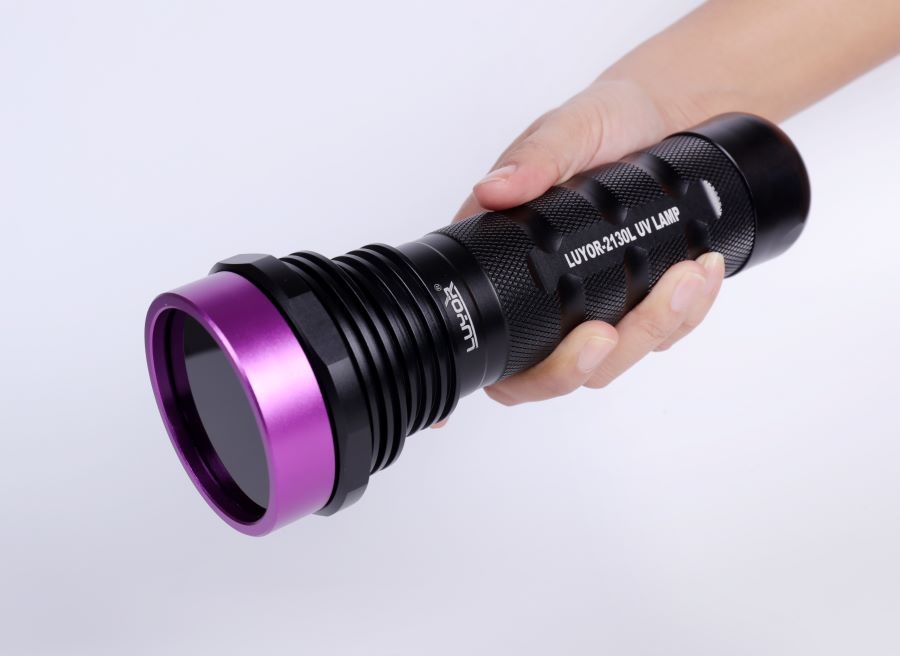
LUYOR-2130L is a 365 nm UV-A degreasing inspection black light for oxygen piping. 25000 uW/cm2 at 150 mm, 3 brightness levels, white light under 15 lux.
Degreasing inspection black light is a 365 nm UV-A inspection lamp for acceptance checks after degreasing of oxygen piping, oxygen tanks, valves and air separation equipment. Residual grease fluoresces under UV, which is how you judge whether cleaning passed. The LUYOR-2130L is the wide-beam model: 25000 μW/cm² center intensity at 150 mm, three brightness levels.
Most customers meet this product because a project specification says 'oxygen piping must be degreased and UV inspected'. Once the reason behind that requirement is clear, how to inspect and how far to go follow naturally.
Oxygen is a strong oxidizer. In contact with grease, under pressure and high gas velocity inside a pipe, it can ignite and burn or detonate very fast. So every internal surface that sees oxygen - carbon and stainless steel pipe, fittings, valve bodies and sealing faces, gaskets, storage tanks - has to be degreased before installation and after maintenance, down to a very low residual grease level. This is not an option for 'a bit cleaner'; it is the safety floor.
After degreasing, how do you prove it is clean? Not by eye, and not under white light. One method in the industry standards is to irradiate the degreased surface with a UV lamp - grease fluoresces yellow-green under 365 nm UV, so even a trace shows. That is where the degreasing inspection black light category comes from.
| Standard | What it does here |
|---|---|
| HG 20202-2000, Code for construction and acceptance of degreasing works | The dedicated degreasing standard. The UV lamp inspection method comes from it: irradiate the degreased surface with a UV source at 3200-3800 Å (that is 320-380 nm, which covers 365 nm) and accept when no violet-blue fluorescence appears. The code also gives three cross-check methods: white filter paper wipe, camphor test, and sampling of the degreasing solution (oil content ≤ 350 mg/L) |
| GB 16912-2008, Safety technical code for oxygen and related gases produced by deep refrigeration | Safety code for oxygen plants and air separation units: after degreasing, oxygen piping must be purged with oil-free dry air or nitrogen, and chlorine-containing degreasers are prohibited |
| GB 50235-2010, Code for construction of industrial metallic piping | General code for industrial metallic piping: cleanliness and pre-installation inspection requirements for oxygen piping |
| GB/T 12244-2021, Valves for oxygen service - Technical specification | Oxygen valve specifics: residual grease in the body and on sealing faces is usually held to max 125 mg/m², and parts must be dried after degreasing |
Traditional degreasing lamps are mostly high-pressure mercury. UV output is indeed high, but three problems are hard to live with on site, and all three hit exactly this job.
| Aspect | Traditional high-pressure mercury black light | LUYOR-2130L (UV-A LED) |
|---|---|---|
| Start-up | About 5 minutes of warm-up to reach stable output | Instant on, no waiting |
| Switching | Cannot be switched often; frequent switching shortens lamp life | Switch any time; tail touch control, three levels |
| Heat and temperature | Bulb surface reaches 200-300 ℃, burn risk | LED cold source, low heat, aluminum body dissipates fast |
| Source life | Short; spare bulbs must be stocked | approx. 50000 hours, close to maintenance-free |
| Spectral purity | Lots of stray visible light; fluorescence is easily washed out | Efficient filter cuts over 90% of white light; white illuminance < 15 lux |
| Format | Mostly tube or hand lamp, bulky | Flashlight type, 220 mm long, reaches into tight spaces and pipe ends |
Standing on a tank roof, crawling through a pipe rack, irradiating every weld and flange one by one - at that workload, the difference between 'wait 5 minutes, do not switch off, mind the heat' and 'pick it up and look' is real labor cost. That is why the LUYOR-2130L replaced the two earlier mercury models (LPX-365 discontinued in 2014, LUYOR-2130 discontinued in 2016).
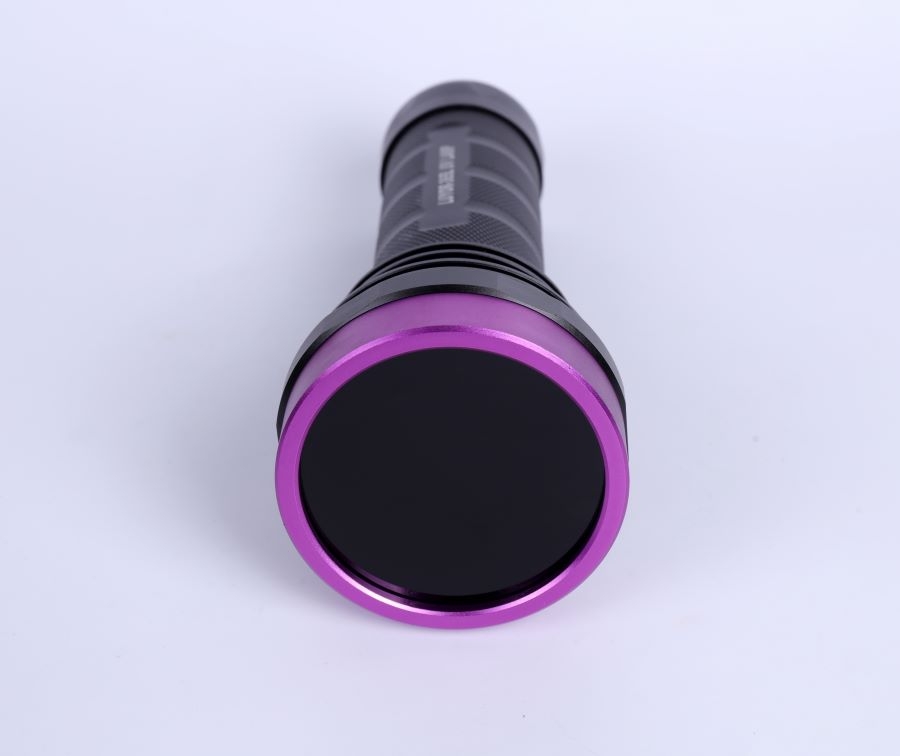
Three UV-A LEDs fire together behind a long-life high-efficiency filter, so the output is not a small dot but a UV patch that covers a flange face or a pipe end. When every point has to be irradiated, a larger spot means fewer passes and fewer misses.
The tail switch steps between high, medium and low. For wide-area scanning, stay on medium, then switch to high and move close to confirm a suspect spot. A fixed level has a second benefit: conditions stay the same across locations and shifts, so results compare.
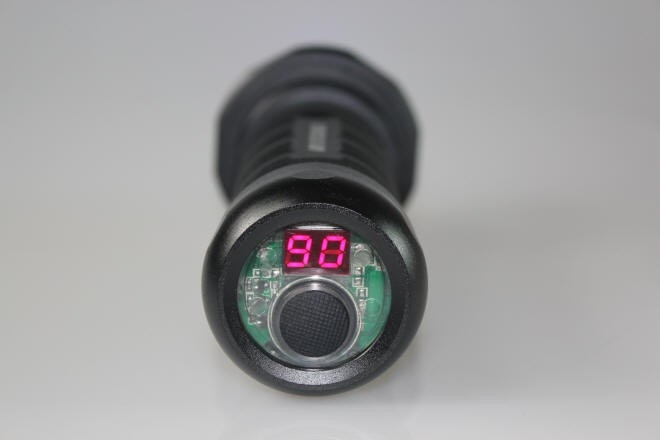
A digital readout in the tail shows remaining charge at a glance. The failure to avoid is running out halfway through, especially up high or inside a tank where going back costs time; one look before you leave prevents it.
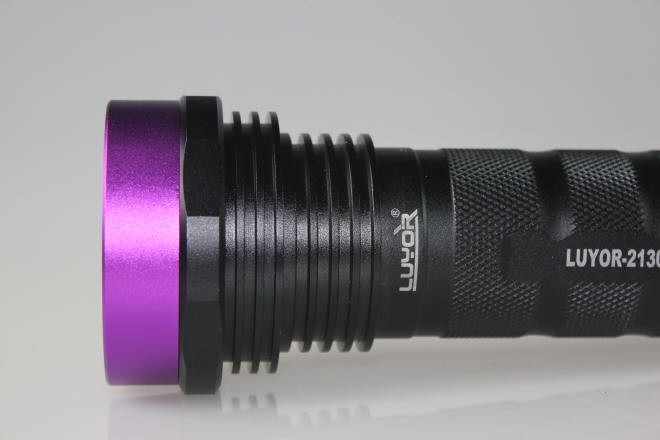
The body is machined from aircraft-grade aluminum with a hard anodized finish. It conducts LED heat away quickly, which protects source life, and it survives knocks on site - this is equipment that rides in a tool bag up towers, into tanks and across the shop.
On heat and life: LED degradation is sensitive to junction temperature, and a good heat path keeps output stable over time. That also means output should still be checked at intervals as the lamp ages; the table and the meter in the next section are for exactly that.
UV intensity falls off quickly with distance, so intensity always has to be read together with distance. Official data for the LUYOR-2130L:
| Distance from lamp head | Center UV intensity | Effective spot diameter | White-light illuminance |
|---|---|---|---|
| 150 mm | 25000 μW/cm² | approx. 100 mm | below 15 lux |
| 250 mm | 13000 μW/cm² | approx. 150 mm | below 10 lux |
| 300 mm | 10000 μW/cm² | approx. 200 mm | below 8 lux |
| 380 mm (38 cm) | approx. 6500 μW/cm² | over 200 mm | - |
Scan far, then near: medium or low level at 250-380 mm for a fast pass over the whole surface, to find suspect areas
Confirm close up: switch to high and move to about 150 mm on each suspect spot, to separate residual grease from contamination
Fix the conditions: within one project, keep scanning distance and level the same, so results from different locations and shifts are comparable
Understand the cost of distance: going from 150 mm to 380 mm leaves about a quarter of the center intensity. Long-distance scanning is faster, but weak residue can be missed - which is why the order is far first, then near
The sequence below follows the UV lamp inspection method of HG 20202-2000 and can serve as the basis of a work instruction. For acceptance criteria and residual limits, use the code clauses and design documents that apply to your project.
Confirm the part has been degreased and rinsed per the process and is fully dry (leftover solvent interferes with reading; purge until no solvent odor remains). Wear the supplied LUV-10 UV safety glasses, oil-free gloves and oil-free tools.
This step is often skipped, and it drives the detection rate. The stronger the ambient visible light, the less a weak fluorescence shows. Where possible, close blinds or screen the area and work in a dark area or at night; if shop lighting cannot be switched off, shield the inspection area and look inside the shield.
Per the intensity data in the previous section: medium or low level at 250-380 mm for wide scanning; high level at about 150 mm for small critical areas and detail. Keep one level and distance across the project so results compare.
Hold the head perpendicular to the surface and work along welds, flanges and threads in overlapping passes, with no skipped sections. Inside pipe and vessels, scan twice, outside-in and top-down.
Pipe and fitting bores, flange sealing faces, welds and heat-affected zones, threaded joints, elbow and tee bores, valve bodies and seat sealing faces, gaskets, blind plates, vessel and tank heads and the area around the liquid level line, and every joint opened before installation.
The criterion is no violet-blue fluorescence on the surface. Mark any fluorescing spot, re-degrease and recheck. The inspection covers every part; record results as pipe section - location - conclusion - inspector - date. After acceptance, passivate immediately or close the pipe ends with dry nitrogen to prevent recontamination.
Black light inspection depends on the eye, so operator experience decides the outcome. The common misreads are collected here.
Under UV, no violet-blue fluorescence on the inspected surface is a pass. That means no fluorescence, not weak fluorescence; there is no middle grade of slightly passing.
| Interference | Source | How to tell it from grease |
|---|---|---|
| Cotton fibers, lint from cleanroom wipes | Shed during wiping, carried on clothing | Wipes off with an oil-free white cloth; appears as threads or dots |
| Dust and inorganic particles | Ambient dust, work by other trades | Wipes off; grease smears into a halo |
| Residue of some cleaners and degreasers | Incomplete rinsing | Re-rinse and dry per process, then recheck; do not reject immediately |
| Rust preventive oil, protective wax | Factory protective coating not fully removed | Continuous film with regular edges: this is not degreased, rather than poorly degreased |
| Marker ink, label adhesive | Construction marking | Fixed position, regular shape, usually obvious at a glance |
Get close in deep holes and small pipe ends. If light cannot reach, you cannot see; put the head into the pipe end when needed and let the bore diffuse the light inward. Avoid aiming at mirror or polished surfaces, which reflect hard and glare.
Intensity sets the detection ceiling. The same residue is visible with strong light at close range and invisible once intensity drops or distance grows. That is why lamp output has to be controlled - which is what the meter in the next section is for.
This category holds several UV lamps with different intent. A wrong choice usually means spot too small and too much walking, or not bright enough and point defects invisible.
| Model | Beam and band | Intensity reference | Runtime | Role | When to choose it |
|---|---|---|---|---|---|
| LUYOR-2130L (this page) | 3 UV-A LEDs, 365 nm, wide area | 25000 μW/cm² at 150 mm approx. 6500 μW/cm² at 38 cm | approx. 2-5 h (three levels) | Oxygen piping degreasing | When you need wide coverage: flange faces, full pipe end circumferences, tank and vessel walls, whole pipe sections |
| LUYOR-3180 | UV-A LED, 365 nm, spot (beam center about 30 mm) | 30000-40000 μW/cm² at 38 cm (depends on filter model) | 6-8 h | Fluorescent leak detection / NDT | When you need reach and punch: point fluorescence, leak points, fine cracks, fingerprints |
| MNT-365A | 365 nm UV-A LED, smooth non-shedding body | Built for fluorescence imaging rather than single-point intensity | Li-ion | Cleanroom particle inspection | When it goes into a cleanroom: particles and biofilm on tools, benches and cavity gaps; the body cleans easily and does not shed |
The data below comes from official product material and can be used directly for selection and internal approval:
| Model | LUYOR-2130L (predecessors LPX-365, discontinued 2014, and LUYOR-2130, discontinued 2016) |
| Type | Flashlight-style wide-area degreasing inspection black light (UV fluorescence inspection lamp) |
| Light source | 3 high-power UV-A LEDs |
| Center wavelength | 365 nm; band 360-370 nm |
| Spectral characteristics | Pure UVA, no UVB or UVC |
| Source life | approx. 50000 hours |
| Filter | Long-life high-efficiency filter, cuts over 90% of white light |
| UV intensity | approx. 25000 μW/cm² at 150 mm; approx. 13000 μW/cm² at 250 mm; approx. 10000 μW/cm² at 300 mm; approx. 6500 μW/cm² at 380 mm (38 cm) |
| Effective spot diameter | approx. 100 mm at 150 mm; approx. 150 mm at 250 mm; approx. 200 mm at 300 mm |
| White-light illuminance | below 15 lux at 150 mm; below 10 lux at 250 mm; below 8 lux at 300 mm |
| Brightness levels | Three (high - medium - low), tail touch switch |
| Battery display | Digital readout in the tail |
| Power | Built-in high-capacity rechargeable Li-ion pack |
| Continuous runtime | approx. 2-5 hours (depends on level; official material also states 3-5 hours, see note below) |
| Charging time | approx. 2-5 hours |
| Charger | AC 110-260 V, 50/60 Hz wide-input charger |
| Dimensions | length 220 mm; head diameter 76 mm; tail diameter 45 mm |
| Packaging dimensions | 380 × 270 × 140 mm |
| Weight | net approx. 600 g (with battery); gross approx. 3000 g (with case and all accessories) |
| Body material | Aircraft-grade aluminum body, hard anodized; LED cold source, heat passed quickly through the body |
| Standard package | 1 LUYOR-2130L flashlight, 1 pair LUV-10 UV safety glasses, 1 high-capacity rechargeable battery pack, 1 110-260 V AC charger, 1 aluminum carrying case, manual, certificate of conformity, warranty card |
| Optional accessories | High-capacity Li-ion pack, LUYOR-340 UV radiometer, LUV-30 fluorescence-enhancing safety glasses, LUV-40 UV face shield, 12 V car charger |
| Warranty | 3-year free warranty on the complete unit |
One risk in degreasing inspection is easy to overlook: the lamp degrades and nobody notices. Below a certain UV intensity, residual oil fluorescence no longer shows and the inspection passes - until the problem appears at commissioning or pressure test. So the basis for judging whether a lamp is usable cannot be that it still lights up; it has to be recorded intensity data against a threshold.
Fixed measurement conditions: one level and one distance (high level at 250 mm, for example), center intensity measured the same way each time and logged in the equipment register
A replacement threshold: for example, send for service or replace when intensity falls below 70% of the initial value, so nobody keeps using a lamp that no longer shows a trace
The second benefit: at audit or acceptance you can produce a continuous intensity record instead of saying you used a black light.
Do not look into the lamp head, and do not check whether it is on with your eyes - 365 nm is UV-A, almost invisible to the eye, but the exposure is real
Wear UV safety glasses: LUV-10 is supplied; for long sessions add the LUV-40 UV face shield
Do not shine the lamp into anyone's eyes or onto bare skin
To see brighter fluorescence, add LUV-30 fluorescence-enhancing glasses rather than taking eye protection off to look harder
Wash hands after work; store the lamp in its case so the window and filter are not contaminated or scratched
Charging: use the supplied 110-260 V wide-input charger, about 2-5 hours; a 12 V car charger is available for field work
Filter and window: soft cloth only, no solvents or abrasives; scratches spoil spot uniformity
Battery management: check the tail readout before leaving; for long trips or work at height, carry a spare pack
Do not open the unit: high voltage and optical assemblies inside; return damaged units to an authorized service station or the LUYOR China service center
Intensity checks: measure and record at fixed conditions at intervals, as in the previous section
| Application | What it checks | Typical targets |
|---|---|---|
| Air separation and industrial gases | Grease residue on oxygen-wetted surfaces after degreasing | Oxygen piping, fittings, tanks, oxygen valves, manifolds, pressure reducing stations |
| Chemical and petrochemical construction | Degreasing acceptance on strongly oxidizing media lines | Oxygen and oxygen-enriched lines, concentrated nitric acid lines, oxygen lines in gasification units |
| Oxygen system turnaround and restart | Re-degreasing and re-inspection after hot work or repair | Opened flanges, replaced valves and gaskets, blind plates and opened joints |
| Medical gas engineering | Degreasing checks on medical oxygen piping and equipment | Manifolds, pressure reducing stations, copper and stainless steel pipe, valve sealing faces |
| Pressure vessels and cryogenic equipment | Degreasing of shells, heads and inner walls | Oxygen tanks, storage vessels, the area near the liquid level line, cryogenic exchanger internals |
| General industrial surface checks | Fluorescence checks of oil, coating and cleaning quality | Large structures, cleaning validation points, before-and-after cleaning comparison |
Air separation, industrial gas and chemical construction: Praxair China, Air Liquide, Air Products, Linde Gas, Messer, China Chemical Engineering Third Construction, China Chemical Engineering Fourteenth Construction, China Chemical Engineering Sixteenth Construction, China Chemical Engineering Eleventh Construction, Sichuan Air Separation Group, China Air Separation Engineering, Henan Kaili Air Separation Equipment Group, Kaifeng Air Separation Group, Blue Star Cleaning and others.
Food and beverage: Mengniu Dairy, Yili Dairy, Want Want Group. Note that food and beverage plants use UV lamps for cleaning and hygiene checks (cleaning validation), which has different criteria from oxygen piping degreasing; do not apply one set of standards to both.
Under HG 20202-2000, the UV lamp method is: irradiate the degreased surface with a UV source at 3200-3800 Å (320-380 nm, covering 365 nm) and accept when no violet-blue fluorescence appears.The code gives three other cross-check methods: wipe with clean dry white filter paper and find no oil trace; blow through with oil-free steam, collect the condensate and drop in a pure camphor granule no larger than 1 mm in diameter, which must keep spinning; and sample the degreasing solution for oil content not over 350 mg/L.Oxygen systems usually also limit residual grease to 125 mg/m².The inspection covers every part - every point is looked at, not sampled.For criteria and residual limits, follow the code clauses and design documents for your project.
Mainly the beam.The 2130L is a three-LED wide-area type: at 150 mm the effective spot is about 100 mm across with about 25000 μW/cm² at center, which covers a flange face, a full pipe end circumference or a tank wall in one go.The 3180 is a spot type: beam center only 30 mm, full beam about 70 mm at 38 cm, but 30000-40000 μW/cm² at the same distance, so it reaches farther with a concentrated hot spot, which suits point fluorescence such as leak points, fingerprints and fine cracks.In one line: wide areas, 2130L; distant points, 3180.Many oxygen piping and leak detection teams carry both.
UV intensity falls fast with distance, and distance decides how weak a trace you can see.Official data: at 150 mm, about 25000 μW/cm² center with about 100 mm effective spot; at 250 mm, about 13000 μW/cm² and about 150 mm; at 300 mm, about 10000 μW/cm² and about 200 mm; at 380 mm (38 cm), about 6500 μW/cm² center.In practice: medium or low level at 250-380 mm for a fast wide pass, then high level at about 150 mm on suspect spots for detail.The three levels change output, not the criterion; keep one level for the whole scan so results compare.
That figure is inconsistent and has been corrected.Official spot size grows with distance: about 100 mm at 150 mm, about 150 mm at 250 mm, about 200 mm at 300 mm; so about 200 mm belongs to the 300 mm (30 cm) distance, not 38 cm, and the spot at 38 cm should be larger.Also, 200 mm is spot diameter, not area, and writing the unit as mm invites misreading.This page follows the official table for the 150/250/300 mm spots and uses only the about 6500 μW/cm² center intensity at 38 cm.We have asked LUYOR to confirm; the shipped manual governs.
Both numbers appear in official and channel material (English material even says 2-3 hours), and we cannot settle it unilaterally.The sensible explanation is that the lamp has three brightness levels with different power draw, so runtime is a range.This page states approx.2-5 hours depending on level.For a tender-grade figure, ask LUYOR for the formal datasheet or measure once at the level you use.Charging time is officially 2-5 hours.
The value of a black light is UV out, little visible light out.This lamp uses a high-efficiency filter that cuts over 90% of white light, so visible illuminance is below 15 lux at 150 mm, below 10 lux at 250 mm and below 8 lux at 300 mm.Two benefits: in a dark area, weak yellow-green fluorescence is not washed out by white light and is easier to see; and the visible light reaching the operator's eyes is low, so long inspections cause less fatigue.A plain UV lamp without a filter puts out much more white light, and residual oil fluorescence becomes hard to see.
It can, but the experience on site is very different.Three problems with mercury: about 5 minutes of warm-up, no frequent switching (switching shortens lamp life), and a bulb surface at 200-300 ℃.On oxygen piping work, where you climb, enter tanks and check point by point, waiting 5 minutes, not daring to switch off and minding burns is slow.The LUYOR-2130L uses a UV-A LED cold source: instant on, switch any time, three touch levels, about 50000 hours of source life, and an aircraft aluminum body that dissipates heat fast.That is why it replaced LPX-365 (discontinued 2014) and LUYOR-2130 (discontinued 2016).
Every UV source degrades with hours, LED included, only much more slowly.In degreasing inspection this is critical: once output drops far enough, residual oil fluorescence stops showing and the inspection passes falsely.Set two controls: fix the distance (250 mm, for example) and the level, measure center intensity with a UV radiometer at intervals and log it in the equipment register; and set a service or replacement threshold, such as 70% of initial intensity.What could be wrong?
Check these in order: ambient light too bright, where weak fluorescence is washed out by white light, so work as dark as possible and screen the area if needed; distance too great, where intensity falls fast, so move the head to 150-250 mm; no UV safety glasses, where the eye adapts poorly to strong UV and color discrimination suffers, so wear the supplied LUV-10; beam too oblique, so aim close to perpendicular; and contamination mistaken for residue, since cotton fiber, dust, some cleaners, rust preventive oil and marker ink all fluoresce.The test is a wipe with an oil-free white cloth: fiber and dust come off, grease in the surface does not.
On the principle of full coverage of media-wetted surfaces, the critical points are: pipe and fitting bores, flange sealing faces, welds and heat-affected zones, threaded joints, elbow and tee bores, valve bodies and seat sealing faces, gaskets, blind plates, vessel and tank heads and the area around the liquid level line, and every joint opened before installation.The code requires all points checked with records; log them as pipe section - location - conclusion - inspector - date.After acceptance, passivate immediately or close pipe ends with dry nitrogen to prevent recontamination.
We can provide the LUYOR-2130L manual and certificate of conformity, the factory warranty card (3-year free warranty on the complete unit), the packing list and UV intensity measurement data.If the project requires a UV lamp intensity verification report or a degreasing inspection record template, we can help put it together.Send us the document list and we will check it item by item.
Xinysun Instruments (Shanghai) supplies the LUYOR-2130L and keeps stock.We can help with model comparison, packing list confirmation and operating notes; for an oxygen piping project, send us the inspection points and criteria and we will walk the process through with you.Call 131-2093-6518 or use the form at the bottom of this page.
By ambient light and distance: high level in bright areas or for longer reach and larger areas; medium for routine inspection; low in tight spaces, for close detail, or to extend runtime.The criterion does not change: no visible residual fluorescence on the surface.Brightness only serves that criterion; do not drop a level just to make something visible.
The tail display shows remaining charge; check it before starting so you are not cut off mid-job.Make charge below half a site rule, and carry a spare pack or a second lamp.Degreasing inspection is a hold point: if the lamp dies halfway, the boundary between checked and unchecked areas becomes hard to define and the work has to be redone.
No special enclosure is needed, but a dark area is a precondition for reading.Switch off or dim site lighting, close blinds, and avoid direct sunlight and highly reflective surfaces; it is enough to see the fluorescence against the background clearly.The brighter the ambient light, the more a weak fluorescence is washed out, and the higher the risk of a missed call.
LUYOR-2130L official manual and specifications
Packing list (LUV-10 glasses, charger, case)
Six-step degreasing inspection procedure and a record sheet template
Intensity check record plan for use with the LUYOR-340 radiometer
Stock in Shanghai, complete standard kit (flashlight, safety glasses, battery pack, charger, aluminum case)
Model comparison, level and distance advice, operating notes
3-year free warranty on the complete unit, factory warranty
Long-term supply of battery packs, safety glasses, car chargers and other accessories
Related reading: Fluorescence inspection black light selection overview | Checking lamp output with a UV radiometer | Also see: Biofilm detection lamps: cleaning validation in food and pharma
Send inquiry

Email: info@xinysun.com

Tel: 131-2093-6518

Address: 1525 Minqiang Road, Bldg 26, Songjiang, Shanghai

Copyright 2026 Xinysun Instrument (Shanghai) Co., Ltd. All rights reserved.
ICP:ICP-2026046447




 Products
 Applications
 Previous:
 Back to list

 Industrial Test Instruments


