
Products
PRODUCTS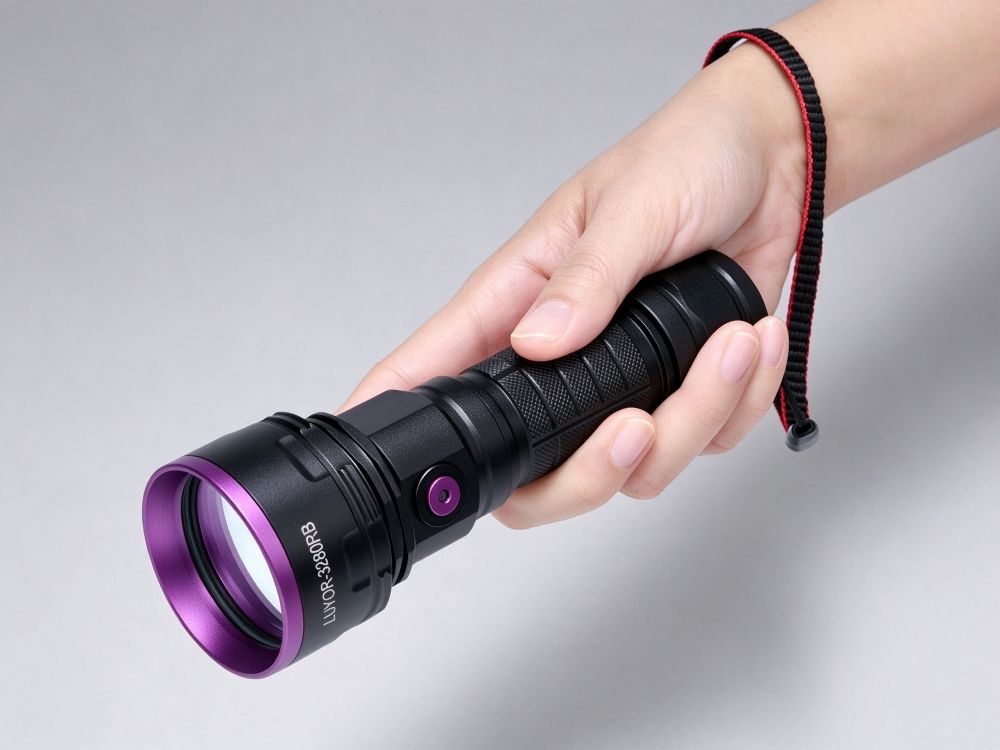
 Overview
LUYOR-3280 GFP flashlight: 20W LED module, 30cm spot at 50cm, 440-460nm blue band and 500nm longpass filter for GFP, eGFP, and chlorophyll screening.
In transgenic and gene-editing work, the step that stalls is often not vector construction but confirming that the gene is actually expressed. Fluorescent protein reporter genes exist for exactly this: if GFP lights up, the transgene is expressed. The catch is that the fluorescence signal is weak, and the eye can see it only under the right excitation light, with the right filter, in a dark enough environment.
The setting makes it harder. In the lab you can switch off the lights and use a microscope, but screening often happens in greenhouses, poly tunnels, and field plots - hundreds of seedlings checked one by one, and carrying each back to a darkroom is not realistic. What you need is a light source you can hold, switch on and read, and carry into a field without hunting for an outlet.
The LUYOR-3280 GFP flashlight is built for that setting. A 20W high-power LED module provides enough excitation intensity, and a multi-module silicone lens with secondary focusing concentrates the light into an even, large spot (30cm diameter at 50cm). With barrier filter glasses matched to the band, GFP green fluorescence can be resolved by eye in a darkened area. Battery powered and compact, one unit serves both the lab and the field plot.
This is the table to confirm when buying a LUYOR-3280 GFP flashlight. The band is fixed at order and cannot be changed afterwards, so decide which fluorescent protein you need to observe, then use the table to choose the model suffix:
| Model | Excitation band | Emission filter | Fluorescent protein / dye |
|---|---|---|---|
| LUYOR-3280UV | UV 360-370nm | 415nm longpass | DAPI, Hoechst (nuclear staining) |
| LUYOR-3280VI | Violet 390-410nm | 460nm longpass | CFP, BFP |
| LUYOR-3280RB | Blue 440-460nm | 500nm longpass | GFP, eGFP, FITC, calcein, lucifer yellow, chlorophyll |
| LUYOR-3280RB-GO | Blue 440-460nm | 500-560nm bandpass | Same, but green only; better contrast where autofluorescence interferes |
| LUYOR-3280LB | 470-490nm | - | Enhanced GFP: eGFP, mGFP, emgfp |
| LUYOR-3280CY | Cyan 500-520nm | 550nm longpass | YFP, Venus |
| LUYOR-3280GR | Green 520-540nm | 600nm longpass | DsRed, tdTomato, RFP, mCherry |
The LUYOR-3280 series can also be configured with 365nm, 395nm, 405nm, 450nm, 505nm, 530nm, 580nm, 610nm, 760nm, 830nm, and 950nm, among others. Beyond life science fluorescence, these bands also serve fluorescent penetrant inspection, mineral and gemstone study, material curing and inspection, and forensic work. If you need a non-standard wavelength, give us the wavelength and the application and we will confirm feasibility with the manufacturer.
| Item | Specification |
|---|---|
| Brand / origin | LUYOR, USA (produced and supplied from Shanghai, China) |
| Model | LUYOR-3280 (including UV / VI / RB / RB-GO / LB / CY / GR band variants) |
| Light source | 20W high-power LED module, single wavelength, single module |
| Optical system | Multi-module silicone lens, secondary focusing, 250-1050nm transmission |
| Illuminated area | 30cm diameter at 50cm from the lamp face |
| Battery | High-power power battery, 2 packs standard; about 2 hours per pack, about 4 hours continuous with both |
| Battery indicator | LED low-battery indicator prompts a timely battery change |
| Charging | Type-C plug charging; US-standard 100-260V AC charger included |
| Extended power | Optional high-power AC adapter for 24-hour continuous screening |
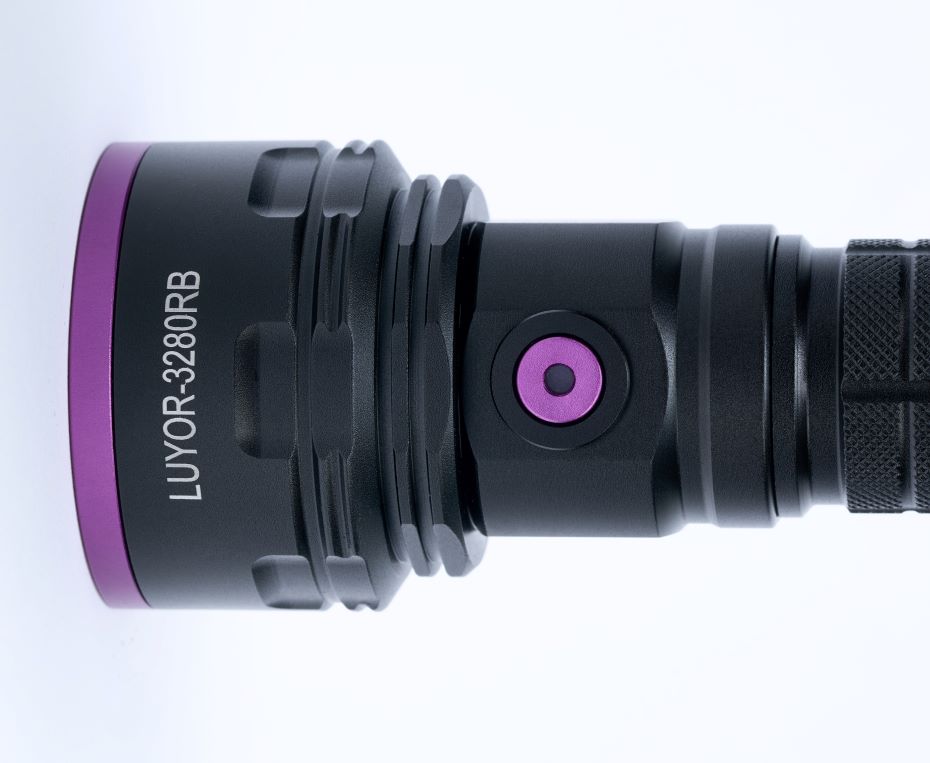
| Switch | Side button switch for one-handed operation |
| Control circuit | Constant-current chip control for stable output power |
| In the box | Flashlight body, dual battery packs, AC charger, Type-C USB charger, photo filter |
| Available bands | 365 / 395 / 405 / 450 / 505 / 530 / 580 / 610 / 760 / 830 / 950nm and others |
| Housing material | Aluminum alloy (channel reference information) |
| Reference weight | About 1 kg (including packaging, channel value; the actual unit governs) |
| Warranty | Free replacement within 1 year for faults; free repair within 3 years (excluding human causes) |
A single 20W high-power LED module (raising power was the upgrade path from the LUYOR-3260) delivers strong illumination, so weakly expressed fluorescent proteins are easier to excite.
Transmission covers 250-1050nm, from UV to near infrared, suiting light sources across bands; the silicone lens handles secondary focusing, with good spot uniformity and no dark edge.
High output current gives about 2 hours per module; two packs come standard, and rotating them gives about 4 hours of continuous work - enough for one field round or one experimental run.
The Type-C port is universal: car, computer, or power bank. An optional high-power AC adapter supports 24-hour continuous screening, for long runs such as seed screening lines.
Wide-voltage design with a US-standard plug, compatible with domestic mains, so it also works when travelling or when shipped to an overseas lab.
Choose 365nm, 395nm, 405nm, 450nm, 505nm, 530nm, 580nm, 610nm, 760nm, 830nm, or 950nm, configured to the fluorescent protein or application.
At 50cm from the lamp face the spot is 30cm across, wide enough to frame a whole plant for fluorescence imaging.
The switch sits on the side, where the thumb falls naturally when the unit is held one-handed, so there is no fumbling in the dark.
When charge runs low the indicator prompts a battery change, so a dimming beam does not cause a missed positive - the risk in weak fluorescence is assuming no expression when the lamp is simply not bright enough.
Constant-current drive keeps output power stable, so brightness stays essentially constant from full charge to near cut-off instead of fading as you work, making readings more reliable and repeatable.
LUYOR-3280 fluorescent protein observation flashlight body (specified band)
High-power battery packs × 2 (rotate for about 4 hours total)
100-260V US-standard AC charger
Type-C USB charger
Photo filter (for fluorescence imaging with a camera or phone)
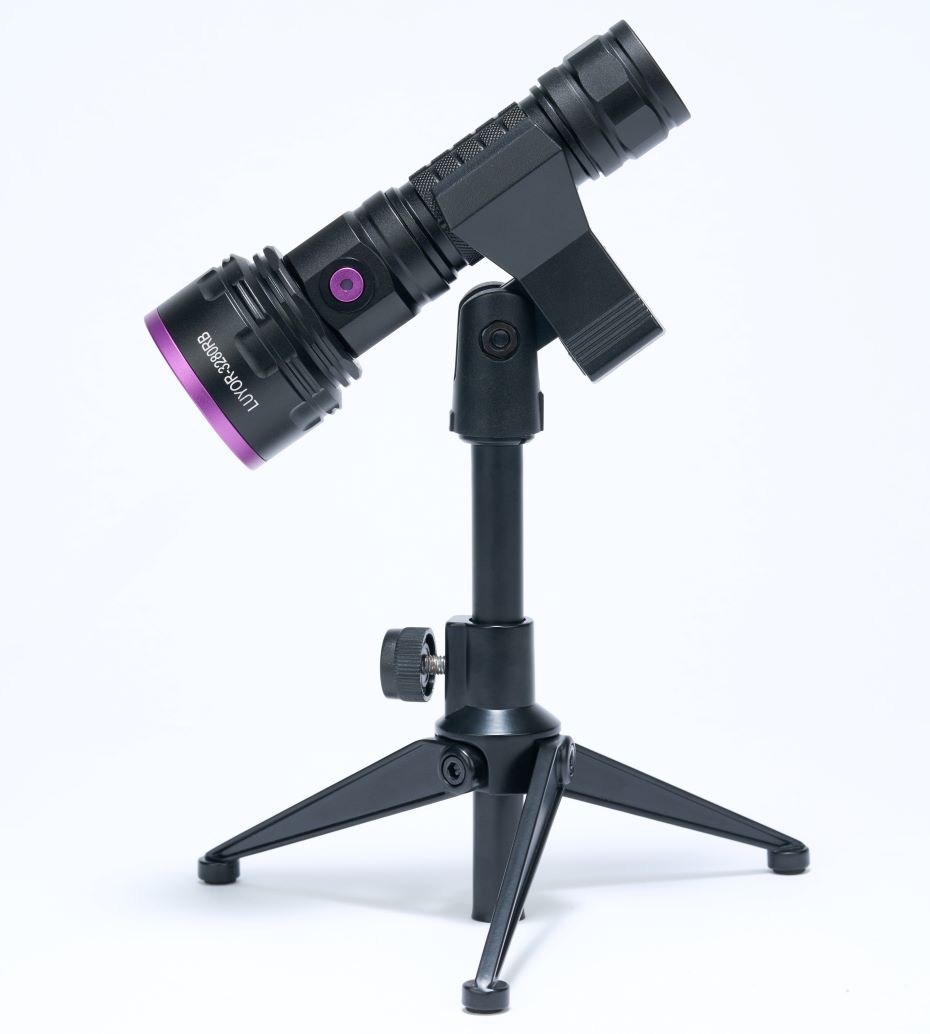
Mini tripod - for long fixed illumination and hands-free sample handling
High-power AC adapter - for 24-hour continuous screening
Spare battery pack - for heavy use or long field sessions
Barrier filter glasses - matched to the band (yellow / green / orange, etc.)
Camera filters and lens adapter rings - 52 / 58 / 62 / 72 / 77mm
Free replacement within 1 year for faults, and free repair within 3 years (excluding human causes). The warranty card supplied with the unit governs.
Fluorescence results depend heavily on sample type, expression strength, and viewing conditions, so trial with your own material and confirm you can see before deciding.
Dual battery packs, AC charger, Type-C charger, and photo filter are included; there is no pile of small parts to buy before it works.
From 365nm UV to 950nm near infrared, with many bands available; one series covers the common fluorescent proteins from DAPI to DsRed.
The successor to the LUYOR-3260, with feedback from nearly a thousand existing users built into this generation.
Produced and supplied in China, so lead times and spare parts are faster than with fully imported products, and service does not wait on overseas parts.
Detection and screening of plant material carrying green fluorescent protein (GFP) or red fluorescent protein (DsRed, RFP) genes, including rice, wheat, maize, soybean, cotton, and Arabidopsis. Uses include early seedling screening, expression observation in leaves and floral organs, callus screening, and initial seed fluorescence screening. In a field plot or greenhouse you can walk the rows with a GFP flashlight and pick out the fluorescent positives instead of carrying everything into a darkroom. For a practical example in woody plant transformation, see the GFP screening case in macadamia hairy root transformation.
Detection of animals carrying GFP or DsRed, such as zebrafish (green fluorescence in embryos and adults), mice, rabbits, and monkeys. Uses include line screening, expression observation in specific tissues and organs, and fluorescence tracking through development. It also supports sample pre-screening and dissection guidance - shine the flashlight in a dark area to confirm where the fluorescence is, then dissect, which cuts wasted work.
Detection of bacteria, fungi, and yeast carrying GFP or DsRed, and fluorescence-labeled cell culture screening. Uses include colony fluorescence screening, tissue-specific expression observation, and fluorescence labeling localization in cell biology and neuroscience.
Coral research: observing natural fluorescent proteins and fluorescence phenomena in coral
Autofluorescent objects: chlorophyll, certain minerals, and biological materials
Fluorescent penetrant inspection: with the matching wavelength model, industrial fluorescent penetrant inspection
Fluorescence imaging support: as an excitation source for a stereo microscope (benchtop models are better suited)
Choose the GFP flashlight band that matches the target fluorescent protein (RB blue for GFP, GR green for RFP), and confirm that the barrier filter glasses and photo filter match that band. Wrong glasses and filters are a common reason for seeing no fluorescence.
Switch off lights, draw shade screens, work in a darkroom or in shade. The weaker the ambient light, the higher the fluorescence contrast. In a greenhouse or field by day, use early morning or late afternoon, or drape a light-blocking cloth over the viewing area.
Wear the barrier filter glasses matched to the band and stay in the dark for 1-2 minutes to let the eyes adapt. Many people skip this step, and it makes a large difference - weak fluorescence invisible on entering a darkroom often appears after a minute of adaptation.
Press the side button to switch on (watch the low-battery indicator and change the pack if needed). Hold 40-50cm away and sweep the whole area quickly, using the 30cm spot to locate which plants and which parts fluoresce; this pass is about speed.
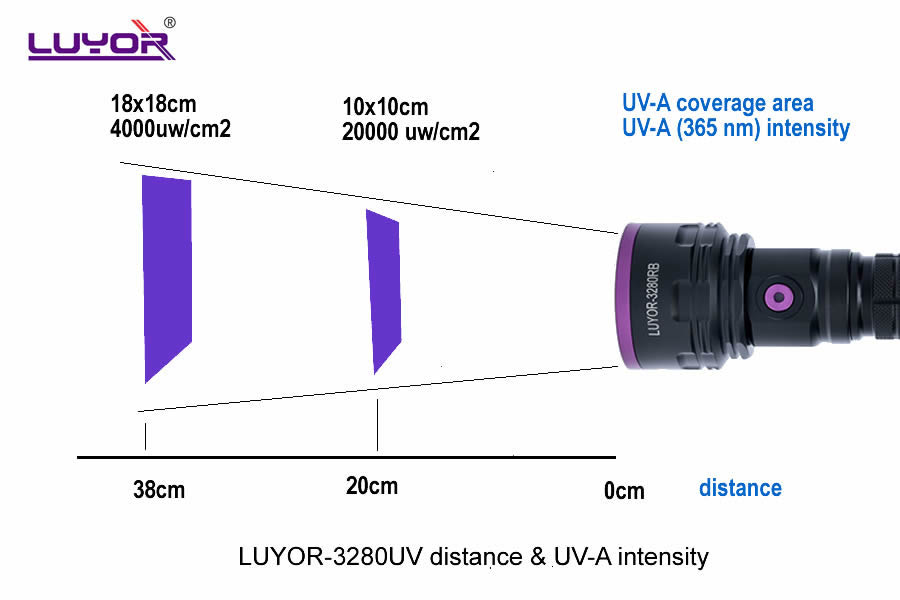
For targets found in the sweep, bring the head to 10-20cm: the spot shrinks but energy density rises, so weak expression is easier to confirm. Do not let the lamp head touch the plant, to avoid mechanical damage.
When you need records, fit the photo filter, fix the flashlight and camera on a mini tripod, lock exposure (manual mode, auto white balance and auto ISO off), switch off the flash, and extend exposure time to accumulate the fluorescence signal.
If the flashlight is in hand but results are poor, work through the list below in order; in most cases the problem is in the first three items:
| Symptom | Likely cause | What to do |
|---|---|---|
| Almost no green light at all | Matching barrier filter glasses not worn (common) | Put on the matching yellow filter glasses and look again; the glasses must match the band |
| Visible but low contrast | Ambient light too bright, washing out the fluorescence | Switch off lights, shade the area, move to a darkroom, or observe at dawn / dusk |
| Not visible at first, appears after a while | Eyes not dark-adapted | Stay in the dark for 1-2 minutes before reading |
| Photo washed out white, no fluorescence | Photo filter not fitted / auto exposure compensation / reflections | Fit the photo filter, switch to manual exposure, avoid mirror-reflection angles |
| Noticeably dim, spot looks yellow | Battery near cut-off | Check the low-battery indicator and change the battery pack |
| Only a few plants in a batch fluoresce | Possibly a real expression difference (not a device problem) | View by transmitted light, re-check from several angles, and confirm with a benchtop model or microscope if needed |
LUYOR's fluorescent protein excitation sources come in three directions, and which one fits depends on the shape of your work. The comparison below should settle it in one pass:
| Item | LUYOR-3280 (this page) | LUYOR-3415 | LUYOR-3421 |
|---|---|---|---|
| Form | Single-wavelength handheld flashlight | Dual-wavelength handheld lamp | Benchtop fluorescence excitation source |
| Number of wavelengths | 1 (fixed at order, not changeable) | 2 (rear-key switching) | 1 or more, heads interchangeable (BNC connector) |
| Available bands | 365-950nm, many options | Two of 365 / 400 / 450 / 485 / 520nm | 365 / 405 / 450 / 488 / 505 / 530nm, etc. |
| Typical power | 20W LED module | 18W per wavelength, 27W total | Depends on configuration |
| Illuminated area | 30cm diameter at 50cm | 180mm diameter at 150mm | With a microscope: small field, high density |
| Filter glasses included | 1 pair matched to the band | Two pairs of barrier filter glasses + carry case | Per configuration |
| Suits | One fluorescent protein only; fast large-area inspection in field, greenhouse, poly tunnel | Routine lab work that observes two fluorescent proteins (GFP + RFP) | Detail work with a stereo microscope on small targets |
They are essentially the same class of device; the names emphasize different things. "Fluorescent protein excitation source" is the category name for any device that supplies excitation light for fluorescent proteins, including handheld, benchtop, and suspended types; "GFP flashlight" specifically means the handheld form with a band aimed at GFP/eGFP observation. The LUYOR-3280RB is both a fluorescent protein excitation source and a GFP flashlight. The dividing line in selection is location and target size: for small targets on a lab bench only, a benchtop model (LUYOR-3421) fits better; for field, greenhouse, and poly tunnel work with whole plants or batch screening, the handheld GFP flashlight (LUYOR-3280) is handier.
No, but it can carry most of the initial screening workload. The value of a fluorescence microscope is magnification and imaging resolution, showing expression localization at cell or subcellular level; the value of a GFP flashlight is speed and freedom of location - hundreds of seedlings or dozens of colonies can be screened on the spot to pick out the positives, with no slide preparation and no instrument booking. The common approach is two-stage screening: use the GFP flashlight for initial screening in a large population, pick the individuals with signal, then send those to the microscope for fine imaging and photography, which greatly reduces demand on microscope time.
The LUYOR-3280 is a single-wavelength model: one unit has one excitation band, fixed at order and not changeable, so one GFP flashlight corresponds to a group of fluorescent proteins with similar excitation. The RB blue band (440-460nm) covers GFP, eGFP, FITC, calcein, lucifer yellow, and chlorophyll; the GR green band (520-540nm) covers DsRed, tdTomato, RFP, and mCherry. If an experiment needs two colors at once (GFP plus RFP), choose the dual-wavelength LUYOR-3415; if band needs may change later, choose the benchtop LUYOR-3421 with interchangeable heads.
The LUYOR-3280 GFP flashlight is a single-wavelength model: one excitation band per unit, specified at order, and the band cannot be changed later - another band means another unit. If your gene-editing work uses one fluorescent protein, the single-wavelength LUYOR-3280 is a very suitable tool; if an experiment observes two fluorescent proteins at once, choose the dual-wavelength LUYOR-3415 or the benchtop LUYOR-3421 with interchangeable heads. Confirm the fluorescent protein you will actually observe before ordering and we will check the band for you. Reference: DAPI and Hoechst use the UV band (360-370nm); BFP and CFP use the VI violet band (390-410nm); GFP, eGFP, FITC, calcein, and lucifer yellow use the RB blue band (440-460nm); YFP and Venus use the CY cyan band (500-520nm); DsRed, tdTomato, RFP, and mCherry use the GR green band (520-540nm).
For green fluorescent protein GFP and enhanced GFP, choose LUYOR-3280RB, the blue band (440-460nm), with a 500nm longpass filter; this is also the model most often ordered here. If you want to see chlorophyll autofluorescence, the same RB band applies. There is also LUYOR-3280RB-GO, again 440-460nm excitation but with a 500-560nm bandpass filter (green-only), which further suppresses the red background and suits samples with strong autofluorescence interference. For red flesh, red stems, mature tissue, and other strongly autofluorescent material, RB-GO usually gives better GFP contrast.
No. The LUYOR-3280 is a constant-current LED source emitting cold light, without the near-infrared heat radiation of an incandescent lamp, so at normal working distance (tens of centimeters) it does not heat-damage plants, leaves, seedlings, or small animals. The multi-module silicone lens provides secondary focusing rather than simple heating, concentrating energy inside the useful spot, which is how it reaches a 30cm illuminated diameter at 50cm. In continuous observation, heat builds mainly in the body of the flashlight itself; for long sessions (fixed on a mini tripod) keep an eye on heat dissipation and do not wrap the head in cloth. For live animal observation, still follow animal ethics rules on single exposure duration.
Yes. The LUYOR-3280 ships with two high-power battery packs; each runs about 2 hours, and rotating them gives about 4 hours of continuous work. For 24-hour continuous screening (a high-volume seed or seedling screening line, for example), the optional high-power AC adapter runs from mains power indefinitely, without battery capacity limits. The standard charger is a US-standard 100-260V AC unit, compatible with domestic voltage. One reminder: a power battery stored unused for a long time should be kept at about half charge and topped up periodically, or capacity will fade faster than in normal use; batteries are consumables and spares can be ordered separately.
By model and band: UV band (360-370nm, 415nm longpass) for DAPI and Hoechst; VI violet band (390-410nm, 460nm longpass) for CFP and BFP; RB blue band (440-460nm, 500nm longpass) for GFP, eGFP, FITC, calcein, lucifer yellow, and chlorophyll; LB band (470-490nm) for enhanced GFP: eGFP, mGFP, emgfp; CY cyan band (500-520nm, 550nm longpass) for YFP and Venus; GR green band (520-540nm, 600nm longpass) for DsRed, tdTomato, RFP, and mCherry. Beyond these common bands, 365nm, 395nm, 405nm, 450nm, 505nm, 530nm, 580nm, 610nm, 760nm, 830nm, and 950nm are also available, for fluorescent penetrant inspection, mineral and material research, and similar work.
Barrier filter glasses block excitation light reflected from the sample surface and pass only the fluorescence, which is what gives high contrast. Viewed without glasses, strong reflected excitation light drowns the weak fluorescence; GFP green in particular is nearly indistinguishable by eye against a blue background, so you would conclude that the transgene is not expressed when in fact you simply cannot see it. Filter glasses are also eye protection, and must be worn for long observation of a strong light source. For photography, fit the matching photo filter on the camera lens or phone lens, or the image will be washed out by reflected light in the same way.
Both. That is exactly the value of the handheld LUYOR-3280 form. It is designed for lab and field alike: compact and portable, it can be carried one-handed through a greenhouse, poly tunnel, or field plot, plant by plant. In the field the main consideration is ambient light - in bright daylight fluorescence contrast drops noticeably, so observe in the early morning, late afternoon, in shade, or inside a shaded tunnel; in strong open daylight, drape a light-blocking cloth over the sample area, or use a benchtop model. In the lab, a darkroom, dark box, or lights-off conditions give ideal results. Battery power frees you from outlet locations, which is especially convenient in the field.
The published figure is a 30cm illuminated diameter at 50cm from the lamp face, a distance suited to whole-plant imaging - framing a whole seedling, a whole leaf, or a small group of seedlings in the spot and lighting it in one pass. But for small detail targets such as a fluorescent speck on a leaf, a seed embryo, or a floral organ, bring the head to 10-20cm or closer: the spot shrinks but energy density rises, and weak expression is easier to see. In practice, sweep quickly from a distance to locate which plants fluoresce, then move in to confirm detail; that is the efficient way to inspect. When close, do not let the lamp head touch the plant, to avoid mechanical damage.
Yes. The LUYOR-3280 standard kit includes a photo filter that works directly on a DSLR or a phone for fluorescence images, which is convenient for lab records and figures in papers. Fit the filter to the camera lens or clip it over the phone lens, then shoot in a dark setting with the matching yellow filter (yellow for the RB band) and the flashlight illuminating the sample. Shooting points: manual mode with locked exposure, auto white balance and auto ISO off so the camera does not raise ISO and add noise; flash off; keep the flashlight still (fix it on a mini tripod); and extend exposure time to accumulate fluorescence signal. Other sizes (52mm, 58mm, 62mm, 72mm, 77mm lens adapter rings) can be supplied separately.
The LUYOR-3280 is the successor to the LUYOR-3260 series; the main upgrade is the high-power LED module, giving stronger illumination, better spot uniformity, and a larger illuminated area. LUYOR has run a free replacement program for existing LUYOR-3260 users (check its official announcement for timing and terms). Experience from nearly a thousand LUYOR-3260 units also fed into the 3280 design, so this generation is mature in grip, switch position, and battery indication. If you still have a 3260, send us the unit details and we will check whether it falls within the replacement program.
All three are fluorescent protein excitation sources; the choice depends on the shape of your work. The LUYOR-3280 is a single-wavelength handheld flashlight: light, lower cost, suited to work with one fluorescent protein and to field or large-area rapid screening. The LUYOR-3415 is a dual-wavelength handheld lamp: two excitation wavelengths selected and switched with a rear key, with two barrier filter glasses and a carry case included, suited to most lab work that observes GFP plus RFP or GFP plus CFP. The LUYOR-3421 is a benchtop excitation source: the head uses a BNC connector so users can change heads, and with a stereo microscope it resolves very small targets, for work that needs high-magnification detail. In short: field work, choose 3280; routine two-color experiments, choose 3415; detail work with a microscope, choose 3421.
All three. In plants it is commonly used to screen rice, wheat, maize, soybean, cotton, and Arabidopsis carrying GFP or DsRed, including seeds, seedlings, leaves, callus, and floral organs; in animals it supports fluorescence screening of transgenic lines such as zebrafish, mice, and rabbits, for example green fluorescence in zebrafish embryos; in microorganisms it supports fluorescence-labeled screening of bacteria, fungi, and yeast. Beyond that, the LUYOR-3280 is also used for autofluorescent objects, cell culture screening, tissue-specific expression observation, dissection guidance, coral research, and industrial fluorescent penetrant inspection (with the matching wavelength model).
In most cases the cause is viewing conditions, not the flashlight itself. Check in this order: first, whether the filter glasses are worn - the common cause, since weak GFP is essentially invisible without them; second, whether the ambient light is dark enough, because daylight washes fluorescence out, so shade the area or move to a dark place; third, whether the working distance suits the target, since detail requires moving in close; fourth, whether the filter matches the band - for GFP a yellow filter (500nm longpass) is required, and a wrong filter loses most of the signal; fifth, the expression level of the sample itself, since some transgenic lines express weakly and need a darker setting and longer adaptation, with dark adaptation typically taking 1-2 minutes; sixth, battery charge, since output falls near cut-off (even though the constant-current circuit holds it stable over most of the range) - watch the low-battery indicator.
The warranty is free replacement within 1 year for faults and free repair within 3 years (excluding human causes), LUYOR's published commitment, with the warranty card supplied with the unit governing. A free trial is available: try it and buy once satisfied - fluorescence results depend greatly on your sample type, expression strength, and viewing conditions, so we suggest trialing with your own material and confirming you can see before deciding. The standard kit includes the flashlight body, two battery packs, a 100-260V AC charger, a Type-C USB charger, and a photo filter; common optional accessories include a mini tripod (for long fixed illumination), a high-power AC adapter (for 24-hour continuous screening), a spare battery pack, barrier filter glasses, and camera filters with lens adapter rings. The band is fixed at order, so confirm it with us before purchasing.
The LUYOR-3280 GFP flashlight is a LUYOR (USA) brand product, produced and supplied in China by LUYOR Shanghai, so lead times and spare parts are fast - a real advantage over fully imported equivalents. Units ship from Shanghai with technical support. Market reference pricing is roughly a few thousand to CNY 7,000, depending on band, configuration (tripod, spare battery, filter sizes), and current lead time; quotes vary between channels, so ask us directly and we will give a clear configuration and price, and confirm whether a trial is included. Volume purchases (several research groups at a university, or a screening line package for a seed company) can be quoted at better pricing.
LUYOR-3280 product literature and official specifications
Band and fluorescent protein cross-reference (full DAPI / CFP / GFP / YFP / DsRed set)
GFP fluorescence viewing and photography notes (dark adaptation, filters, exposure)
LUYOR-3280 / 3415 / 3421 selection comparison
Measured energy-distance-spot data for the LUYOR-3280RB blue band source
Free trial application and scheduling
Band and model recommendations by fluorescent protein type and application
Troubleshooting guidance when results are poor (glasses / ambient light / distance / charge)
Accessory matching: photo filters, lens adapter rings, tripods
Spare battery and consumables planning
Volume and project quotations, lead time confirmation
Send inquiry

Email: info@xinysun.com

Tel: 131-2093-6518

Address: 1525 Minqiang Road, Bldg 26, Songjiang, Shanghai

Copyright 2026 Xinysun Instrument (Shanghai) Co., Ltd. All rights reserved.
ICP:ICP-2026046447




 Breadcrumb:
 Products
 Applications
 Previous:
 Back to list

 Industrial Test Instruments


