
Products
PRODUCTS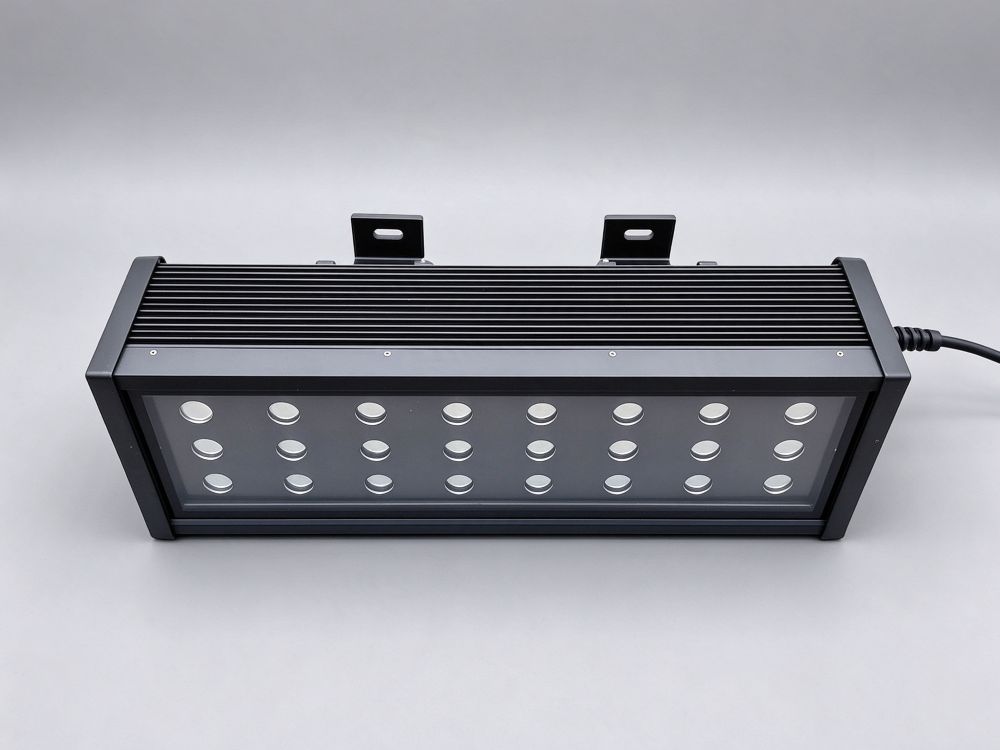
 Overview
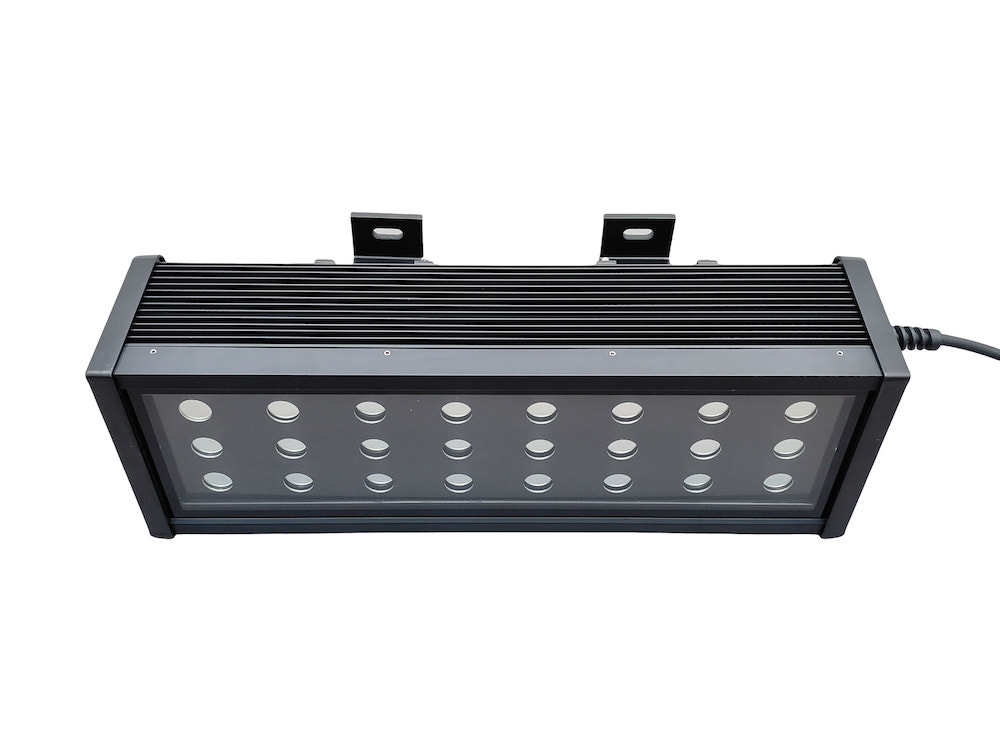
LUYOR-3124RB is a hanging royal-blue LED panel for whole-tray screening: 24 high-power LEDs, 440-460 nm, and 18x45 cm even coverage at 40 cm.
Anyone running large-batch fluorescence screening knows the situation: a handheld lamp takes over ten minutes to sweep one tray of seedlings. Holding the lamp and scanning plant by plant tires the arm, slows the pace, and easily misses weakly expressing positive plants hidden in the middle. A fluorescence microscope offers magnification but a small field, so a whole tray does not fit and samples still have to be split and checked one by one.
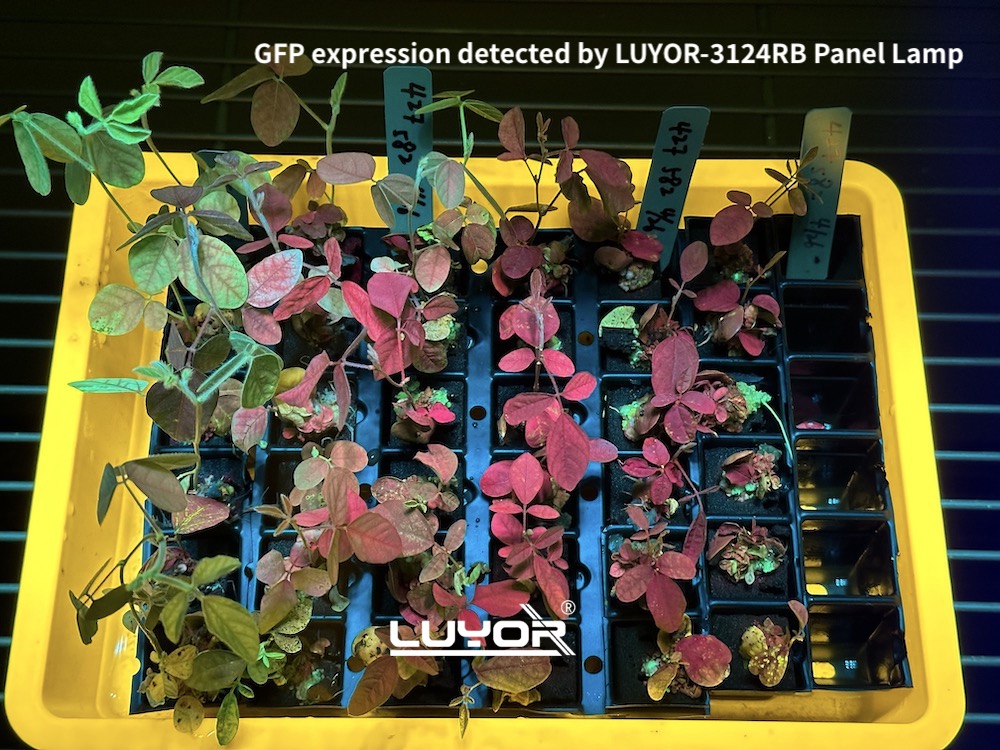
LUYOR-3124RB is a panel light built for whole-tray viewing: 24 high-power LEDs arranged in a panel with a narrow-band filter cover about 18×45cm at a 40cm working distance, which puts one lamp over a standard breeding tray. With room lights off or blinds drawn, fluorescent positives light up against a dark background, one sweep in front of the tray completes a screening round, and positive plants are picked out with their labels.
It has run large-batch screening workflows for years at several US universities and at seed companies in Brazil, and it is a mature engineered product proven in volume production. This model is now supplied to the China market, shipped from Shanghai with selection and after-sales support.
The two brackets on top of the housing allow hanging from a growth rack crossbar, a shelf, or a wall. Set the tilt so the panel faces down onto the sample area, connect 100-240V, and the light reaches full output instantly with no warm-up. A hanging height of about 40cm is the reference starting point, covering roughly 18×45cm, which fits a standard breeding tray; mount higher for a larger footprint, or lower for weakly fluorescent samples to gain more illuminance.
Observe samples through the barrier filter: reflected blue excitation is blocked and green fluorescence alone reaches the eye. If you prefer direct viewing, wear the yellow viewing glasses (LUV-30A series, optional). For photography, fit a barrier filter in front of the phone or camera lens and lower the ambient light; GFP-positive tissue stands out clearly in the image and can go straight into lab records and reports.
| Item | Specification |
|---|---|
| Brand | LUYOR, USA |
| Product type | Large-area hanging fluorescent protein excitation light (panel source) |
| Model on this page | LUYOR-3124RB (royal blue excitation) |
| Light source | 24 high-power LED panel module with narrow-band filter |
| Excitation band | 440-460nm (royal blue) |
| Barrier filtration | 500nm longpass or 500-560nm bandpass, one pair supplied with the light |
| Coverage | About 18×45cm at a 40cm working distance |
| Starting | Instant start, full output at power-on, no warm-up |
| LED life | About 50000 hours, no bulb changes, no maintenance |
| Power | 100-240V AC, 50/60Hz |
| Mounting | Two adjustable brackets on top for hanging, wall, or crossbar fixing, with adjustable angle |
| Environmental design | Water-resistant housing and cooling design for greenhouse and growth room conditions |
The 3124 series shares the same construction and coverage area. The difference lies in the LED band and the matching filter. Confirm the model by the fluorescent protein the current project observes:
| Model | Light color | Excitation band | Barrier filter | Fluorescent protein / dye observed |
|---|---|---|---|---|
| LUYOR-3124UV | Ultraviolet | 360-380nm | 415nm longpass | DAPI, Hoechst, and other nuclear dyes |
| LUYOR-3124VI | Violet | 400-415nm | 460nm longpass | BFP, CFP |
| LUYOR-3124RB | Royal blue | 440-460nm | 500nm longpass or 500-560nm bandpass | GFP, eGFP, fluorescein FITC, calcein, Lucifer Yellow |
| LUYOR-3124CY | Cyan | 490-515nm | 550nm longpass | YFP, Venus |
| LUYOR-3124GR | Green | 510-540nm | 600nm longpass | DsRed, tdTomato, mCherry, and other RFP variants |
GFP / fluorescein work alone: choose the RB model on this page, the normal order volume. Where sample red autofluorescence background is high, the factory can confirm a change to a 500-560nm bandpass filter for better contrast
GFP plus RFP two-color projects: pair RB with GR, or use one 3124RB for initial screening and one bench 3421 for two-color confirmation
Nuclear stain plus expression: RB for expression and UV for DAPI nuclear stain, combined as needed
Unsure of the band: send us the fluorescent proteins and dyes involved, and we will confirm a model recommendation with the factory
The 3124 is a unit that hangs in a growth room and runs continuously year after year, and LUYOR designed the engineering details around that role:
Full intensity at power-on with no mercury-lamp warm-up; switch it on and off as you walk through, and a glance on the way in or out does not interrupt the workflow.
Expected life of about 50000 hours, with no bulb changes and no maintenance, and none of the warm-up wait or mercury waste handling of a mercury lamp.
A water-resistant housing with a cooling design performs reliably in the high humidity of a greenhouse and under long continuous runs in a growth room.
The aluminum housing is rigid and does not deform under long-term hanging operation; the narrow-band filter is built into the panel face and needs no routine calibration.
The two top brackets adjust in angle for hanging, wall, or crossbar fixing; one adjustment aims the light at the work area, and trays move in and out without interference.
A pair of barrier filters matched to the band ships with the light, giving reliable contrast for both viewing and photography with no separate filter system.
Whole-tray observation of transgenic seedlings: positives light up against the dark background and are picked out with their labels, a tray per round in a few minutes. This is the typical 3124 series scenario and a daily routine in US university labs.
Fluorescent marker batch confirmation across large numbers of seedlings, a practice used for years at several seed companies in Brazil; hung above the breeding rack, batch flow does not occupy an extra workstation.
Rapid fluorescence screening of transgenic mouse colonies: place each cage under the light and positives are visible at a glance, which reduces the number of handlings and restraint and lowers animal stress.
FITC fluorescein labeling, calcein viability staining, and similar green fluorescent dyes fall within the RB band, so one panel serves several assay types.
Hung on the growth rack and left powered, a glance on the way past catches fluorescence anomalies on the same day; the water-resistant, cooled design handles greenhouse humidity.
A whole class can watch a full tray of fluorescent samples at once, far more direct than taking turns at an eyepiece; instant start lets student groups work without queuing.
LUYOR-3124RB panel excitation light (royal blue 440-460nm)
Pair of barrier filters (matched to the RB band: 500nm longpass or 500-560nm bandpass)
Top mounting brackets
Power cable (100-240V AC, 50/60Hz)
Viewing glasses: yellow LUV-30A series (for direct viewing)
Phone photo clamp and filter adapter
Other band models: 3124UV / 3124VI / 3124CY / 3124GR
Of the pair of barrier filters, one goes in front of the camera lens for photography and the other is for viewing or spare use. If you need extra filters or viewing glasses, note them with the order and they ship with the light.
Within the LUYOR fluorescence observation line these four are often compared. The difference is not quality but working situation:
| Item | LUYOR-3124RB hanging panel | LUYOR-3421 bench | LUYOR-3415RG handheld | LUYOR-3280 handheld |
|---|---|---|---|---|
| Form | Hanging panel light | Bench: gooseneck stand with microscope adapter | Handheld: two-wavelength integrated lamp | Handheld: single-wavelength lamp |
| Illumination | Large area from above, downward | Directed on the gooseneck | Handheld | Handheld |
| Coverage | 18×45cm (at 40cm) | Large area, adjustable | Single plant or dish | Single plant or dish |
| Bands | Single band (five models) | 6 modules, changeable and expandable | Two, fixed at the factory | Single band, fixed at the factory |
| Microscope mounting | No | Yes (stereo microscope adapter) | No | No |
| Typical use | High-throughput initial screening of whole trays and racks | Screening under the eyepiece, dissection and injection, plate sorting | Plant-by-plant inspection in greenhouse and field | Large-area single-color screening in tunnels |
| Power | 100-240V AC | 110-220V AC | Rechargeable battery, 0.9kg portable | Dual battery, about 4 h continuous |
In short: if you screen trays and racks, choose the hanging 3124RB; if the work happens at the microscope or the bench, choose the bench 3421; if it happens in a greenhouse, a tunnel, or a trial field, choose a handheld. Many users run three: 3124RB hanging in the growth room for batch initial screening, a handheld at the greenhouse door for daily inspection, and 3421 fixed on the bench for confirmation and sorting under the eyepiece, each covering one stage.
Detailed information on the four: the bench microscope adapter in LUYOR-3421 bench fluorescent protein excitation source, the two-wavelength handheld in LUYOR-3415RG two-wavelength fluorescent protein excitation source, the single-wavelength handheld in LUYOR-3280 fluorescent protein viewing torch, and the US-made portable models in NIGHTSEA Xite-RB / Xite-GR fluorescence torch. Field use of the handhelds is also described in the actual workflows in the LUYOR-3415RG application notes.
Look at what you screen and at the pace. For high-throughput initial screening of whole trays and racks, the hanging 3124RB covers a full tray with one lamp and a sweep in front of the tray completes the round; for observation under the eyepiece, dissection and injection, or careful confirmation of a single dish, choose the bench 3421. The two do not conflict, and many labs use 3124RB for initial screening with 3421 for confirmation under the eyepiece.
The official figure is about 18×45cm at a 40cm working distance, which covers a standard breeding tray with margin. Hanging higher increases the footprint but lowers illuminance; for weakly fluorescent samples, keep the height near 40cm or reduce ambient light before viewing.
The GFP absorption peak lies in the blue region, and 440-460nm royal blue excites GFP fluorescence effectively; the matching 500nm longpass barrier filter blocks reflected blue light and passes green fluorescence to the eye or camera, so positive tissue is clearly visible against a dark background. This is the shared design of the LUYOR RB series, including 3124RB, 3421RB, and 3415RG.
The pair supplied with the light is matched to the RB band: one goes in front of a camera or phone lens to filter out reflected blue excitation so recorded green fluorescence is clean, and the other can be held in front of the eye for direct viewing or kept as a spare. Without a filter, direct viewing shows a harsh blue field.
Not when viewing or photographing through the barrier filter. If you prefer to look at samples directly, yellow viewing glasses (LUV-30A series) are recommended, since they pass green fluorescence and block blue excitation for better contrast. Glasses are an option and can be added to the order.
The 3124RB on this page is a royal blue unit intended for green fluorescence such as GFP, fluorescein, and calcein. For DsRed, tdTomato, mCherry, and other RFP variants, choose the 3124GR in the same series (green 510-540nm excitation with a 600nm longpass filter); two-color projects can pair two units, or complement the modular 3421.
Five models: UV (ultraviolet 360-380nm, DAPI and Hoechst), VI (violet 400-415nm, BFP and CFP), RB (royal blue 440-460nm, GFP and fluorescein), CY (cyan 490-515nm, YFP and Venus), and GR (green 510-540nm, DsRed and tdTomato). Construction is identical, and the model is fixed at order by fluorescent protein; see the table on this page.
Take a 40cm working distance as the reference starting point: at that height the coverage is about 18×45cm with sufficient illuminance. Mount higher to cover more area, though weak signals become dimmer; with a lower tray or a need for higher contrast, drop to about 30cm. After mounting, run a trial sweep and judge by whether positives are clearly visible.
Yes. The water-resistant housing and cooling design are intended for humid, continuously running environments such as greenhouses and growth rooms; the aluminum body dissipates heat well and runs stably when left powered. Avoid direct spray on the panel face and power connector, and fix cables along the rack.
Expected LED life is about 50000 hours, which at 8 hours a day covers more than a decade. There is no bulb to replace, and none of the mercury-lamp warm-up wait or mercury waste handling. If fluorescence from the same sample looks visibly dimmer, check the power supply and clean the filters before contacting service.
Yes. Fit the supplied barrier filter in front of a phone or camera lens and reduce ambient light (lights off, blinds drawn, or shooting at night), and the green fluorescence of positive plants is very clear. For batch records, a fixed camera position with interval shooting records the fluorescence development of a whole tray of seedlings.
The 3124RB hangs and illuminates trays and racks, so nobody holds a lamp, which suits batch initial screening at a fixed position; the 3415RG and 3280 are handheld lamps for walking inspection and flexible fill light in greenhouses and tunnels. A common combination is 3124RB hanging in the growth room with a handheld kept in the greenhouse.
Yes. LUYOR lists mouse colonies as a typical screening subject: place each cage under the light and the fluorescence signal of transgenic individuals is visible at a glance, which reduces the number of handlings and restraint. Handle animals gently, keep the room darkened, and follow your institution's animal ethics requirements for the detailed procedure.
The five band models in the 3124 series are separate complete units, with the band fixed at the factory. When a project changes you can add another model, or use the bench 3421 as a complement, since its six wavelength modules change on a BNC connector in seconds; the two approaches can be combined within a budget.
Price is confirmed by model and accessories: a 3124RB unit with a pair of barrier filters is the base configuration, and viewing glasses or other band models affect the quotation, so please ask us for a price. Warranty and service follow the official LUYOR commitment. Xinysun Instruments (Shanghai) Co., Ltd. ships from Shanghai and supports configuration confirmation, installation guidance, and later support; project pricing is available for volume orders from universities and seed companies.
LUYOR-3124RB product document and official specification notes
3124 series five-band and fluorescent protein cross-reference table
Hanging installation and bracket dimension notes
Barrier filter and viewing glasses instructions
Fluorescence photography options (phone and camera adapters)
Quotations for other band models
Band model recommended from your fluorescent protein combination
Hanging position and coverage calculation
Advice on greenhouse and growth room conditions
Troubleshooting guidance when fluorescence observation is weak
Support for later purchases of other bands
Volume purchase and group-level pricing
Send inquiry

Email: info@xinysun.com

Tel: 131-2093-6518

Address: 1525 Minqiang Road, Bldg 26, Songjiang, Shanghai

Copyright 2026 Xinysun Instrument (Shanghai) Co., Ltd. All rights reserved.
ICP:ICP-2026046447




 Breadcrumb:
 Products
 Applications
 Previous:
 Back to list

 Industrial Test Instruments


