Applications
 Breadcrumb: Home > Applications > Semiconductor Cleanroom
 Updated:2026-11-12
 Views:
A contradiction keeps recurring in clean areas: air data can pass while surfaces are not clean. ISO 14644 governs airborne particle concentration, whereas residue on tool interior walls, carrier slots, guide rails and fixture surfaces is a separate set of facts that has to be confirmed point by point. A particle inspection lamp covers that gap. This article describes how the BBMA particle inspection lamp is used in three scenarios - re-inspection after tool PM, interior inspection of FOUPs and wafer carriers, and re-inspection after tool move-in or modification - and how the work is divided with high-intensity visual inspection. It also explains why 365 nm fluorescence and grazing white light are used in a fixed order.
Cleanroom contamination decisions run into the same contradiction again and again: air data can pass while surfaces are not clean. The ISO 14644 system governs airborne particle concentration, whereas residue on tool interior walls, carrier slots, guide rails and fixture surfaces is a separate set of facts that has to be confirmed point by point. A particle inspection lamp fills that gap - it does not count particles, but it makes clear whether there is contamination, what it is and where it sits, and it turns re-inspection into a task that can be judged, using a fixed setup.
Taking the LUYOR-BBMA as the main thread, this article explains how the lamp is used in three stages - cleanroom re-inspection, carrier interior inspection and acceptance after tool move-in - why it is used that way, and how it combines with high-intensity visual inspection equipment.
The "8 LEDs in an array" design deserves a paragraph of its own. A common approach in compact products is to pack 3 to 5 UV LEDs a few millimeters apart into a small housing, and the direct consequences are concentrated heat, higher junction temperature and faster output depreciation; worse, after a single LED fails light still comes out, and the operator cannot easily see it from the outside. Spacing the LEDs apart with enough heat-dissipating area keeps junction temperature lower and depreciation slower, and a single failed LED leaves a visible dark patch against a uniform background, so it is easy to notice. ASTM E3022 requires failed LEDs and other critical parts to be replaced before use, and that requirement can be met once LED status can be read.
The window between the end of PM and the return to production is when contamination risk in a cleanroom concentrates. On many site PM checklists this step is a single line - "clean and confirm the area is tidy" - and that is exactly where problems tend to appear. Re-inspection should work in three rings - inner, middle and outer - with a fixed method:
The full inspection scope, acceptance criteria and work-order wording are covered in the SOP for particle re-inspection after tool PM.
A carrier is the layer of container closest to the wafer as it moves around the fab: it may spend a few hours in a tool but several days in a carrier. Cleaning validation is far harder than for a tool: the structure is closed, slots are dense, the inner walls have ribs and locating pins, a wipe cannot reach inside, a particle counter cannot sample, and a particle scanner cannot be inserted.
A workable approach is to divide the methods by contaminant type:
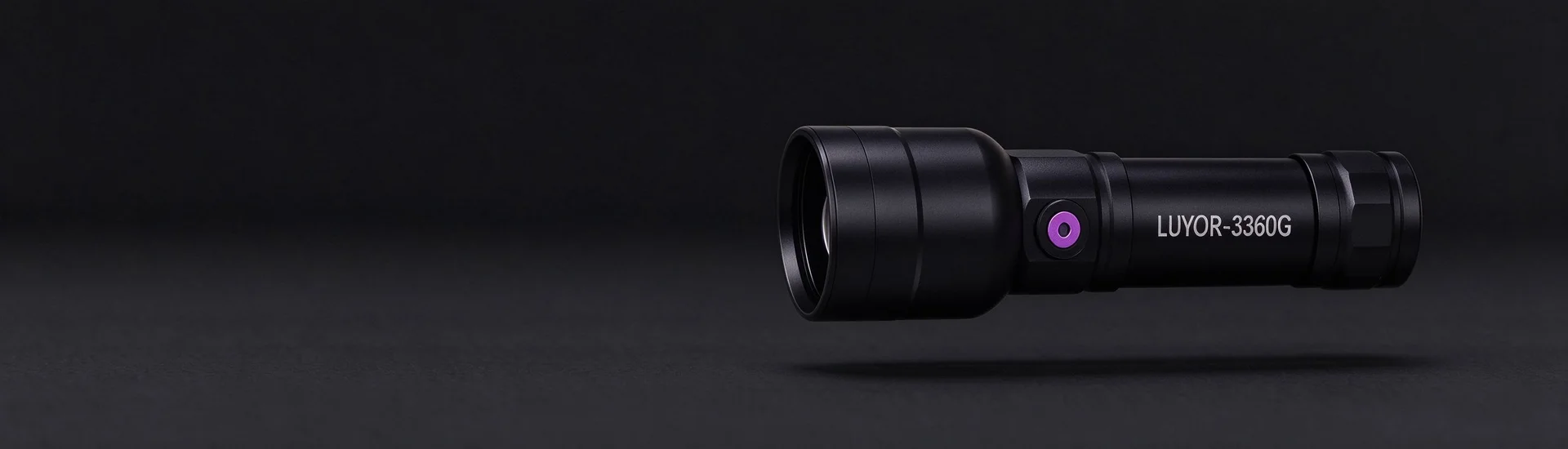
One lamp worth adding for this work is the MNT-365A : a one-piece smooth barrel with no knurling, so it does not trap soil or shed particles, and it can be taken directly into the clean area for organic contamination checks on carriers and pods; inorganic particles and scratches are then located with grazing light from the LUYOR-3360G yellow-green zoom flashlight. The four contamination pathways for carriers and the division of inspection work are covered in how to inspect particle contamination on carrier interior walls.
After a major overhaul, modification or relocation, particle contamination peaks: construction dust, seal debris, leftover adhesive and oil, tool marks. The object of inspection at that point is often not the tool itself but the move-in path and the area around the workstation - floor trenches, floors, staging areas and carrier storage racks.
This stage suits the LUYOR-BBMA particularly: AC power means it can stay on all night for continuous work, the 1.2 kg weight with the L-bracket lets it be mounted on a tripod or fixture to look down on large floor and trench areas, and IP68 lets it be washed free of oil and dust and put back to work. The battery version, BBMB, suits temporary points without mains power and cross-area patrols. The division between the two formats and the reasoning behind the choice are covered in the article on BB series lamp model naming.
| Method | What it finds | Relation to the BBMA |
|---|---|---|
| BBMA 365 nm fluorescence | Fiber, skin flakes, grease, fingerprints, cleaning agent and water-mark residue | Primary method; answers what the contamination is |
| Yellow-green surface inspection lamp | Silicon dust, metal wear debris, glass fragments, scratches, handprints | Complementary method; covers inorganic particles and topographical defects |
| Particle counter | Airborne particle concentration and size distribution | Supplies air-side baseline data; does not replace surface inspection |
| Wipe sampling and laboratory analysis | Particle count and ionic residue at defined points (quantitative) | Quantitative confirmation at key nodes, producing traceable records |
The complete method system that links the four, the reading of cleanliness classes and the basis for judgment are covered in the semiconductor particle inspection topic; the difference between systems (an air cleanliness class certificate and the fact of surface cleanliness) is covered in the difference between ISO 14644 classification and surface cleanliness.
Enough depends on two things: whether the measured illuminance at the readout position is above the 1000 μW/cm² threshold, and whether the whole area meets it rather than the center alone. The BBMA gives 9000 μW/cm² at the center at 38 cm, with a 28.5 cm effective spot, which is a deliberate balance between coverage and contrast. Record the measured center and edge values at the readout positions in the equipment check sheet, not just the nominal figure.
It cannot be left out. The difficulty in fluorescence reading is contrast, not brightness: the fluorescent indicator at a defect emits weakly, and white light leaking in with the excitation light illuminates the work surface and raises the background, compressing the brightness difference between fluorescence and background and making the reading harder. Every lamp in the BB series carries a white-light blocking filter that cuts the visible light leaking from the LEDs, which is what allows weak fluorescent residue to be seen.
Choose by working distance and readout need. The BBH at 17000 μW/cm² suits long-distance inspection and high-penetration needs (large structures, dark or rough surfaces, brighter ambient light); the BBMA at 9000 μW/cm² has a wider spot than the other two, which suits routine re-inspection and production-line takt inspection; the BBL at 4000 μW/cm² suits fine reading in a darkroom or under controlled light, and long continuous work. The difference is a trade-off between intensity and spot size, not one being better than another.
Yes, and that is one of the design directions of the BBMA. The IP68 one-piece seal resists water, oil and penetrants, and the lamp can be washed and put back to use. At workstations with oil and residue, such as tool bases, floor trenches and rail roots, an ordinary flashlight often fails quickly from liquid ingress and buildup. Note that the lens should be wiped after each use: an oil film weakens excitation and can cause weak fluorescent residue to be missed.
Not advisable. The BBMA is a fixed-mount, large-spot instrument for the area around tools, carrier staging areas and workstation racks; routine patrols in the core of a clean area use a handheld smooth-barrel unit such as the MNT-365A, which does not generate or shed particles and does not take up workstation space. The two split the work between bench level and area level; one does not replace the other.
Yes, but it depends on the goal. The riboflavin check targets cleaning residue, and what is read is uniform surface fluorescence rather than particles, so the essentials are illuminance and control of white-light leakage; the white-light blocking filter and the large uniform spot of the BBMA suit whole-surface residue confirmation. If the goal is a quantitative conclusion on cleanliness, sampling and laboratory analysis to GMP requirements are still needed, with the report as the reference.
This article belongs to the semiconductor cleanroom section.
Other sections on the same product line include UV radiometers (measuring mW/cm² intensity and J/cm² accumulated energy - the instrument for judging whether a lamp is compliant), 365 nm blacklights (UV area sources for penetrant inspection, leak detection and fluorescence inspection generally; look at irradiance, not wattage), and surface inspection lamps (low-angle side light that pulls particles, scratches and handprints out of the background).
Models mentioned in this article: MNT-365A, LUYOR-BBMA, LUYOR-3360G. Range, accuracy and accessory lists for each model are given on its product page.

Email: info@xinysun.com

Tel: 131-2093-6518

Address: 1525 Minqiang Road, Bldg 26, Songjiang, Shanghai

Copyright 2026 Xinysun Instrument (Shanghai) Co., Ltd. All rights reserved.
ICP:ICP-2026046447




 Industrial Test Instruments


