Products
PRODUCTS Breadcrumb: Home > Products > Industrial Test Instruments > Stroboscopes
LED stroboscopes freeze fast rotating or moving objects into still or slow-motion images using persistence of vision, for speed observation and non-contact measurement. The LUYOR-906L has a built-in laser sensor that auto-tracks printed marks, with a 60-300000 fpm trigger range and +/-0.01% accuracy; the 906UV and 906IR versions cover UV and infrared inspection.
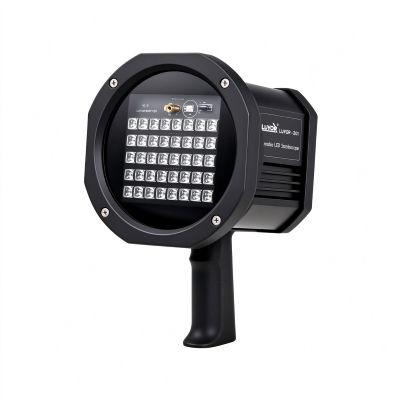
 Model: LUYOR-906L

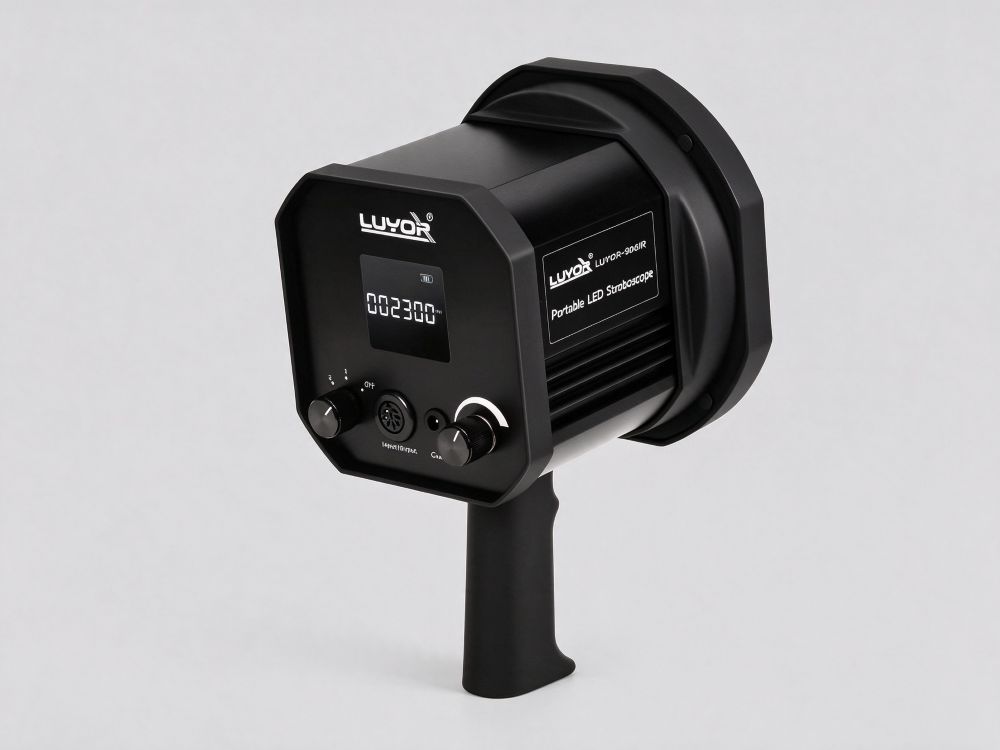
Model: LUYOR-906
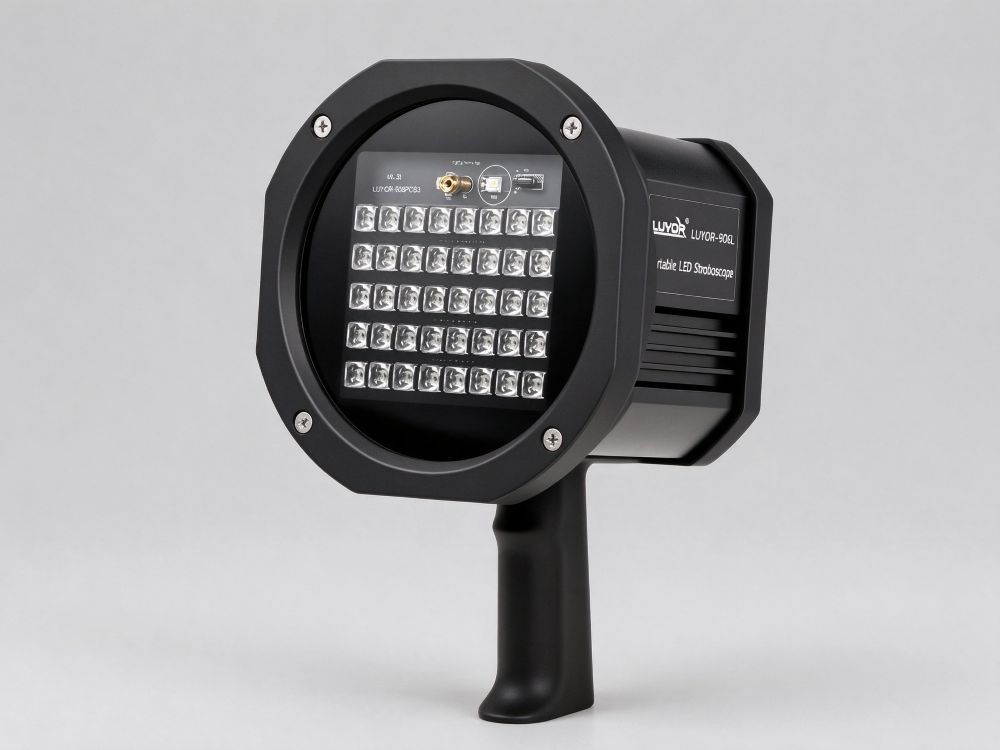
Model: LUYOR-906IR
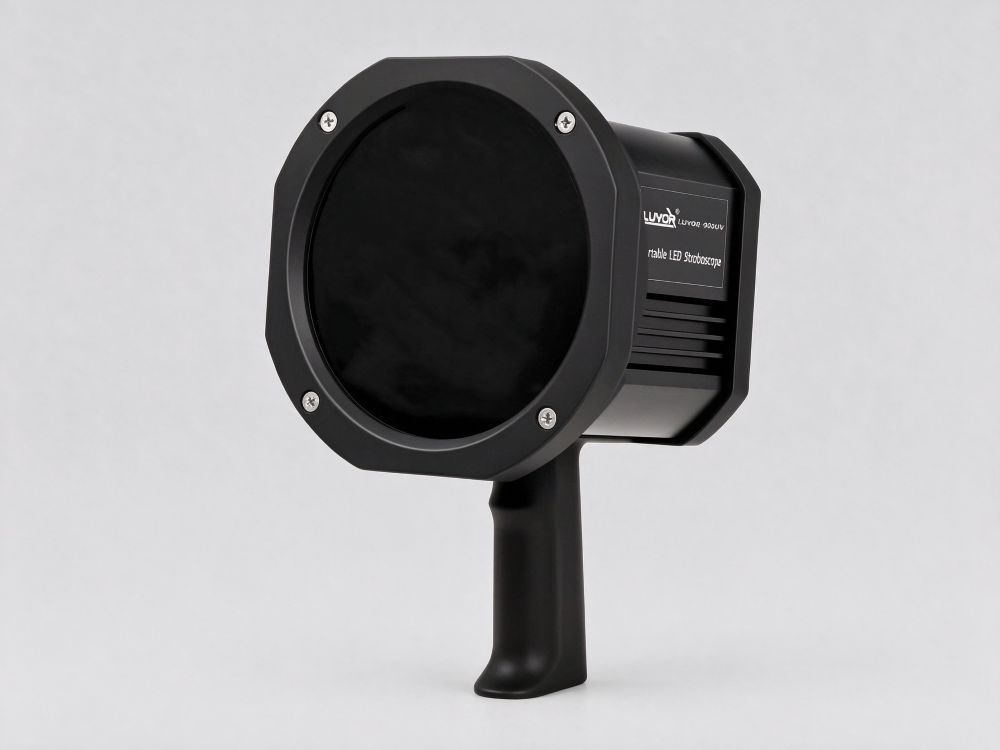
Model: LUYOR-906UV
The first fork in choosing a stroboscope is the light source: white LEDs cover the vast majority of rotating-equipment observation and printing or textile pattern inspection; UV and infrared are special-wavelength tools used for anti-counterfeit development and machine-vision fill light. The second fork is maximum frequency and accuracy: fan and spindle dynamic balancing calls for several hundred thousand FPM and 0.001%-class accuracy, while routine visual inspection only needs an entry-level model. The third is battery life and protection, which determine whether the unit can be taken out for continuous on-site work.
| Model | Light Source | Frequency Range | Accuracy | Power / Battery Life |
|---|---|---|---|---|
| LUYOR-906 | 40 white LEDs | 60-300000 FPM | 0.01% | Lithium battery power, 5 trigger modes |
| LUYOR-906L | 40×5W white LEDs, 6000K, automatic laser tracking | 60-300000 FPM | 0.01% | Lithium battery, about 4 hours |
| LUYOR-906UV | 40 UV LEDs, 365-375nm | 60-300000 FPM | - | Lithium battery, over 10 hours |
| LUYOR-906IR | 40×850nm infrared LEDs | 60-300000 FPM | - | About 9.5 hours, IP54 |
The comparisons above are compiled from the published specifications on each product page. For exact configurations, prices and lead times, please refer to the relevant product page or call the number at the bottom of the page. Xinysun Instruments (Shanghai) Co., Ltd. supplies LUYOR and XEPU instruments for industrial inspection, UV curing and speed measurement.
A stroboscope flashes instantaneously at a set frequency. When the flash frequency matches the rotational frequency of the test object, the mark appears at the same position each time, and persistence of vision makes the rotation look like a still image. When the frequency is slightly higher or lower, the mark drifts slowly by the difference, producing readable slow motion. This is why the stroboscopic method can measure speed without attaching reflective tape or touching the rotating shaft.
Conversion: flash frequency f (flashes per minute, FPM) = rotational speed n (revolutions per minute, RPM) x number of marks per revolution k. With a single mark, f and RPM are numerically equal; when using natural marks such as coupling bolts or blades, divide the reading by the number of marks. If the image is frozen but the speed does not match expectations, first check for harmonic misjudgment by ×2 and ÷2; see Harmonic Interpretation and the ÷2 Check.
Xenon stroboscopes have a fixed flash duration (about 5-20 microseconds), while LED stroboscopes can be adjusted about 1-3000 microseconds. Shorter flashes reduce motion blur but lower brightness, so on site you must balance freezing the image against adequate illumination; see Xenon vs. LED Stroboscopes for details on the trade-off.
Objects with periodic repeating features, such as continuous printed patterns or knitted loops, need no extra mark; use the repeating unit of the pattern as the reference. The LUYOR-906L has a built-in laser sensor that automatically tracks a printed mark, eliminating manual frequency adjustment; see LUYOR-906L Stroboscopic Observation in Practice for setup. If you need a combined stroboscope and tachometer, see the .
The three solve different problems: use a stroboscope to see motion, a laser tachometer to read an accurate number, and a tachometer sensor for long-term online recording. In many plants all three are used together - the sensor handles trends, the tachometer handles verification, and the stroboscope identifies where the abnormality occurs.
| Tool | Contact? | Typical Accuracy | Best At | Not Suitable For |
|---|---|---|---|---|
| Stroboscope | Non-contact | ±0.01% (LUYOR 906 series), 0.001% (NP series) | Freezing motion, visual speed reading, print registration and pattern inspection | Non-periodic motion, applications requiring continuous curve recording |
| Laser tachometer | Non-contact | ±0.01%, 0.001% on some models | Direct RPM reading, with max/min/average recording | Cannot show motion posture or patterns |
| Tachometer sensor | Non-contact (optical/laser) or contact | Model-dependent; pulse counting has no accumulated error | Long-term online monitoring; pulses feed PLCs and data acquisition systems | Requires mounting, target alignment and wiring commissioning |
For sensor mounting angle and signal conventions, see ROLS Series Troubleshooting; for solution-level comparison and selection steps, see Speed Measurement Solutions.
- Printing and packaging: print registration, repeating-unit inspection, and locating ink bars and dirt spots;
- Textiles and cable: spindle, needle cylinder and guide-roller speed, and yarn vibration;
- Motors, fans and pumps: pre-balancing observation of blades and couplings, and fan slip detection;
- Belt and chain drives: visual assessment of slip, and before/after tensioning comparison;
- Vibration and reciprocating mechanisms: external-trigger synchronization to observe vibration phase and stroke endpoints;
- Anti-counterfeiting and fluorescence detection: 365-375nm UV strobing reveals invisible fluorescent inks under the flash.
UV models are used for anti-counterfeit printing and fluorescent penetrant inspection, while 850nm infrared models provide machine-vision fill light and through-material inspection; they are invisible to the eye and do not disturb the test object. You can also browse by industry through Product Applications.
- Selection and brands: How to choose speed measurement: tachometers and sensors compared, 20 Questions About LED Stroboscopes: Frequency Range, Pulse Width, Triggering and Model Selection, How to choose a stroboscope? LED vs. xenon, frequency accuracy and model comparison
- Operation and interpretation: Laser Tachometer and Stroboscope FAQ: Practical Speed Measurement Answers
- Field and literature case studies: LUYOR-906L Laser-Tracking Stroboscope Applications: Six Field Observations
LEDs last long, consume little power and can reach several hundred thousand FPM, making them suitable for most rotating-equipment observation and printing or textile pattern inspection. Xenon lamps deliver high energy per flash and a color temperature close to daylight, so they still have advantages in high-speed photography and applications needing intense instantaneous illumination; however, the flash tube has a limited life, battery life is short (about 2 hours for the BBX), and the maximum frequency is lower (10000-20000 FPM).
The units are numerically the same (counts per minute versus revolutions per minute), but the meanings differ: FPM is the number of flashes, while RPM is the number of revolutions of the rotating part per minute. With a single mark the two values are equal; when the image appears frozen but the actual speed is half or double due to harmonic misjudgment, confirm with the ×2 and ÷2 harmonic keys. Models with a laser tachometer mode (NP series) read RPM directly.
365-375nm UV strobing is used for anti-counterfeit printing, invisible fluorescent inks and fluorescent penetrant inspection, making marks that glow only under UV visible in the flash. 850nm infrared strobing is used for low-light machine-vision fill, through-material inspection and high-speed photography; it is invisible to the human eye and does not disturb the test object. Both are special-wavelength flashes, so first confirm the response wavelength of the material you are measuring.
The LUYOR 906 series is rated at 60-300000 FPM with 0.01% accuracy; the laser-tracking 906L extends the range for large machinery and high-speed lines. When selecting, allow about 20% headroom above the maximum speed to be measured and confirm that the flash duration at that speed still freezes the image.
For reading numbers, use a tachometer; for observing motion, use a stroboscope. A laser tachometer (such as the LUYOR-925) gives RPM directly without relying on visual interpretation; the stroboscope's strength is freezing motion to inspect posture and print registration. All-in-one units like the Nova-Pro 300/500 offer both modes; with the laser module installed you can switch between STROBE and TACH.
The LUYOR-906UV runs over 10 hours on its lithium battery, and the 906IR about 9.5 hours with an IP54 rating. For dusty or humid workshop environments, prefer IP54-rated LED models.
Price depends mainly on maximum frequency, accuracy, protection rating and whether laser auto-tracking is included: entry-level white-LED handheld models and imported high-precision models fall into two different price brackets. Choose the tier based on the maximum speed to be measured, the accuracy required and whether auto-tracking is needed; confirm the price and lead time of a specific model by phone or on its product page.

Email: info@xinysun.com

Tel: 131-2093-6518

Address: 1525 Minqiang Road, Bldg 26, Songjiang, Shanghai

Copyright 2026 Xinysun Instrument (Shanghai) Co., Ltd. All rights reserved.
ICP:ICP-2026046447




 Products
 Applications
 Industrial Test Instruments


