Products
PRODUCTS Breadcrumb: Home > Products > Life Science Instruments > Irradiation Systems
 Overview
LUYOR-3416 LED parallel-light photochemical reactor: 4x4 16-well array, 365-610nm selectable, 200 mW/cm2, 48 W, fan-cooled, for parallel photocatalysis.
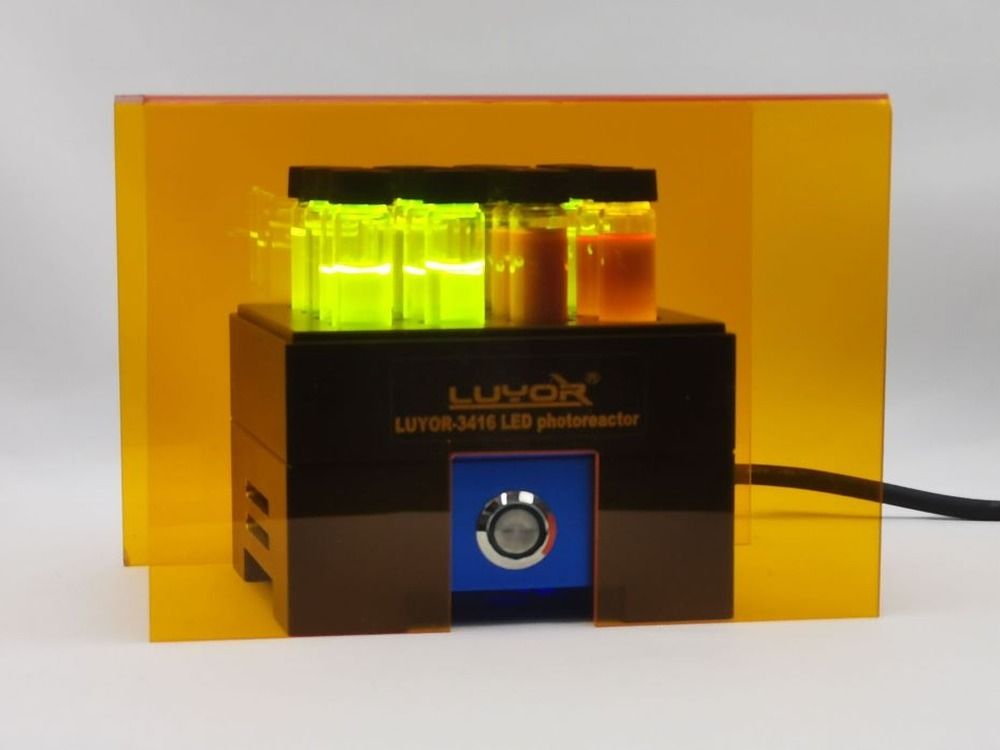
Running several photochemistry experiments in one instrument at the same time is the design goal of the LUYOR-3416 LED parallel-light photochemical reactor. A 4×4 array of 16 reaction wells is illuminated evenly from below; the unit can sit on a magnetic stirrer and is used with a light shield and protective glasses. It suits parallel screening of visible and UV reactions such as photocatalysis, photosynthesis and pollutant degradation.
Compared with reactors built around a xenon lamp, the 3416 uses high-power LEDs from below, so more of the light energy reaches the reaction, LED life is long, heat is manageable, and surface temperature stays low in long runs.
The hard part of photochemistry research is often not the reaction but the number of conditions and controls. Catalyst loading, concentration, temperature, irradiance, additive type - the number of combinations to screen is large, while staff and equipment are limited. The 3416 makes this simpler with 16 parallel channels:
Parallel controls:the 4×4 well array holds several samples at once, so multiple condition sets are compared within one batch and systematic error (irradiance decay, ambient drift and so on) is suppressed.
Reproducible data:the bottom LED array gives consistent irradiance, so differences between wells are small and data sets are comparable.
Configurable wavelength:365nm, 405nm, 450nm, 480nm, 505nm, 530nm and 610nm are available, and combinations can be customized, covering both UV crosslinking and visible-light catalysis.
Fits existing setups:the unit sits directly on a magnetic stirrer, samples are illuminated while stirring, and it connects smoothly with conventional photochemistry practice.
| Item | Specification | Notes |
|---|---|---|
| Product model | LUYOR-3416 | LED parallel-light photochemical reactor (LUYOR) |
| Input power | AC 100-240V, 50/60Hz | Wide-range input, fits most laboratory outlets |
| Output power | 48 W | Rated power of the complete unit |
| Beam angle | 20° | Concentrated illumination from below |
| Light intensity | 200 mW/cm² | Irradiance at the reaction wells |
| Wavelength options | 365 / 405 / 450 / 480 / 505 / 530 / 610 nm, selectable | Custom wavelength combinations available |
| Reaction well array | 4×4 (16 channels) | Several reactions in parallel |
| Irradiation | Bottom LED, shining upward | Replaces a conventional xenon source |
| Ambient temperature | -35 - +60 °C | Operating ambient range (per manufacturer) |
| Service life | 50000 hours | Nominal LED source life |
| Cooling | Fan-cooled (built-in fan) | Temperature control in long runs |
| Dimming | Optional | Supported in some configurations |
| Accessories | Light shield, LUV-50 blue-light glasses | Required during operation |
The 4×4 well array holds several samples at once, so condition controls run in one batch, systematic error is suppressed, and screening is more efficient than with a single-channel setup.
LEDs shine upward and the 20° beam angle concentrates light on the reaction zone, so irradiance is consistent across wells and data are reproducible.
Any wavelength from 365-610nm can be selected, or customized, so one hardware set covers both UV crosslinking and visible-light catalysis.
A built-in fan controls temperature and the LED is rated for 50000 hours, which suits lifetime studies that run for tens of hours or more.
It sits directly on a magnetic stirrer, samples are illuminated while stirring, and it fits conventional photochemistry setups.
Compared with a xenon setup, the LED approach costs less to buy and to run, so groups with few people and tight budgets can keep photochemistry work going.
| Field | What is studied | How it is used |
|---|---|---|
| Photocatalytic water splitting for hydrogen | Photocatalytic hydrogen production with Pt/P25 and similar catalysts in aqueous methanol | Mix catalyst and aqueous methanol under magnetic stirring, irradiate with the LED, and measure hydrogen by gas chromatography |
| Visible-light chemical synthesis | Oxidation, reduction and neutral visible-light catalytic reactions | Mix ruthenium or iridium complexes or organic dye catalysts with substrates under stirring, irradiate, then sample the liquid phase for GC or spot by TLC |
| Photocatalytic pollutant degradation | Visible-light catalytic decomposition of organic pollutants | Let the pollutant solution degrade under light in the wells and take timed samples to measure concentration change |
| Bench-scale drug synthesis | Building specific drug molecules and intermediates | Use light-induced reactions to build a set of unique structures quickly and improve screening efficiency for new drugs |
| Fine chemical R&D | Photochemical reactions in bench trials and process development | Compare the effect of different illumination conditions on yield and selectivity across parallel channels |
The 3416 can operate under vacuum, inert gas or a flowing atmosphere, covering gas-phase, liquid-phase, fixed and flow conditions, which makes it a cost-effective tool for the early screening stage of much photochemistry work.
The 3416 has a simple structure; operate it as follows:
Place the unit:put the LUYOR-3416 on a suitable magnetic stirrer and leave enough space around the vents for heat dissipation.
Connect power:unscrew the dust cover on the rear socket, screw the power cord plug into the rear socket, and connect the adapter to AC 100-260V mains.
Put on protection:the operator first puts on the supplied orange protective glasses (LUV-50 blue-light glasses) and avoids looking directly at the LEDs.
Start irradiation:press the stainless steel switch button on the front; the blue LED lights and the unit starts.
Fit the shield:place the orange light shield over the unit to reduce stray visible light during the reaction.
Shut down:when the reaction is finished, switch off first (the blue LED goes out), then unplug the adapter.
Eye protection:wear the LUV-50 blue-light glasses whenever the unit is running and never look directly at the LEDs.
Shutdown order:always switch the unit off before unplugging the adapter.
Power matching:confirm the mains voltage matches the unit (about ±10% tolerance) and that the outlet rating is not below the unit's requirement.
Cable care:use the supplied cord; a damaged cord must be replaced with the same type and rating and must not be repaired in-house. Do not put heavy objects on the cord or route it across walkways.
Location:place the unit in a cool, ventilated, dry and dust-free area, and keep effective clearance (over 30cm recommended) between the vents and nearby objects for heat dissipation.
Environment:avoid strong acid or alkali atmospheres; clean up corrosive liquid spilled from sample containers promptly so it does not seep into the housing.
The core difference is the source. The 3416 replaces the xenon lamp with a bottom LED array: higher light utilization, longer life (50000 hours nominal), less heat and no frequent bulb changes; xenon systems are usually bulky, run hot and have limited bulb life. When several parallel controls are needed, the 16 channels of the 3416 are a clear advantage.
Standard options include 365nm, 405nm, 450nm, 480nm, 505nm, 530nm and 610nm, and combinations can be customized. 365nm is UV-A and can be used for UV crosslinking work; for other bands, confirm a custom option with the manufacturer. Common derivatives are 3416UV (365nm), 3416RB (450nm) and 3416LB (470nm).
The well array is 4×4, 16 channels, so 16 samples run in parallel and multiple condition sets are compared in one batch, which suppresses systematic error and speeds up screening.
It is designed to sit on a magnetic stirrer so samples are illuminated while stirring, consistent with conventional photochemistry practice. If the reaction does not need stirring, it can run static, provided the vessels fit the wells and receive even light.
Wear the supplied LUV-50 blue-light glasses and never look directly at the LEDs. The orange shield covers the unit to reduce stray visible light; switch off before unplugging.
Photocatalytic water splitting for hydrogen, visible-light chemical synthesis (oxidation, reduction, neutral), photocatalytic pollutant degradation, bench-scale drug synthesis and fine chemical R&D, covering gas-phase, liquid-phase, fixed and flow conditions.
The LED is rated for 50000 hours and the built-in fan controls temperature, so it suits catalyst lifetime tests that run for tens of hours or longer; for long runs keep ventilation good and leave space around the unit.
Send inquiry

Email: info@xinysun.com

Tel: 131-2093-6518

Address: 1525 Minqiang Road, Bldg 26, Songjiang, Shanghai

Copyright 2026 Xinysun Instrument (Shanghai) Co., Ltd. All rights reserved.
ICP:ICP-2026046447




 Products
 Applications
 Previous:
 Back to list

 Industrial Test Instruments


