
Products
PRODUCTS Breadcrumb: Home > Products > Life Science Instruments > Irradiation Systems
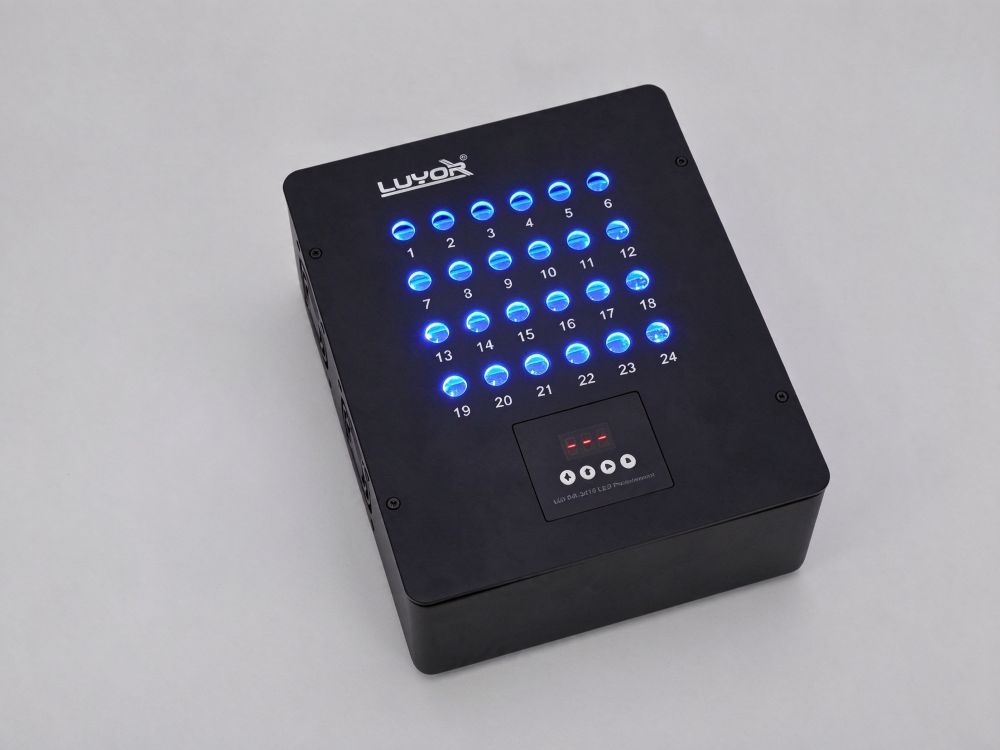
 Overview
Blue-light photolysis before viable qPCR: 96 LEDs at 465-475nm, 24 x 1.5-2mL tubes, 1-999 minute timer, and fan cooling below 37 C for sample safety.
The LUYOR-3419PMA is an LED blue-light photolysis device for sample preparation ahead of viable quantitative PCR (v-PCR), used to complete controlled photoactivation of PMA, PMAxx, EMA, and similar photoactive dyes. It uses 96 blue LEDs at 465-475nm that illuminate the sample tubes from the side and from the bottom at the same time. One run takes 24 x 1.5-2mL centrifuge tubes, exposure time is set freely from 1 to 999 minutes, and a built-in fan holds the sample area below 37℃.
Standard qPCR is sensitive and fast, but it cannot tell dead cells from live ones - the amplified signal carries residual DNA from dead bacteria. The PMA (propidium monoazide) method closes that gap. PMA is a photoreactive DNA-binding dye: it cannot cross an intact membrane, so live cells exclude it, while dead cells with damaged membranes let it in and it binds their DNA. After blue-light photoactivation, PMA cross-links covalently to the DNA and that stretch of DNA can no longer be amplified by PCR. The qPCR signal then comes from live cells alone, so a viable-cell count is obtained without culture, including viable but non-culturable (VBNC) bacteria.
In this workflow the LUYOR-3419PMA carries out the photolysis step: load the incubated tubes, set the time, start, and the device stops on its own. Wavelength, illumination uniformity, temperature, and time are all controlled and repeatable, which is the physical basis for stable v-PCR data.
PMA is not membrane-permeable. A live cell keeps an intact membrane and the dye stays outside; a dead cell with a damaged membrane lets PMA in, where it binds DNA with high affinity.
Under 465-475nm blue light the azide group on the PMA molecule is activated and forms covalent cross-links with DNA. This photolysis step is the job of the LUYOR-3419PMA.
Once cross-linked, the DNA can no longer serve as a PCR template, so DNA from dead cells drops out of the detection signal.
qPCR amplifies DNA from live cells alone; Ct values and a standard curve convert the result into a viable-cell count for the sample.
The method combines the speed, sensitivity, and specificity of qPCR with quantifiable viable-cell information. It applies to bacteria, yeast, fungi, viruses, and eukaryotic cells, and it connects to downstream techniques such as NGS, Sanger sequencing, and LAMP, with wide use in food safety, water safety, and environmental testing.
The 465-475nm blue band covers the photoactivation range of PMA and PMAxx, which is closer to the dye manufacturer's design conditions than an arbitrary blue light source, so photolysis efficiency and batch-to-batch consistency are better supported.
Multiple LEDs illuminate from the side and the bottom at several angles, and 24 tubes are photolyzed together, so conditions are consistent across tubes and batches and dose drift from manual placement is avoided.
A built-in fan actively removes heat during photolysis and keeps the sample area below 37℃, reducing the effect of heat on viable-cell state and nucleic acid quality.
Digital setting from 1 to 999 minutes with automatic stop at the end, plus a stop-irradiation key for interrupting at any point, which simplifies exploring and standardizing a new protocol.
A 100-220V wide-range supply and a universal socket adapter are included; the unit weighs about 3.5kg, sits on a bench, and is easy to move.
Three-year warranty from the date of purchase, with application support from the manufacturer.
| Item | Specification |
|---|---|
| Model | LUYOR-3419PMA (PMA LED Photolysis Device) |
| Purpose | Controlled photoactivation of PMA, PMAxx, EMA, and similar photoactive dyes |
| Emission wavelength | 465-475nm (blue) |
| Light source | 96 blue LEDs |
| Illumination | Multiple LEDs illuminate the sample tubes evenly from the side and the bottom at the same time |
| Sample capacity | 24 x 1.5-2mL centrifuge tubes photolyzed together |
| Exposure time | 1-999 minutes, freely set, automatic stop at the end |
| Temperature control | Built-in fan, sample area below 37℃ |
| Interruption | Stop-irradiation key, stops at any time |
| Power | 100-220V AC, 50/60Hz (wide range) |
| Power consumption | About 60W |
| Dimensions | 260 × 270 × 70mm |
| Weight | About 3.5kg |
| Supplied accessories | Universal socket adapter |
| Warranty | 3 years |
Add sample and dye and incubate in the dark following the instructions of the PMA or PMAxx kit in use. Keep the incubation and transfer steps away from light so the dye does not photolyze early.
Place the centrifuge tubes in the sample positions, evenly spaced and not shading one another, set the exposure time on the panel, and start.
Irradiation stops automatically at the set time. To finish early, press the stop-irradiation key.
Extract DNA from the photolyzed samples by the usual procedure and run qPCR, NGS, Sanger sequencing, or LAMP.
Incubation time, dye concentration, and photolysis time follow the protocol of the kit in use. The LUYOR-3419PMA supplies controlled, repeatable physical conditions; the protocol parameters need to be established by the user and kept constant within a batch.
The LUYOR irradiation range covers several directions in in-vitro photobiology and photochemistry, with different wavelengths, sample formats, and throughput. Start selection from the sample format and the goal:
| Model | Light source and sample format | Typical use |
|---|---|---|
| LUYOR-3419PMA photolysis device | 465-475nm blue light, 24 x 1.5-2mL centrifuge tubes | PMA/PMAxx/EMA photolysis, sample prep for viable qPCR |
| LUYOR-3480 microplate cell irradiator | 365-808nm selectable, fits 6/12/24/48/96-well plates | Optogenetics, photobiology, photopharmacology, and photochemistry screening; can be placed in an incubator |
| LUYOR-3450 cell phototoxicity irradiator | In-vitro irradiation for the 3T3 NRU phototoxicity test | Cosmetic and chemical safety assessment |
| LUYOR-3550 UV irradiation chamber | UVA UV irradiation chamber | UVA exposure work such as animal phototoxicity testing |
If the goal is controlled blue-light exposure of samples in centrifuge tubes, choose the 3419PMA. For whole-plate irradiation or optogenetic stimulation, look at the 3480. For 3T3 NRU phototoxicity or animal UVA exposure, the choices are the 3450 and the 3550. The full model list is in the laboratory irradiation systems section.
PMA-qPCR quantification of Bifidobacterium animalis subsp. lactis BB-12 and Lactobacillus plantarum ST-III in fermented milk (Journal of Food Safety and Quality, 2025): PMA pretreatment combined with qPCR quantifies viable cells directly in a fermentation matrix that carries a large dead-cell load, replacing time-consuming plate counts.
Analysis of viable communities in wastewater treatment biofilm (Microorganisms, 2024): PMA combined with real-time PCR and metagenomic sequencing reflects the community that is actually alive, instead of the false signal left by DNA from dead cells.
Microbiome dynamics during ultrasound-assisted fermentation of corn processing by-products (Ultrasonics Sonochemistry, 2025): PMA modification separates live from dead cells and tracks viable succession at each fermentation stage.
Any molecular test that needs to measure live cells alone can use the method. Sample types cover bacteria, biofilm, yeast, fungi, viruses, and eukaryotic cells; application fields include food, water, and environmental safety testing; downstream methods include qPCR, NGS, Sanger sequencing, and LAMP. For viable but non-culturable (VBNC) populations, PMA-qPCR is one of the limited number of approaches that returns a viable-cell count.
Keep everything dark: PMA is a photosensitive dye, so loading, incubation, and transfer should be done away from light to avoid partial photolysis before the tubes reach the instrument.
Tube placement: use 1.5-2mL centrifuge tubes, no more than 24 per run, evenly spaced and not stacked or shaded, so every tube receives the same light.
Time standardization: keep the photolysis time fixed within one experimental batch, and re-standardize after changing dye lot or protocol so batches stay comparable.
Heat dissipation space: the built-in fan keeps the sample area below 37℃; leave clearance at the rear and around the body, and ventilate the room when ambient temperature is high.
Routine cleaning: keep the LED panel and sample positions clean and prevent liquid spillage; disconnect power before cleaning and wipe the panel with a soft dry cloth.
A common blue-light box provides blue light and nothing more, while the PMA method sets requirements on the wavelength window, illumination uniformity, sample temperature, and exposure time. The 3419PMA centers on the 465-475nm activation band of PMA/PMAxx, illuminates 24 tubes from the side and the bottom at once, holds the sample area below 37℃ with a built-in fan, and runs 1-999 minutes with interruption at any time. These are the physical conditions that repeatable v-PCR data depends on.
The device accepts any setting from 1 to 999 minutes. The actual duration depends on the dye, its concentration, and the sample matrix, so follow the kit protocol. For a new protocol, start with a time gradient and confirm that dead-cell DNA is blocked sufficiently without affecting the live-cell signal, then fix the parameters.
The standard configuration fits 1.5-2mL centrifuge tubes and photolyzes 24 at a time. Close the caps firmly, space the tubes evenly, and avoid shading. For tube markings, use a light-blocking label or place the mark on the shaded side.
Samples warm up during LED photolysis, and excessive temperature can change membrane state and nucleic acid quality, which indirectly affects how well live and dead cells are separated. The built-in fan holds the sample area below 37℃, giving the sample an exposure environment close to physiological conditions.
The device is designed for photoactive dyes, so in addition to PMA it can be used with PMAxx, EMA, and similar dyes whose activation window falls within 465-475nm. It also serves other experiments that need controlled blue-light exposure.
The supply is 100-220V AC, 50/60Hz wide range, and a universal socket adapter is included. The instrument carries a three-year warranty from the date of purchase, and the manufacturer provides application support for use and selection questions.
Send inquiry

Email: info@xinysun.com

Tel: 131-2093-6518

Address: 1525 Minqiang Road, Bldg 26, Songjiang, Shanghai

Copyright 2026 Xinysun Instrument (Shanghai) Co., Ltd. All rights reserved.
ICP:ICP-2026046447




 Products
 Applications
 Previous:
 Back to list

 Industrial Test Instruments


