
Products
PRODUCTS Breadcrumb: Home > Products > Industrial Test Instruments > Tachometers
 Overview
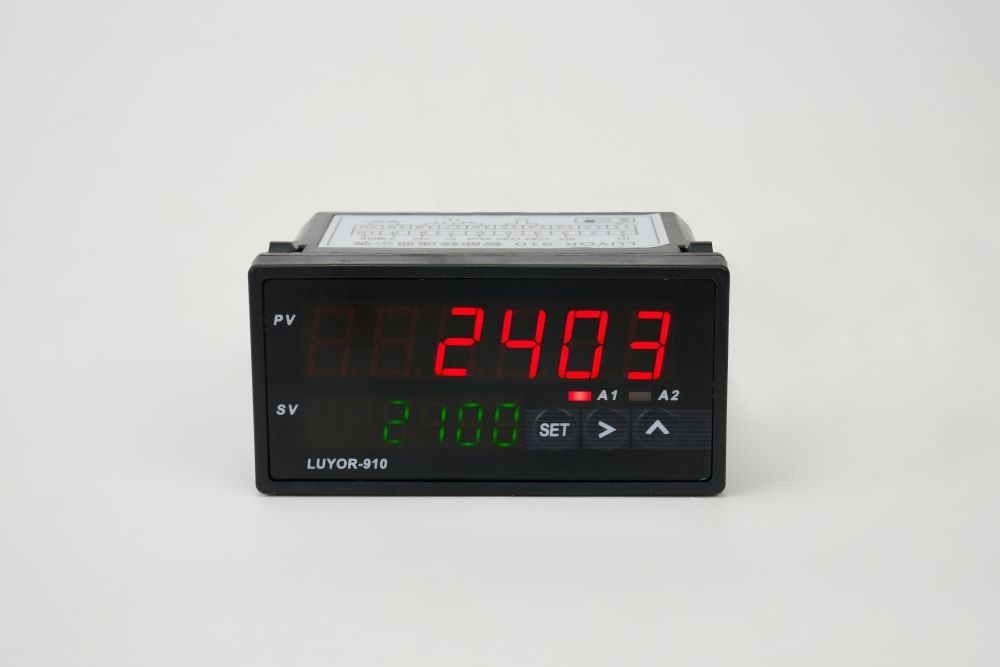
LUYOR-910 panel mount tachometer, 5-999990 RPM, +/-0.001% of reading, 2 relay alarms, 0-5V or 4-20mA output, RS485 option, 96x48mm bezel.
A machine shaft has to be monitored continuously, but the people in the control room cannot see the machine. A hand-held tachometer can take a reading, but it cannot watch all the time or trigger an alarm. Separating measurement from viewing calls for a split speed measurement system: a sensor reads speed without contact, and a meter displays it, raises alarms and sends the signal out.
LUYOR-910 is the meter half of that system: panel-mount, standard 96×48mm bezel (92×44mm cutout), flush with the cabinet door or console face once installed. The measuring end comes from the LUYOR speed sensor range - the ROLS-5PW laser model, the ROS photoelectric series and the ROS-HT-W-25 high-temperature model all connect directly; third-party sensors or devices that output 0-5V TTL pulses (proximity switches, encoders and so on) also work, and 1.5-50V AC signals are within the input range.
Beyond the reading, its more important role is automatic judgment: each of the two alarm setpoints drives its own relay, so an out-of-limit speed triggers an action that can stop the machine, light a warning or notify the control room. Analog and RS485 outputs feed speed data into a PLC, recorder or host system, closing the monitoring loop.
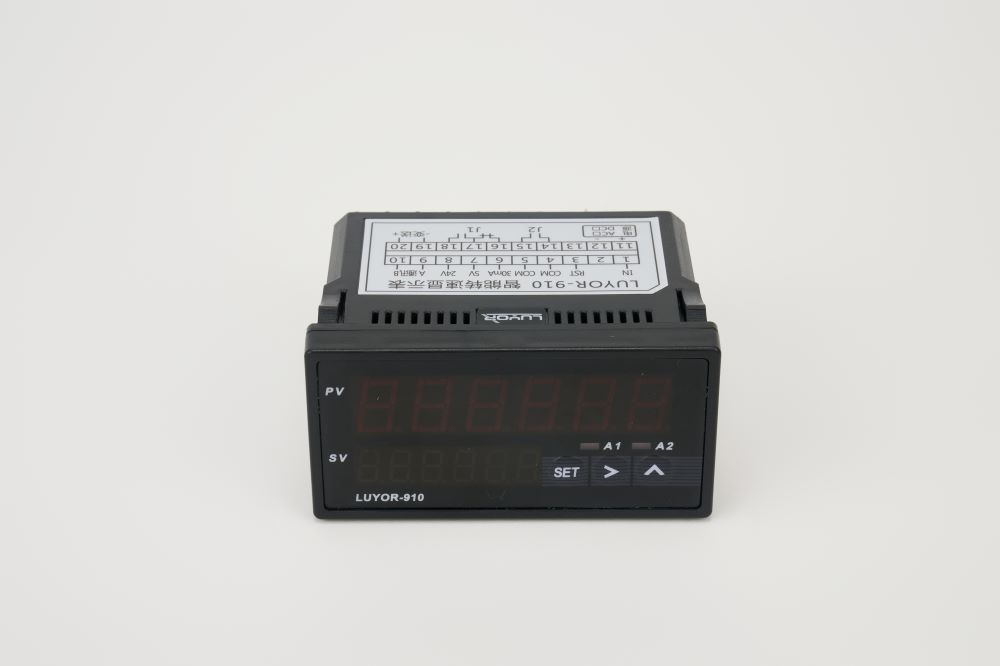
Cut a 92×44mm opening in the cabinet door or console panel, push the body in from the front and tighten the supplied bracket from behind. Overall depth is 90mm, so shallow cabinets work too. For bench use or temporary setups, the optional LUYOR-910BOX housing needs no cutout and sits on a desk with a full terminal panel.
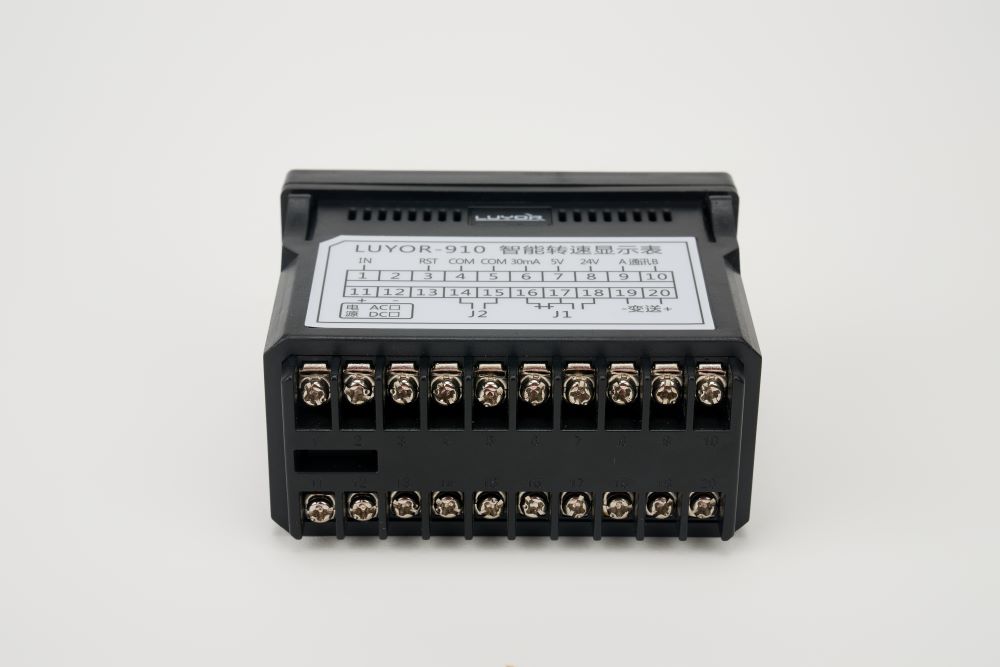
Take the ROLS-5PW laser sensor: brown (power +) goes to terminal 7 (5V), blue (GND) to terminal 5 (COM), black (signal) to terminal 1 (IN). Other LUYOR sensors follow the same color code. The meter can supply 5V or 24V to the sensor, so no separate power supply is needed.
XA AC series: terminals 11 and 12 take 110V or 220V AC. XD DC series: terminal 11 to 24V positive, terminal 12 to 24V negative. Both versions have identical functions; choose at order time to match the cabinet.
Analog output is on terminals 19 and 20 (19 negative, 20 positive) for a recorder or PLC analog input. RS485 is on terminals 9 and 10 (9 = A, 10 = B) for SCADA or data acquisition. The two relay outputs drive alarms, indicator lamps or interlock circuits directly.
| Item | Specification |
|---|---|
| Brand | LUYOR |
| Product type | Panel-mount tachometer (display and alarm end of a split speed measurement system) |
| Range | 5-999990 RPM |
| Accuracy | ±0.001% of reading or ±1 in the last digit (standard update); ±0.006% of reading or ±1 in the last digit (fast update); NIST compliant |
| Resolution | 0.001-10 RPM (in the 100000-999990 RPM range) |
| Display | 6-digit 14mm high LED, dual row PV measured value / SV setpoint, refreshed twice per second |
| Input configuration | LUYOR speed sensors / 0-5V TTL pulse / 1.5-50Vac signal |
| Alarm | 2 alarm setpoints, high or low, latching or non-latching, hysteresis and editable low-limit lock |
| Alarm output | Two Form C relays, contact rating 1A @ 230Vac |
| Analog output | 0-5Vdc voltage or 4-20mA current (by model) |
| Communication | Optional RS485, Modbus RTU protocol |
| Scale / totalizer | Scale factor 1-999999; totalizer/counter display 0.001-999999 |
| Sensor supply | 5Vdc or 24Vdc (output from the meter) |
| Power | XA: 100-240Vac 50/60Hz; XD: 24Vdc (by model) |
| Dimensions | Bezel 96×48mm, cutout 92×44mm, depth 90mm |
| Options | LUYOR-910BOX panel meter housing (desktop use, no cutout) |
The code has three parts: power (XA AC / XD 24V DC) + analog output (DC 0-5V voltage / MA 4-20mA current) + whether RS485 is fitted. Start with what the cabinet supplies, then with what the downstream device accepts:
| Ordering code | Power | Analog output | RS485 | Typical destination |
|---|---|---|---|---|
| LUYOR-910XA-DC | 100-240V AC | 0-5V voltage | - | Recorders, voltage input cards |
| LUYOR-910XA-MA | 100-240V AC | 4-20mA current | - | PLC analog inputs, secondary meters |
| LUYOR-910XA-DC-RS485 | 100-240V AC | 0-5V voltage | Yes | Voltage acquisition plus SCADA/data acquisition |
| LUYOR-910XA-MA-RS485 | 100-240V AC | 4-20mA current | Yes | PLC plus SCADA/data acquisition |
| LUYOR-910XD-DC | 24V DC | 0-5V voltage | - | DC control cabinets, mobile equipment |
| LUYOR-910XD-MA | 24V DC | 4-20mA current | - | DC cabinets with PLC analog input |
| LUYOR-910XD-DC-RS485 | 24V DC | 0-5V voltage | Yes | DC cabinets plus SCADA/data acquisition |
| LUYOR-910XD-MA-RS485 | 24V DC | 4-20mA current | Yes | DC cabinets plus PLC and SCADA |
The two meters are two forms of the same split-measurement approach and share the same sensor range; the difference is mounting position and output emphasis: the 910 is panel-mount and focuses on local display and alarms, the 912 is 35mm DIN rail and focuses on signal transmission and remote monitoring. If unsure, use the table below:
| Item | LUYOR-910 panel tachometer | LUYOR-912 intelligent speed transmitter |
|---|---|---|
| Mounting | Panel cutout, flush (92×44mm cutout) | 35mm standard DIN rail clip-on |
| Role | Local display + alarm + transmission | Signal transmission + remote monitoring + alarm |
| Display | 6-digit LED, PV/SV dual row, 14mm high | 6-digit LED, PV red 9mm / SV green 6.5mm |
| Accuracy | ±0.001% of reading (NIST standard) | Transmission accuracy 0.2% FS |
| Relays | 2 Form C, 1A @ 230Vac | 2 Form C, AC220V/3A, 100000 operations |
| Communication | Optional RS485 (Modbus RTU) | Standard RS485, opto-isolated (Modbus RTU) |
| Power | 100-240Vac or 24Vdc | AC85-260V, 4W |
| Typical use | Operator positions that read and alarm at the cabinet door | Automation and data acquisition into PLC/DCS/SCADA |
Many projects use both: a 912 on the rail beside the machine sends the signal to the control room, and a 910 in the cabinet door gives the operator a local reading and alarm; with the same sensor model and scale factor, the two readings check each other. Full 912 specifications are on the LUYOR-912 intelligent speed transmitter / speed monitor product page.
For motors, fans and pumps that run continuously, aim the sensor at a reflective mark or keyway and the 910 shows speed continuously on the cabinet panel; when speed falls below the process minimum the relay acts, flagging a stall or an idle run.
Set the alarm to the process maximum and wire the relay output into the stop circuit: centrifuges, sand mills and test rigs with overspeed risk get a protection layer that is independent of the PLC.
±0.001% of reading with NIST calibration backing suits rig testing and acceptance reference speeds for motors and gearboxes; the analog output feeds a recorder for a curve at the same time.
4-20mA or RS485 carries speed into the PLC and host system for monitoring and storage alongside temperature and pressure; RS485 models use Modbus RTU, configured once.
The 24V DC XD series suits mobile lab rigs; with the 910BOX housing no cutout is needed, so one meter demonstrates the measurement principle, alarm logic and signal transmission.
For machines with no speed monitoring, add a sensor at the shaft and cut one hole in the door; existing pulse sources such as proximity switches and encoders connect directly, without touching the original control system.
The 910 is only half the system; the measuring end is chosen from the LUYOR sensor range by distance and environment.
It is the tachometer (display and control end) and has no measuring function of its own; it pairs with a speed sensor to form a split system. The sensor measures without contact at the machine, and the 910 displays, alarms and outputs signals in the cabinet panel. Sensors and meters can be bought separately or as a set.
Three-wire LUYOR photoelectric and laser sensors connect directly. Third-party sensors that output 0-5V TTL pulses (proximity switches, Hall sensors, encoders and so on) also work, and 1.5-50Vac AC signals are within the input range. State the signal source type at order time so compatibility can be confirmed.
Look at the downstream device: choose DC (0-5V) for voltage inputs on recorders and data acquisition cards; choose MA (4-20mA current loop) for PLC analog inputs and for long runs or high-noise environments. If both are needed, take an RS485 model and run analog and digital in parallel.
It uses Modbus RTU to send real-time speed as a digital value to SCADA software, a data acquisition system or the 485 port of a PLC; several meters can share one bus and be polled in turn. Unlike analog, it does not drift and needs no calibration, which makes it the recommended choice for data acquisition projects.
The two setpoints are independent; each can be high or low, latching or non-latching, with hysteresis and an editable low-limit lock. They are changed with the panel keys and survive power loss. A common setup is one setpoint at the upper limit for overspeed protection and one at the lower limit for stall warning.
Bezel 96×48mm, cutout 92×44mm, overall depth 90mm. It fits cabinet doors, console panels and distribution box panels; the body pushes in from the front and the rear bracket locks it. For temporary use without a cutout, choose the LUYOR-910BOX housing.
XA series: 100-240V AC 50/60Hz, straight onto 220V mains. XD series: 24V DC, for DC cabinets, mobile rigs or laboratories. Functions are identical; just specify at order time.
No. The meter outputs 5V or 24V to power the sensor, so three wires are enough. This also avoids signal faults from a mismatched sensor supply, one of the conveniences of using LUYOR meters and sensors as a set.
Brown (power +) to terminal 7 (5V), blue (GND) to terminal 5 (COM), black (signal) to terminal 1 (IN). Other models follow the same color code; the Installation and Wiring in Four Steps section above has the full description.
±0.001% of reading or ±1 in the last digit at the standard update rate, NIST compliant; ±0.006% of reading at the fast update rate. That is accurate enough to serve as a reference for production line speed acceptance and for checking other tachometers.
Two forms of the same measurement system: the 910 is panel-mount and focuses on local display and alarms; the 912 is rail-mount and focuses on transmitting signals into PLCs and SCADA. They share the same sensors; see the comparison table above. For automation projects, look at the 912 first.
A hand-held unit such as the PLT200 suits spot checks on patrol, but it cannot monitor continuously, alarm automatically, or provide analog and communication outputs. For 24/7 monitoring or integration with a control system, the split 910 system is the right tool.
A metal housing matched to the meter body that turns the panel-mount unit into a standalone desktop instrument with a full terminal panel; it suits laboratories, temporary testing and places where a cutout is impractical. Ordered separately from the meter.
Common models are in stock or ship short; confirm lead time for specific configurations such as RS485 and for volume orders. Warranty and service follow LUYOR's official terms. Units ship from Shanghai, with selection confirmation, wiring guidance and follow-up support.
Three things: the power available (AC or 24V DC), what the meter connects to downstream (which decides analog output and whether RS485 is needed), and which sensor you plan to use (or ask us to recommend). A complete request usually gets a configuration and price the same day.
LUYOR-910 product literature and official specifications
Comparison table of the eight ordering codes
Panel cutout dimensions and housing notes
Wiring diagrams for each sensor (ROLS-5PW / ROS / ROS-HT)
Modbus RTU register map
Quotation for sensors and complete systems
Meter and sensor configuration recommended for your site
Ordering code confirmation and alternative suggestions
Guidance on wiring, scale factor and alarm settings
Technical support for Modbus integration with SCADA and PLCs
Troubleshooting and tuning of alarm interlock schemes
Volume purchasing and project quotations
Send inquiry

Email: info@xinysun.com

Tel: 131-2093-6518

Address: 1525 Minqiang Road, Bldg 26, Songjiang, Shanghai

Copyright 2026 Xinysun Instrument (Shanghai) Co., Ltd. All rights reserved.
ICP:ICP-2026046447




 Products
 Applications
 Previous:
 Back to list

 Industrial Test Instruments


