
Products
PRODUCTS Breadcrumb: Home > Products > Industrial Test Instruments > Tachometers
 Overview
LUYOR-912 turns pulses from a 3-wire speed sensor into 4-20 mA, 0-5 V and isolated RS485 Modbus RTU, with two relay alarms for overspeed and stall.
The speed sensor delivers a pulse train, and then what? A PLC analog module accepts 4-20mA or 0-5V, and a SCADA system accepts communication telegrams. Converting between the two is what LUYOR-912 is for. It takes the square-wave pulses from a 3-wire active sensor, measures frequency and converts it to speed, then outputs both a standard analog signal and RS485, with input and output isolated throughout against industrial interference.
It is also a watchdog for rotating equipment: it monitors speed continuously and the relay acts immediately on overspeed or underspeed (stall). The typical applications LUYOR lists are overspeed protection for diesel engines, motor protection on crushers, pumps, and centrifuges, speed limiting and roll-back protection on cranes, winches, and hoists, and overspeed, underspeed, jam, and reverse protection on conveyor lines - all cases that cannot rely on an operator watching.
Because it mounts on standard 35mm rail, accepts wide-range AC supply, and speaks the general Modbus protocol, it presents almost no integration barrier in industrial automation, smart manufacturing, industrial internet data acquisition, and smart city projects: if the cabinet has rail, it mounts, and if the system speaks Modbus, it connects.
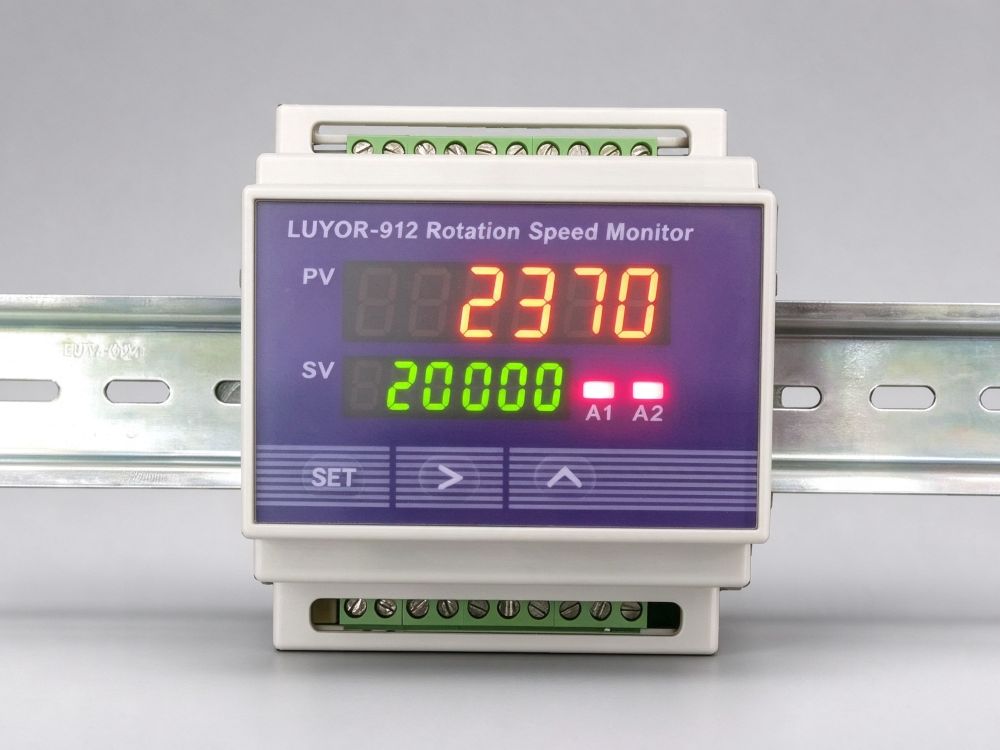
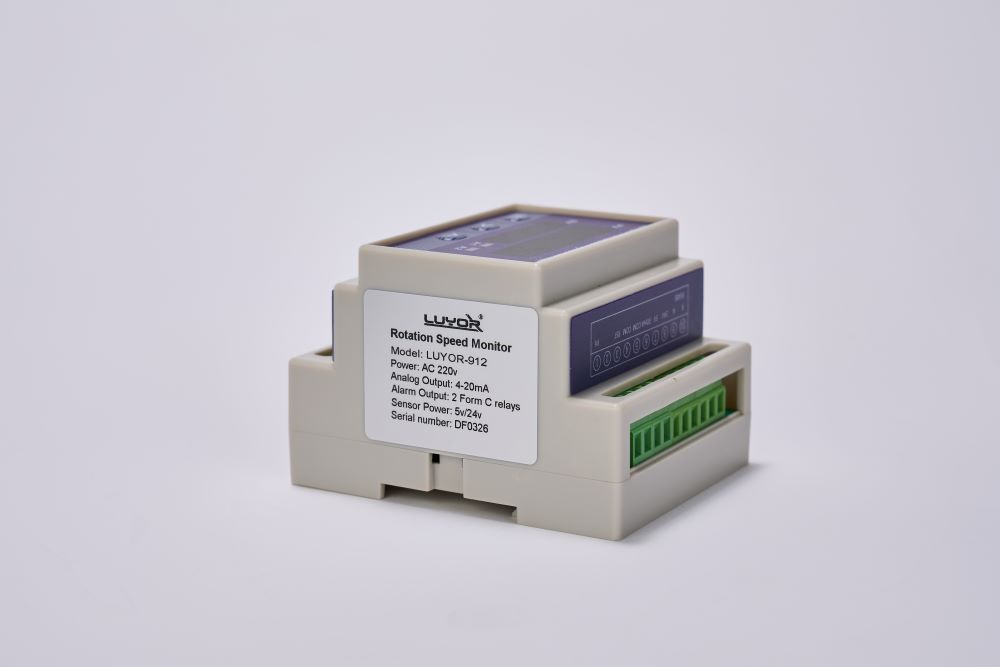
Align the slot on the rear of the housing with 35mm DIN rail and press to mount, then wire the green terminals on the front: three sensor wires (supply, ground, signal, with 5V or 24V sensor supply selectable in the instrument), operating supply AC85-260V, outputs one set of analog and one RS485, and relays two contact sets. The housing is 90×72×60mm, so one rail run holds it alongside other instruments.
Measured value PV (red 9mm digits) and setpoint SV (green 6.5mm) share the screen: multiplier A, multiplier b, decimal point position, and both alarm thresholds are set directly with the SET key and arrow keys, with no dismantling, no rewiring, and no computer. When setting is complete, SV stays displayed, so the alarm thresholds can be checked at any time.
Each Form C relay is bound to one alarm: the contact operates when speed rises above the upper limit or falls below the lower limit, and can be wired into a shutdown circuit, an audible-visual alarm, or a control-room signal. Alarms can be set separately for the stopped and running states of the start switch, so an anomaly while the machine is at rest, such as a crane or hoist creeping back as the rope slackens, can be caught with its own threshold.
Analog output is 0-20mA / 4-20mA or 0-5V depending on the order code and feeds a PLC analog module directly; RS485 runs the general Modbus RTU protocol, maps the speed value to a register, and lets several instruments share one bus. Does the reading need scaling by the multiplier? The instrument does that internally, and the register holds the real speed.
| Item | Specification |
|---|---|
| Brand | LUYOR, USA |
| Product type | Intelligent speed transmitter and speed monitor (rail mounting) |
| Input signal | Square-wave level pulse (3-wire active sensor), measuring frequency 50KHz, frequency range or speed span customizable |
| Display | Two rows of 7-segment digits: measured value in red 9mm, setpoint in green 6.5mm, up to 999999 rpm |
| Transmission output | 0-20mA / 4-20mA (load up to 750Ω) or 0-5V voltage, transmission accuracy 0.2% FS |
| Communication | RS485 optically isolated, Modbus RTU protocol |
| Relays | 2 Form C, contact rating AC220V/3A, life 100,000 operations |
| Alarm logic | Overspeed and underspeed thresholds set independently, with separate alarms for stopped and running states |
| Parameter setting | Front-panel keys set multiplier A, multiplier b, decimal point position, and alarm thresholds, retained at power-off |
| Sensor supply | 5V or 24V (output from the instrument) |
| Operating supply | AC85-260V, power consumption 4W |
| Protection and mounting | Front panel IP50; clips onto standard 35mm DIN rail |
| Dimensions | 90×72×60mm |
The naming follows the same scheme as the 910: supply (XA AC / XD 24V DC) plus analog output (DC 0-5V voltage / MA 4-20mA current) plus whether RS485 is fitted:
| Order code | Supply | Analog output | RS485 | Typical destination |
|---|---|---|---|---|
| LUYOR-912XA-DC | AC | 0-5V voltage | — | Voltage-input recorders and acquisition cards |
| LUYOR-912XA-MA | AC | 4-20mA current | — | PLC analog modules |
| LUYOR-912XA-DC-RS485 | AC | 0-5V voltage | Yes | Voltage acquisition plus SCADA, two channels |
| LUYOR-912XA-MA-RS485 | AC | 4-20mA current | Yes | PLC plus SCADA, two channels |
| LUYOR-912XD-DC | 24V DC | 0-5V voltage | — | DC cabinets, vehicle and mobile equipment |
| LUYOR-912XD-MA | 24V DC | 4-20mA current | — | DC cabinet plus PLC |
| LUYOR-912XD-DC-RS485 | 24V DC | 0-5V voltage | Yes | DC cabinet plus SCADA or DAQ |
| LUYOR-912XD-MA-RS485 | 24V DC | 4-20mA current | Yes | DC cabinet plus PLC plus SCADA |
The two instruments are two forms of the same split speed-measurement approach and share the same sensor range. The difference is mounting position and role: the 912 is a rail-mounted transmitter focused on feeding a control system, while the 910 is a panel-mount tachometer focused on local display and alarm. The comparison:
| Item | LUYOR-912 intelligent speed transmitter | LUYOR-910 panel tachometer |
|---|---|---|
| Mounting | Clips onto standard 35mm DIN rail | Panel cutout (92×44mm) |
| Role | Signal transmission, remote monitoring, alarm | Local display, alarm, transmission |
| Display | 6-digit display, PV red 9mm / SV green 6.5mm | 6-digit LED, PV/SV two rows 14mm high |
| Accuracy | Transmission accuracy 0.2% FS | ±0.001% of reading (NIST standard) |
| Relays | 2 Form C, AC220V/3A, life 100,000 operations | 2 Form C, 1A @ 230Vac |
| Distinctive capability | Separate alarms for stopped and running states, suited to crane roll-back protection | Complies with NIST standard, usable as a reference instrument |
| Supply | AC85-260V (4W) or 24Vdc models | 100-240Vac or 24Vdc |
| Suited to | Automation and data acquisition projects feeding PLC, DCS, or SCADA | Operator stations reading values and raising local alarms on a cabinet door |
Many projects use both together: the 912 on the rail feeds the control room, and the 910 on the cabinet door gives the operator local readings and alarms, with the same sensors and multiplier settings on both. Full specifications for the 910 are on the LUYOR-910 series panel tachometer page.
When engine or test-bed speed exceeds the safety threshold, the relay cuts the fuel rack or the air path directly - a second protection layer independent of the vehicle controller, suited to both factory testing and equipment in service.
Jamming and overload on crushers, pumps, and centrifuges all show up as speed anomalies: the 912 monitors continuously and alarms immediately on overspeed or stall, which is more direct than current-based protection.
Cranes, winches, and hoists share a property: a stopped machine is not necessarily safe. The 912 sets separate alarm thresholds for running and stopped states, so creep, roll-back, and reverse rotation at rest can be caught on their own.
Overspeed, underspeed, jamming, stoppage, reverse running, back-running, and differential speed on conveyors can all be turned into speed thresholds monitored by the 912; the relay signal enters the interlock circuit and isolates the affected section automatically.
In high winds, fan overspeed is a hard risk: the sensor monitors main shaft or impeller speed, the 912 alarms on limit and triggers braking, and RS485 sends the data to SCADA for remote visibility.
The general Modbus RTU protocol lets the 912 connect to gateways and cloud platforms without custom work: several instruments poll on one bus, and speed data joins output and energy data in the industrial internet system for analysis.
The 912 is the transmission and monitoring end; the measuring end comes from the LUYOR sensor range to suit site conditions, and the full range is in the tacho sensor section:
| Sensor | Light source type | Where it suits | Product page |
|---|---|---|---|
| LUYOR-ROLS-5PW | Class 2 laser | The usual choice for long distance (up to 7.6m) and large off-angle mounting | ROLS-5PW laser sensor |
| ROS series | Visible red LED | Economical choice for close range within 1m and volume installation | ROS photoelectric sensor |
| ROS-HT-W-25 | White LED | Continuous monitoring in high-temperature areas (up to 125℃) | ROS-HT-W-25 |
| Third-party pulse source | — | Proximity switches, encoders, and other 3-wire square-wave pulse signals connect directly | — |
Tell us the mounting distance, ambient temperature, and reflection conditions and we can recommend a sensor model; the selection approach for a complete system is set out in the LUYOR tacho sensor selection guide, and the principles apply generally. Where handheld spot checks are also needed, add a LUYOR-925 handheld laser tachometer alongside fixed monitoring.
It is the translation and guarding stage of a speed signal: it accepts square-wave pulses from a 3-wire active speed sensor, converts them to speed, and outputs a standard 4-20mA (or 0-5V) analog signal plus RS485 (Modbus RTU) to a PLC, DCS, or SCADA system, while two relays provide overspeed and underspeed alarm protection. It is also known as a speed monitor or speed supervisory unit.
Look at the role. To feed speed into a PLC, SCADA, or data acquisition system from a control cabinet rail, choose the 912; to embed in a cabinet door for local readings and alarms with metrology-grade accuracy, choose the 910. They share the same sensors and often appear as a pair; the comparison table is above.
The whole LUYOR photoelectric and laser sensor range connects directly, since they output square-wave pulses and the instrument can power them; proximity switches, Hall sensors, encoders, and other 3-wire active pulse sources are equally compatible. Measuring frequency is 50KHz, covering low speeds up to several hundred thousand rpm, and special frequency ranges can be customized at order.
Depending on the order code, analog output is 0-5V voltage or 0-20mA / 4-20mA current (load up to 750Ω); RS485 is a separate channel, so a model with RS485 outputs analog and digital communication at the same time, one for a local PLC interlock and one for host-system data storage.
No. RS485 is optically isolated and Modbus RTU is a general automation protocol supported natively by PLC serial modules, SCADA software, and gateways; read the register to get the speed value, and several instruments can poll on one bus. We can supply the register address table and help with commissioning.
Yes, and that is one of its core uses: two Form C relays (AC220V/3A) are each bound to an overspeed or underspeed threshold, the contact operates on limit and connects to a shutdown circuit, an audible-visual alarm, or a control-room signal. Relay life is 100,000 operations, and an independent protection layer is more reliable than relying on PLC logic alone.
The 912 supports separate alarms for the stopped and running states of the start switch: the running state watches overspeed and underspeed, and the stopped state watches creep and reverse rotation, so abnormal rotation of a machine at rest also trips the relay. This is a function the lifting industry values, and LUYOR lists it specifically in the application notes.
It clips onto standard 35mm DIN rail, with a 90×72×60mm housing that sits alongside breakers, intermediate relays, and similar components; the front panel is IP50, the operating supply is wide-range AC85-260V, and consumption is 4W, so fitting one in a cabinet generally needs no layout change.
No. The instrument can supply 5V or 24V to the sensor, so wiring is all that is needed; this also avoids pulse faults caused by a mismatched external supply, and it is one convenience of using LUYOR instruments and sensors as a set.
Transmission accuracy is 0.2% FS with isolated input and output, good stability, and good linearity; measurement is by frequency (50KHz), so the reading has no cumulative drift. For acceptance testing and reference work needing ±0.001% metrology-grade accuracy, the panel-mount LUYOR-910 is recommended.
The SET key and arrow keys set multiplier A, multiplier b, and decimal point position directly, and settings are retained at power-off; where a sensor emits a non-integer number of pulses per revolution, the multipliers convert the count to true speed. Once set, the SV display stays on the alarm setpoint, so the threshold can be checked at any time.
Two rows: PV in red digits (9mm) shows live speed, SV in green digits (6.5mm) shows the alarm setpoint, and each alarm has an A1 or A2 indicator. Route checks need no menu navigation, since measurement and threshold share one screen.
Standard models are in stock or ship in a short lead time; for specific output combinations and volume orders, please confirm lead time with your inquiry. Warranty and service follow the official LUYOR commitment. Xinysun Instruments (Shanghai) Co., Ltd. ships from Shanghai and supports configuration confirmation, wiring, and Modbus commissioning.
Yes, the complete set can be supplied. We recommend a sensor model from mounting distance, ambient temperature, and reflection conditions, and quote and ship it with the 912; the overall selection method is in the LUYOR tacho sensor selection guide, and the principles apply generally. LUYOR-branded sensors are also described on the LUYOR product page.
Tell us three things: the supply available (AC or 24V DC), what the back end is (PLC, DCS, or SCADA, which sets the analog and RS485 configuration), and the measured object with the intended sensor, or let us recommend one. A routine inquiry with this information is answered with configuration and price on the same day.
LUYOR-912 product document and official specification notes
Cross-reference table of the eight order codes
Terminal assignment drawing
Modbus RTU register address table
Overspeed and roll-back protection application notes
Sensor and complete-system quotation
Instrument and sensor configuration recommended from site conditions
Order code confirmation and alternative options
Guidance on multipliers, decimal point, and alarm thresholds
Commissioning support for Modbus into PLC or SCADA
Discussion of protection logic such as crane roll-back
Volume purchase and project pricing
Send inquiry

Email: info@xinysun.com

Tel: 131-2093-6518

Address: 1525 Minqiang Road, Bldg 26, Songjiang, Shanghai

Copyright 2026 Xinysun Instrument (Shanghai) Co., Ltd. All rights reserved.
ICP:ICP-2026046447




 Products
 Applications
 Previous:
 Back to list

 Industrial Test Instruments


