
Products
PRODUCTS Breadcrumb: Home > Products > Industrial Test Instruments > Stroboscopes
 Overview
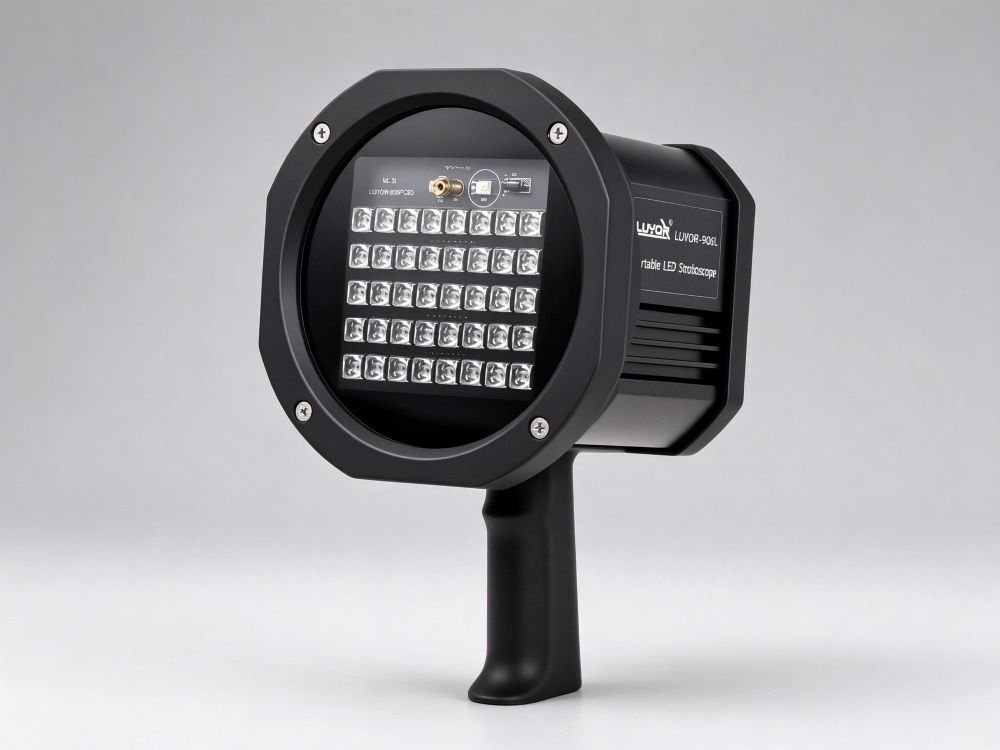
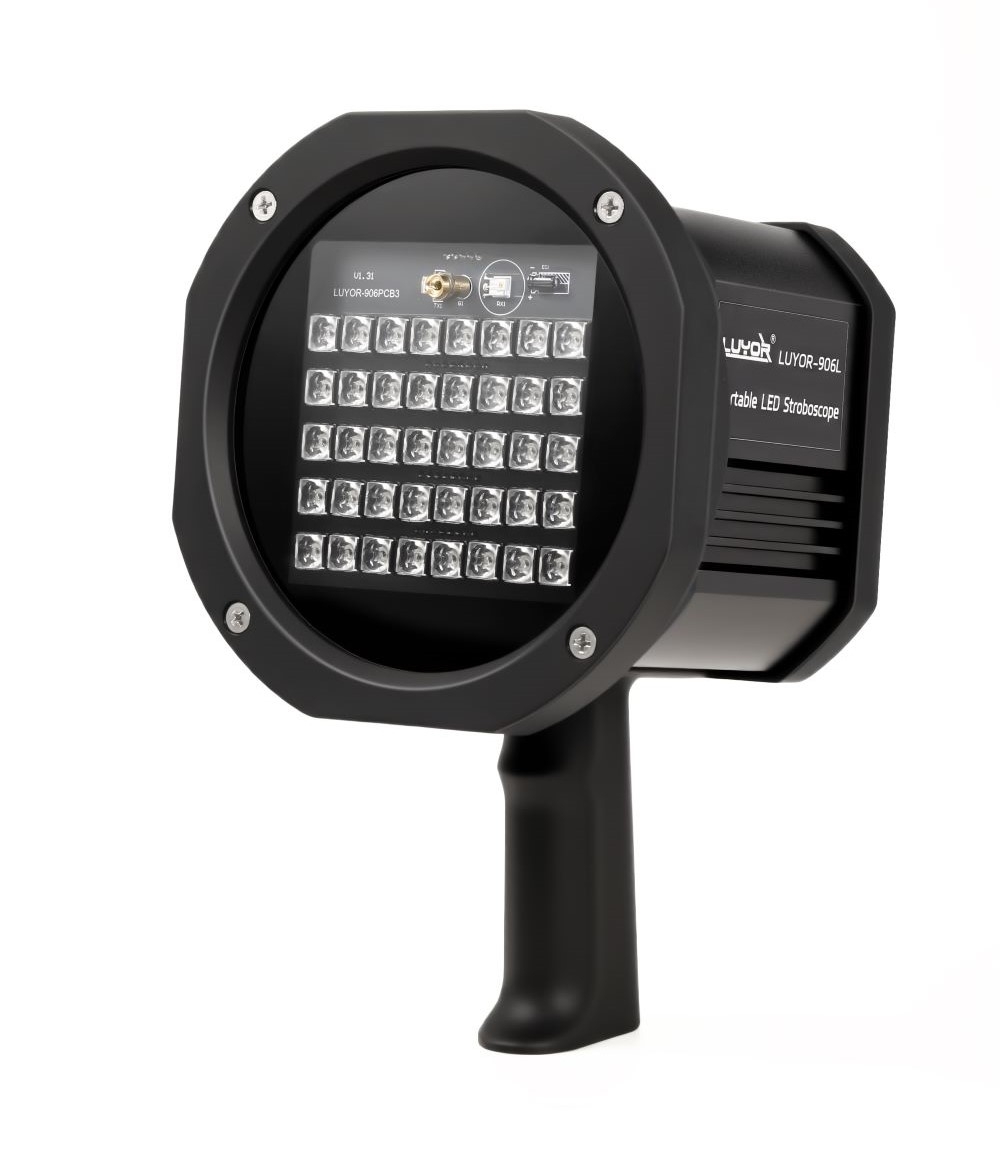
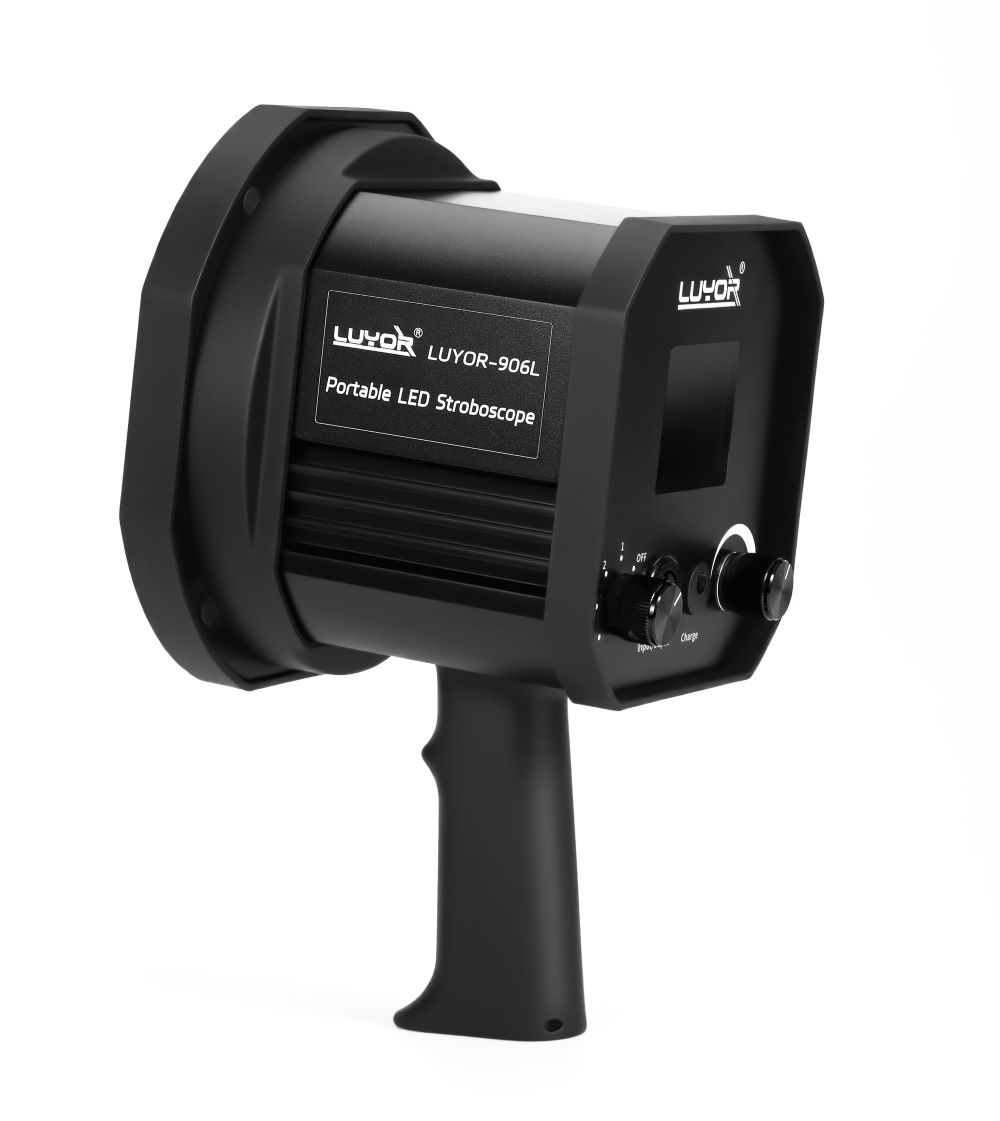
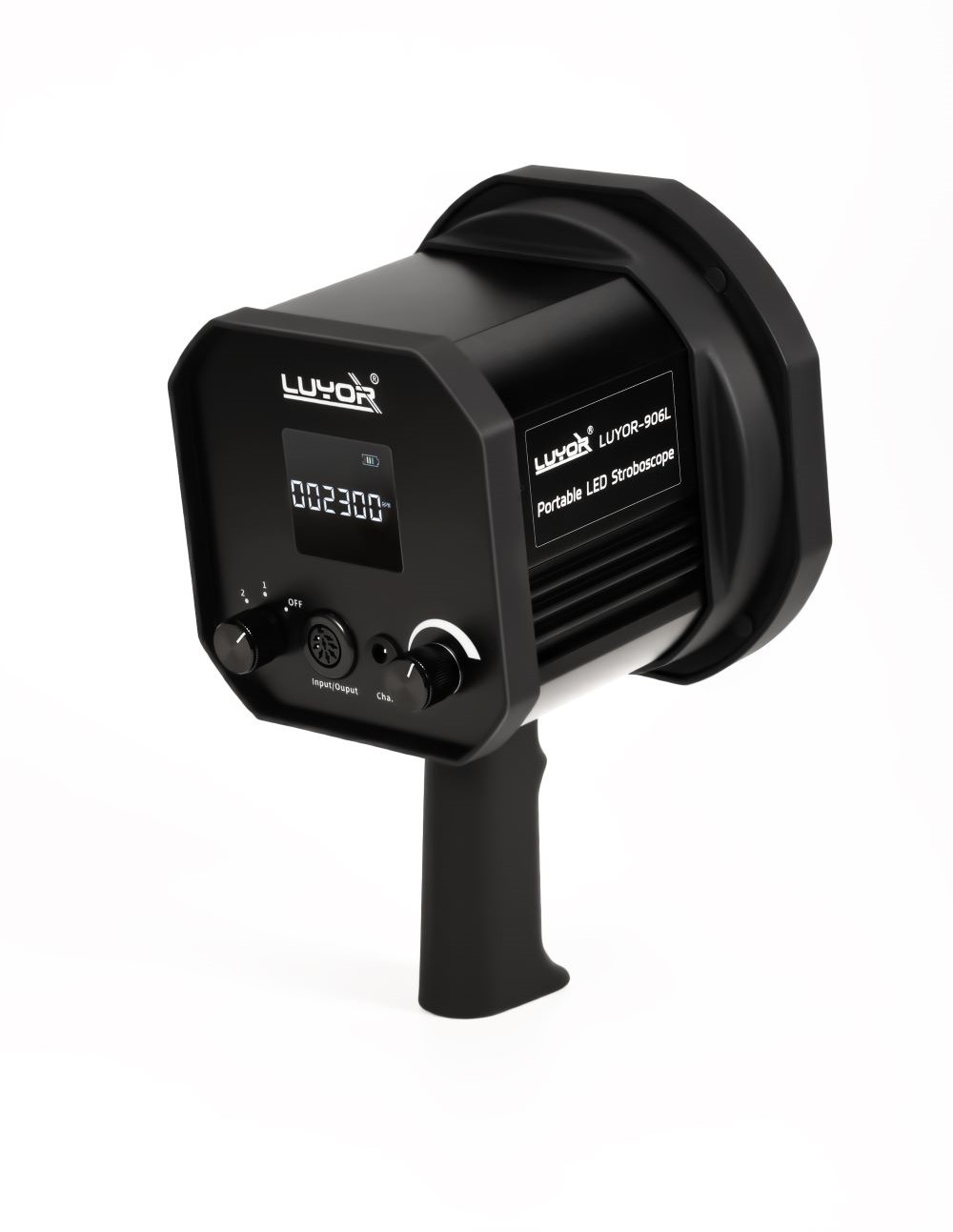
LUYOR-906L is an LED stroboscope that locks onto printed patterns by laser and reads RPM. 60-300000 FPM, +/-0.01% accuracy, 40 x 5W LEDs, 6000K.
A stroboscope works on persistence of vision: it fires very short flashes at an adjustable rate. When the flash rate matches the motion of the target, the eye sees what looks like a frozen image. That is what lets it freeze a fast-running or fast-moving object for visual inspection without stopping the machine.
The LUYOR-906L is the laser-tracking version of the LUYOR 906 platform. The difference that matters: you do not guess, hunt or keep re-adjusting the flash rate. A built-in laser sensor reads the moving print pattern directly, locks onto the pattern period and syncs the flash to it automatically. The same laser head also gives a direct RPM reading, so the unit works as a laser tachometer as well. On presses running several pattern sizes at once, that saves a lot of setup time.
To stop a moving pattern, the flash rate has to match the pattern period exactly. How that rate is found decides whether a stroboscope is usable on the floor. There are three technical levels:
| Tuning method | Principle | Limitation |
|---|---|---|
| Manual tuning (internal trigger) | The operator steps the flash rate up or down until the image stops moving | Depends on experience and takes time; any pattern change means re-tuning; several pattern sizes at once cannot share one rate |
| Laser speed sensing, auto-set rate | A built-in laser measures the speed of a continuously rotating part and sets the flash rate to that speed | Requires a continuously rotating body with a reflective target surface |
| Laser pattern tracking (LUYOR-906L) | The laser sensor reads the moving print pattern directly, locks the pattern period and syncs the flash, giving automatic pattern tracking | Depends on the light and dark contrast of the pattern; sensing range is limited to 10-200 cm |
The 906L takes the third route. It locks onto the pattern, not the RPM, which gives two practical advantages:
No sensor on the machine. On many presses and looms the moving parts are cramped, run fast, or cannot take any add-on hardware at all, so an external sensor never gets installed. Laser sensing works at a distance: place the strobe in a suitable position and aim it at the pattern. That makes this instrument a good fit where mounting a sensor is awkward or impractical.
It holds on multi-pattern jobs. When one machine prints several pattern sizes at once, a single fixed manual rate cannot cover them all. Auto tracking reads the period of the pattern in view and keeps following it.
A strobe has to light the target within a very short flash, on the order of microseconds, so it depends on peak brightness. With few LEDs the output is closer to a point source: on a wide surface the center is bright, the sides fall off, and bands appear. On wide print, full-width fabric or large-diameter rotating parts, those bands hide local detail and can even be read as defects.
The LUYOR-906L uses 40 LEDs in an array layout, so the emitting face behaves more like an area source and brightness is even across the full field. It also uses imported high-power LEDs with a built-in high-performance power module and an efficient energy-control chip, which keeps output stable, brightness high and heat low. All three matter for long continuous inspection.
| Aspect | Few LEDs (about 12), point-source design | 40-LED array (LUYOR-906L) |
|---|---|---|
| Output pattern | Close to a point source, bright center, falloff at the edges | Close to an area source, more even across the field |
| Large-area inspection | Banding appears; edge detail is hard to see | Even brightness; wide patterns and fabric weave read clearly |
| LEDs and power | 12 pcs | 40 pcs 5W white, 6000K |
| Reference illuminance | 3400 lux @6000 RPM (NP100) | approx. 2 250 Lux (150 mm from lamp, 6000 FPM) |
| Dimming | On some models | Adjustable brightness |
Flash rate decides whether the image stops; accuracy and flash duration decide how sharp it is. Key specifications of the LUYOR-906L:
| Item | Specification | Notes |
|---|---|---|
| Flash rate range | 60-300 000 FPM | Internal continuous adjustment; covers slow winding through high-speed rotation |
| Rate resolution | 0.1 FPM | Keys step the rate until the image is exactly stopped |
| Flash accuracy | ±0.01% | At 6000 FPM the deviation stays within about 0.6 FPM |
| Display resolution | ±0.1 (60.0-999.9 FPM) ±1 (1 000-9 999 FPM) ±10 (10 000-300 000 FPM) | Auto-ranging by band; finer resolution at low rates |
| Flash duration (single-flash on time) | Adjustable 8-50 μs (±1 μs) | Shorter flash, less motion blur, sharper image |
| Trigger modes | Manual / Auto | Auto mode performs pattern tracking |
| Phase shift | Strobe phase-angle adjustment | Sets where in the motion cycle the image stops |
| Display | Color LCD | Straightforward operator interface |
| Memory | Flash rate and internal settings stored automatically | Resumes where you left off, no re-tuning |
Why does flash duration matter?The shorter the flash, the less the target moves during exposure, so the image is sharper and has less smear. The 906L flash duration is adjustable from 8 to 50 μs: a short flash (8 μs, for example) on fast targets kills motion blur, and a longer flash on slow processes gains brightness. It is an easy parameter to overlook, and it directly affects image sharpness.
The LUYOR-906 is a platform family. Housing and operation are the same; the difference is the output band. Choose the band first, then decide whether you need laser tracking:
| Model | Output band | Typical use |
|---|---|---|
| LUYOR-906L | White LED (6000K) + built-in laser sensor | Print pattern tracking, general strobe inspection, RPM readout (this page) |
| LUYOR-906 | White LED | General strobe inspection where pattern tracking is not needed |
| LUYOR-906UV-365 | UV 365 nm LED | UV-excited fluorescence: UV curing, fluorescent security printing, fluorescent penetrant inspection |
| LUYOR-906UV-385 | UV 385 nm LED | Same as above, for phosphors excited nearer 385 nm |
| LUYOR-906IR | Infrared LED | IR strobe inspection for targets that are light-sensitive or need an IR response |
When should you choose a UV strobe?When the signal you care about is fluorescence rather than reflected light. A UV flash excites the fluorescent material and freezes the moving fluorescent image, so you can watch coating change during UV curing, pattern consistency in fluorescent security printing, or defect distribution in fluorescent penetrant inspection. A white-light strobe cannot do this; excitation has to be in the UV band. The difference between 365 nm and 385 nm is excitation efficiency for a given material, so the choice depends on the absorption of the material under test. Tell us the material and we will advise.
Our stroboscope range covers both LUYOR and LUYOR models.Side-by-side comparison of the main types, so you can match a model to the job:
| Model | Rate range | Light source | Trigger | Runtime | Weight / protection |
|---|---|---|---|---|---|
| LUYOR-906L LUYOR | 60-300 000 FPM | 40-LED 5W array (6000K), dimmable, even light | Manual + laser pattern tracking + external trigger (3-5 V) | approx.4 hours | approx.1 kg / IP30 |
How to decide:
Inspecting printed patterns, or no room for a sensor -> LUYOR-906L.Laser pattern tracking is specific to this model.The laser on the LUYOR NP series is for speed measurement, not for pattern tracking.
Large targets, even brightness -> the 40-LED array of the 906L has the advantage.
Higher rate ceiling, longer runtime, better sealing -> the NP series.The 906L is about pattern tracking, even brightness and a color LCD.The NP series is about a high rate ceiling, long runtime, IP54 sealing and advanced phase functions.If the floor needs hours of inspection in oily air and printed-pattern tracking at the same time, two units may be the practical answer.
A strobe is for looking, not measuring. Fix the goal first: register check, paper defects, spindle vibration, or a loose component. Each goal implies a different position, angle and rate range.
Set the instrument where it sees the target, and for auto tracking stay within 30-150 cm. Avoid facing a strong light source or letting hard light enter the field; strong ambient light reduces the relative brightness of the flash and also interferes with laser recognition.
Aim the built-in laser sensor at the print pattern and let it read the pattern period. If low contrast makes tracking unstable, aim at a high-contrast edge, or switch straight to manual mode.
The right rate stops the image, but phase decides which frame you see. Adjust phase to bring the area you care about (color bar, mark, suspect defect) to the center of the view for judging and recording.
If the image smears or edges look soft, shorten the flash duration (toward 8 μs). If the image is dim, lengthen it and raise brightness, and balance the two for sharpness and brightness.
The housing has a tripod thread; mount it on a tripod to avoid hand-shake drift. At a fixed station, run it from the AC adapter (AC 100-240 V) while charging, with no runtime limit.
The instrument stores flash rate and internal settings and resumes on power-up. After a job, note the rate, phase and flash duration; they make a starting point for the next job and save setup time.
Print pattern tracking and register check
On-line print quality inspection
Paper defect inspection
Cigarette pack printing check
Water-jet loom inspection
Running condition of spinning and weaving machines
Spindle speed and vibration check
Weft insertion observation on looms
Weave pattern consistency
Speed observation on centrifuges, motors and drives
Clutch and turbine running check
Fan blades, shafts, couplings, belts, chains and gears
Vibration analysis and shaker testing
Maintenance, repair and commissioning
Also used in packaging, automotive, acoustic labs, medical technology, liquid filling and bottling, high-speed video, helicopter balancing and surface defect inspection on high-speed steel strip. The common thread: the target runs fast, cannot be stopped, and has to be seen rather than measured.
The standard package is main unit, charger, 2 m reflective tape, aluminum carrying case. It is ready for strobe inspection out of the box; the reflective tape supports the laser speed and sync step.
| Item | Specification |
|---|---|
| Model | LUYOR-906L (laser-tracking LED stroboscope) |
| Brand / manufacturer | LUYOR (USA) / LUYOR Instruments |
| Flash rate range | 60-300 000 FPM (internal continuous adjustment) |
| Rate resolution | 0.1 FPM |
| Flash accuracy | ±0.01% (Chinese official figure; English material states ±0.02%) |
| Display resolution | ±0.1 (60.0-999.9 FPM); ±1 (1 000-9 999 FPM); ±10 (10 000-300 000 FPM) |
| Flash duration | Adjustable 8-50 μs (to ±1 μs) |
| Laser sensing range | 10 cm-200 cm |
| Light source | 40-LED array, 5W white, 6000K |
| Illuminance | approx. 2 250 Lux at 150 mm from lamp, 6000 FPM |
| Brightness control | Adjustable |
| Display | Color LCD |
| Trigger modes | Manual / Auto (auto pattern tracking) |
| Phase shift | Strobe phase-angle adjustment |
| Memory | Flash rate and internal settings stored automatically |
| External trigger | 3-5 V / 5 mA max (opto-isolated), DIN 41524 5-pin connector |
| Power | DC 8.4 V 2 800 mA (built-in high-capacity Li-ion battery) |
| Charger input | AC 100-240 V, 50-60 Hz |
| Continuous runtime | approx. 4 hours (depends on flash rate), covers one shift |
| Mounting | Tripod thread in the housing |
| Dimensions | 160 mm (L) × 130 mm (W) × 210 mm (H) |
| Weight | approx. 1 kg (approx. 1 050 g) |
| Operating temperature | 0 ℃-40 ℃ |
| Protection | IP30 |
| Certification | CE, RoHS |
| Standard package | Main unit, charger, 2 m reflective tape, aluminum carrying case |
A strobe relies on persistence of vision: it fires very short flashes at an adjustable rate, and when that rate matches the rotation or motion of the target, the eye sees a frozen image; offset the rate slightly and the object appears to turn slowly. So a stroboscope is first of all a visual inspection tool - it shows you the condition of running equipment, whether fan blades are cracked, a belt is slipping, the weave on a loom is correct or the register on a print is drifting, all without stopping the line. A tachometer (an optical tachometer, for example) is a readout tool: it gives you a number. The two answer different questions - use the strobe to see, the tachometer to measure. The LUYOR-906L is a portable LED stroboscope that adds laser pattern tracking for inspection and a laser tachometer readout when you need the RPM value.
These are two different methods and they are easy to confuse. An ordinary laser speed-sensing strobe works as measure first, flash at that speed: a built-in laser measures the speed of a rotating part and the instrument sets the flash rate to it, so the image stops. That solves manual tuning, but it requires a continuously rotating body. The LUYOR-906L works differently: its built-in laser sensor reads the moving print pattern directly, locks the pattern period and syncs the flash to it, which is automatic pattern tracking. It locks onto the pattern, not the RPM, so it suits installations where a sensor is hard to mount, or where several pattern sizes run at once - aim the laser sensor at the printed pattern and the pattern follows, with no repeated manual tuning. That is the core capability that sets the 906L apart from an ordinary stroboscope.
Two things on a press make manual tuning painful. First, the pattern changes: a new job brings a new pattern size and repeat, so the manual rate has to be found again; and when one machine prints several pattern sizes at once, no single fixed rate covers them. Second, sensors are hard to fit: on many presses the moving parts are cramped, run fast, or cannot take any add-on hardware, so an external sensor never gets installed. Laser tracking sidesteps both - nothing is mounted on the machine, and once the strobe laser is aimed at the printed pattern, the instrument reads the pattern period itself and locks the flash. The result is shorter setup, less wasted material and lower production cost, which is why this function is the lead feature of the 906L.
Coverage and evenness, and both show up clearly when the target is large or far away. With few LEDs the output is closer to a point source: on a wide surface the center is bright, the sides fall off, and bands appear. On wide print, full-width fabric or a large-diameter rotating part, those bands hide detail and can be mistaken for defects. The LUYOR-906L uses 40 LEDs in an array layout, so the emitting face behaves more like an area source, light is more even, brightness is consistent across the field, and large printed areas and fabric weave read evenly. The 906L also uses imported high-power LEDs with an efficient energy-control chip, giving stable output, high brightness and low heat, which helps in long continuous work. Note that manufacturers state illuminance at different distances (the 906L figure of about 2 250 Lux is at 150 mm from the lamp, 6000 FPM), so illuminance numbers from different sources cannot be compared directly.
60-300 000 FPM covers most industrial work: common printing, paper and textile rates fall in the hundreds to tens of thousands of FPM; high-speed rotating equipment, high-speed steel strip and precision cutting can reach above 100 000 FPM, and the 300 000 FPM ceiling covers that. The 60 FPM floor means slow processes are visible too, such as low-speed winding or intermittent feed. Accuracy of ±0.01% means the flash rate deviates by no more than one part in ten thousand of the set value - at 6000 FPM, within about 0.6 FPM. For visual inspection that is more than enough to hold a pattern steady, and it is also adequate for rate comparison or a rough speed check. Rate resolution is 0.1 FPM, so keys can trim the value until the image is exactly stopped. Note that some official English material states whole-unit flash accuracy of ±0.02%, slightly different from the Chinese figure; check the current factory datasheet before purchase.
The stated continuous runtime is about 4 hours, with the note that actual time depends on flash rate, and that one full charge covers a production shift. The key point: the flash itself is the main load. A higher rate means more flashes per unit time and faster drain; higher brightness also drains faster. So at low rate and low brightness you get more than 4 hours, and at high rate with full brightness, less. If you inspect across several shifts without stopping, do three things: set brightness just high enough rather than at maximum; keep a spare battery to swap in; and at a fixed station, use the AC adapter (charger input AC 100-240 V) to run while charging. To judge whether runtime is sufficient, first check what flash rate your process actually runs at.
Phase shift trims which frame you see, after the rate is right and the image has stopped. Rate decides whether the image moves; phase decides where in the rotation it stops. A practical example: you want to see the position of a bolt on a coupling, or whether a color bar on a print has drifted. The rate is right and the image is still, but it stops at an angle you do not want. Adjusting phase slides the frozen image forward or back along the motion, bringing the area of interest to the center of the view. Mark measurement, keyway position checks, gear mesh points and register color bars all use phase shift. The LUYOR-906L provides strobe phase-angle adjustment, which is one of the practical features that make it easier to use than an entry-level unit.
This is a useful technique in strobe work. The principle: the image also appears stopped at integer fractions of the real rate. Let the real rate be F. Flashing at F gives the 1x image, one full revolution of the object, which is the usual setting. Flashing at F/2 (half rate) advances the image one revolution every two flashes, so two objects appear to alternate and adjacent revolutions can be compared side by side. Flashing at 2F looks at half of each cycle, giving a brighter, sharper image for local detail. The caution: because all of these rates stop the image, a stopped image alone does not identify the true rate. Confirm it against a known speed, or sweep from low to high and watch how the image changes. In print inspection, half rate is often used to compare register on two adjacent patterns at once.
It is the working distance of laser auto tracking: the range in which the built-in laser sensor can reliably read the pattern, from about 10 cm out to about 200 cm. Too close (under about 10 cm) and the spot and field cannot cover the pattern period properly; too far (over about 200 cm) and the return signal weakens, so tracking becomes unstable or drops out. In practice, mount the instrument 30-150 cm from the target for auto tracking, where the hit rate is highest. If the location forces a longer distance, fix the unit on a tripod and aim at a high-contrast part of the pattern. Also note that tracking depends on the light and dark contrast of the pattern: pale, low-contrast patterns or strong ambient light degrade recognition, and in that case switch to manual mode at a fixed rate.
Yes. The LUYOR-906L accepts an external trigger input, rated 3-5 V / 5 mA max through an opto-isolated coupler, on a DIN 41524 5-pin connector. That means an external signal source (photoelectric sensor, proximity switch, encoder output, pulse generator and so on) can drive the flash, so the strobe stays locked to the machine instead of being tuned by hand. This suits fixed installations on automated lines: mount the strobe on a tripod or bracket, trigger it from the machine sync signal, and the image stays stopped regardless of speed fluctuation. Before connecting, confirm the level and polarity of the external signal are within 3-5 V and the drive current stays under 5 mA; exceeding that can damage the input circuit. If your signal is 12 V or 24 V industrial level, add a current-limiting or conversion circuit.
Be careful. IP30 means the first digit, 3, protects against solid objects larger than 2.5 mm (it keeps fingers and similar out of the interior), and the second digit, 0, means no water protection at all. Dust protection is limited and it is not water-resistant. A dry shop, or working beside a press or loom, is fine. Where there is visible oil mist, coolant spray, condensation or a washdown station, protect the unit: add a cover, keep it out of the spray path, and wipe the surface after use. Do not charge it in a damp area. If your environment is dusty or wet, weigh the IP rating as a selection criterion; we can also compare models with better sealing if you need that.
Yes, and they are variants of the same 906 platform. Beyond the LUYOR-906L on this page (laser-tracking LED stroboscope), the LUYOR 906 series includes the LUYOR-906 (general LED stroboscope), LUYOR-906UV-365 (365 nm UV LED stroboscope), LUYOR-906UV-385 (385 nm UV LED stroboscope) and LUYOR-906IR (infrared LED stroboscope). A UV strobe is used with fluorescent materials for dynamic inspection: the UV flash excites the phosphor and visually freezes the moving fluorescent image, so you can watch coating condition during UV curing, pattern consistency in fluorescent security printing, defect distribution in fluorescent penetrant inspection, and the position of fluorescent marks at speed. A white-light strobe cannot do this, because UV excitation is what produces the fluorescent signal. If you need UV, tell us the excitation wavelength and the material, and we will advise between 365 nm and 385 nm.
The standard package has four items: main unit, charger, 2 m reflective tape and aluminum carrying case. It is ready for strobe inspection out of the box; the reflective tape supports the laser speed and sync step. Add-ons worth considering: a tripod if you need long fixed-position inspection (the housing already has a tripod thread); a spare battery to rotate, or AC-adapter running at a fixed station, for multi-shift use; a signal source and DIN 41524 5-pin cable rated 3-5 V / 5 mA if you will trigger externally; and a simple protective cover for oil mist or spray. Final configuration follows the factory packing list, and we confirm the list with you before purchase so nothing is missing on site.
Yes, and it is the classic pitfall of strobe work, known as harmonic ambiguity. The principle: the image looks stopped whenever the flash rate is an integer multiple or an integer fraction of the real rate. If the real speed is 3000 FPM and you set 1500, 1000, 6000 or 9000 FPM, the image also stops, but what you see is the second revolution, the third, or half a revolution. A stopped image alone cannot confirm the true rate. Three ways to avoid a wrong reading: sweep slowly from low to high and watch how the image changes rather than only the end point, since the first rate that holds steady is closer to the true value; cross-check against known data such as the motor nameplate speed, the drive display frequency, or a tachometer reading; and use phase shift or time delay as a secondary check. For strict measurement, confirm the true speed with a tachometer (we carry optical and laser tachometers) and then set the strobe.
Xinysun Instruments (Shanghai) supplies the LUYOR-906L laser-tracking LED stroboscope, along with the UV (365 nm / 385 nm) and IR variants of the 906 series. If you are unsure between manual tuning and laser tracking, whether you need UV, or you want help diagnosing unstable pattern tracking, tell us the target (press / loom / paper machine / rotating equipment), the approximate rate range, the working distance, the environment (dust / oil mist / ambient light) and whether you need external sync triggering, and we will recommend a model and configuration. Call 131-2093-6518 or leave a message through the form on this page.
Model recommendation by target, rate range and working distance
Troubleshooting for unstable print pattern tracking
UV / IR band selection by material
External trigger source and interface matching
Accessories: tripods, spare batteries, protective covers
Volume and project quotations, lead-time confirmation
Send inquiry

Email: info@xinysun.com

Tel: 131-2093-6518

Address: 1525 Minqiang Road, Bldg 26, Songjiang, Shanghai

Copyright 2026 Xinysun Instrument (Shanghai) Co., Ltd. All rights reserved.
ICP:ICP-2026046447




 Products
 Applications
 Previous:
 Back to list

 Industrial Test Instruments


