Products
PRODUCTS Breadcrumb: Home > Products > Life Science Instruments > UV Crosslinkers
 Overview
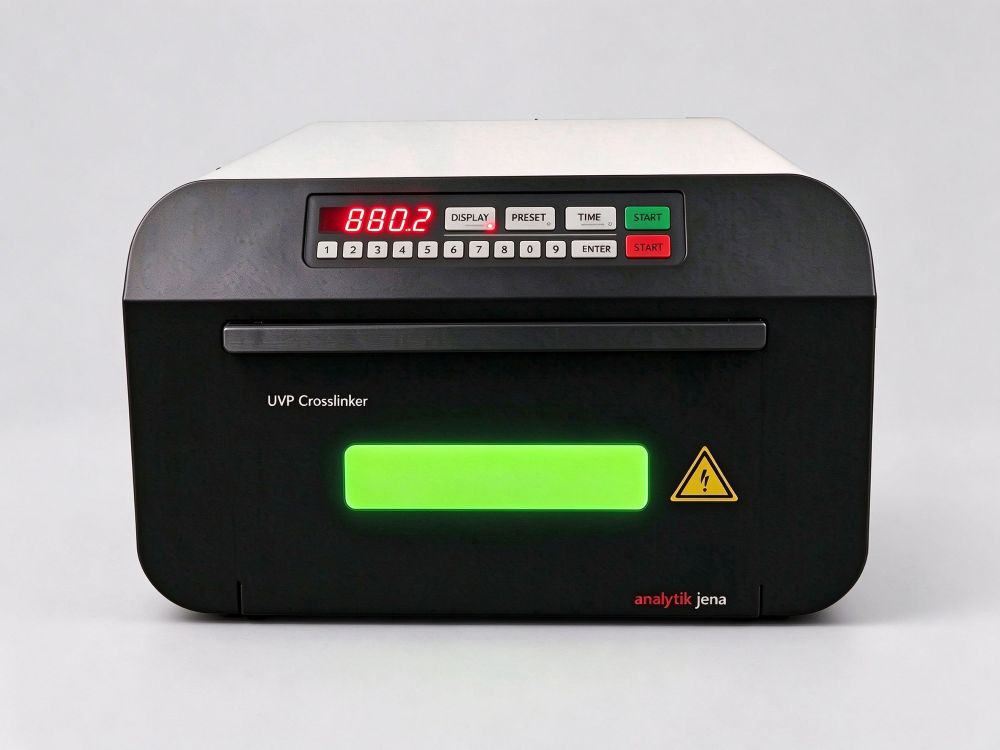
UVP Crosslinker CL-3000 sets the dose in mJ/cm2 and stops at the set value, 254 nm plus 302/365 nm versions, 6x8 W lamps, 35x27x16 cm chamber.
A UVP Crosslinker - also written UV crosslinker - is the UV crosslinking instrument line of the UVP brand, now operated by Analytik Jena. It uses 254 nm shortwave UV to crosslink and immobilize DNA/RNA onto nylon or nitrocellulose membranes in tens of seconds, replacing a 2-hour bake at 80 ℃, and is also used for PCR contamination control, UV mutagenesis and surface decontamination. The CL-3000 supplied here is UVP's current model and the successor to the discontinued CL-1000: 6 × 8 W lamps, 254/302/365 nm versions, 0.1–9999.9 mJ/cm² energy range, and a built-in UV sensor that compensates for lamp aging.
To choose between the UVP Crosslinker and the LUYOR UCL series, start with the three crosslinkers in this category: the UVP/Analytik Jena CL-3000, and the LUYOR UCL-3200 and UCL-3500. The usual misunderstanding is that the three differ in control concept. They do not: all three use the same control principle - a built-in UV sensor for energy integration, automatic stop at the set dose, and a metal chamber with reflector. What actually separates them is power, chamber capacity, structural detail and brand positioning.
| Item | UVP CL-3000 | LUYOR UCL-3200 | LUYOR UCL-3500 |
|---|---|---|---|
| Manufacturer / brand | UVP (Analytik Jena, USA) | LUYOR, USA | LUYOR, USA |
| UV lamps | 6 × 8 W | 6 × 8 W | 6 × 15 W |
| Interior chamber (L×W×H) | 35 × 27 × 16 cm | 32 × 26 × 15 cm | 44 × 34 × 15 cm |
| Exterior dimensions (L×W×H) | 41 × 40 × 26.5 cm | 34 × 35 × 31 cm | 55 × 36 × 30 cm |
| Weight | 6.8 kg | 10 kg | 10 kg |
| Energy setting | 0000.1–9999.9 mJ/cm² (0–10 J/cm²) | 0.000–9.999 J/cm² (or 0.00–99.99) | 0.000–9.999 J/cm² (or 0.00–99.99) |
| Time setting | 000:01–999:59 (min:sec) | 00.00–99.59 min (or 000.0–599.5) | |
| Door viewing window | Yes (observe while UV is blocked) | - | - |
| Safety door interlock | Yes | Not stated | Not stated |
| Certification | CE, RoHS (CSA in progress) | CE | CE |
| Wavelength versions | All three models are available in 254/302/365 nm versions | ||
| Suited to | Tight bench space, a visible process and a safer structure; labs already standardized on UVP/Analytik Jena | Routine molecular biology workhorse, samples up to A4 size | Multiple membranes, large gels, batch samples |
Start with the basic logic: crosslinking depends on how much UV energy the sample actually receives (dose, in mJ/cm² or J/cm²), not on how long it is exposed. Time is only the means to reach a dose; the dose is the result.
The weakness of time mode is lamp decay: UV lamps lose output continuously with use, and ambient temperature and line voltage drift as well. So "30 seconds" from a new lamp and from a two-year-old lamp can differ by a wide margin - and that change is invisible from the outside. You only notice that hybridization signal gets weaker year after year, without finding the cause.
The CL-3000 closes the loop: a built-in UV sensor continuously measures UV energy inside the exposure chamber and automatically adapts to the intensity changes caused by lamp aging. This sensor feedback measurement system lets the user set the UV exposure dose the sample should receive, and the UV source switches off automatically once the set dose is reached. The sensor is calibrated at the UVP factory to ensure accuracy and reliability.
Energy setting range 0000.1–9999.9 mJ/cm² (0–10 J/cm²), with a minimum step of 0.1 mJ/cm². For dose-gradient scouting before crosslinking, that resolution lets you set 50 / 100 / 150 / 200 mJ/cm² cleanly and reproduce a validated value exactly.
Lamp intensity falls over its service life, and a plain timer lets the dose drift down quietly; the CL-3000 sensor feedback extends exposure time automatically to keep the accumulated dose constant. No re-scouting of conditions after every lamp change.
Time is set as 000:01–999:59 (min:sec), which differs from the "minutes plus decimals" entry of the LUYOR series. You enter seconds directly, with no mental unit conversion - and no ambiguity over whether "55.15" means 55 minutes or 55 minutes 15 seconds.
This is rarely written into product pages, but it directly affects reproducibility. The manufacturer's technical documentation recommends placing the sample at the center of the irradiation surface, where irradiance uniformity is ideal (coefficient of variation CV = 6%). The reason is that every irradiation chamber has edge effects: positions toward the front and back receive less dose than the value you entered.
The manufacturer's measured example is clear: with 100 mJ/cm² entered, the front and right positions measured only about 78.18 mJ/cm², roughly 20% below the set value. This is not an instrument defect but a physical property of the irradiation chamber; what differs between vendors is whether they document it.
Center the sample - prefer the center of the irradiation surface, where CV = 6% and consistency is good
Raise the entered dose to compensate - if a sample must sit at the edge, consider a higher entered dose (for example 125 mJ/cm² instead of 100 mJ/cm²)
Measure the edge dose - use a UVP 254 nm radiometer (part no. 97-0015-02) with the matching sensor (97-0016-01) to measure the lower dose at the edge, then adjust
Fix the position: use the same area for the same batch and the same type of experiment - do not center one batch and push the next to the edge
Do not overlap: where membranes overlap, almost no dose reaches the lower one, and heat builds up
Write the position into the record: log dose, membrane type, lamp hours and sample position together, so any later problem can be traced
The CL-3000 series offers three wavelength versions of the same instrument. The choice depends on what you need to excite, not on which costs more:
| Model | Wavelength | Band | Typical use |
|---|---|---|---|
| CL-3000 This page | 254 nm | UV-C | Membrane crosslinking and immobilization of nucleic acids (Southern/Northern/Dot/Slot blot; DNA/RNA crosslinked to nitrocellulose, nylon or reinforced nitrocellulose membranes); PCR contamination control; DNA photo nicking; RecA function assays; rapid site mapping; UV sterilization and surface decontamination |
| CL-3000M | 302 nm | UV-B | Milder than 254 nm with less damage to nucleic acids; suited to experiments that need longer-wavelength irradiation or activation while limiting photodamage |
| CL-3000L | 365 nm | UV-A | Photosensitizer activation (e.g. psoralen crosslinking), photoaffinity labeling, UV curing and some biomolecule photocrosslinking - the long wavelength carries less energy and causes almost no direct DNA damage |
120 mJ/cm² is a widely quoted reference for nucleic acid membrane crosslinking, taken from some commercial nylon membranes and classic Northern protocols, and many vendors ship it as a preset. It is not a universal answer for every membrane and every nucleic acid.
| Sample type | Typical starting dose (254 nm) | Notes |
|---|---|---|
| DNA membrane crosslinking (nylon) | about 100–120 mJ/cm² | Common starting point; follow the membrane datasheet |
| RNA membrane crosslinking | about 80–100 mJ/cm² | RNA degrades more easily; use a lower dose and shorter exposure |
| Nitrocellulose / reinforced nitrocellulose | +20%–30% over nylon | Recommended UV conditions differ by membrane material |
| DNA photo nicking | gradient by plasmid conformation ratio | Dose sets the ratio of supercoiled / open-circular / linear forms |
| Protein / biomolecule crosslinking | about 150–300 mJ/cm² (optimized by gradient) | Usually higher than for nucleic acids; adjust for molecular weight and system |
After power-up, confirm whether this run uses energy mode or time mode, and check the set dose (for example 120 mJ/cm²). Energy mode sets down to 0.1 mJ/cm²; time mode is entered as min:sec.
Lay it flat in a single layer, sample side up, centered as a whole (CV = 6% there); do not overlap and do not touch the edges. Crosslink immediately after transfer while the membrane is still slightly damp.
Exposure can start only when the door is fully closed and the interlock is engaged. Do not open the door during exposure; if you need to watch, use the door window and do not stare at it for long periods.
The instrument measures UV energy in the chamber in real time and switches the UV source off at the set dose. If a run takes noticeably longer than usual, that is a signal to log it and check lamp output.
Record the dose, the mode used, membrane brand and model, cumulative lamp hours, and sample position. Logging them together gives you a trace if a problem appears later.
Fix dose, position and membrane model into a lab SOP. This turns individual experience into a shared lab asset and is the easiest way to reduce batch-to-batch variation.
Door viewing window: the window blocks UV radiation while letting you watch the sample during exposure - you can see inside without opening the door
Safety door interlock: the safety door lock design prevents UV leakage and supports safe operation; exposure cannot start unless the door is fully closed
Housing surface ≤30 ℃, so the housing is not a burn hazard in normal closed-door use
Do not bypass or modify the interlock - a failed interlock is a dangerous fault
Do not stare through the viewing window for long periods; the window only blocks UV while you observe
254 nm emits almost no visible light, so you cannot judge whether it is on - rely on the instrument status display, not your eyes
Report scratched or clouded windows, aged door seals and loose locks promptly - UV leakage usually starts at these details
DNA/RNA crosslinked to nitrocellulose, nylon or reinforced nitrocellulose membranes (Southern/Northern/Dot/Slot blot). Key points: crosslink immediately after transfer, keep the membrane slightly damp, lay it flat in the center, and set the dose from the membrane datasheet.
254 nm drives pyrimidine dimer formation, which blocks the polymerase, so contaminants are no longer effective templates. Note: treat bench surfaces, racks and consumables that contain no enzyme or primers; do not irradiate whole reaction tubes.
UV exposure introduces nicks into DNA; you then follow the shift in the ratio of supercoiled, open-circular and linear forms. The ratio depends on dose, so use energy mode with a dose gradient; timing alone cannot reproduce it.
UV-induced DNA damage is used to assay recombinational repair function - a classic approach in E. coli RecA work. A stable UV dose is the prerequisite; state the dose in the methods section.
UV damage at specific sites (e.g. thymine dimers) blocks cleavage by certain restriction enzymes, so irradiation + digestion + electrophoresis locates the site. Dose sets the density of damage sites.
Photochemical UV curing applications, plus surface UV sterilization of benches and implements. Remember that UV is a surface method - it is limited in shadowed areas and where organic soil shields the surface; do not treat it as whole-tube sterilization.
Values below are stated for the CL-3000; differences between the three wavelength versions are marked separately. Confirm wavelength and voltage before ordering:
| Parameter | CL-3000 | CL-3000M | CL-3000L |
|---|---|---|---|
| Wavelength | 254 nm | 302 nm | 365 nm |
| UV lamps | 6 × 8 W | 6 × 8 W | 6 × 8 W |
| Energy output range | 0000.1 to 9999.9 mJ/cm² (0 to 10 J/cm²) | ||
| Time range | 000:01 to 999:59 (min:sec) | ||
| Operating temperature | 15 ℃ – 35 ℃ | ||
| Humidity | 70%, non-condensing | ||
| Operating altitude | 3,000 m (9,842 ft) max | ||
| Sound level | ≤ 50 dBA | ||
| Housing surface temperature | ≤ 30 ℃ | ||
| Start-up time | < 1 s | ||
| Exterior dimensions (L×W×H) | 41 cm × 40 cm × 26.5 cm | ||
| Interior chamber (L×W×H) | 35 cm × 27 cm × 16 cm | ||
| Weight | 6.8 kg (15 lb) | ||
| Power | 100 – 115 VAC and 230 VAC, 50/60 Hz | ||
| Display | LED digital display with touch keys | ||
| Configuration | Front-opening door (door viewing window + safety door interlock) | ||
| Certification | CE, RoHS (CSA in progress) | ||
| Model | Wavelength | 115 V part no. | 230 V part no. |
|---|---|---|---|
| UVP Crosslinker CL-3000 | 254 nm | 849-95-0615-01 | 849-95-0615-02 |
| UVP Crosslinker CL-3000M | 302 nm | 849-95-0615-03 | 849-95-0615-04 |
| UVP Crosslinker CL-3000L | 365 nm | 849-95-0615-05 | 849-95-0615-06 |
| Item | Wavelength / spec | Part no. |
|---|---|---|
| Replacement UV lamp | 8 W, 254 nm | 34-0007-01 (US) / 849-057-007 (Europe) |
| Replacement UV lamp | 8 W, 302 nm | 34-0042-01 |
| Replacement UV lamp | 8 W, 365 nm | 34-0006-01 |
| 254 nm radiometer (for edge-dose checks) | Accessory | 97-0015-02 |
| Matching sensor | Accessory | 97-0016-01 |
Two items on a UV crosslinker have to be run as consumables management, or the instrument looks fine while results drift:
Lamps: UV output falls continuously with hours of use.The common replacement criterion in the industry is output down to about 70% of the initial value - at that point the lamp still lights, and because energy is integrated, your set dose is still delivered and everything looks correct; it just takes longer and longer.Log cumulative hours and watch for exposure time growing noticeably longer at the same dose.The CL-3000 uses six 8 W lamps; replacement lamps are ordered by wavelength (table above), and replacing the whole set keeps uniformity.Lamp warranty is 90 days.
Chamber and sensor window: contamination and residue on the reflector surfaces and on the sensor protection window change the actual irradiance distribution.Clean regularly, and do not scrape with abrasives.
To make dose accuracy auditable, set up two controls:
Fixed measurement conditions: use one measurement position and orientation, measure irradiance at several fixed points in the chamber with a UV radiometer, cross-check against the instrument reading, and log it in the equipment record.See the full range of UV meters and radiometers →
UVP is a US brand of UV equipment, now operated by Analytik Jena in Germany. A UVP Crosslinker is that brand's UV crosslinking instrument, also commonly written UV crosslinker. It uses 254 nm shortwave UV (302/365 nm versions are also available) to form covalent bonds between pyrimidines in nucleic acids and the membrane surface, immobilizing DNA/RNA onto nylon or nitrocellulose membranes in tens of seconds instead of a 2-hour bake at 80 ℃ or vacuum drying. The same instrument is used for PCR contamination control, UV mutagenesis, bacterial and phage inactivation, and surface disinfection of items such as N95 respirators. The current UVP model is the CL-3000 (254 nm), with the CL-3000M (302 nm) and CL-3000L (365 nm) in the same series; the previous UVP CL-1000 was discontinued on August 1, 2020.
All three are wavelength versions of the UVP Crosslinker CL-3000 series. Lamp power, chamber size and control method are identical; only the lamp type and the part number differ: CL-3000 is 254 nm, part no. 849-95-0615-01 (115 V) / -02 (230 V); CL-3000M is 302 nm, corresponding to -03 / -04; CL-3000L is 365 nm, corresponding to -05 / -06. Customers in mainland China should order the 230 V version, i.e. 849-95-0615-02 for 254 nm. Once wavelength and voltage are fixed, the part number is determined; putting the part number in the purchase contract is far safer than the model name alone.
This category also supplies the LUYOR UCL-3200 (6×8 W, chamber 32×26×15 cm, the routine lab workhorse) and UCL-3500 (6×15 W, chamber 44×34×15 cm, high capacity), plus Spectro-UV XL-1000/XL-1500 and XEPU-1208/1215. Compared with the UVP CL-3000, the UCL series differs mainly in chamber capacity and structural detail: the CL-3000 is the model of the three that has a door viewing window and a safety door interlock, and its body is more compact (41×40×26.5 cm, 6.8 kg). For the full side-by-side comparison see How to choose a UV crosslinker: seven models from LUYOR/UVP/Spectro-UV/XEPU compared, and for dose setting see UV crosslinker crosslinking energy setting guide.
All three are energy-integrating UV crosslinkers with the same control principle (built-in UV sensor, automatic stop at the set dose, metal chamber with reflector); they differ in power, chamber and brand positioning. The CL-3000 is 6×8 W with a 35×27×16 cm chamber, 6.8 kg, and a compact body; the UCL-3200 is also 6×8 W but with a 32×26×15 cm chamber, close to the CL-3000; the UCL-3500 is 6×15 W with a 44×34×15 cm chamber, clearly larger and faster to reach the same dose. So decide in two steps. Step 1, capacity: for a single membrane up to A4, the CL-3000 and UCL-3200 both suffice; multiple membranes, large gels or batch samples need the UCL-3500. Step 2, brand and structure: the CL-3000 is the model of the three that has a door viewing window (watch the process while UV is blocked) and a safety door interlock, and its lighter body saves bench space - suited to crowded benches or labs that want a visible process; if your site already runs UVP/Analytik Jena equipment and your quality system already names the model, the CL-3000 keeps purchasing and consumables management simpler. All three are available in 254/302/365 nm versions.
The CL-3000 is the successor to the CL-1000; both belong to the UVP crosslinker line. The key differences are control and display: the CL-1000 is an earlier generation; the CL-3000 uses a large LED digital display with touch keys, an energy range of 0000.1–9999.9 mJ/cm² (0–10 J/cm²), time in min:sec from 000:01–999:59, and keeps the front-opening door, door viewing window and safety door interlock. On availability, stated plainly: the UVP CL-1000 (including CL-1000M and CL-1000L) was officially discontinued on August 1, 2020, with 5 years of service and spare-part supply from that date (i.e. to August 2025). New purchases should therefore be the CL-3000 series. If your lab still runs an older CL-1000 and spare parts are a problem, contact us to compare the cost of repair-and-continue against full replacement - a replacement quote is usually no higher than long-term upkeep of a discontinued model.
This is rarely documented but directly affects reproducibility, so we go by the manufacturer's technical documentation. The recommendation is to place the sample at the center of the irradiation surface, where irradiance uniformity is ideal (CV = 6%). The reason is that every irradiation chamber has edge effects: positions toward the front and back receive less than the entered dose. The measured example is clear: with 100 mJ/cm² entered, the front and right positions read only about 78.18 mJ/cm², about 20% below the set value. The manufacturer's options are to enter a higher dose (for example 125 mJ/cm²) if a sample must sit at the edge, or to measure the actual edge dose with the UVP 254 nm radiometer (part no. 97-0015-02) and matching sensor (97-0016-01) and adjust from that. In practice, three rules: 1. keep samples as central as possible; 2. use the same position for the same batch; 3. where strict reproducibility is required, measure the actual intensity at your usual position with an external radiometer and keep the record.
The core design of the CL-3000 is that you set the dose and the instrument delivers it. A built-in UV sensor continuously measures UV energy in the exposure chamber and adapts automatically to intensity changes from lamp aging - as the lamp dims it exposes longer, and at higher intensity it stops earlier. This sensor feedback measurement system lets the user set the UV exposure dose directly, and the UV source switches off automatically at the set value. So dose accuracy is ensured by closed-loop control as long as the lamp works normally. One boundary needs stating: automatic compensation solves dose accuracy, not output decay or uniformity change. Once lamp output falls far enough, the time needed for the same dose grows noticeably (lower flux), and uniformity in the chamber can change; the sensor itself also needs recalibration after long use. So log cumulative lamp hours, watch for exposure time growing noticeably longer at the same dose, and verify periodically with an external radiometer as your quality system requires. The UVP original lamp carries a 90-day warranty.
The CL-3000 (254 nm), CL-3000M (302 nm) and CL-3000L (365 nm) are three versions of the same instrument; the choice depends on what you need to excite, and the part numbers differ: 254 nm is 849-95-0615-01 (115 V) / 849-95-0615-02 (230 V); 302 nm is -03 / -04; 365 nm is -05 / -06. Confirm wavelength and voltage together when ordering. On applications: 254 nm is UV-C, close to the absorption peak of nucleic acids and biologically potent, used for membrane crosslinking, PCR contamination control, UV sterilization, DNA photo nicking, RecA function assays and rapid site mapping - the version most molecular biology labs need; 302 nm is UV-B, milder than 254 nm with less nucleic acid damage, suited to longer-wavelength irradiation or activation where photodamage must be limited; 365 nm is UV-A, lower energy and almost no direct DNA damage, used mainly for photosensitizer activation (e.g. psoralens), photoaffinity labeling and some UV curing. Also note that replacement lamps are ordered by wavelength: 8 W 254 nm is 34-0007-01 (US) / 849-057-007 (Europe), 302 nm is 34-0042-01, 365 nm is 34-0006-01.
120 mJ/cm² is a widely quoted reference for nucleic acid membrane crosslinking, and many vendors' presets are close to it, so nearly every lab has heard of it. It is not a universal answer for every membrane: recommended UV conditions differ between membrane brands and models; nitrocellulose usually needs about 20%–30% more than nylon, or baking in addition; RNA degrades more readily than DNA, so doses should be more conservative; wet versus dry membranes and different transfer buffers also shift the optimum. Do it in three steps: 1. confirm your membrane type and check its datasheet or the reagent datasheet; 2. scout a gradient from there (for example 50 / 100 / 150 / 200 mJ/cm²) - the CL-3000 resolves 0.1 mJ/cm² (0000.1–9999.9 mJ/cm²), so fine gradients are easy; 3. adopt the step with strong signal and no visible degradation as your lab's routine value, and log dose, membrane brand and model, lamp hours and sample position together. Protein and biomolecule crosslinking usually needs more than nucleic acids; start a gradient from 150–300 mJ/cm².
This is where UV decontamination is easily misapplied. The principle is sound: 254 nm UV forms pyrimidine dimers that block the polymerase, so contaminants are no longer effective templates, and the literature reports reducing residual template in tubes by more than 1000-fold. The problem is that UV also damages the other components of the reaction, at the same time: 1. Taq DNA polymerase is highly UV-sensitive; 2. primers are UV-sensitive in a sequence-dependent way (primers with adjacent thymines are damaged more easily); 3. dNTPs absorb strongly at 254 nm and shield the DNA, which cuts decontamination efficiency and requires longer exposure; 4. tube plastic absorbs UV, and results vary widely between tube types and placement distances - and the CL-3000 edge effect amplifies position differences further. So do not treat UV as a universal "irradiate the whole reaction" method: if enzyme and primers are already in the tube, exposure directly reduces sensitivity (reported up to 10-fold). Suitable targets are bench surfaces, pipettes, racks, and reagents and consumables that contain no enzyme or primers. If you do use the classic "irradiate the reaction mix" strategy, add enzyme and primers after exposure and validate sensitivity for each PCR system. More robust routes are aliquoting reagents, filter tips to control aerosols, and UNG/dUTP systems.
These are two applications listed by the manufacturer that differ from routine membrane crosslinking, and they are worth explaining separately. DNA photo nicking: UV exposure introduces nicks (single-strand breaks) into DNA, used in specific experiments to convert supercoiled plasmid to open-circular or linear form, and to study UV photodamage and repair. DNA is exposed at 254 nm to a given dose, then run on an agarose gel to see the ratio of supercoiled, open-circular and linear forms - that ratio depends on dose, so energy mode with a dose gradient is required, and timing alone cannot reproduce it. Rapid site mapping: UV damage at specific sites (e.g. thymine dimers) blocks cleavage by certain restriction enzymes, so UV exposure + digestion + electrophoresis locates restriction sites or specific structures on the DNA. These experiments also demand dose stability, because dose sets the density of damage sites. Both are strongly dose-dependent experiments, and both warrant stating the dose in the methods section - which is exactly why this instrument offers 0.1 mJ/cm² energy resolution and closed-loop control from a built-in sensor.
These two features are a clear design difference from comparable models. Viewing window: the window in the door blocks UV radiation while letting you watch the sample during exposure, so you do not need to open the door to see inside - which addresses a very practical risk, since opening the door during exposure is a common accident source on UV equipment. Safety door interlock: the safety door lock design prevents UV leakage and supports safe operation; in normal use, exposure cannot start unless the door is fully closed. It has to be said that any interlock and window only reduce risk; they do not replace discipline: 1. do not try to bypass or modify the interlock; 2. the window only blocks UV while you observe - do not stare at it for long periods; 3. 254 nm emits almost no visible light, so you cannot see whether it is on; rely on the instrument status display rather than your eyes; 4. if the window is scratched or clouded, the door seal ages or the lock loosens, report it for service promptly instead of continuing to use it - UV leakage usually starts at these overlooked sealing details.
Yes, but the boundaries need to be clear. UVP/Analytik Jena crosslinkers are described in public materials for UV sterilization and surface disinfection, and some channel documentation refers to CDC guidance for UV disinfection of N95 respirators; in the 254 nm (UV-C) version, UV does inactivate microorganisms. Four points to note: 1. UV is a surface method - it works only on surfaces the UV can reach directly and is largely ineffective inside layers, in shadows, or where organic matter (blood, body fluids, soil) shields the surface; a respirator is a multilayer structure, and shadowing at pleats and straps is where field use tends to fail; 2. the dose must be sufficient and recordable, which is the point of using this instrument rather than an arbitrary UV lamp; 3. keep disinfection targets separate from the experimental area; do not use a chamber that has handled clinical contamination for nucleic acid samples; 4. whether a practice meets your institution's, industry's or regulatory requirements (e.g. medical device disinfection, biosafety rules) is determined by the relevant authority's guidance and your own SOP. We supply the instrument and the means to control dose; the specific disinfection process and the compliance decision follow your institution's rules. For routine surface decontamination in a nucleic acid lab, the CL-3000 is fully adequate.
UV output falls continuously with hours of use; the common industry criterion is replacement at about 70% of initial output. One easily misunderstood point: because energy is integrated, even a clearly degraded lamp still delivers your set dose and the result still looks correct - it just takes longer and longer. So do not judge by whether the lamp still lights; watch two signals: whether the time for the same dose is noticeably longer than with a new lamp, and whether periodic external irradiance readings have fallen below 70% of initial and below your action threshold. Three points for replacement: 1. power down first and let the lamp cool (the tube wall is hot in operation); 2. avoid touching the quartz envelope with bare fingers during fitting - grease causes local clouding and affects output and uniformity; 3. replace the whole set rather than only the failed lamp, because lamps with different hours have different output and will degrade chamber uniformity. The CL-3000 uses six 8 W lamps; order by wavelength: 254 nm is 34-0007-01 (US) / 849-057-007 (Europe), 302 nm is 34-0042-01, 365 nm is 34-0006-01. Lamp warranty is 90 days; lamps are consumables and are not covered by the instrument warranty.
The CL-3000 has a built-in UV sensor that measures UV energy in the chamber in real time and closes the dose loop; the sensor is calibrated at the UVP factory to ensure accuracy and reliability. Note that such calibration is documented through factory calibration records rather than continuous legal metrology. Two levels of verification are advisable. The first is the instrument itself: request and check the factory calibration documents on receipt, and schedule recalibration per your quality system after long use. The second is independent external verification: measure irradiance at several fixed points in the chamber with a UV radiometer, cross-check against the instrument display and the set dose, and keep the record - particularly worthwhile on the CL-3000, because the manufacturer documents an edge effect (about 78.18 mJ/cm² at the edge when 100 mJ/cm² is entered), so you need to know what your usual position actually receives. The recommended accessories are the UVP 254 nm radiometer (part no. 97-0015-02) and matching sensor (97-0016-01). Third-party UV meters such as the XP4000 (UV/visible/blue) or Spectroline XRP-3000 (UV/white light) can also be used. If your lab faces CMA/CNAS assessment or a customer audit, building factory calibration documents + periodic external verification records + lamp replacement records into a logbook is the solid approach.
254 nm is UV-C, the stronger of the UV bands in biological effect, with clear hazard to the cornea (photokeratitis) and skin (erythema); it also emits almost no visible light, so you cannot see whether it is on and will not recoil from it as you would from a bright light - which is exactly why it is dangerous. The CL-3000 provides a door viewing window and a safety door interlock, but operating discipline is still essential: 1. start only with the door fully closed and the interlock engaged; do not open the door during exposure; 2. observe through the door window, do not stare at it for long periods, and do not look directly into the chamber; 3. before replacing or cleaning lamps, power down and let them cool; 4. avoid touching the quartz envelope with bare fingers when fitting lamps; 5. do not bypass or modify the safety interlock. Two more easily missed points: low-pressure mercury UV lamps generate a small amount of ozone in use (the 185 nm line splits atmospheric oxygen) - if there is an obvious smell when you open the door, ventilate the room first, especially in small rooms; and lamps contain mercury, so a broken lamp is not ordinary waste - hand it to a licensed hazardous-waste handler, and do not discard spent lamps in general trash.
Exterior dimensions are 41×40×26.5 cm at 6.8 kg, with a 35×27×16 cm interior chamber - compact and light among the three, with an interior in the same class as the LUYOR UCL-3200 (32×26×15 cm). That means it takes routine membranes and gels flat: one or several blotted hybridization membranes, agarose gels of common sizes, and small batches of samples. It suits molecular biology labs with crowded benches that want a small footprint; groups working mainly one membrane or one gel at a time who do not need a large chamber; users who want a visible process (door window) and a safer structure (door interlock); and labs already standardized on UVP/Analytik Jena equipment. Conversely, if a single run means multiple membranes, large gels or a whole batch, look at the larger LUYOR UCL-3500 (44×34×15 cm chamber). Tell us your sample size and count per run and we will answer from the actual workload, not from which unit is bigger.
Confirm four things before ordering; this avoids most procurement disputes. 1. Wavelength to part number: 254 nm is 849-95-0615-01 (115 V) / 849-95-0615-02 (230 V); 302 nm is -03 / -04; 365 nm is -05 / -06. Part numbers map one-to-one to wavelength and voltage, and a wrong number means a unit that cannot be used on arrival. 2. Voltage: both 100–115 VAC and 230 VAC versions exist; customers in mainland China should order 230 V (849-95-0615-02 for the CL-3000). 3. Manufacturer marking: the UVP brand is now operated by Analytik Jena, so the housing and shipped documents should trace to Analytik Jena; the original page listed "US UVP" under manufacturer. 4. Documents and certification: the unit should ship with a manual, certificate of conformity and warranty document; certification is CE and RoHS (CSA in progress). For accessories and consumables, replacement lamps are ordered by wavelength (254 nm: 34-0007-01 / 849-057-007; 302 nm: 34-0042-01; 365 nm: 34-0006-01), and verification uses radiometer 97-0015-02 with sensor 97-0016-01. Put these part numbers in the purchase contract - safer than the model name alone. Ask us for the formal model and part-number cross-reference.
Xinysun Instruments (Shanghai) supplies UVP/Analytik Jena crosslinkers on an ongoing basis; the three wavelength versions of the CL-3000 (254/302/365 nm) and 230 V configurations are available to order, and the same category includes the LUYOR UCL-3200 (routine lab workhorse) and UCL-3500 (high power, large chamber) for comparison. Support includes: help choosing between the CL-3000, UCL-3200 and UCL-3500 based on your protocol (membrane type, nucleic acid type, downstream hybridization/amplification/photoactivation), sample size and count per run; confirming part numbers by wavelength and voltage, with a packing list and quotation; help obtaining official specification documents, factory calibration documents and part-number cross-references; long-term supply of lamps (by wavelength), radiometers, sensors and other consumables and spares; and advice on chamber irradiance verification. Phone 131-2093-6518, or leave a message through the inquiry form at the bottom of the page; response is usually within 2 hours on business days.
UVP CL-3000 official technical specifications and key manual points (including the 254/302/365 nm versions)
Model / voltage / part-number cross-reference, plus part numbers for replacement lamps and verification accessories
CL-3000 versus CL-1000 differences, and replacement assessment for discontinued models
Edge-effect notes and a chamber irradiance verification record template
254 nm crosslinking dose reference table for common membranes, with gradient scouting suggestions
In stock in Shanghai; 230 V configurations available to order; standard items included (main unit, UV lamps, manual, certificate of conformity, warranty document)
Consulting support on wavelength selection, part-number confirmation, starting dose and membrane crosslinking method
Long-term supply of replacement lamps (by wavelength), radiometers, sensors and other consumables and spares
Instrument warranty per manufacturer terms; lamps warranted for 90 days
Further reading: How to choose a UVP Crosslinker: seven crosslinker models compared | What crosslinking energy to set on a UV crosslinker | Which wavelength to choose for a UV crosslinker | Related: UV crosslinker selection overview | UCL-3200, the routine workhorse | UCL-3500, high power and large chamber | Life science instruments, full range
Send inquiry

Email: info@xinysun.com

Tel: 131-2093-6518

Address: 1525 Minqiang Road, Bldg 26, Songjiang, Shanghai

Copyright 2026 Xinysun Instrument (Shanghai) Co., Ltd. All rights reserved.
ICP:ICP-2026046447




 Products
 Applications
 Previous:
 Back to list

 Industrial Test Instruments


