Products
PRODUCTS Breadcrumb: Home > Products > Industrial Test Instruments > UV Flashlights
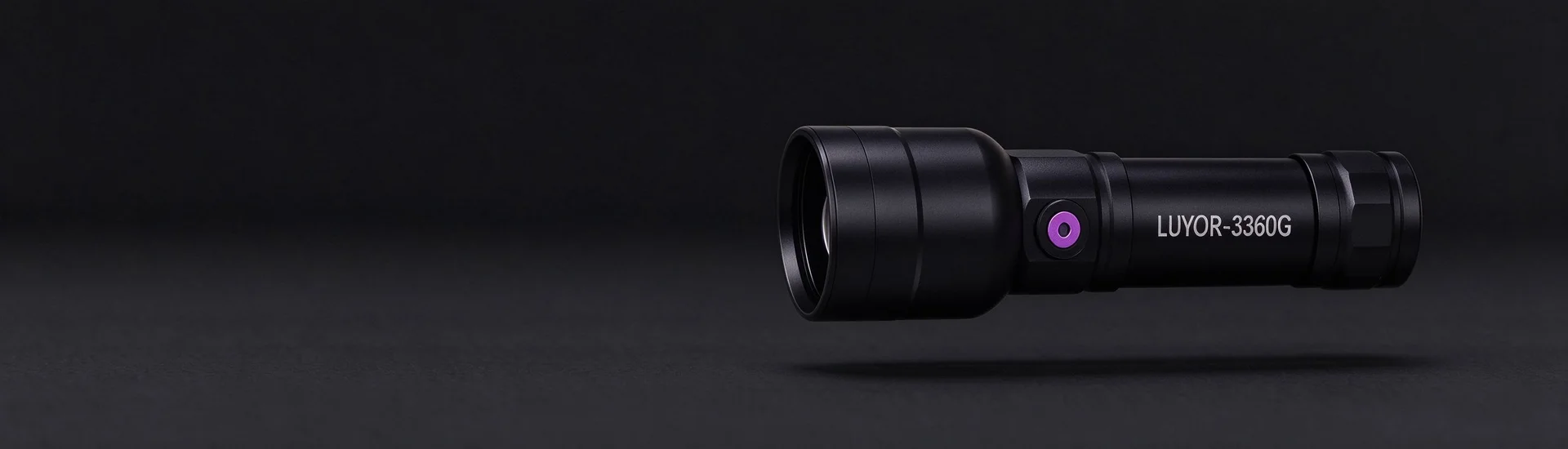
365nm UV flashlight selection: fluorescent inspection lamps, UV inspection lamps, magnetic particle lamps, degreasing check lamps and UV flashlights compared, including the LUYOR-3115 hanging lamp, 3105D portable lamp, 3103 magnetic particle lamp, 2130L degreasing lamp and 3180 spot flashlight, for fluorescent penetrant and magnetic particle inspection, degreasing acceptance and leak detection. In stock in Shanghai.
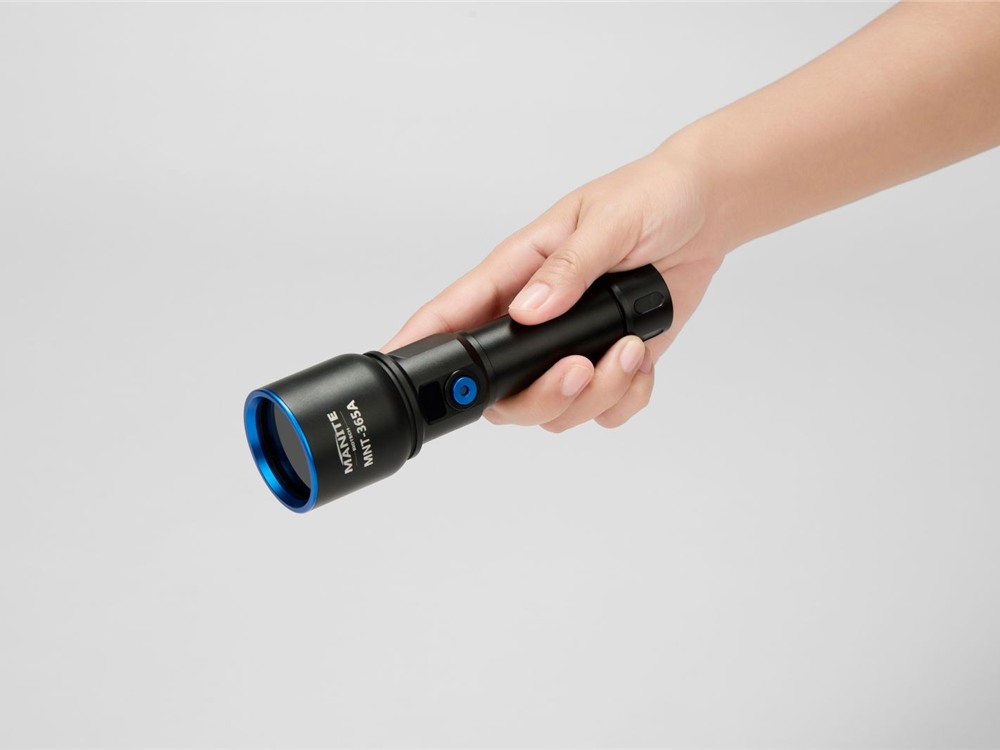
 Model: MNT-365A

The criterion for choosing a blacklight is not the number of LEDs, but the irradiance at the working distance (μW/cm²) and the spot size. Fluorescent penetrant and magnetic particle inspection require UV-A irradiance on the workpiece surface of at least 1000 μW/cm² in the darkroom, per ASTM E3022 and GB/T 5097; in practice a 3-5× margin is typical, since LEDs and filters age with use and their intensity declines year by year. Cleanroom particle and fingerprint inspection places more weight on spot coverage and white-light leakage: the lower the white light, the cleaner the fluorescence contrast.
| Model | Form Factor | Intensity (at Stated Distance) | Spot / Coverage | Power and Protection |
|---|---|---|---|---|
| LUYOR-3160A | Flashlight | 15000 / 4500 μW/cm² (38cm, high/low modes) | Focused beam, no UV-B or UV-C | 2×3500mAh lithium battery, IP65 |
| LUYOR-3180 | Flashlight (focused beam) | 30000-40000 μW/cm² (38cm) | Ø30mm at beam center | Lithium battery, IP65 |
| LUYOR-2130L | Flashlight (degreasing inspection) | 25000 μW/cm² (150mm) | Three brightness levels, white light below 15 lux | Lithium battery power |
| LUYOR-365L | Flashlight (large-area) | Approx. 6500 μW/cm² (38cm) | Effective coverage approx. 200mm | Lithium battery, 3-5 hours |
| LUYOR-3105D | Portable UV inspection lamps | 7000 μW/cm² (38cm) | Ø150mm, white light below 10 lux | Lithium battery, approx. 6 hours |
| LUYOR-3115 | Hanging workstation lamp | Approx. 9500 μW/cm² (380mm) | Approx. 250×500mm | AC power, IP65 |
| LUYOR-BBMA | Benchtop / fixed workstation | 9000 μW/cm² (38cm) | Ø285mm | AC power, IP68 |
The comparisons above are compiled from publicly available parameters on the individual product pages. For exact configuration, pricing and lead time, please refer to the corresponding product page or call the number at the bottom of this page. Xinysun Instruments (Shanghai) Co., Ltd. supplies LUYOR and XEPU instruments for industrial inspection, UV curing and speed measurement.
A blacklight is not simply a "dimmer purple lamp"; its job is to concentrate energy near 365nm in the UV-A band, exciting fluorescent materials to emit visible light while providing almost no visible illumination of its own. Fluorescent penetrants, fluorescent magnetic particles, fluorescent leak detection dyes, riboflavin, mineral oil and most greases all fluoresce clearly at 365nm, while ordinary reflections from the workpiece surface darken in the absence of visible light — so defects and residues "pop" into view.
The reason to choose 365nm over 395nm is contrast: 395nm contains more visible violet light, which gives the workpiece an overall purple cast and makes reflections easy to mistake for fluorescence. 365nm offers higher excitation efficiency and less visible residue, making it the safer choice when you need photographic evidence or audit documentation.
1. Pre-cleaning: For penetrant inspection, carry out penetration, washing and development according to the process; for degreasing and leak inspection, first wipe off surface oil so a large oil film does not mask small defects.
2. Dark adaptation: After entering the darkroom, wait at least one minute before observing — the eye needs time to regain sensitivity to weak fluorescence. Keep darkroom white-light illumination below 20 lux as required by the standard.
3. Pre-irradiation: First sweep the lamp over the whole area to fully excite the fluorescent material, then examine region by region; don't start by holding the lamp right up against the workpiece looking for spots.
4. Control distance and angle: Maintain the stated distance (commonly 38cm) to preserve spot intensity, and keep the lamp axis about 45° from the viewing direction to avoid specular glare directly into the eyes.
5. Recheck and document: Re-examine suspicious spots from a different angle, use a radiometer to confirm that the UV-A intensity on the workpiece surface meets the requirement, then photograph and record the finding.
Don't choose by counting LEDs; focus on three measurable parameters.
| Parameter | How to Set It | What Happens If It Fails |
|---|---|---|
| Irradiance | Fluorescent penetrant / magnetic particle per ASTM E3022 and GB/T 5097: UV-A on the workpiece surface not below 1000 μW/cm², with a practical 3-5× margin | Fluorescence from tiny defects is too weak and is missed |
| Spot and Coverage | Choose a focused beam (Ø30mm class) for single-spot rechecks; choose a large-area lamp (over 200mm) or a hanging lamp for production-line scanning | A spot that is too small means repeated searching; one that is too large dilutes the intensity |
| White-Light Leakage | White-light illumination in the darkroom below 20 lux, or as required by the standard | Surface reflections overwhelm the fluorescence, increasing both false positives and missed detections |
- Fluorescent penetrant testing (PT): Surface-breaking defects in welds, castings, blades and fasteners.
- Fluorescent magnetic particle testing (MT): Surface and near-surface cracks in ferromagnetic materials.
- Degreasing and cleaning acceptance: Check for residual oil, release agents and fingerprints to verify the cleaning process.
- Fluorescent leak detection: Locate leaks in HVAC, hydraulic and water systems after adding a fluorescent tracer.
- Cleanrooms and precision parts: Visual inspection of particles, fingerprints and uneven coatings.
- Anti-counterfeiting and forensics: Preliminary screening of fluorescent inks, fibers and body-fluid stains.
- Selection and Brands: Which Brand of Fluorescent UV Inspection Lamp Is Best? How to Choose Between LED and Mercury Lamps, How to Choose a UV-A Lamp for Aviation Inspection? Four Standards and a Selection Checklist, How to Choose a UV Radiometer: Principles, Units, a Comparison of Three Models and Periodic Verification Methods, How to Choose a Biofilm Detection Light? Answers to 10 Common Questions (Authorized LUYOR Distributor), How to Use a UV Inspection Lamp Correctly? 365nm Fluorescence Interpretation and LUYOR Product Selection…
Fluorescent penetrant and magnetic particle inspection require UV-A irradiance on the workpiece surface of at least 1000 μW/cm² in the darkroom, per ASTM E3022 and GB/T 5097. In practice we recommend choosing 3000 μW/cm² or more with a margin for degradation: LEDs and filters age with accumulated operating hours, so a new lamp that passes today may not pass two years later. Cleanroom particle and fingerprint inspection places more weight on coverage area and white-light leakage — the lower the white light, the stronger the fluorescence contrast.
365nm sits at the short end of UV-A and excites fluorescent penetrants, leak detection dyes and riboflavin efficiently, with little residual visible violet light and strong fluorescence contrast. 395nm is cheaper but contains more visible violet, making surface reflections easy to mistake for fluorescence. Choose 365nm when you need photographic evidence, cleanroom acceptance or audit documentation.
Choose a head-mounted model for spot checks that require climbing or crawling — it is hands-free and follows your line of sight. Choose a flashlight for large-area scanning and production-line patrols, such as the LUYOR-3160A or 365L. For fixed workstations and batch acceptance, choose a hanging or benchtop model (LUYOR-3115, BBMA) that can run continuously without battery life interrupting the inspection.
Yes. The fixture degrades in ways the eye cannot see, and only a radiometer can tell whether it still meets the requirement. ASTM E3022 specifies verification intervals for LED blacklights; in practice, record a reading every shift or weekly, and always re-measure after replacing LEDs, after a drop or impact, or after changing the filter. Pair it with a UV-A radiometer such as the XP4000, capable of reading UV-A, white light and blue light simultaneously.
In a darkroom, point the lamp at white paper or a fluorescent screen and look for a clearly visible violet-white spot. A more accurate method is to measure the white-light illuminance on the workpiece with a radiometer that has a white-light channel and keep it below 20 lux as required. Filter aging, LED batch variation and a failed housing seal can all increase white-light leakage.
The typical symptom is declining intensity rather than sudden failure. After 1000 hours of accumulated operation, intensity may drop by 10%-30%, so a lamp that just passed 1000 μW/cm² can fall into the non-compliant range. If you find yourself having to hold the lamp closer to see the fluorescence, use a radiometer to confirm and consider replacement.
Mixing is not recommended. 395nm contains more visible violet light and offers lower fluorescence contrast, and its excitation efficiency is inferior to 365nm for most penetrants and leak detection dyes. Mixing them within one process makes the acceptance criteria inconsistent and hard to justify during an audit. If you are only looking for large oil stains and sensitivity is not critical, the lower cost of 395nm is acceptable.

Email: info@xinysun.com

Tel: 131-2093-6518

Address: 1525 Minqiang Road, Bldg 26, Songjiang, Shanghai

Copyright 2026 Xinysun Instrument (Shanghai) Co., Ltd. All rights reserved.
ICP:ICP-2026046447




 Products
 Applications
 Industrial Test Instruments


