Products
PRODUCTS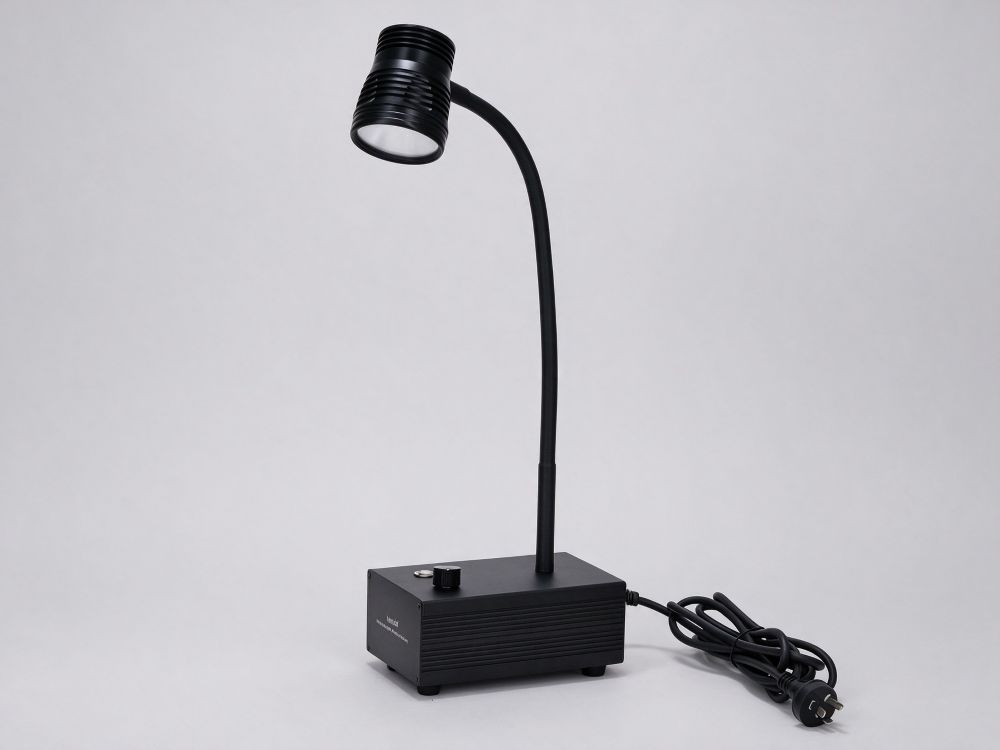
 Overview
LUYOR-3318 bench surface inspection lamp: 24W LED with diffuser, 49000 or 59000 lux at 30cm, 10-99% dimming, 500mm flexible arm, fanless.
The time-consuming part of surface inspection is not finding the defect; it is holding a steady illumination angle and looking for a long time. A hand-held lamp tires your arm within minutes, and as soon as the angle drifts the same defect disappears. LUYOR-3318 takes a direct approach: a 1.7kg base sits on the bench, and a 500mm flexible arm puts the 78mm lamp head where it is needed, after which you can forget about it.
A diffuser in front of the head spreads the output into a soft area of light rather than a harsh point source. That makes a real difference in long visual inspection: a point source leaves a bright spot on the workpiece, the eye keeps adapting between highlight and shadow, and fatigue comes quickly; area light evens out the whole field of view, and ten minutes of work leaves the eyes in a different state from an hour.
There is no fan; the aluminum housing cools passively. No fan means no dust is raised, light workpieces are not blown about, and cleanroom airflow is not disturbed, which is the precondition for cleanroom use. The trade-off is lower heat removal than forced air, so do not run it at full power for long periods in an enclosed space.
The catalog cover says warm, cool and green light are available; in model terms that is two models plus one optional filter:
| Model / configuration | Color temperature / band | Center illuminance at 30cm | Typical use |
|---|---|---|---|
| LUYOR-3318W | 6000K cool white | About 59000 lux | The default for routine visual inspection: color rendering close to daylight, so both defects and background are visible |
| LUYOR-3318Y | 3000K warm white | About 49000 lux | Warmer light, softer contrast, for long inspection sessions and warm-toned substrates (copper, brass, wood, paper) |
| 3318W/Y + green filter | 500-600nm green (optional) | Falls with filter transmittance | Monochromatic green reduces background interference; scratches and particles on glass, lenses and coatings stand out more cleanly |
The difference between the two models is not just which color looks nicer. Color temperature affects contrast and fatigue: under cool white the edges of fine particles are sharper and contrast is higher, which suits fast screening; under warm white the eyes are more comfortable over long periods, which suits full inspection stations. Green follows a different logic: it narrows the spectrum to 500-600nm, suppressing color-difference interference from color filters, coatings and colored inks, so the remaining light-dark variation comes almost entirely from geometric defects.
The filter is an optional accessory that fits on the front of the head. Note that illuminance drops once it is fitted (the catalog figures of 49000 / 59000 lux are quoted with the clear filter installed). After switching to the green filter, measure illuminance at the working distance and then decide whether to raise the dimming level.
| Item | Specification |
|---|---|
| Model | LUYOR-3318Y (warm) / LUYOR-3318W (cool) |
| Light source | 24W high-power LED with diffuser |
| Power | 3W at low level, 28W at full load |
| Color temperature | 3318Y: 3000K | 3318W: 6000K |
| Dimming | Stepless 10-99% |
| Center illuminance (30cm) | 3318Y about 49000 lux | 3318W about 59000 lux (with clear filter installed) |
| Spot size (30cm) | 30cm diameter |
| Flexible arm | 500mm long, height and angle freely adjustable |
| Head diameter | 78mm |
| Base dimensions | 200 × 130 × 90 mm |
| Weight | 1.7kg |
| Cooling | Aluminum housing, passive, fanless |
| Power supply | 200-240V AC, 50Hz |
| LED life | About 50000 hours |
| Startup | Instant, no warm-up |
| Options | Green filter (500-600nm) |
About 24W light source / 28W power:24W is the nominal LED source power, 28W is the maximum input power of the complete unit (including driver losses), and 3W is the input at the lowest dimming level. The three numbers are consistent; allow 28W when sizing the power budget.
People new to the lamp often treat dimming as a power-saving feature, but in visual inspection its role is closer to contrast control. On the same workpiece, the wrong light level drowns the defect in glare.
| Situation | How to set it | Why |
|---|---|---|
| Mirror, polished and coated surfaces | Turn down to mid-low | Full power creates an overexposed highlight in which shallow scratches are completely invisible |
| Rough surfaces, matte plastics, fabric | Turn up to high | Diffuse reflection scatters the light, so more illuminance is needed for particles to show enough brightness difference |
| Dark workpieces (black plastic, anodized aluminum) | Turn up to high | High absorption leaves too little contrast at low illuminance |
| Photo documentation | Turn down and fix camera exposure | High illuminance makes phone auto-exposure darken the background, and the defect may not appear in the photo |
| Long full-inspection shifts | One step below just visible | The eye tires faster under brighter light; use only as much as needed |
One caution: dimming changes brightness, not color temperature. A 3318Y at low level is still 3000K warm light, and a 3318W is still 6000K cool light, so changing the light color means changing the model or adding a filter, not changing the level.
At a 30cm working distance the spot is exactly 30cm across, about the width of an A4 sheet, which covers the core area of a 12-inch wafer, a phone cover glass or a weld run. Spot size is tied directly to distance: pull back and the spot grows while illuminance falls; move closer and the spot shrinks while illuminance rises.
Following the 30cm calibration point in the catalog, set the head above the workpiece, check once with a ruler, and return to that height every time.
For particle and scratch criteria, illuminate as perpendicular as possible so the lit surface is evenly distributed; oblique light stretches the spot and lowers edge illuminance.
On mirror-like parts, bend the arm to a 20°-30° angle so the specular reflection goes to the side rather than into your eyes.
One spot covers only 30cm, so scan large workpieces in zones. Overlap zone boundaries by one third to avoid misses at the seams.
For re-inspection of the same batch, fix distance, angle and dimming level together so results are comparable.
Fanless.With no forced airflow, particles on the bench or workpiece are not blown up to cause secondary contamination, and laminar flow in the cleanroom is not disturbed.
Passive cooling and aluminum housing.Heat spreads through the housing and the surface stays comfortable to the touch, but heat removal is limited, so do not run it with the head fully covered by a dust cover.
1.7kg split structure.The base and head are separate; carry it by the base and the arm angle stays put. Move it between lines, tools and inspection benches as needed.
200-240V AC supply.No battery, which suits fixed stations that stay on for hours; a moving station needs an outlet.
Easy-to-wipe surfaces.The housing is flat and can be cleaned with a cleanroom wipe and cleaner; follow your site procedure for a cleanroom wipe-down before entry.
The 3318 is a visible-light inspection lamp with no UV component in its output, so no UV protection is needed. This differs from UV-A lamps such as the 3405A, where long exposure should be avoided even without looking into the head.
| Workpiece | Recommended light | What to look for |
|---|---|---|
| Wafers, silicon (polished, epitaxial) | White 6000K or green | Particles, haze contamination, fine scratches |
| LCD color filters, color filters | Green | Color-difference interference is strongly suppressed; look for coating unevenness, pinholes, foreign matter |
| Glass lenses, silica glass, touch screens | Green or cool white | Scratches, fingerprints, water marks, coating pinholes |
| Photomasks, film | Cool white 6000K | Pinholes, chipped corners, pattern defects |
| Ceramics, metal surfaces (aluminum, stainless, copper) | Cool white 6000K | Particles, burrs, scratches, oxidation spots |
| Automotive paint and coated parts | Warm white 3000K or cool white | Orange peel, particles, runs, sanding marks |
| Long full-inspection stations | Warm white 3318Y | Less eye fatigue, suitable for a full shift |
A practical routine: sweep quickly with cool white to find suspect points, then confirm with green or oblique light. Cool white gives strong contrast and finds problems fast; green suppresses color-difference interference, so confirmation is less prone to misjudgment.
The lamps in this section do not replace each other; they divide work by who holds the lamp and whether the light must be parallel:
| Model | Format and beam | Illuminance reference | Typical use |
|---|---|---|---|
| LUYOR-3318 | Bench flexible arm, 24W LED + diffuser, area light | 49000 / 59000 lux at 30cm | Fixed-station visual inspection where both hands are needed for parts and records |
| LUYOR-3325G | Portable (bracket optional), 36W LED yellow-green 570-580nm | Illuminance not published | Wide-area even scanning of wafers and glass, hand-held between tools |
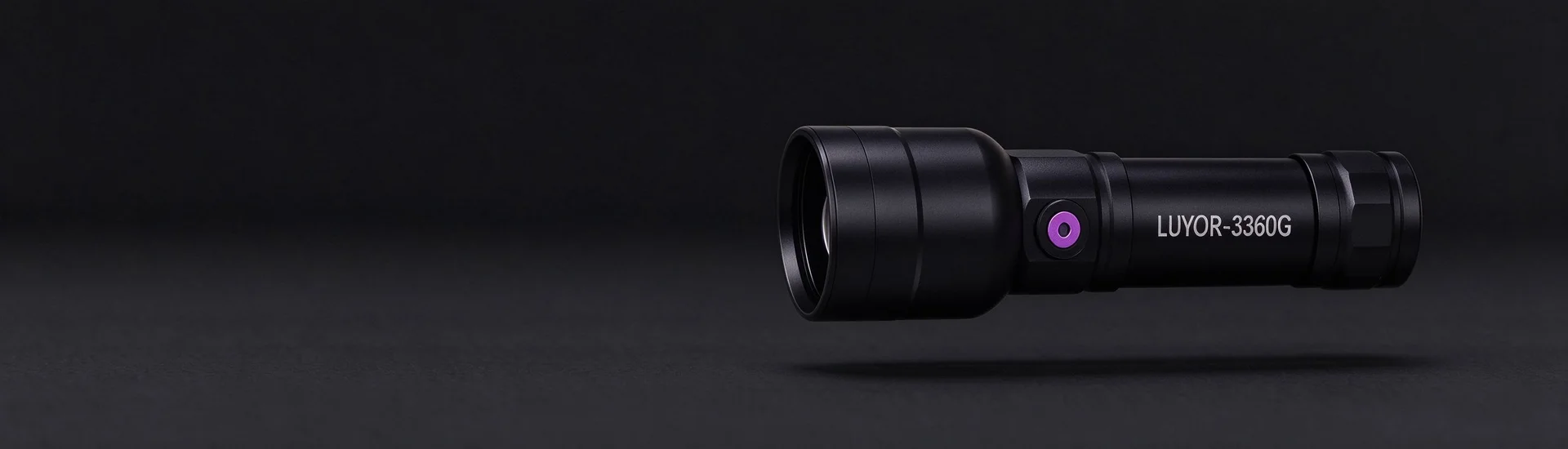
| LUYOR-3360G | Flashlight, 20W laser-collimated parallel light | About 280000 lux with a 5cm spot at 40cm | Grazing inspection that forces micro-particles and scratches to show |
| LUYOR-3405A | Bench flexible arm, 20W UV-A LED 365nm | 19750 μW/cm² at 38cm | Photocatalysis, photopolymerization, fluorescence viewing (not a visual inspection lamp) |
In one line: to free your hands and look for a long time, choose the 3318; to walk around with a large workpiece, choose the 3325G; to put a parallel beam on 1-micron particles, choose the 3360G. The 3318 and 3405A share the same body platform (same base size, 500mm flexible arm, 78mm head, 1.7kg); the difference is the head module, one white LED and one 365nm UV.
Do not wrap the head to block the light.The 3318 cools through its housing; covering the head with cloth, paper or a box traps heat inside, noticeably shortens source life and is unsafe. To narrow the spot, use a snoot or move the lamp closer; to change color, change the filter.
Do not force the arm.Bend it by holding the joint and applying slow force; do not swing it by the head. Repeated hard bending at large angles fatigues the internal cable early.
Clean the output window.Wipe the diffuser gently with lens paper or a cleanroom wipe; do not dry-wipe with tissue and do not soak it in solvent.
Prevent tipping.The 1.7kg base is not heavy, and reaching far with the arm moves the center of gravity outward, so a workpiece touching the head can tip it. At critical stations, put the base against a wall or fix it to the bench.
Check output periodically.LED output decays slowly with cumulative hours and the eye will not notice. Where quantitative work matters, measure at the 30cm working position with a lux meter every six months and record it.
Long storage.Unplug it and fit the dust cover (only while switched off).
Two things: background color and shift length. For routine inspection looking for particles and scratches, choose the 3318W (6000K cool white, about 59000 lux at 30cm); under cool white the edges of tiny defects are sharper and contrast is higher. For full-shift inspection, warm-toned substrates (copper, brass, wood, paper) or where eye comfort matters, choose the 3318Y (3000K warm white, about 49000 lux). Both use a 24W source, stepless dimming and the same body; only color temperature and illuminance differ.
No, it is an optional green filter (500-600nm) fitted to the head. It suppresses color-difference interference from color filters, coatings and colored inks so the light-dark variation comes almost only from geometric defects, which suits glass, lenses and coated parts. Note that illuminance drops with the filter fitted; the catalog figures correspond to the clear filter, so measure once after switching to green.
Center illuminance at a 30cm working distance with a 30cm spot and the clear filter installed. It is the value at the center of the spot; the edge is lower. In practice the number changes with distance, so measure at your own working distance before making quantitative judgments.
The design supports it: fanless (no dust raised, no disturbance to laminar flow), a flat housing that is easy to wipe, passive cooling. Whether it may enter depends on your cleanroom rules, and usually requires cleaning to the wipe-down procedure and following the tool entry process. It is also AC powered, so confirm that power and cable routing meet site requirements.
The body is the same platform: 200×130×90mm base, 500mm flexible arm, 78mm head, 1.7kg. The difference is the head module: the 3318 uses a 24W white LED (3000K/6000K), the 3405A a 20W UV-A LED (365nm). One is for visual surface inspection, the other for photocatalysis, photopolymerization and fluorescence viewing; the uses are not interchangeable.
No. The 3318 is a lighting device with no magnification or imaging; it shows defects at the resolution of the naked eye. What it does is use suitable light to create contrast so that things previously invisible become visible; judging micron-scale size still needs a microscope or an image inspection system.
500mm is the arm length from base to head, and together with where you place the base the actual bench coverage is larger than the number suggests. It mainly serves the case where the workpiece sits on the bench and the lamp shines down; to reach across a large part or into equipment, the flashlight-format 3360G is a better fit.
If you are unsure whether to use warm white, cool white or green, tell us the material being inspected, the defect type (particles / scratches / color difference / coating) and the station conditions (cleanroom or not, hands free or not), and we will suggest a model and dimming level; you can also leave a message through Contact Us.
Send inquiry

Email: info@xinysun.com

Tel: 131-2093-6518

Address: 1525 Minqiang Road, Bldg 26, Songjiang, Shanghai

Copyright 2026 Xinysun Instrument (Shanghai) Co., Ltd. All rights reserved.
ICP:ICP-2026046447




 Breadcrumb:
 Products
 Applications
 Previous:
 Back to list

 Industrial Test Instruments


