
Products
PRODUCTS Breadcrumb: Home > Products > Life Science Instruments > UV Transilluminators
 Overview
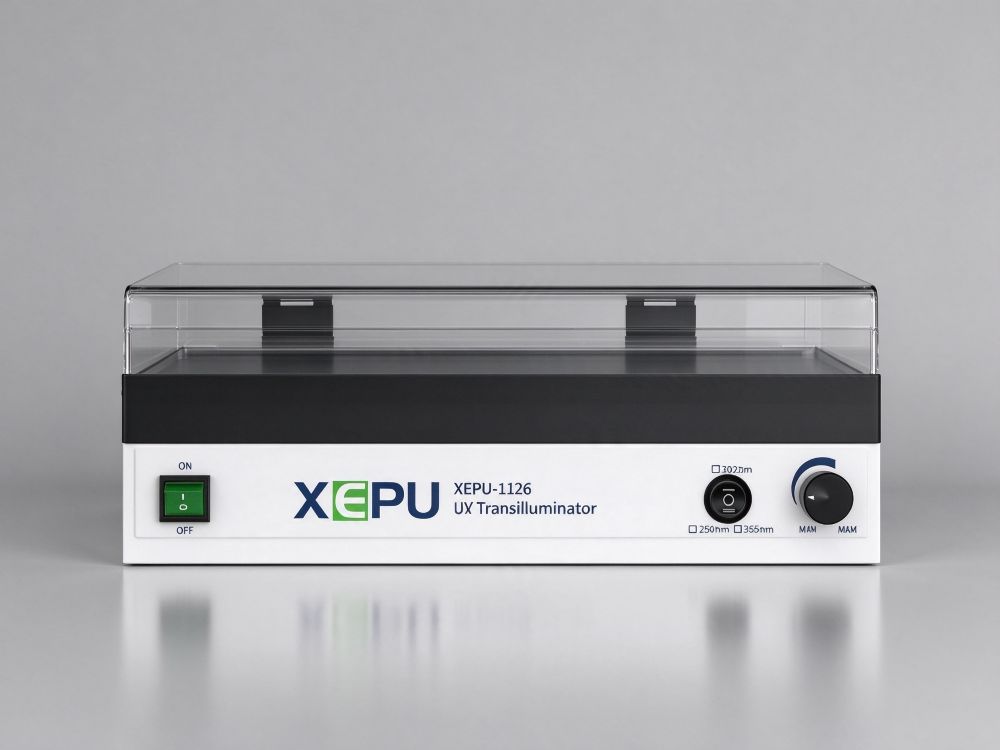
XEPU-1126ML dual-wavelength UV transilluminator: 4x302nm + 4x365nm 8W tubes, 26x21cm area, 5%-99% intensity, hinged UV shield, built-in fan.
The XEPU-1126ML is a dual-wavelength bench UV transilluminator with four 302nm mid-wave and four 365nm long-wave tubes (eight 8W tubes in total) and a 26×21cm illuminated area. Mid-wave excitation is efficient and bands are bright, which suits viewing and photography; long-wave is gentle on the sample and suits gel excision. Both bands are used in sequence on one instrument, so viewing and cutting need no equipment change.
Intensity is continuously adjustable from 5% to 99%, so widely varying sample concentrations do not have to be handled by stretching exposure time. A hinged transparent UV shield is height-adjustable, and with the built-in fan, surface temperature rise and UV exposure stay controlled during long sessions.
The shorter the UV wavelength, the higher the energy, and the brighter the fluorescence from the EB/DNA complex, so band contrast is better. Use mid-wave for viewing, sizing and photographic records.
Long-wave does less damage to DNA. Fragments excised for ligation, transformation or sequencing are more usable when located and cut under long-wave light.
With a single-wavelength model you have to choose one of these needs; the 1126ML puts both tube sets in one unit, a two-in-one configuration.
Within the series, any two of 254/302/365nm can form a dual-wavelength model; this unit is 302nm + 365nm.
Set output to sample concentration and dye brightness, so weak bands need no forced exposure and strong bands do not blow out.
The transparent UV shield is height-adjustable, leaving enough room for hands during excision while keeping UV blocked.
Continuously cools the filter glass so surface heat does not affect gel shape or sample activity, and tube life is extended.
Eight tubes behind a single filter glass give consistent brightness across 26×21cm, so several small gels side by side show no color shift.
325×322×105mm and about 7kg, it fits a standard bench and is easy to move or store.
Single-wavelength models double the tube count (eight of one band), giving higher intensity in that band; dual-wavelength models use four each, trading some single-band intensity for flexibility. The series also includes the XEPU-1126B blue-light and 1126W white-light models for labs that use non-toxic dyes or white-light viewing.
UV tubes need a short warm-up after ignition; judge bands once brightness is stable, so the dim first tens of seconds do not cause a misread.
Start low and raise until bands are clear. Full intensity is not clearer; overexposure washes out weak and strong bands alike.
Locate with 302nm, confirm position, then switch to 365nm and excise, reducing exposure of the target fragment to short-wave light.
Wear the supplied XP-100 UV glasses and set the shield to the lowest height that does not obstruct work, balancing view and blocking.
Buffer and gel debris on the filter surface disturb transmission uniformity; wipe promptly with a soft lint-free cloth.
Use 302nm for viewing and locating, 365nm for excision. Mid-wave has high excitation efficiency and bright bands, which makes judgment easier; long-wave does less DNA damage and suits work where the fragment will be used afterward. If you only view and photograph and never recover fragments, 302nm throughout is fine.
Three uses: raise intensity for weak bands to improve signal-to-noise; lower it for strong bands or concentrated samples to avoid overexposure; and set a fixed intensity for photography so exposure conditions are repeatable and brightness is comparable between gels. A fixed-intensity model can only compensate through camera settings; an adjustable model solves it at the light source.
The 1126ML uses a hinged shield with adjustable height. For excision, raise it to the point where your wrist goes in naturally, keeping UV blocking while you work. A pair of XP-100 UV glasses is included and should be worn at the same time.
There is no fixed interval; it depends on usage. Judge by brightness: on the same gel and the same intensity setting, if bands are clearly dimmer than with new tubes, or the tube ends are blackened and brightness is uneven after ignition, replace the set. UV tubes are consumables; keep one spare set on hand to avoid interrupting experiments.
Illuminated area is close (26×21cm); the core differences are intensity control and operating details: the XEPU-1126ML has 5%-99% continuous adjustment, a hinged shield and a slimmer body (105mm); the LUV-260 series offers six wavelength combinations and fixed or adjustable intensity versions. For fine brightness control and frequent band switching, take the 1126ML; for routine viewing at fixed conditions, a single-wavelength LUV-260 is more economical.
Full comparison table of the six XEPU-1126 models (wavelength, tube count, intensity range)
Comparison of 302nm and 365nm for viewing and excision
Exposure and filter settings for gel photography
Tube replacement and filter cleaning guidance
Standard package: main unit, XP-100 protective glasses, manual, certificate, warranty card
Advice on wavelength selection and dye matching
Long-term supply of UV tubes, filter glass and other consumables
Demo units and operator training available
Send inquiry

Email: info@xinysun.com

Tel: 131-2093-6518

Address: 1525 Minqiang Road, Bldg 26, Songjiang, Shanghai

Copyright 2026 Xinysun Instrument (Shanghai) Co., Ltd. All rights reserved.
ICP:ICP-2026046447




 Products
 Applications
 Previous:
 Back to list

 Industrial Test Instruments


