
Products
PRODUCTS Breadcrumb: Home > Products > Life Science Instruments > UV Crosslinkers
 Overview
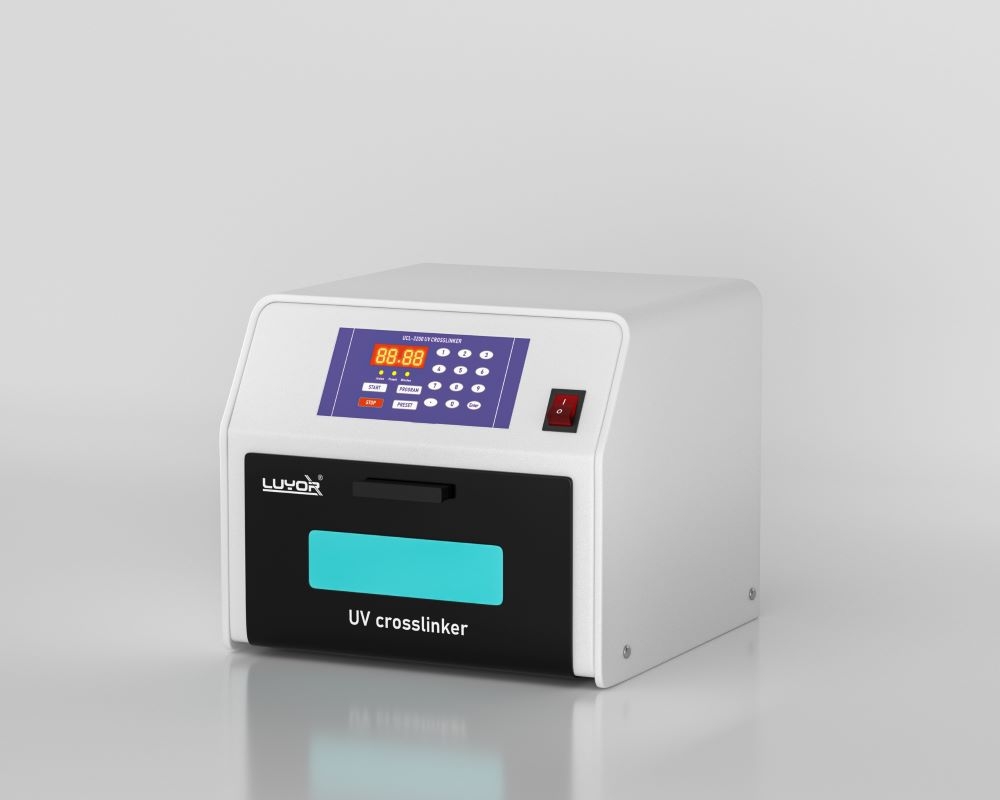
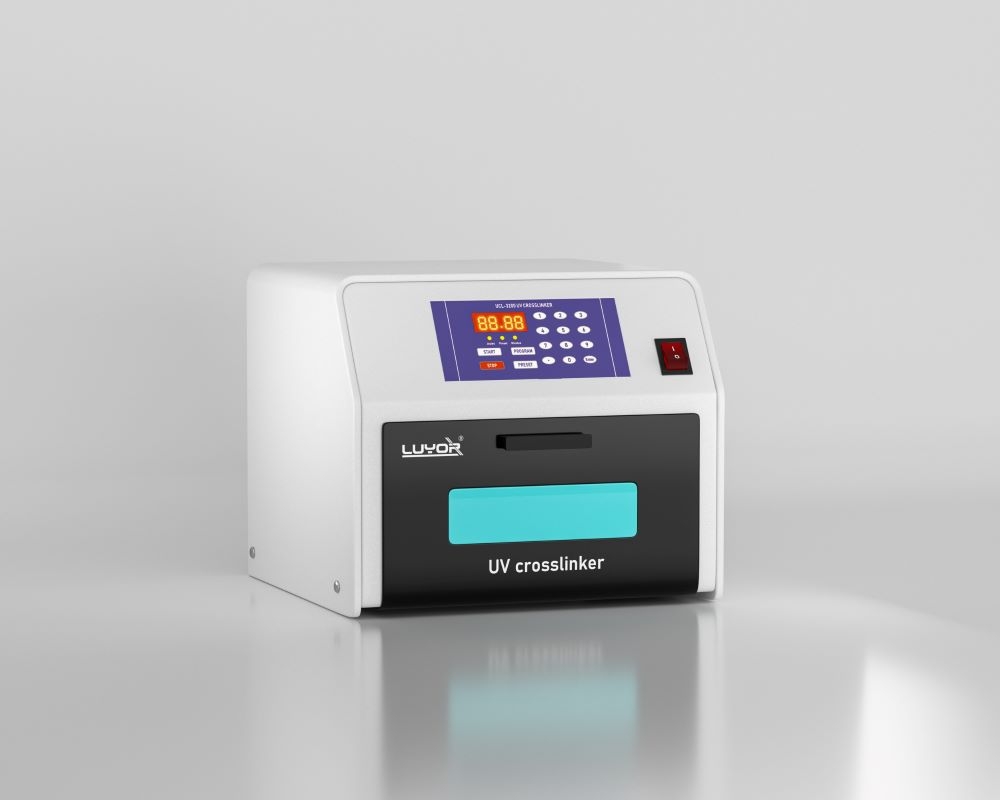
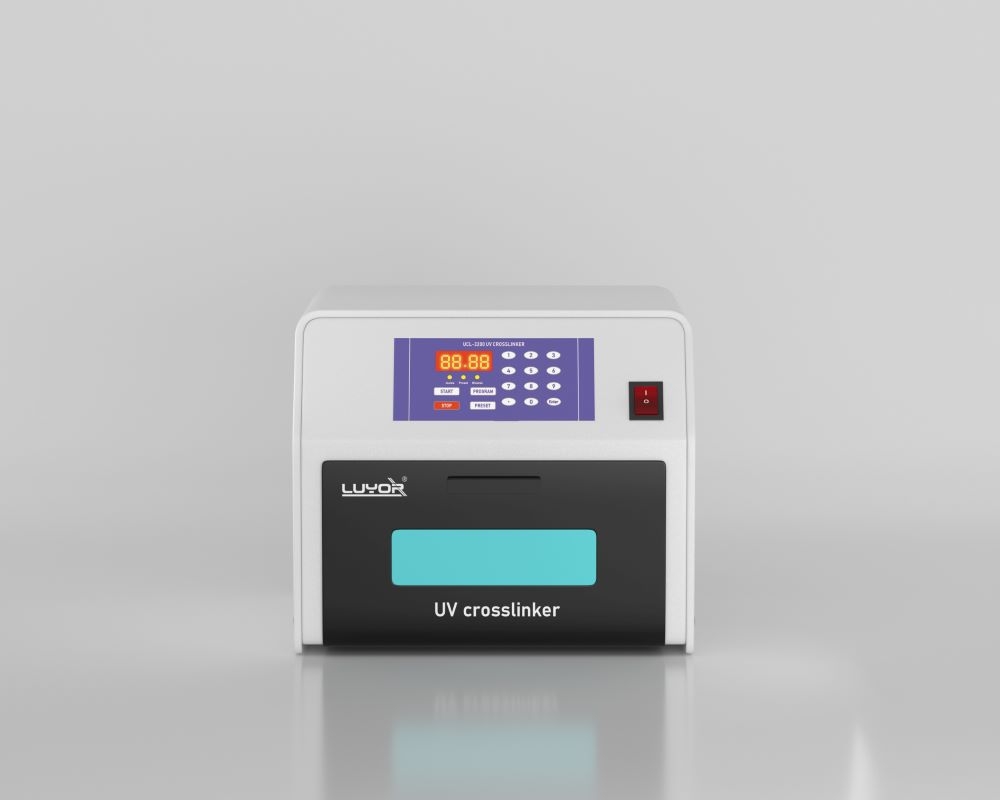
UCL-3200 UV crosslinker: 254 nm, 6x8 W lamps, 32x26x15 cm chamber, 0-9.999 J/cm2 energy mode and 9 presets for reproducible Southern blot crosslinking.
Start with something almost every UV crosslinker page skips: crosslinking depends on how much UV energy the sample actually receives (dose, in mJ/cm² or J/cm²), not on how long it is exposed.Time is only the means to a dose; the dose is the result.
That explains why "set 30 seconds" carries a hidden risk. UV lamps decline continuously with use, and ambient temperature and line voltage fluctuate, so "30 seconds" from a new lamp and from a lamp that has run for two years can differ by a wide margin. And that change is completely invisible from the outside - you only notice hybridization signal weakening year after year and background rising, without finding the cause; then you spend a lot of time changing probes, reagents and membranes.
The UCL-3200 approach: during exposure a microprocessor monitors UV intensity in the chamber in real time and integrates it over time, stopping automatically when the set dose is reached.Dimmer lamps get a longer exposure, higher intensity stops earlier - whatever the lamp output does, the irradiation energy can be reproduced. That delivers three practical things, not just a specification: a dose written into the record means something; the same method on another day or another unit gives matching results; and lamp aging no longer has to be compensated by experience.
| Item | Time mode | Energy mode (the core of the UCL-3200) |
|---|---|---|
| What you set | Exposure duration (e.g. 30 s) | Accumulated dose (e.g. 120 mJ/cm²) |
| When lamps age | Dose drops, and you cannot see it | Exposure extends automatically, dose unchanged |
| Line / temperature fluctuation | Directly affects dose | Absorbed by the integrator, dose unaffected |
| Reproducibility | Low - new lamps or a different unit mean re-establishing conditions | High - the dose is a value you can record and compare |
| Best for | Aligning to fixed times in older literature; sterilization protocols judged by time | Nucleic acid membrane crosslinking, PCR decontamination, UV mutagenesis - anything dose-dependent |
The UCL-3200 series offers three wavelength versions of the same chassis; the original page listed them in the specification table without any explanation, and this is exactly what has to be settled before ordering. The biological effects of the three differ substantially:
| Model | Wavelength | Band | Typical use |
|---|---|---|---|
| UCL-3200
This page |
254 nm | UV-C | Membrane crosslinking and immobilization of nucleic acids (Southern/Northern/Dot/Slot blot, EMSA); eliminating PCR contamination and UV sterilization; UV-induced mutagenesis (UV breeding); E. coli RecA mutant screening; pyrimidine dimer induction and related restriction digestion experiments |
| UCL-3200M | 302 nm | UV-B | Gentler than 254 nm with less damage to nucleic acids; suited to experiments that need longer-wavelength irradiation or activation while keeping photodamage under control |
| UCL-3200L | 365 nm | UV-A | Photosensitizer activation (e.g. psoralen crosslinking), photoaffinity labeling, photocrosslinking of some proteins and biomolecules - long-wave energy is low and does not directly damage DNA to any appreciable extent |
The choice comes down to one question: what are you crosslinking, and at what wavelength do you excite it.If you are unsure, send us the protocol - membrane type, nucleic acid type (DNA/RNA), and whether the next step is hybridization, amplification or photoactivation - and we will advise on the wavelength version rather than on the more expensive one.
120 mJ/cm² is a widely circulated reference value for nucleic acid membrane crosslinking. It comes from some commercial nylon membranes and classic Northern methods, and many manufacturers also build it in as a factory preset, so almost every lab has heard of it. But treating it as "the universal answer for every membrane and every nucleic acid" is a common reason crosslinking experiments fail.
Why it is not universal:membranes of different brands and models specify different recommended UV conditions; nitrocellulose usually needs about 20%-30% more dose than nylon, or baking in addition; RNA degrades more readily than DNA and calls for a more conservative dose; wet versus dry membranes and different transfer buffer systems shift the suitable dose. All of this depends on the membrane roll and the reagent set in your hands, not on a number in circulation.
| Sample type | Typical starting reference dose (254 nm) | Notes |
|---|---|---|
| DNA membrane crosslinking (nylon) | approx. 100-120 mJ/cm² | The usual starting point; follow the value recommended for your membrane |
| RNA membrane crosslinking | approx. 80-100 mJ/cm² | RNA degrades more readily; keep the dose lower and the exposure shorter |
| Nitrocellulose membrane | +20%-30% over nylon | Or use baking as an additional fixation step |
| Protein / biomolecule crosslinking | approx. 150-300 mJ/cm² (optimize with a gradient) | Usually higher than for nucleic acids; adjust for molecular weight and system |
Signal is generally weak after washing and long incubation, and nucleic acid tends to come off the membrane
Typical corroboration: a second exposure under the same conditions after drying markedly improves the signal
It may also not be a dose problem but a membrane that dried before crosslinking - crosslink immediately after transfer and keep the membrane slightly wet
Signal falls and at the same time background rises, with bands looking diffuse and smeared
Higher-molecular-weight fragments are affected more - excess UV immobilizes nucleic acid while also damaging the nucleic acid itself and probe binding sites
What to check: lower the dose, shorten the exposure, and run an uncrosslinked control alongside
A programmable microprocessor monitors UV intensity continuously during exposure and stops the moment the set energy is reached. Lamp aging that lowers UV output does not change the delivered dose - this is what makes energy mode possible, and what separates it from a timer.
The irradiation chamber uses mirror-finish stainless steelwalls with an aluminum diffuse reflector: the mirror surface reflects light back into the chamber in a directed way, the matte surface scatters it, and together they keep UV intensity across the chamber as even as possible - uniformity determines whether the center and the edge of the same membrane give the same result.
The UV sensor unit sits at the top of the chamber rather than in a corner, so its reading is more representative. A quartz glass shield prevents chemical corrosion and contamination - once a sensor has drifted or been contaminated, even an accurate energy mode integrates on a wrong basis.
Two further design points reduce human variation: at power-up the instrument returns to the settings used before shutdown, one-key operation, with no values to re-enter each time; the end of crosslinking is signalled by a beep and the unit goes to standby automatically, so it does not sit running if the operator walks away, and nobody opens the door on a guess.
The UCL-3200 offers energy mode, time mode and preset mode, plus 9 stored programs. The sequence below covers a routine membrane crosslinking run:
At power-up the instrument returns to the settings it had before shutdown. First confirm whether this run uses energy modeor time mode, and check that the dose value matches the protocol (for example 120 mJ/cm²).
Membranes flat in a single layer, sample side up, in the center region, with no overlap; crosslink immediately after transfer while still slightly wet. If the dose for this run comes from a preset program, confirm the channel number is correct.
Start only after the door is fully closed. During exposure do not open the door, and do not look into the chamber to check whether the lamps are on - read the display instead.
In energy mode the instrument integrates in real time and stops with a beep when the set dose is reached. Note: as lamps age and ambient temperature changes, the time needed for the same dose gradually increases - if one exposure takes noticeably longer than usual, that is a signal worth recording and worth checking lamp output for.
When the run ends the instrument goes to standby. Remove the samples and record the dose, the mode used, the membrane brand and model, and the accumulated lamp hours. Record these together, so you have a basis for backtracking if a problem appears later.
If the conditions are validated by the experiment, store them in one of the 9 presets and label the purpose (e.g. "nylon membrane · DNA · 120 mJ"). This step turns individual experience into a lab asset and is the easy way to reduce batch-to-batch variation.
Start only after the chamber door is fully closed, and do not open it during exposure
Do not look into the chamber to check whether the lamps are on - 254 nm produces almost no visible light, so you cannot tell whether it is on and will not instinctively look away as you would from a bright light; that is exactly what makes it dangerous
Before replacing or cleaning lamps, switch off power and let the lamps cool; the tube wall is hot in operation
When fitting lamps, avoid touching the quartz envelope with your fingers; grease causes local devitrification and affects output and uniformity
Do not let UV from an open chamber door reach eyes or bare skin for any length of time
Ozone:low-pressure mercury UV lamps generate a small amount of ozone in operation (the 185 nm line splits atmospheric oxygen). If there is an obvious smell when you open the door, ventilate the room before continuing; small rooms need particular care
Mercury:the lamps contain mercury; a broken lamp must not go into ordinary waste. Hand it to a licensed hazardous-waste contractor, and do not simply discard lamps you have replaced
On the UV risk class:254 nm is UV-C, the more biologically active part of the UV spectrum, with documented damage to the cornea (photokeratitis) and skin (erythema). The instrument itself has protective construction and is safe when used with the door closed; but if the door seal or the door lock is aging or loose, have it repaired rather than using it as is
This is the design home of the instrument. The procedure itself is not complicated, but success depends almost entirely on details: DNA reaches the membrane surface by electrophoresis and transfer, then 254 nm UV is used to form a stable bond between nucleic acid and membrane, so the nucleic acid is retained through prehybridization, long incubations and washes. Key points:
Crosslink immediately after transfer and keep the membrane slightly wet - do not let it dry out; crosslinking efficiency drops noticeably once the membrane is dry, and this is often misdiagnosed as "not enough dose"
Single layer, sample side up, centered, no overlap
Set the dose from the membrane/reagent instructions, and run a dose gradient if needed (see "120 mJ/cm² is not a universal answer" above)
Record the dose and the lamp hours; store validated conditions as a preset program
Related work includes membrane crosslinking for EMSA (gel shift): the crosslinking step follows transfer, typically at 254 nm for several tens of seconds at the dose recommended by the membrane instructions. Published methods and method documents note that if crosslinking is poor and even the free-probe band is weak, a second crosslinking pass under the same conditions after drying the membrane can be tried - but only after confirming that a dried membrane is not the cause, otherwise it just hides the problem.
The principle holds: 254 nm UV makes DNA form pyrimidine dimers, the polymerase cannot read through them, and the contaminant is no longer a valid template. Published work reports that this inactivation can reduce residual template in a tube by more than 1000-fold, which makes it one of the classic ways to control false positives in PCR.
But while UV destroys contaminating DNA, it also damages other components of the reaction, and this side effect is often ignored:
| Component | Sensitivity to UV | Practical consequence |
|---|---|---|
| Taq DNA polymerase | Highly sensitive | Activity drops after exposure, and PCR sensitivity drops with it |
| Primers | Sensitive, and sequence-dependent | Primers with adjacent thymines are damaged more readily; results vary widely between primer sets |
| dNTPs | Relatively UV-resistant, but absorb 254 nm strongly | They sit in front of the DNA and shade it, so decontamination efficiency falls sharply and longer exposure is needed |
| Tube plastic | Most materials absorb UV | The same instrument with different tubes and distances gives very different decontamination results |
254 nm exposure of cell suspensions or spore suspensions produces random mutations. These experiments demand dose reproducibility - dose determines mutation rate and survival rate, and "how long" cannot be aligned between batches. Fix the dose and pair it with a survival curve.
E. coli RecA mutant screening, pyrimidine dimer induction, and gene mapping based on dimer-blocked cleavage all assume a stable UV dose. These experiments suit energy mode, with the dose written into the methods section.
Protein and biomolecule crosslinking usually needs a higher dose than nucleic acids (start gradients around 150-300 mJ/cm²); for psoralen-type photosensitizer activation or photoaffinity labeling, choose the 365 nm UCL-3200L - long-wave energy is low and does not directly damage DNA to any appreciable extent.
The UV crosslinker section of this site currently offers three models, with clear differences in positioning:
| Model | Brand | Lamps | Chamber (internal) | Energy / dose | Positioning |
|---|---|---|---|---|---|
| UCL-3200
(this page) |
LUYOR (USA) | 6 × 8 W | 32×26×15 cm
Complete unit 34×35×31 cm / 10 kg |
Energy 0-9.999 J/cm²
Time 0-99.59 min 9 presets |
The routine lab workhorse: one membrane, one gel, samples up to A4; all three wavelength versions available; a good balance of cost and versatility |
| UCL-3500 | LUYOR (USA) | 6 × 15 W
About twice the power |
44×34×15 cm
Complete unit 55×36×30 cm / 10 kg |
Energy 0-9.999 J/cm²
9 presets |
High capacity and throughput: several membranes, large gels and multiple sample groups in one run; less time needed for the same dose |
| UVP / Analytik Jena
CL-3000 |
UVP (USA)
(Analytik Jena) |
6 × 8 W (254 nm) | 35×27×16 cm
Complete unit 41×40×26.5 cm |
0.1-9999.9 mJ/cm²
(0-10 J/cm²) Time 000:01-999:59 |
Imported-brand reference model: real-time UVC dose monitoring, a door window that lets you watch the run while blocking UV, and a safety door lock; pre-exposure preset of 120,000 μJ (= 120 mJ/cm²) or 5 minutes |
Listed below for the UCL-3200. Differences between the three wavelength versions are noted separately - please confirm the wavelength before ordering:
| Parameter | UCL-3200 | UCL-3200M | UCL-3200L |
|---|---|---|---|
| Wavelength | 254 nm | 302 nm | 365 nm |
| UV lamps | 6 × 8 W | 6 × 8 W | 6 × 8 W |
| Programming | 9 preset irradiation energy values (LUYOR's official mobile site and other sources also state "9 preset irradiation energy values and 9 preset times") | ||
| Energy | 0.000 to 9.999 J/cm² or 0.00 to 99.99 J/cm²
LUYOR's official mobile site gives a lower limit of 0.025 J/cm² |
||
| Time | 00.00 to 99.59 min or 000.0 to 599.5 min | ||
| Temperature (operating environment) | 15 ℃ - 35 ℃ | ||
| Humidity | 70%, non-condensing | ||
| Housing surface temperature | ≤ 30 ℃ | ||
| Start-up time | < 1 s | ||
| External dimensions (L×W×H) | 34 cm × 35 cm × 31 cm | ||
| Internal dimensions (L×W×H) | 32 cm × 26 cm × 15 cm | ||
| Weight | 10 kg | ||
| Power supply | 230 VAC 50/60 Hz | ||
| Certification | CE | ||
| Model | UCL-3200 (254 nm, this page); the same chassis is also available as UCL-3200M (302 nm) and UCL-3200L (365 nm) |
| Product type | Microprocessor-controlled UV irradiation system / UV crosslinker |
| Brand / manufacturer | LUYOR, USA (per the product field on this site; the series is LUYOR's UV crosslinker line) |
| Control method | A programmable microprocessor monitors UV intensity in real time; exposure stops automatically when the irradiation energy matches the preset value, so irradiation energy is reproducible regardless of lamp output fluctuation |
| Operating modes | Energy mode, time mode, preset mode; 9 preset programs |
| Irradiation chamber | Mirror-finish stainless steel UV chamber plus aluminum diffuse reflector (mirror and matte optical reflectors used together), keeping UV intensity uniform inside the chamber |
| UV sensor | Located at the top of the irradiation chamber with a quartz glass shield, protecting it from chemical contamination and ensuring long-term durability |
| Power-up and alerts | At power-up the instrument returns to the settings used before shutdown, one-key operation; a beep signals the end of crosslinking and the unit goes to standby without further input |
| Warranty | Free replacement within one year, three-year free warranty |
| Main applications | Membrane crosslinking and immobilization of nucleic acids (Southern/Northern/Dot/Slot blot, EMSA); eliminating PCR contamination and UV sterilization; UV-induced mutagenesis; RecA mutant screening in E. coli; biomolecule crosslinking; DNA nicking in agarose gels; restriction enzyme digestion related to pyrimidine dimers |
Two things on a UV crosslinker have to be handled as consumable management, otherwise the instrument looks fine while results drift:
Lamps: UV output from low-pressure mercury lamps declines continuously with use, and the common replacement criterion in the industry is output down to about 70% of the initial value (at that point the lamp still lights, and because of energy integration the dose you set is still delivered and everything looks correct, only the time needed keeps growing).Record accumulated lamp hours and watch for the signal "is the time for the same dose clearly longer".
Quartz shield and chamber reflector: contamination on the quartz shield and dust or residue on the reflector both change the actual irradiance distribution.Clean regularly with a soft cloth and a suitable cleaner; do not scrape with anything abrasive.See the full range of UV meters and radiometers →
The control logic is identical on both (microprocessor energy integration, mirror-finish stainless steel chamber, 9 presets, three-year warranty); there are only two differences: lamp power and chamber capacity.The UCL-3200 uses six 8 W lamps, with external dimensions of 34×35×31 cm and an internal chamber of 32×26×15 cm; the UCL-3500 uses six 15 W lamps (about twice the power), with external dimensions of 55×36×30 cm and an internal chamber of 44×34×15 cm, also 10 kg.The decision is simple: if you process one membrane or one or two gels per run, or samples up to A4, the UCL-3200 is fully sufficient - crosslinking takes tens of seconds to a few minutes, and the power difference mainly changes how long the same dose takes; if you need to process several membranes, a large gel or a 96-well plate at once, or your per-run sample volume is large and you want to cut waiting time, choose the UCL-3500.Also note that the larger chamber of the 3500 makes edge-to-center intensity differences more likely, so sample placement needs more attention to centering.
Crosslinking depends on how much UV energy the sample actually receives (dose, in mJ/cm² or J/cm²), not on exposure time.The problem with time mode: lamps age and lose output, and ambient temperature and voltage fluctuation also affect output, so "30 seconds" from a new lamp and from a lamp used for two years can give very different doses - and the change is invisible externally.You only notice hybridization signal weakening year after year, without finding the cause.In energy mode the microprocessor monitors chamber intensity during exposure and integrates over time, stopping at the set dose: dimmer lamps run longer, higher intensity stops earlier.The UCL-3200 offers both modes.Recommendation: use energy mode for everything where the result depends on dose - nucleic acid membrane crosslinking, PCR contamination control, UV mutagenesis - and write the dose into the record; use time mode only when you must align to a fixed exposure time from older literature, or when a sterilization protocol is explicitly judged by time.
The three are the UCL-3200 (254 nm), UCL-3200M (302 nm) and UCL-3200L (365 nm), three versions of the same instrument, and the choice depends on what you need to excite.254 nm is UV-C, close to the absorption peak of nucleic acids (about 260 nm), with strong biological effect: nucleic acid membrane crosslinking, EMSA membrane crosslinking, PCR contamination control and UV sterilization, UV-induced mutagenesis, RecA mutant screening, pyrimidine dimer induction - this is the version most molecular biology labs need, and the UCL-3200 featured on this page.302 nm is UV-B, gentler than 254 nm with less DNA damage, often used where you need to observe under UV or activate at a longer wavelength without excessive photodamage.365 nm is UV-A, lower energy and practically non-damaging to DNA directly; it is mainly used for photosensitizer activation (such as psoralen crosslinking), photoaffinity labeling and some photocrosslinking experiments.If you are unsure, send us the protocol first - the choice depends only on what you are crosslinking and at what wavelength you excite it, not on which costs more.
120 mJ/cm² is a widely circulated reference value for nucleic acid membrane crosslinking, coming from some commercial nylon membranes and classic Northern methods, and many manufacturers make it a factory preset.But it is not the universal answer for every membrane: different brands and models specify different recommended UV conditions; nitrocellulose usually needs about 20%-30% more dose than nylon, or baking in addition; RNA degrades more readily than DNA and calls for a more conservative dose; wet versus dry membranes and different buffer systems also shift the suitable dose.So the right approach is not to copy a number but to follow three steps: 1.Confirm which membrane you are using and check the recommended value in its instructions or those of the matching reagents.2.Use that as a starting point for a dose gradient (for example 50 / 100 / 150 / 200 mJ/cm²).3.Take the level that gives strong signal without obvious degradation as your lab's standard value, and record it together with the membrane brand and model and lamp hours.For protein and biomolecule crosslinking the dose is usually higher than for nucleic acids; start gradients at 150-300 mJ/cm².
This is where UV decontamination is easily misapplied, so it is worth spelling out.The principle is sound: 254 nm UV makes DNA form pyrimidine dimers, the polymerase cannot read through them, the contaminant is inactivated and stops being a valid template, and published work reports more than 1000-fold reduction of residual template in a tube.The problem is that UV is equally harmful to the other components of the reaction, at the same time: 1.Taq DNA polymerase is highly UV-sensitive.2.Primers are UV-sensitive and the sensitivity is sequence-dependent (primers with adjacent thymines are damaged more readily).3.dNTPs absorb strongly at 254 nm and shade the DNA, so decontamination efficiency drops sharply and longer exposure is needed.4.Tube plastic absorbs UV, so results differ widely between tube types and placement distances.So the conclusion in clinical and published work is: UV exposure is not a general method for "irradiating the whole reaction mix"; if enzyme and primers are already in the tube, exposure directly lowers sensitivity (reported up to 10-fold).The correct approach: UV should target bench surfaces, pipettes, tube racks, and reagents and consumables that contain no enzyme or primers.If you do use the classic "irradiate the reaction mix" strategy, add enzyme and primers after exposure and validate sensitivity separately for each PCR system.The more robust direction is aliquoting reagents, using filter tips to control aerosols, and adopting UNG/dUTP systems.
Both are possible, and the symptoms are easy to confuse.Typical signs of under-crosslinking: signal is generally weak after washing and long incubation, or nucleic acid on the membrane tends to come off; a second crosslinking pass (dry the membrane and expose again under the same conditions) usually improves it markedly.Signs of over-crosslinking: signal falls while background rises, bands look diffuse and smeared, and higher-molecular-weight fragments are affected more - because excess UV immobilizes nucleic acid while also damaging the nucleic acid itself and probe binding sites.Two ways to tell them apart: first, check whether you ran an untreated control and a dose gradient (irradiating different regions of one membrane at different doses is intuitive); second, recall where the dose came from - if you copied someone's 120 mJ/cm² without checking the instructions for your membrane, redo it at the membrane manufacturer's recommended value first, which is usually more effective than changing reagents.Do not forget the environmental factors: crosslink immediately after transfer, keep the membrane slightly wet, keep a single layer.Exposing a membrane after it has dried drops efficiency noticeably, and many people misdiagnose that as "not enough dose".
These figures are genuinely inconsistent, and we state them as they are.1.Lower energy limit: this site's original page and several distributors state 0.000 J/cm², while LUYOR's official mobile site states 0.025 J/cm².This page presents the original site value and flags it here; the actual lower limit is what the setting screen in the manual supplied with the unit shows.2.External and internal dimensions, weight: this site's original page and LUYOR's official mobile site state 34×35×31 cm / 32×26×15 cm / 10 kg; some dealer pages state 40×34×30 cm / 32×30×16 cm / 9 kg.Two dimensional data sets for the same machine usually mean one side copied a figure incorrectly or used documentation from a different batch.3.Number of program groups: this site's original page states "9 preset irradiation energy values", while the official mobile site and other sources state "9 preset irradiation energy values and 9 preset times".None of these affects use, but if the figures must go into a purchase contract, tender document or asset register, use the parameter page of the manual supplied with the unit; we can also request a formal datasheet from LUYOR for you.
No.This is a common misunderstanding about energy mode: energy mode solves dose accuracy; it does not solve output decay or changes in uniformity.Low-pressure mercury UV lamps lose output continuously over their service life, and the common replacement criterion in the industry is output down to about 70% of the initial value - at that point the lamp still lights, and because of energy integration the dose you set is still delivered and the result still "looks correct", only the time needed keeps growing.That creates two practical problems: runs take longer and throughput falls; and uniformity inside the chamber may change, while the dose integrator reads intensity at the sensor position, and an aging sensor also drifts.So: 1.Record accumulated lamp hours and schedule replacement against the rated life.2.Periodically (for example every 3 months, or per your quality system) measure intensity at several positions with an external UV meter and keep the records.3.When output has clearly dropped, or the time for the same dose is much longer than with new lamps, replace the whole set rather than only the lamp that failed.
The UCL-3200 addresses uniformity structurally in two ways: the irradiation chamber has mirror-finish stainless steel walls, and it is fitted with an aluminum diffuse reflector (mirror and matte optical reflectors used together) - the mirror surface reflects light back into the chamber in a directed way while the matte surface scatters it into diffuse light, so irradiance at different positions is as close as possible; the UV sensor is mounted at the top of the chamber rather than in a corner, so its reading is more representative.But note: structural uniformity addresses variation inside the chamber, and sample placement is still a variable that cannot be ignored.Keep samples flat in a single layer, sample side up, as close to the center as possible, avoid putting different batches in different positions, and do not overlap membranes.For work that demands strict reproducibility, measure irradiance at a few fixed positions at intervals to confirm the actual difference in the area you normally use and keep it within an acceptable range.Note that the original page on this site does not publish a quantified uniformity figure; for written data, ask us for the factory test records for this model.
The UCL-3200 has a built-in UV sensor that monitors chamber irradiance in real time and performs the energy integration; this site describes the irradiance meter as "traceable to a CMA/CNAS laboratory".To be clear about our position: this kind of traceability is normally evidenced by a factory calibration certificate, not by the instrument acting as a legal measuring standard at all times, so ask for the calibration certificate on delivery, check the calibration date and validity, and arrange recalibration per your quality system over the long term.For genuine "provable dose" you also need an independent external check: measure irradiance inside the chamber with a UV meter, cross-check it against the instrument reading and the set dose, and keep the verification records.If your lab has to pass a CMA/CNAS assessment or a customer audit, building energy integration, periodic external verification and lamp replacement records into a logbook is far more solid than a single claim of traceability.
254 nm is UV-C, the more biologically active part of the UV spectrum, with documented damage to the cornea (photokeratitis) and skin (erythema), and it produces almost no visible light - you cannot see whether it is on, so you do not instinctively look away as you would from a bright light, the same risk logic as a UV flashlight.Basic requirements: 1.Start the exposure only after the chamber door is fully closed; do not open the door during exposure.2.Do not look into the chamber to check whether the lamps are on; use the display and the beep.3.Before replacing or cleaning lamps, switch off power and let the lamps cool (the tube wall is hot in operation).4.When fitting lamps, avoid touching the quartz envelope with your fingers; grease causes local devitrification and affects output.Two more points that are easily overlooked: first, low-pressure mercury UV lamps generate a small amount of ozone in operation (the 185 nm line splits atmospheric oxygen); if there is an obvious smell when the door is open, ventilate the room before continuing.Second, the lamps contain mercury, so a broken lamp must not go into ordinary waste - hand it to a licensed hazardous-waste contractor, and do not simply discard lamps you have replaced.The instrument itself has protective construction and is safe when used with the door closed; if the door seal or the door lock is aging or loose, have it repaired rather than using it as is.
Applications fall into a few groups: 1.Membrane crosslinking and immobilization of nucleic acids - Southern, Northern, Dot/Slot blot, and membrane crosslinking for EMSA gel-shift work.2.Eliminating PCR contamination and UV sterilization.3.UV-induced mutagenesis (UV breeding).4.RecA mutant screening in E.coli.5.Biomolecule and protein crosslinking.6.DNA nicking in agarose gels and restriction digestion experiments related to pyrimidine dimers.The fundamental difference from a hand-held UV lamp or the lamp inside a clean bench is metering: hand-held lamps and bench lamps have no energy integration and no dose readout, and position and distance are entirely manual, so repeating the same conditions twice can give quite different doses - they can only do qualitative surface sterilization or rough irradiation.The UCL-3200 turns UV exposure into a "dose" that can be set, recorded and reproduced.If your current practice is "10 minutes under the clean-bench UV lamp and hope it works" while results have to go into papers, grant applications or quality records, the missing piece is exactly this reproducible dose step - which is the point of this instrument.
Start with the conclusion: nucleic acid membrane crosslinking typically falls in the range of tens of seconds to a few minutes, and the exact time depends on the set dose and the lamp intensity at that moment - which is the value of energy mode, because it turns "how long" into something the instrument works out.The relationship is: dose (J/cm²) = irradiance (W/cm²) × time (s).With new lamps intensity is high and exposure is short; as output decays exposure lengthens, and the instrument compensates automatically - you only enter the target dose.A few common references: nucleic acid membrane crosslinking at 100-120 mJ/cm² (0.1-0.12 J/cm²) usually takes tens of seconds; exposure for UV sterilization and PCR decontamination depends on the surface and the actual irradiance, so start with 1-5 minutes and validate; for UV mutagenesis, set the dose from a survival curve at your cell concentration.Any "reference time" is only a starting point - whether a sample is shaded, whether the membrane is dry, and the distance from sample to lamps all significantly affect the dose actually received, so what matters is not memorizing a number of seconds but recording the dose and conditions so the next run can reproduce them.
Here is a simple decision path.Step 1, fix the wavelength: 254 nm for nucleic acid membrane crosslinking, PCR decontamination, UV sterilization and UV mutagenesis; 365 nm for photosensitizer activation and photoaffinity labeling; 302 nm sits in between, mainly for work that needs observation under UV without excessive damage.Step 2, fix the capacity: for one membrane or one or two gels up to A4 per run, choose the UCL-3200 (32×26×15 cm chamber), which is also the general-purpose choice; to process several membranes, a large gel or a large batch at once, choose the UCL-3500 (44×34×15 cm chamber, 6×15 W at about twice the power, less time for the same dose).Step 3, consider your organization's habits: if the lab already runs UVP/Analytik Jena equipment, the quality system already lists the corresponding asset number, or you need features such as a door window and safety door lock, choose the CL-3000.All three share the same control approach (internal sensor, energy integration, stainless steel chamber with reflector); the real differences are power, chamber size, brand and budget.
Xinysun Instrument (Shanghai) supplies the LUYOR UV crosslinker range and holds stock of the crosslinker series; the three wavelength versions (254/302/365 nm) can be supplied as needed, and the same category also offers the higher-power UCL-3500 and the UVP/Analytik Jena CL-3000 for comparison.Support we can provide: help fixing the wavelength version and starting dose from your protocol (membrane type, nucleic acid type, probe system), the supplied-accessory list and a quotation, help obtaining the official datasheet and factory calibration data, and long-term supply of lamps and consumables.Phone 131-2093-6518, or leave a message in the inquiry form at the bottom of the page - tell us the protocol and the membrane brand and model, and we usually respond within 2 hours on business days.
LUYOR UCL-3200 official product documentation and specifications (including a comparison of the 254/302/365 nm versions)
Full difference table between the UCL-3200 and UCL-3500 (power, chamber size, suitable sample volume)
254 nm crosslinking dose reference table for common membranes, with dose-gradient pilot protocols
Correct use and validation of UV decontamination (PCR contamination control)
Chamber irradiance verification log template and lamp replacement log template
Stock in Shanghai, supplied accessories complete (main unit, UV lamps, manual, certificate of conformity, warranty card)
Advisory support on wavelength selection, starting dose and membrane crosslinking method
Long-term supply of consumables and spares such as lamps and quartz shields
Free replacement within one year, three-year free warranty
Related reading: UV crosslinker selection overview | UCL-3500 high-power version | Verifying chamber irradiance with a UV meter | Life science instruments, full range
Send inquiry

Email: info@xinysun.com

Tel: 131-2093-6518

Address: 1525 Minqiang Road, Bldg 26, Songjiang, Shanghai

Copyright 2026 Xinysun Instrument (Shanghai) Co., Ltd. All rights reserved.
ICP:ICP-2026046447




 Products
 Applications
 Previous:
 Back to list

 Industrial Test Instruments


