
Products
PRODUCTS Breadcrumb: Home > Products > Life Science Instruments > UV Crosslinkers
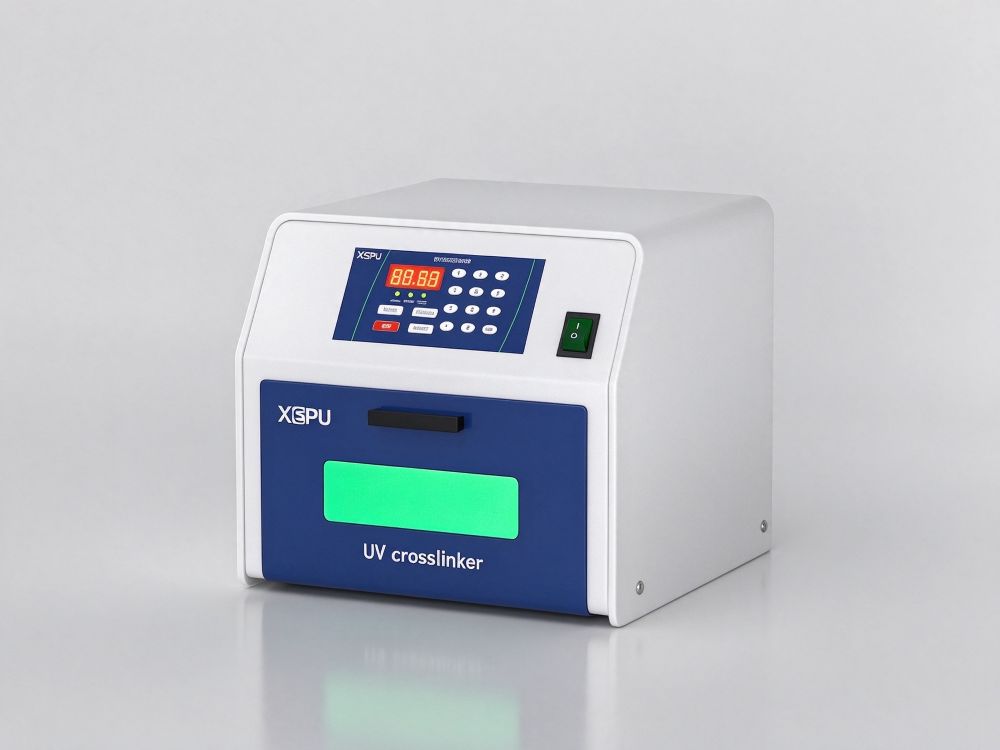
 Overview
XEPU-1208 is a compact UV crosslinker with six 8 W tubes, 254 nm standard, energy dosing and 9 presets for nucleic acid membrane crosslinking.
XEPU nucleic acid membrane crosslinking equipment. A microprocessor turns "how long it was exposed" into "how much dose it received", so tube aging and mains variation no longer change the UV energy the sample actually receives. 254 nm is the standard configuration, with 302 nm and 365 nm tubes available. (The XEPU-1208 is the 8 W compact model.)
The purpose of nucleic acid membrane crosslinking is to bind DNA/RNA covalently to a nylon membrane for later hybridization and detection. The result of this step depends on how much 254 nm energy the membrane actually receives. If you expose by time alone, tube aging and voltage variation let the real dose drift quietly, and batches stop matching.
The XEPU-1208 reduces the task to the essentials: deliver just the wavelength you need, just the dose you set, and stop when the dose is reached.
| Comparison item | Clean bench UV lamp | Manual timing | XEPU-1208 |
|---|---|---|---|
| Dose metering | None | None | Microprocessor integration, stops at the set dose |
| When tubes age | Actual dose falls with no indication | Same | Exposure is extended automatically |
| Wavelength | Fixed 254 nm | Fixed | 254 / 302 / 365 nm interchangeable |
| Sample capacity | No defined sample position | Depends on the operator | 32×26×15 cm chamber, multiple membranes |
| Safety | Exposure risk depends on habits | Same | Curtain window plus safety interlock |
Microprocessor control provides three switchable operating modes. The core difference is what you set and what the instrument compensates for.
| Comparison item | Time mode | Energy mode (recommended for crosslinking) |
|---|---|---|
| What you set | Exposure duration | Accumulated dose (J) |
| When tubes age | Actual dose falls, with no external sign | Exposure is extended, dose unchanged |
| Comparability of results | Conditions must be re-established after a tube or unit change | Dose can be recorded and compared directly |
| Typical use | When a fixed duration from the literature must be matched | Any nucleic acid crosslinking that depends on dose |
How it works: an internal UV sensor monitors intensity in real time and the microprocessor integrates the remaining energy from it. This is not an estimate of brightness multiplied by time; it is integration of the value measured inside the chamber, so intensity loss from tube aging or chamber contamination is compensated automatically.
| Parameter | XEPU-1208 |
|---|---|
| Model | XEPU-1208 (standard 254 nm; 302 / 365 nm tubes available) |
| UV wavelength | 254 nm (302 nm and 365 nm available) |
| Tubes | 6 × 8 W UV tubes |
| Operating modes | Time / energy / preset (9 preset energy values) |
| Time mode | 00.00–99.59 min, or 000.0–599.5 min |
| Energy mode | 0.000–9.999 J, or 0.00–99.99 J |
| Preset mode | 9 common radiant energy values |
| External dimensions | 34×35×31 cm |
| Chamber dimensions | 32×26×15 cm |
| Weight | About 10 kg |
| Power | 100–240 VAC, 50 / 60 Hz |
| Start time | Under 1 second |
| Chamber material | Mirror-finish stainless steel plus aluminum diffuser |
| Safety design | UV-blocking curtain window plus internal safety interlock |
| End of cycle | Buzzer at the end of crosslinking, automatic standby |
Southern/Northern/Dot/Slot blot work binds DNA/RNA covalently to nylon membranes and improves the stability of the hybridization signal, which is the common use of a crosslinker.
UV crosslinking and fixation of nucleic acid-protein complexes for mobility shift analysis, confirming that a transcription factor binds its target sequence.
Sample crosslinking and fixation for CLIP-seq, iCLIP, PAR-CLIP, pBpa, and photochemical crosslinking experiments, capturing transient interactions.
UV inactivation of bacteria, fungi, and viruses to validate disinfection and aseptic processes and to assess the microbial load on material surfaces.
Crosslinking and setting of photocurable materials such as hydrogels and acrylate resins, with exposure defined by energy so cure level can be compared between formulations.
Aging and stability assessment of materials or products at a defined UV dose, for screening and batch verification.
What we provide goes beyond the instrument. Tell us the experimental requirements (sample type, membrane format, planned crosslinking energy, detection method) and we can help confirm the wavelength and starting exposure conditions. The instrument is in stock in Shanghai, and accessories and consumables can be ordered for the long term.
The XEPU-1208 uses a microprocessor to monitor 254 nm intensity inside the chamber in real time and integrate it, stopping automatically at the set energy, so the dose is unaffected by tube aging. A clean bench germicidal lamp falls in intensity as the tube ages and has no metering; it can sterilize but cannot serve as a quantitative crosslinking source.
An internal UV sensor monitors intensity in real time and the microprocessor integrates the remaining energy from it, stopping when the accumulated value reaches the set point. Intensity changes from tube aging, supply variation, or chamber contamination are compensated automatically, so recorded doses can be compared and reproduced.
254 nm is common for nucleic acid membrane crosslinking and PCR contamination control. 302 nm suits protein-nucleic acid crosslinking or work that needs longer-wave penetration. 365 nm suits photochemical crosslinking systems that respond to longer wavelengths. Tell us the application before ordering and we will help confirm the configuration.
Wherever the conclusion depends on how much dose was delivered, prefer energy mode, which removes the effect of tube aging and voltage variation. To match a fixed duration reported in the literature, use time mode. Both are switched with the front-panel keys.
The chamber measures 32×26×15 cm, so several transfer membranes or mid-size Petri dishes can lie flat inside. The exact number depends on vessel shape and placement; avoid stacking samples where one shades another.
No. In energy mode the instrument integrates the intensity measured inside the chamber, so tube decay is compensated and recorded doses stay consistent. Rechecking chamber intensity once as the tubes approach end of life is still recommended.
Not for routine crosslinking, because the dose is closed-loop controlled by the internal sensor. If your laboratory has separate metrology or periodic-check requirements, an optional UV radiometer can be added for regular comparison.
The unit has a UV-blocking curtain window and an internal safety interlock that cuts the UV source when the door opens, so the operator and people nearby are not exposed to UV. That makes it a better fit for daily laboratory use than an open UV source.
No. Switch on, set the parameters, and run; start time is under 1 second. Because the dose accumulates from the energy measured inside the chamber, short-term intensity variation does not change the delivered dose.
Yes. The XEPU-1208 ships with 254 nm as standard and can be fitted with 302 nm or 365 nm tubes for different crosslinking and photochemistry needs, including configurations built around a specific protocol.
Nucleic acid membrane crosslinking commonly uses 0.1–0.2 J/cm² (100–200 mJ/cm²), subject to the membrane supplier's instructions and the published protocol. The instrument accepts energy settings from 0.000 to 99.99 J and provides 9 preset values for direct recall.
The instrument is supplied from stock in Shanghai, with installation guidance and help setting parameters; tubes and other consumables are available for the long term. If a protocol needs a different wavelength, preset, or special vessel adaptation, contact us to confirm customization and lead time.
Send inquiry

Email: info@xinysun.com

Tel: 131-2093-6518

Address: 1525 Minqiang Road, Bldg 26, Songjiang, Shanghai

Copyright 2026 Xinysun Instrument (Shanghai) Co., Ltd. All rights reserved.
ICP:ICP-2026046447




 Products
 Applications
 Previous:
 Back to list

 Industrial Test Instruments


