Products
PRODUCTS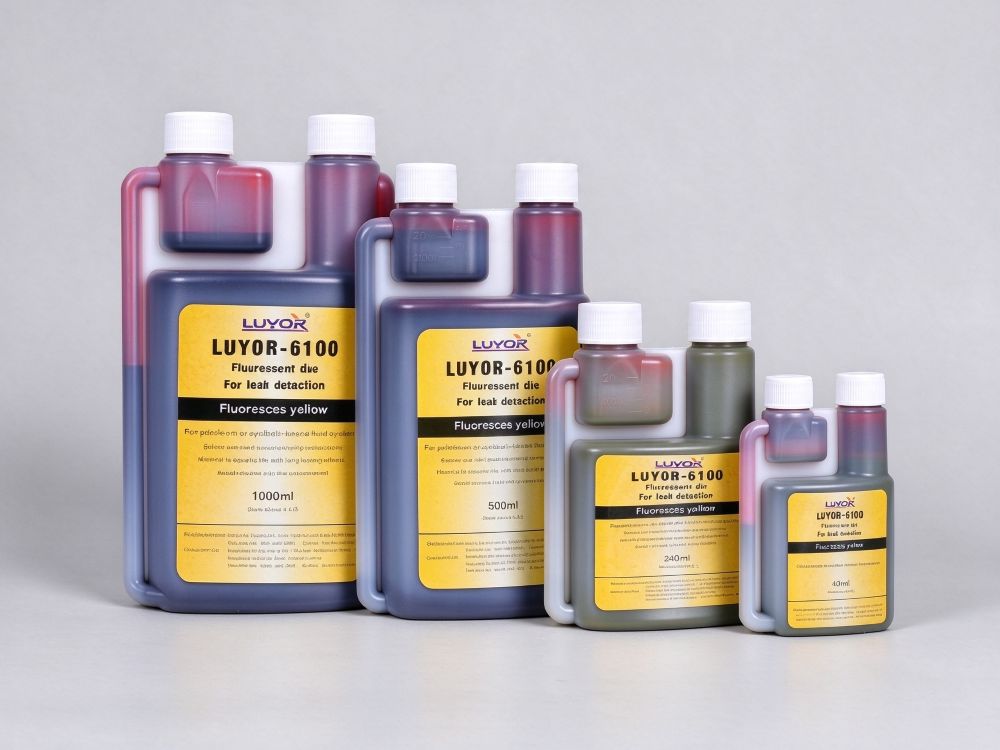
 Overview
LUYOR-6100 is an oil-soluble dye for engine, hydraulic and fuel systems, dosed at 0.5-2.5 ml per liter and read as yellow-white light under 365 nm UV.
LUYOR-6100 is a concentrated solvent dye that carries Solvent Red 175 fluorescent dye in a highly active hydrogenated naphthenic solvent system. The product is a dark liquid and mixes readily with most petroleum products and organic solvents. When a small amount is added to engine oil, fuel, or hydraulic oil, the dye circulates with the medium into every part of the system. Wherever a leak exists, the dye seeps out with the medium and emits bright yellow-white fluorescence under 365nm UV light.
Its place in the range matters: this is a product for oil-phase systems. It dissolves completely in petroleum products and does not dissolve in water. Use it in engine lubrication systems, hydraulic systems, fuel systems, transmissions, and industrial oil circuits. It must not be used in water systems - for those, choose the water-based LUYOR-6200 or LUYOR-6300.
The dye stays in the system for a long period and can be used repeatedly, with no scheduled replacement and no flushing after the inspection. That helps planned maintenance: after a leak is repaired, one more pass with the lamp confirms the repair without a second dose.
The hard part of an oil leak is never the repair. It is the search. Pinholes in welds, seeping fittings, and aged seals leave stains a few millimeters across, and once sludge and dust cover them the eye has little to work with. Pressure testing with compressed air and soap solution requires a shutdown and pipe removal, which is costly on equipment in service.
Fluorescence turns "where is the leak" into a question that one pass of the lamp answers:
No dismantling - the dye travels with the oil and seeps out where the leak is, so anything visible from outside can be checked.
No need to stop the machine - in normal operation the dye dissolves fully and reaches the circuit within 5-10 minutes.
Small leaks show up - even a very low seepage rate that has not yet formed a droplet leaves a clear fluorescent spot.
Distinct from the oil's own glow - most oils show a weak blue natural fluorescence under UV, while LUYOR-6100 emits a strong yellow-white, so the two are not confused.
Compared with visual inspection, pressure testing, and soap solution testing, fluorescence offers advantages in cost, speed, and the range of leaks it can cover. It suits construction machinery, fleets, and production lines, where long shutdowns are inconvenient.
| Item | Specification | Notes |
|---|---|---|
| Product model | LUYOR-6100 | Oil-soluble fluorescent leak detection dye, LUYOR |
| Dye type | Solvent Red 175 concentrated solvent dye | Highly active hydrogenated naphthenic solvent system |
| Appearance | Dark liquid | Treated oil appears orange or red in daylight |
| Fluorescence color | Yellow-white | Clear contrast against the oil's natural blue glow |
| Excitation peak | 494 ± 5 nm | Measured in hexane |
| Emission peak | 535 ± 5 nm | Measured in hexane |
| Lamp wavelength | 365 nm | Use with the LUYOR-365L or another high-intensity black light |
| Typical dose | 0.5-2.5 ml per liter of oil | About 500-2500 ppm; see the dosing table |
| Solubility in petroleum products | Complete | No sediment, including after long standing |
| Solubility in water | Insoluble | Use a water-based grade for water systems |
| Density at 20°C | Approx. 0.91 | Typical value, not an acceptance criterion |
| Flash point | >85°C (ASTM D-3278) | Not classified as a harmful or flammable chemical |
| Dissolution time | 5-10 minutes in operation; 2-3 hours at rest | Depends on the oil and the working temperature |
The values above are typical physical properties and do not replace the product data sheet. If your acceptance document sets a limit on any parameter, ask us for the specification of the relevant batch.
| Order code | Package | Suited to |
|---|---|---|
| LUYOR-6100-00030 | 1 × 30 ml bottle | Single small machine, prototype trials, service vehicle stock |
| LUYOR-6100-00100 | 1 × 100 ml bottle | Rotating checks across several machines, repair shop stock |
| LUYOR-6100-00240 | 1 × 240 ml bottle | Batch dosing for gensets and production lines |
| LUYOR-6100-00500 | 1 × 500 ml bottle | Large systems, workshop-wide surveys |
| LUYOR-6100-04000 | 1 × 4 L plastic pail | Cyclic dosing on a production line, fleet maintenance |
| LUYOR-6100-18000 | 1 × 18 L steel drum | Central fluid supply in large plants, long-term planned maintenance |
The table below gives the manufacturer's recommended starting points. The exact dose depends on the color strength you want and on the background color of the system. The oil type, biodegradable oils in particular, also affects the result, so adjust within the recommended range.
| System type | Recommended dose | Notes |
|---|---|---|
| Hydraulic transmission fluid | 500-2000 ppm | Mineral oil, synthetic oil, and most biodegradable oils |
| Automotive engine oil | 500 ppm | Synthetic and mineral oils |
| Diesel engine oil | 700-2000 ppm | Use the upper end under heavy-duty conditions |
| Fuel | 700 ppm | Diesel and other fuel oils |
Conversion: ppm is by volume, and 500 ppm equals about 0.5 ml per liter of oil. A 200 L hydraulic reservoir at 1000 ppm takes about 100 ml, which is one 100 ml bottle.
Passenger cars, heavy trucks, and locomotives; synthetic and mineral oils both apply.
Mineral oil, synthetic oil, and several biodegradable oils, for construction machinery and machine tool hydraulic stations.
Diesel and other fuel oils; leaks in tanks, fuel lines, and injection return circuits.
Manual transmissions, automatic transmissions, and differential gearboxes.
Tractors and agricultural loaders; a preliminary screening can be done in the field.
Hydraulic and drive systems on forklifts, loaders, cranes, and excavators.
Beyond these, any closed circulating system whose medium is an oil can use the dye: turbine power systems, pneumatic systems, industrial piping, and leak checks on industrial valves and connections.
With an engine there are two options: premix the engine oil and the dye before the test run and add the mixture, or add the dye straight to the sump once the oil is in the engine. Hydraulic systems work the same way, either premixed before the test or added directly after the hydraulic oil is in the reservoir.
In normal operation the dye dissolves fully and reaches every leak path within about 5-10 minutes. If the system sits idle, allow about 2-3 hours. The time depends on the oil and the working temperature.
Examine the test area with a LUYOR-365L high-intensity fluorescent lamp (365nm). Leak points show strong yellow-white fluorescence. The darker the ambient light, the stronger the contrast and the easier the reading. Mark each fluorescent spot, then inspect again after the repair to confirm the result.
Use color differences to rule out false readings: under UV light, fuel and other oils give a natural blue glow, paper appears white, and some sealants appear green, while LUYOR-6100 is a clear yellow fluorescence that is easy to identify. Because the blue glow varies widely between oil types, the right dose depends on the oil you actually use.
| Contact material | Compatibility | Notes |
|---|---|---|
| Fluoroelastomer, PTFE, and perfluoroelastomer seals | Suitable | These seal types are recommended when pumping the concentrated dye |
| Nitrile and butyl synthetic rubber, after dilution in oil | Suitable | Safe for both rubber types once diluted |
| Water, glycol | Not suitable | Do not add to water systems; it will contaminate the system |
| Oil performance | No effect | At normal dose, no effect on lubricating or hydraulic oil |
| Oils that already contain a visible dye | Can be used | Does not conflict with the existing colorant |
Before dosing, confirm that the fluid in the system is an oil-soluble oil. If the system holds water or glycol, adding LUYOR-6100 contaminates it, and a water-based grade should be used instead. Handle the product according to its MSDS (Material Safety Data Sheet); under the relevant regulations and standards it is not classified as a harmful or flammable chemical.
To remove dye marks from machine surfaces later, wipe with a chlorinated solvent, a suitable metal cleaner, or paraffin oil, or use LUYOR-6900 cleaner. The marks come off easily with a wipe.
LUYOR-6100, 6200, and 6300 in the same range do not overlap. Start with whether the medium is oil or water, which settles most cases, then look at fluorescence color preference and system size.
| Model | Base | Fluorescence color | Suited to |
|---|---|---|---|
| LUYOR-6100 | Oil-soluble | Yellow-white | Engine oil, hydraulic oil, fuel, transmissions, and other oil-phase closed circuits |
| LUYOR-6200 | Water-based | Green | Leaks and flow tracing in boilers, heaters, pumps, irrigation systems, tanks, and piping, especially where high-contrast green is needed |
| LUYOR-6300 | Water-based | Blue | Where blue does not clash with existing color in the water system, and for telling parallel lines apart; 500 ml treats 3000 liters of water |
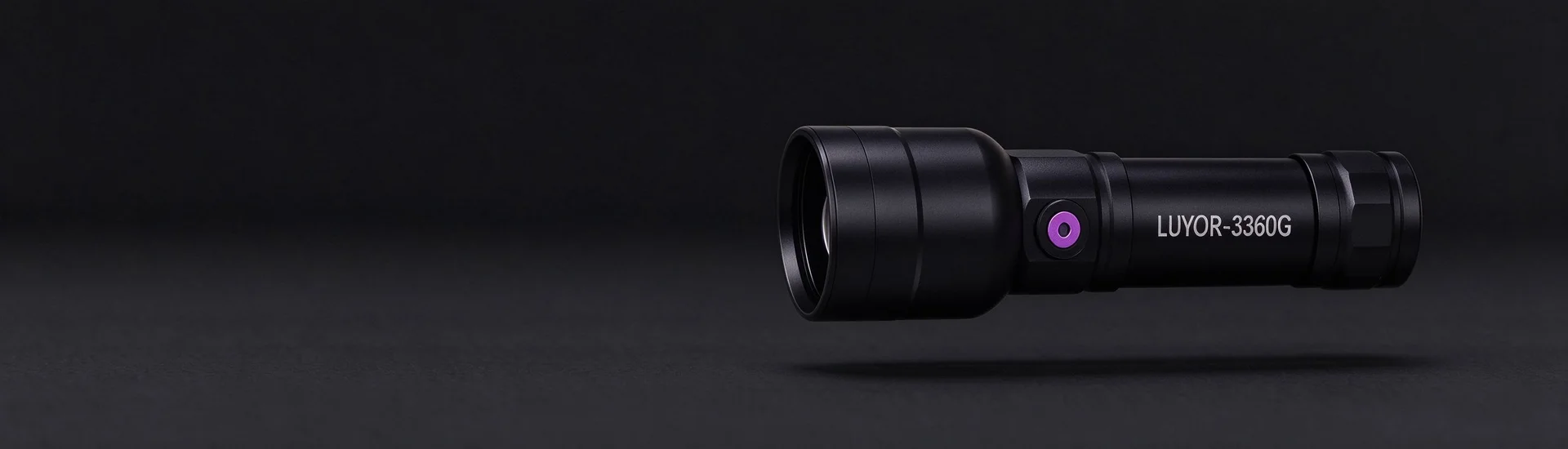
Choosing a lamp: a standard UV flashlight suits small spot checks. For long pipe runs and whole machines, use the LUYOR-365L wide-area fluorescent leak detection flashlight, with about 200 mm of effective coverage at 38 cm and battery power so no cable has to be dragged.
No. LUYOR-6100 is a concentrated solvent dye carrying a specific fluorescent dye in a highly active hydrogenated naphthenic solvent system. It mixes readily with most petroleum and organic products and does not harm the performance of the fluid or the system components. At normal dose it has no effect on lubricating or hydraulic oil performance.
No stirring is needed. The dye dissolves readily: about 5-10 minutes with the system running normally, or about 2-3 hours if the system sits idle. The time depends on the oil and the working temperature, and it may be longer when the oil is cold.
Neither is needed. The dye stays in the system for a long period, supports repeated checks of repaired areas, and needs no scheduled replacement. No flushing is needed after the inspection. If fresh oil is added to a sump or tank, top up the dye in proportion.
No. The product has high solubility and does not form sediment even after long standing, which is what allows it to stay in the system for repeated use.
The dye is still in the system, so inspect the area again: if the yellow-white fluorescence no longer appears at the original spot, the leak is gone. This is why fluorescent leak detection fits planned, preventive maintenance: low cost, repeatable, and the result is visible.
Most oils do show a natural blue fluorescence, paper appears white, and some sealants appear green. LUYOR-6100 emits a strong yellow fluorescence that contrasts clearly with these backgrounds and is easy to tell apart. If the dose is too low and contrast is weak, increase it within the recommended range.
Wipe with a chlorinated solvent, a suitable metal cleaner, or paraffin oil, or use LUYOR-6900 cleaner. Cleaning covers surface marks; the dye inside the system needs no treatment.
Price depends on the pack size and the accessories ordered, such as whether a LUYOR-365L lamp, safety glasses, and cleaner are included. Send us the system type, the oil, and the total volume through the form on this page or by phone, and we will calculate the quantity from the recommended dose and quote the configuration. Stock is held in Shanghai, and an on-site demonstration can be arranged.
LUYOR-6100 product data and typical properties table
MSDS (Material Safety Data Sheet)
Guide to Adding Fluorescent Leak Detection Dye
Dosing table calculated from system volume
Comparison notes for the water-based LUYOR-6200 and 6300
Selection chart for matching black lights
Dose calculation from medium, oil, and system volume
Oil-phase versus water-phase selection
Selection of a matching 365nm lamp and safety glasses
Troubleshooting when no leak is found
Surface residue removal and re-inspection methods
Volume and project quotations, lead time confirmation
Send inquiry

Email: info@xinysun.com

Tel: 131-2093-6518

Address: 1525 Minqiang Road, Bldg 26, Songjiang, Shanghai

Copyright 2026 Xinysun Instrument (Shanghai) Co., Ltd. All rights reserved.
ICP:ICP-2026046447




 Breadcrumb:
 Products
 Applications
 Previous:
 Back to list

 Industrial Test Instruments


