
Products
PRODUCTS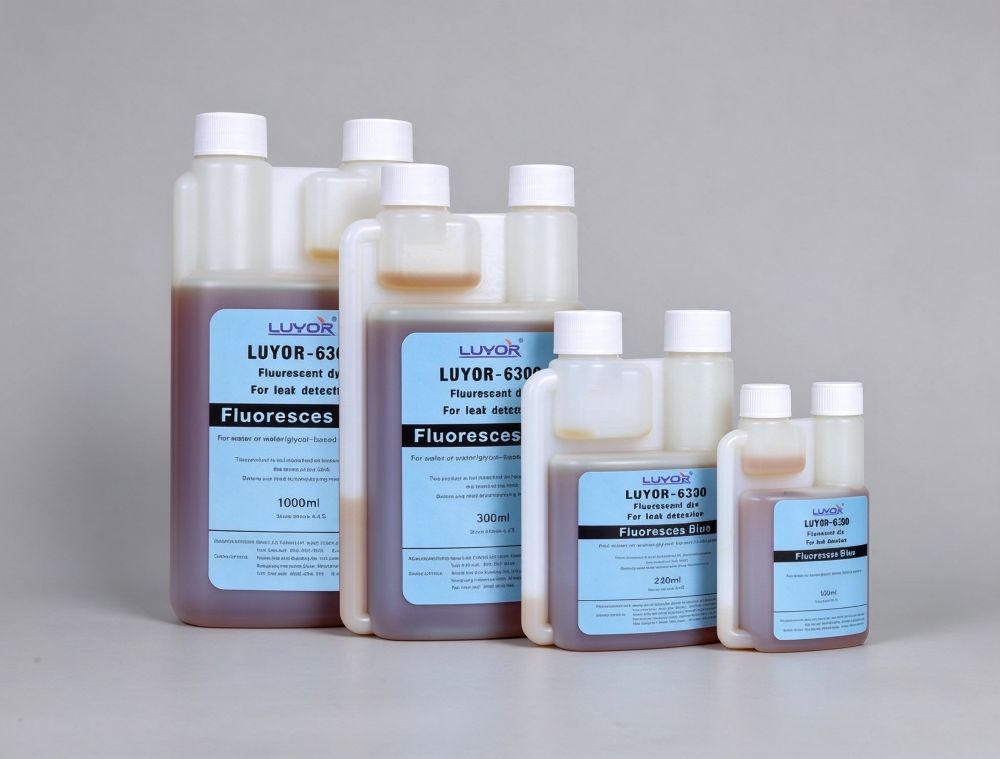
 Overview
LUYOR-6300 is a water-based blue dye for boilers, pumps, sprinkler lines and tanks; 500 ml treats about 3000 liters in static or moving water.
LUYOR-6300 is a water-based fluorescent tracer designed for leak detection and flow tracing in water systems. Add the dye to the system, let it mix with the water, then inspect the area of interest under a UV lamp. Where a leak exists, water carrying the dye seeps out and emits bright blue fluorescence under UV light, so the leak point is visible to the eye.
It covers almost the same systems as LUYOR-6200 in the same range: both work in static or circulating water systems and cover boilers, heaters, pumps, sprinkler systems, storage tanks, piping, and the associated connections. The real difference is fluorescence color: 6300 emits blue, 6200 emits green. Choosing between them is, in practice, choosing a color.
It goes a long way on volume. The manufacturer's economy figure is 500 ml of dye for 3000 liters of water. For pools, storage tanks, and circulating water circuits with a large water body, that dilution capacity means one purchase covers a substantial inspection job.
Fluorescence color does not change how leak detection works, but it does make a practical difference on site. These cases favor 6300:
Separation from green fluorescence - if green tracer has already been used in the same workshop or system, or materials with their own green fluorescence are present (some sealants, cleaning agent residue, algae, and cooling water additives), blue avoids confusion.
Zone marking on parallel lines - when several pipes in one project have to be traced, inject blue and green alternately into different sources and one pass of the lamp shows which line comes from where.
Reading habits on site - blue fluorescence contrasts more clearly on some backgrounds, such as rust and yellow-brown deposits, while green stands out better on dark metal. Which one reads better depends on the surface color.
Existing procedures - if the user's tracer management procedure already assigns blue tracer to a class of piping, following it avoids rewriting the procedure.
If none of these apply, 6200 and 6300 perform the same, and the choice comes down to stock and budget.
| Item | Specification | Notes |
|---|---|---|
| Product model | LUYOR-6300 | Water-based fluorescent leak detection dye, LUYOR |
| Base type | Water-based | Used mixed with water |
| Fluorescence color | Blue | LUYOR-6200 in the same range is green |
| Excitation source | 365nm high-intensity UV lamp | LUYOR-365L fluorescent leak detection flashlight recommended |
| Dilution capacity | 500 ml covers about 3000 liters of water | About a 6000:1 level; adjust to the concentration needed |
| System type | Static or circulating water systems | New and existing systems |
| Typical uses | Leak detection, flow testing, invisible marking, weld and seal inspection | Also used for tracing pipe routes |
| After the test | Rinse with clean water | No special cleaning agent needed |
| Storage | Keep sealed and away from light | Mix a fresh batch if fluorescence drops |
Set the dilution from the total water volume and the fluorescence strength you need. For a large water body or a dark background, a higher concentration helps. Tell us the volume and we will calculate the quantity for you.
| Order code | Package | Suited to |
|---|---|---|
| LUYOR-6300-00030 | 30 ml plastic bottle | Small systems, single low-volume checks, and trials |
| LUYOR-6300-00240 | 240 ml twin-neck bottle | Medium circulating water systems; the twin-neck bottle has a graduated measuring chamber |
| LUYOR-6300-00500 | 500 ml twin-neck bottle | Large-volume work, covers about 3000 liters of water |
The twin-neck design makes measuring on site easier. The left side is a graduated chamber: squeeze the bottle gently and the dye passes through a tube into the chamber, and you stop at the mark you need, then pour it into the system. For a large volume, unscrew the right cap and pour directly, with no separate measuring cup.
Take the calculated volume and add it to the water in the system. Choose a point with good flow, such as near the circulating pump inlet, so the dye mixes quickly.
Run a circulating system normally so the tracer disperses evenly and enters any leak path. In a static system, natural diffusion and seepage do the work, and a longer standing time is needed.
Dim the ambient light and examine pipes, fittings, welds, and seals with a 365nm UV lamp. Leak points emit bright blue fluorescence. Mark the position, carry out the repair, then rinse with clean water.
Blue appears visually dimmer than green, so reading depends more on ambient light. Turn off the work area lighting or draw a blind, and use a dark cloth for a local dark environment when needed. Cutting ambient light usually raises the detection rate more than switching to a brighter lamp.
Leak checks on boiler shells, heaters, hot water circuits, and their connections.
Locating seal and joint leaks on circulating pumps, spray systems, and sprinkler lines.
Leak checks on welds and nozzles of storage tanks, water tanks, and jacketed vessels.
Water system leak detection on pipe bodies, flanges, threaded joints, and welded connections.
Using the tracer to judge flow direction and residence time, and to support flow path analysis.
Where positions have to be marked and traced under conditions where marks cannot be seen.
The manufacturer's list of typical uses also includes weld and seal inspection. The dye applies wherever the medium is water and a leak has to be located, or a flow direction confirmed, without a shutdown or pipe removal.
6300 is for water systems. If the system holds oil, glycol, or another non-aqueous medium, do not use it; oil-phase systems take LUYOR-6100.
At a low concentration, small leaks fluoresce weakly and can be read as no leak. Start at a higher concentration at the outset, confirm the reading, then reduce it from experience.
Store mixed solution in a container away from light when not in use. Check the solution itself under UV before reuse, and mix a fresh batch if the glow has dropped noticeably.
A water-based solution runs down surfaces and leaves a streak. The leak itself is usually at the start of the streak or where trails converge, so work upstream from there.
Wear gloves and safety glasses during handling, and avoid direct contact of the concentrate with skin or eyes. For environmental water studies or discharge applications, follow local testing and discharge regulations.
| Model | Base | Fluorescence color | Suited to |
|---|---|---|---|
| LUYOR-6100 | Oil-soluble | Yellow-white | Engine oil, hydraulic oil, fuel, transmissions, and other oil-phase closed circuits |
| LUYOR-6200 | Water-based | Green | Routine water system leak detection and flow tracing, where a bright green reads at a glance |
| LUYOR-6300 | Water-based | Blue | Where green has to be kept separate, parallel lines need zone marking, or a blue tracer procedure is already in place; 500 ml covers about 3000 liters of water |
Matching lamp: the LUYOR-365L wide-area fluorescent leak detection flashlight gives about 200 mm of effective coverage at 38cm with a center intensity of about 6500uw/cm2, runs on battery power with no cable to drag, and suits wide-area scanning of long pipe runs and large vessels. For tight spaces, add a standard UV flashlight.
The systems are almost the same. Both are water-based and both work in static or circulating water systems, covering boilers, heaters, pumps, sprinkler systems, storage tanks, piping, and the associated connections. The core difference is fluorescence color: 6300 blue, 6200 green. Selection depends on whether green has to be kept separate, whether parallel lines need zone marking, and which color reads better against the surface being inspected.
Blue is visually a little dimmer than green, but two things settle it: enough concentration and low enough ambient light. In practice, turning off the work area lighting or using a dark cloth for a local dark environment makes reading noticeably easier. If the surface being inspected is itself blue-gray, use 6200 with its stronger green.
That is the manufacturer's economy figure, corresponding to a dilution level of about 6000:1. Whether you can work at that ratio depends on the fluorescence strength you need and the background color of the system. With clean water, a light background, and clear leaks to locate, it is achievable. With turbid water, a dark background, or a search for very small leaks, raise the concentration. At the outset, start at a higher concentration, confirm the result, then reduce it.
No. 6300 is a water-based product, and oil-phase systems take LUYOR-6100. The test is whether the medium circulating in the system is water or oil.
Rinsing the pipes with clean water is enough, with no special cleaning agent. If the system is process circulating water, follow the process water change requirements; for ordinary cooling or test water, rinse until the fluorescence is no longer visible.
Yes. A static system relies on natural diffusion and seepage, so allow a longer standing time and raise the concentration. In open vessels, concentrate the lamp on welds, flanges, and nozzles below the water line.
Yes. Add 6300 to one source or inlet, then inspect the other outlets, inspection chambers, or drains under the UV lamp: blue fluorescence shows the two are connected. If green tracer is already in use on site, blue keeps the two apart.
Price depends on the pack size and the accessories ordered, such as whether a LUYOR-365L lamp and safety glasses are included. Tell us the system type, the total water volume, and the test method through the form on this page or by phone, and we will return a dose calculation, a configuration, and a quotation. Stock is held in Shanghai, and an on-site demonstration can be arranged.
LUYOR-6300 product data and dilution capacity notes
MSDS (Material Safety Data Sheet)
Illustrated guide to measuring with the twin-neck bottle
Notes on choosing blue or green fluorescence
Dosing table calculated from total water volume
Selection chart for matching black lights
Dilution and pack size calculated from water volume
Advice on choosing blue or green tracer
Zone marking plans for parallel lines
Matching 365nm lamp and irradiance verification
Reading technique at low concentration
Volume and project quotations, lead time confirmation
Send inquiry

Email: info@xinysun.com

Tel: 131-2093-6518

Address: 1525 Minqiang Road, Bldg 26, Songjiang, Shanghai

Copyright 2026 Xinysun Instrument (Shanghai) Co., Ltd. All rights reserved.
ICP:ICP-2026046447




 Breadcrumb:
 Products
 Applications
 Previous:
 Back to list

 Industrial Test Instruments


