Products
PRODUCTS Breadcrumb: Home > Products > Life Science Instruments > Laboratory UV Lamps
 Overview
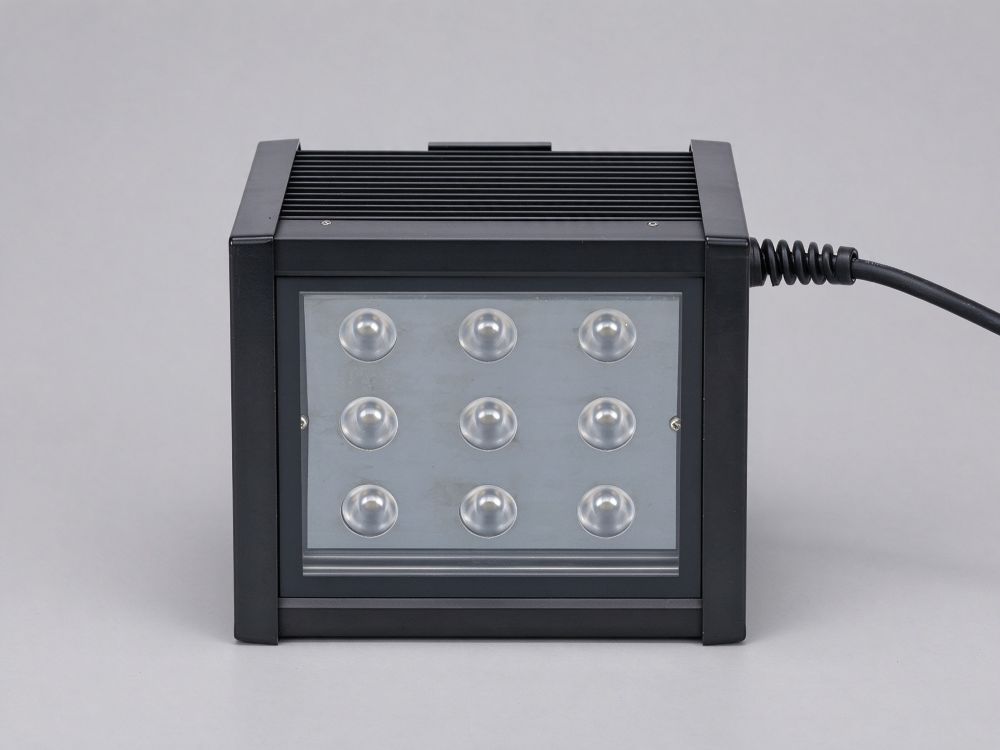
LUYOR-3109 is a benchtop 365 nm LED lamp giving 9000 uW/cm2 at 38 cm over a 250 x 250 mm spot, with no infrared heat and 24-hour operation.
In photocatalysis, photopolymerisation, and photodegradation, a light source has to do more than stay lit. Three conditions have to hold before it can be relied on:
The wavelength has to match.365 nm is the working band for most photoinitiators and semiconductor photocatalysts (modified TiO₂ systems, g-C₃N₄, and others). Visible and infrared light that a broad-spectrum lamp mixes in contributes nothing to the reaction and brings side reactions and heating with it.
The irradiance has to be stable and adequate.Reaction rate tracks light intensity directly. If output drifts with tube ageing or ambient temperature, the same set of conditions cannot be compared across batches.
The system must not be heated.Many photochemical reactions run at room temperature or below. A mercury lamp placed close by can raise the temperature inside the reaction vessel by more than ten degrees, and both yield and selectivity shift.
LUYOR-3109 is built to those three conditions: 9 × 365 nm high-power LEDs behind a quartz lens, 9000 μW/cm² at 38 cm over a 250×250 mm spot; a cool source with no infrared, body temperature about 50℃; instant on, with 24-hour continuous operation.
| Item | Specification |
|---|---|
| Model | LUYOR-3109 |
| UV source | 9 × high-power UV-A LED (365 nm) |
| Optics | Quartz lens focusing, square even spot |
| UV intensity at 38 cm | 9000 μW/cm² |
| Spot size at 38 cm | 250 × 250 mm |
| Equivalent replacement | Approximately equivalent to a 400 W high-pressure mercury lamp for photocatalytic work |
| Source life | LED, approx. 50000 hours |
| Operating mode | Instant on, 24-hour continuous irradiation |
| Beam direction | Lamp head direction adjustable |
| Body temperature | Approx. 50℃ in continuous operation |
| Ingress protection | IP67 |
| Dimensions | 113 × 85 × 110 mm |
| Power supply | 24 V DC (with adapter) or 220 V AC |
| Housing | Extruded aluminium profile, rapid heat dissipation |
The phrase "equivalent to a 400 W high-pressure mercury lamp" refers to comparable irradiation effect on a photocatalytic reaction, not equal power. A large share of a mercury lamp's rated power leaves as heat and visible light, and the UV band that actually drives the reaction is a small fraction of it. An LED concentrates its electrical input at 365 nm, so lower power can produce the same reaction efficiency.
The main difference between the sources in this category is not the intensity figure but spot shape and uniformity. The 3109 produces a square spot, 250×250 mm at 38 cm, with the intensity difference from centre to edge held within an acceptable range. That matters in experiments that irradiate several replicates at once, because every sample has to receive the same dose for the results to be comparable.
| Placement | Irradiance and coverage | Use |
|---|---|---|
| 38 cm from the sample (rated position) | 9000 μW/cm², covering 250×250 mm | Multiwell plates, several dishes, or a small reactor array at one time |
| About 25 cm from the sample | Irradiance about twice the rated value, coverage narrowed to about 165×165 mm | A single large reaction vessel, or systems needing higher photon flux |
| More than 50 cm from the sample | Irradiance reduced, coverage extended beyond 300 mm | Large vessels or samples needing gentler irradiation; recalculate the dose |
| Side irradiation | Lamp head angled to throw light onto the side of the vessel | Avoiding obstruction, observing changes inside the reaction liquid |
Two practical rules for placement. Fix one distance for a batch and record it; do not adjust it by feel each time. Do not stack samples - no spot is even enough to pass through them, and multiwell plates should sit in a single layer inside the spot.
Many photocatalytic rigs in laboratories date from the mercury lamp era. Moving to LED changes more than the electricity bill:
| Comparison | LUYOR-3109 (LED) | High-pressure mercury lamp |
|---|---|---|
| Warm-up | Instant on, full output within seconds | 5 to 10 minutes of warm-up; after a shutdown it must cool before restart |
| Thermal radiation | Cool source, body at about 50℃, negligible infrared | Very hot body; the vessel needs a water jacket or a heat filter |
| Spectrum | Narrow band at 365 nm, no stray visible or infrared | Broad and continuous, with a great deal of visible and infrared light; an added filter is needed |
| Life | Approx. 50000 hours, essentially no replacement | Approx. 500 to 1000 hours, with replacements logged by the hour |
| Output decay | Slow and stable over the long term | Falls markedly with operating hours, so conditions drift |
| Safety | No high voltage, no ozone (depending on lamp type) | High voltage, high temperature, and ozone from some bands, so extraction is needed |
| Size and installation | 113×85×110 mm, sits directly on the bench | Needs a dedicated housing, ballast, and ventilation |
One point is often overlooked when changing sources: after a mercury lamp is replaced by an LED, the same irradiation time no longer gives the same dose. Carrying the old time parameters over will make results inconsistent. Measure once with a UV radiometer after the change, and recalibrate the exposure time from the dose.
Continuous duty is one of the more frequent questions about this class of equipment. Three things carry the 3109 through long runs:
Extruded aluminium housing.A solid aluminium body acts as the heat sink, with thermal resistance an order of magnitude lower than a plastic or thin steel shell, which keeps the LED junction temperature inside the safe range.
Fanless passive cooling.With no moving parts there is no fan to fail and no fan to blow dust into the optical cavity, and no airflow disturbance either - an unobtrusive advantage for reaction systems that must sit still.
The LED lifetime curve.LEDs degrade gradually rather than failing abruptly; over the 50000-hour design life the output declines slowly, and the lamp does not go dark one day the way a tube can. Even so, measure irradiance periodically and treat the decline as part of the experimental conditions.
The IP67 rating brings an extra convenience: a spill on the bench, or a need to wipe the whole unit down, calls for no particular care. In a working environment with culture media and organic solvents, that counts for more than it appears to on a specification sheet.
| Field | Key practice |
|---|---|
| Photocatalytic degradation | Place the reaction vessel at the centre of the spot, stir magnetically to keep the catalyst suspended, set the irradiation time from the target dose, and sample at intervals for concentration |
| Photoinitiated polymerisation | Fill a transparent vessel with monomer and photoinitiator, set the distance from the initiator absorption, and keep the vessel wall from blocking 365 nm (ordinary glass absorbs part of the UV, so quartz is preferred) |
| Water splitting and hydrogen evolution | Seal the reactor and exclude oxygen, irradiate from the side or above, and rely on the cool source to avoid temperature swings that affect gas solubility |
| Photochemical organic synthesis | For small volumes, use a 25 cm distance to raise photon flux; for several replicates, use the rated 38 cm position to keep conditions identical |
| Material ageing and light stability testing | Irradiate for several days, log accumulated time and irradiance, and rotate samples periodically for even exposure |
| Excitation source for fluorescence work | Used where a large, evenly excited area is needed; coverage is greater than a handheld lamp provides |
Operating note: 365 nm is UV-A, less hazardous than shortwave, but prolonged direct viewing and skin exposure still carry risk. Keep out of the beam while the lamp is on, and wear UV protective glasses when you need to look. Do not substitute an ordinary glass sheet for a vessel lid or shield - ordinary glass absorbs a substantial part of the 365 nm output.
For irradiation effect on a photocatalytic reaction the two are broadly comparable, which is the manufacturer's equivalence claim. What "equivalent" means here is the useful UV photon flux reaching the sample, not electrical power. A substantial share of a mercury lamp's input becomes heat and visible light, while the 3109 concentrates its output at 365 nm. For a real comparison, measure at the working position with a UV radiometer.
Because 9 LEDs behind a quartz lens form a rectangular, even irradiation area of 250×250 mm. A square matches the layout of multiwell plates, plate racks, and rectangular vessels better than a circle, so the corners are not wasted.
Quartz is advisable. Transmission of ordinary borosilicate glass at 365 nm drops noticeably, and the loss grows with wall thickness. If the experiment uses ordinary glass vessels, the dose reaching the system is below the rated figure and should be confirmed by measurement.
No. 50℃ is the housing temperature, and no infrared radiation is directed at the sample, so the temperature rise inside the spot is far smaller than under a mercury lamp. For temperature-sensitive reactions, a temperature-controlled holder or logged ambient temperature is still advisable.
The unit is dust-tight and works after brief immersion, so everyday splashes and bench wiping are no problem. Prolonged immersion of the connectors and cable plugs is not advised; wipe dry before storage.
For a fixed station, area irradiation, and long continuous runs, take the 3109; to carry the lamp to the sample for local high-intensity work, take the 3410. Both are 365 nm cool sources, and the difference is form factor and coverage.
For photocatalytic work, tell us four things - the reaction system and volume, the light intensity required, the vessel material, and the length of a continuous run - and we can check the model, the working distance, and whether a custom stand is needed.
Send inquiry

Email: info@xinysun.com

Tel: 131-2093-6518

Address: 1525 Minqiang Road, Bldg 26, Songjiang, Shanghai

Copyright 2026 Xinysun Instrument (Shanghai) Co., Ltd. All rights reserved.
ICP:ICP-2026046447




 Products
 Applications
 Previous:
 Back to list

 Industrial Test Instruments


