
Products
PRODUCTS Breadcrumb: Home > Products > Life Science Instruments > Laboratory UV Lamps
 Overview
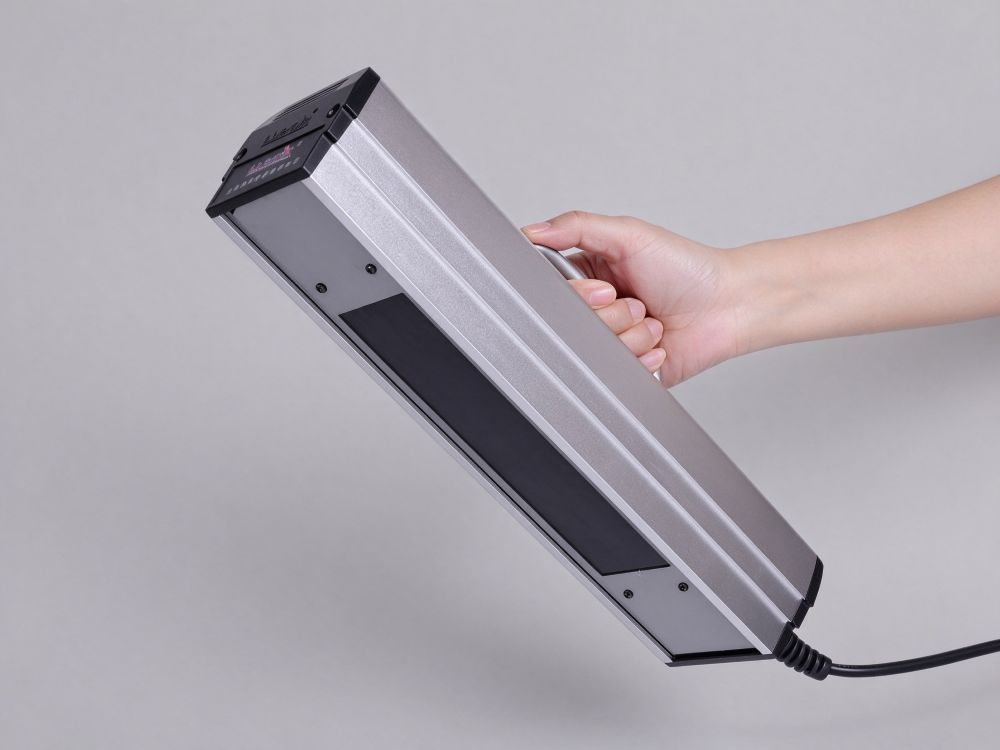
LEAC-280L combines 254 nm and 365 nm tubes in one 8 W handheld housing with independent switches, for fluorescence viewing, forensics and surface checks.
In field work such as fluorescence inspection, conservation of cultural objects, forensic evidence examination, and verification of disinfection, you often need to move back and forth between two wavelengths: 365 nm longwave to see the natural fluorescence of a material (adhesives, repair marks, body fluids, minerals), then 254 nm shortwave for absorption contrast or surface disinfection. Carrying two lamps means weight, time lost to swapping, and a real chance of leaving one behind.
LEAC-280L takes a direct approach: two tubes side by side in a horizontal housing, each with its own switch. Run the band you need, without both lit and the spectra confusing the reading. The tubes are quartz, with a pure UV filter at the front that removes visible light, so the output is largely UV and the background is cleaner when viewing fluorescence.
It belongs to the LE series of dual-wavelength handheld lamps, which also covers 260 mm and 280 mm lengths and other band combinations.
LEAC-280L is the 280 mm class, longwave plus shortwave version, with a filter. The letters in the model code give the band combination, and the trailing L means the filter is fitted - an easy detail to miss when ordering.
| Item | Specification |
|---|---|
| Model | LEAC-280L |
| Wavelength configuration | Longwave 365 nm × 1 + shortwave 254 nm × 1 |
| Tube power | 8 W × 2 (365 nm 8 W × 1 + 254 nm 8 W × 1, 16 W in total) |
| Tube material | Quartz |
| Optics | Pure UV filter + aluminium reflector |
| Dimensions | Approx. 337 × 83 × 64 mm (280 class) |
| Filter size | Approx. 260 × 50 mm |
| Weight | Approx. 1 kg |
| Switching | Independent 254 nm and 365 nm switches, not to be run together |
| Power supply | 24 V adapter, or internal Li-ion battery (battery version) |
| Tube replacement interval | Every 12 months or 1000 cumulative hours |
| Standard accessory | LUV-10 UV protective glasses |
On running both bands together: the restriction comes from the power supply and thermal design, and it also keeps the two spectra from adding up and disturbing the reading. In practice the sequence is longwave for fluorescence, then shortwave for absorption or disinfection, so the work is stepwise in any case and throughput is unaffected.
The series has many variants and they are easy to confuse. The code breaks into three parts: the two leading letters give the band combination, the middle number gives the tube length, and the trailing L means a filter is fitted.
| Band code | Meaning | Typical use |
|---|---|---|
| AB | Longwave 365 nm + midwave 312 nm | Biology work that needs midwave excitation without shortwave |
| AC | Longwave 365 nm + shortwave 254 nm | Fluorescence inspection plus disinfection verification, a common combination |
| BC | Midwave 312 nm + shortwave 254 nm | Nucleic acid work and surface disinfection |
| Length code | Tube configuration | Body length |
|---|---|---|
| 260 | 6 W × 2 (one 365 nm tube + one 254 nm tube) | Approx. 260 mm |
| 280 | 8 W × 2 (one 365 nm tube + one 254 nm tube) | Approx. 337 mm |
So LEAC-280L = longwave + shortwave / 28 cm tube / filter fitted. Where budget is tighter and stray visible light is not a concern, the version without the L (LEAC-280) will serve, but the background is brighter when viewing fluorescence and weak signals are harder to pick out.
These two are often compared side by side. Their band configuration is the same: one 365 nm longwave tube plus one 254 nm shortwave tube, a pure UV filter on both, independent switches, and either a 24 V adapter or an internal Li-ion battery. The real difference lies in one place - tube length and per-tube power: the 280 takes two 8 W tubes, the 260 takes two 6 W tubes - and everything else follows from it.
| Comparison | LEAC-260L | LEAC-280L |
|---|---|---|
| Tube configuration | 365 nm 6 W × 1 + 254 nm 6 W × 1 | 365 nm 8 W × 1 + 254 nm 8 W × 1 |
| Total power | 12 W | 16 W |
| Tube length | 26 cm | 28 cm |
| Dimensions | Approx. 260 × 83 × 64 mm | Approx. 337 × 83 × 64 mm |
| Filter size | Approx. 190 × 50 mm | Approx. 260 × 50 mm |
| Weight | Approx. 0.8 kg | Approx. 1 kg |
| Centre intensity at the same distance | Comparatively low | Comparatively high (per-tube power about one third greater) |
| Effective irradiation area | Narrower | Wider (aperture about one third longer) |
| Suited to | Carrying on the person, inside cabinets and tight spaces, short spot checks | Routine inspection, large workpieces, photographic records |
Put into practical terms, three questions settle it:
How large an area you must cover at one time.For a single weld, one connector, or a small repair area, the 260 spot is enough and the extra length simply adds weight. To cover a whole panel, a full page of an archive document, or a row of workpieces in one pass, the 280 saves time by not needing repeated repositioning.
Whether you need photographic records.A phone or camera captures fluorescence according to the UV energy received per unit area. The 280 has higher power and a longer aperture, so at the same distance the image is brighter with less falloff at the edges and weak fluorescence is easier to record. To match that brightness with the 260 you have to move the lamp closer, which shrinks the field of view.
How you carry it and the space you work in.Carried every day, or pushed into cabinets, pipe openings, and drawers, the 26 cm body of the 260 goes in more easily. Fixed on a bench or a service trolley, a 200 g weight difference is barely noticeable and the 280 covers more.
One point that is easily overlooked: both tubes are consumables, replaced at 12 months or 1000 hours. An 8 W tube costs a little more than a 6 W tube, but the difference for a pair is small against the cost of reworking a missed defect, so consumable cost need not drive the selection.
An ordinary UV tube emits a fair proportion of visible light alongside the UV - which is why the tube looks violet and blue to the eye. That visible component interferes with fluorescence viewing: the fluorescence from the sample is weak to begin with, and a layer of ambient visible light presses the weak signal down.
A filter (a pure UV filter) cuts that visible band and passes the UV. The change is practical:
| Comparison | Without filter (LEAC-280) | With filter (LEAC-280L) |
|---|---|---|
| Stray visible light | Noticeable; the tube area glows | Largely eliminated; output is UV |
| Fluorescence contrast | Weak fluorescence is easily swamped by the background | Dark background, weak signals easier to identify |
| Photography | An additional lens filter is needed | Direct capture, less post-processing |
| Visible glare to the operator | Present | Markedly reduced |
| Cost | Lower | Higher |
The test is simple: where the main purpose is finding fluorescence, seeing weak signals, and taking photographic records, choose the L version; where the work is surface irradiation or disinfection, the version without the filter is sufficient. The filter is a glass part, so after a drop or impact inspect it for cracks even if it looks intact - a crack lets visible light through and the effect degrades noticeably.
| Power | Description | Suited to |
|---|---|---|
| 24 V adapter | Mains operation, stable output, no runtime limit | Laboratories, fixed stations, long inspections |
| Internal Li-ion battery | Works free of the cable, ready when needed | Site surveys, museum stores, plant rooms and field locations without sockets |
A few details matter in handheld use:
The tubes warm up.Shortwave tubes produce heat while running, and after ten minutes or so the front of the housing is noticeably warm; hold the middle and rear of the body.
Do not aim shortwave at people at close range for long.254 nm is strongly irritating to the cornea and skin. Keep the beam pointing away from anyone present, and wear LUV-10 series protective glasses when you need to look at the sample.
The tubes are consumables.The manufacturer recommends replacement every 12 months or 1000 cumulative hours. UV output declines gradually and the change is invisible to the eye, so replacing on schedule is more reliable than waiting until the lamp looks dim.
| Application | Which wavelength | Key points |
|---|---|---|
| Reading aid for fluorescent penetrant and magnetic particle inspection | 365 nm | Irradiate in darkened conditions and look for the yellow-green indication on the workpiece surface; size the intensity to the inspection standard |
| Conservation and archive inspection | 365 nm | Irradiate at a shallow angle to see fluorescence differences from repairs, adhesives, and aged layers; the angle of the light matters more than the intensity |
| Forensic and evidence examination | 365 nm | Initial fluorescence screening of body fluids, fibres, and counterfeit marks, with photographic records |
| Disinfection verification (indicator organisms or fluorescent markers) | 254 nm | Compare before and after irradiation to confirm whether shadowed areas were missed |
| TLC plate fluorescence viewing | 254 nm | Shortwave excitation of the plate, spots viewed in darkness; avoid looking directly at reflected light |
| Surface and object disinfection | 254 nm | Close-range direct irradiation, noting that shadowed areas receive no dose; use unattended |
For the relationship between UV intensity and inspection standards, a dedicated article on this site goes further: UV lamp wattage misleads you: what different inspections require in μW/cm².
The procedure for a handheld UV lamp (UV viewing lamp) is direct: establish which band the subject needs, switch on that band, hold the lamp close to the sample, and view the fluorescence in darkness. The two bands of the LEAC-280L are independently controlled, so use 365 nm longwave for fluorescence and 254 nm shortwave for absorption or disinfection, never both at once.
In the laboratory, imported handheld UV lamps are often used to view fluorescence during experiments: TLC spots, gel cutting and recovery after nucleic acid and protein electrophoresis, and qualitative fluorescence of drugs and alkaloids can all be examined beside the clean bench or the electrophoresis tank without moving the sample.
365 nm for fluorescence viewing; 254 nm for disinfection verification or shortwave absorption contrast.
Work in darkness or under a shield, wear the supplied LUV-10 UV protective glasses, and keep the beam out of your eyes.
After electrophoresis, place the lamp to reflect off the gel, locate the bands, and excise the target band with a clean blade; where quantitative photographs are needed, the L version with its filter gives a cleaner background.
Tubes lose output with operating hours, so before a quantitative experiment calibrate the output with a UV radiometer.
Each tube in the LEAC-280L is 8 W, one longwave 365 nm and one shortwave 254 nm, 16 W in total. The wavelength determines the use: 365 nm longwave excites most fluorescent materials (adhesives, minerals, nucleic acid and protein stains, oil fluorescence), while 254 nm shortwave serves disinfection verification and shortwave absorption contrast. Neither is superior; what counts is which excitation the subject requires.
For fluorescence viewing alone, a single 365 nm tube is enough; add 254 nm where disinfection verification or shortwave contrast is also needed. With 254 and 365 nm in one handheld lamp, the two bands switch independently in one housing, so a single unit covers the visit. Where budget and irradiance take priority, the 6 W 260 class in the same series is an alternative.
The price of a handheld UV lamp varies with the wavelength combination, whether a filter is fitted (the L version), the power option (adapter or battery), and whether a stand is included; the common range is a few thousand CNY, and the configured specification governs the final figure. A dual-wavelength 280 class unit with a filter costs more than a single-wavelength or 260 short-tube version, because it carries an extra tube along with the aluminium reflector and quartz tube.
Four points settle the selection: what you inspect, which band is needed, whether photographs are required, and whether power is available on site. Give us those four and we can confirm the L version and the length, and quote the matching configuration.
No. The two bands have separate switches, but the design does not allow both to be lit together. The power supply and cooling are dimensioned for single-channel operation, and running both would superimpose the 254 nm and 365 nm spectra, introducing stray light that makes fluorescence harder, not easier, to see.
L means a pure UV filter is fitted. With the filter, visible light is cut and the background is darker when viewing fluorescence, weak signals are easier to identify, and photographs are cleaner. The version without the L has no filter layer, costs less, and suits work centred on irradiation and disinfection.
The band configuration is the same - one 365 nm and one 254 nm tube, both with filters. The difference is in the tubes: 280 is 8 W × 2 (16 W total) and 260 is 6 W × 2 (12 W total), with 28 cm against 26 cm tubes. For a larger area, photographic records, and bench-mounted use, take the 280; for carrying on the person, tight spaces, and small spot checks, take the 260.
It depends on battery capacity and the band in use, and the published data does not state a fixed number of hours. For field work, plan for about half a working day per charge, and use the 24 V adapter for long fixed inspections.
The manufacturer recommends every 12 months or 1000 cumulative hours, whichever is reached sooner. UV tube output decline cannot be judged by eye, so keep a log of operating hours in the laboratory and confirm the output with a UV radiometer after replacement.
Yes, especially for 254 nm shortwave. LUV-10 UV protective glasses are included, and should be worn when viewing fluorescence or working under shortwave. Prolonged shortwave exposure of the skin should also be avoided.
Choose the band to suit the subject before you start: 365 nm for fluorescence viewing, 254 nm for disinfection verification or shortwave contrast, on separate switches and never together. View in darkness wearing the supplied LUV-10 glasses; after gel electrophoresis the lamp can be used to locate bands and excise them for recovery.
365 nm is longwave and excites fluorescence (adhesives, minerals, nucleic acid and protein stains, oil fluorescence); 254 nm is shortwave and serves disinfection verification and shortwave absorption contrast. The LEAC-280L controls the two tubes independently, so you switch to suit the subject.
The price varies with the wavelength combination, whether a filter is fitted, the power option, and the accessories; the common range is a few thousand CNY, and the configuration sets the final figure. Once the subject, the required band, the photographic requirement, and the on-site power are known, a quotation can be given.
For a dual-wavelength handheld lamp, tell us what you inspect, which band is needed, whether photographs are required, and whether power is available on site, and we can check the L version and the length with you.
Send inquiry

Email: info@xinysun.com

Tel: 131-2093-6518

Address: 1525 Minqiang Road, Bldg 26, Songjiang, Shanghai

Copyright 2026 Xinysun Instrument (Shanghai) Co., Ltd. All rights reserved.
ICP:ICP-2026046447




 Products
 Applications
 Previous:
 Back to list

 Industrial Test Instruments


