
Products
PRODUCTS Breadcrumb: Home > Products > Life Science Instruments > Laboratory UV Lamps
 Overview
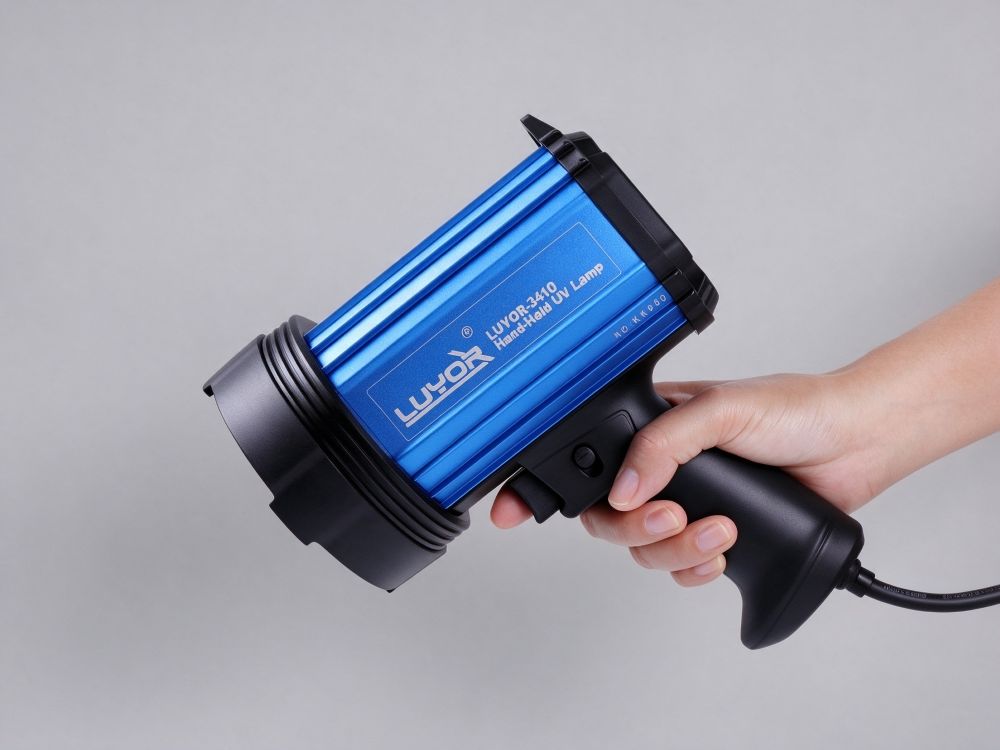
LUYOR-3410 is a 365 nm UV viewing lamp with 6000 uW/cm2 at 38 cm and separate UV and white channels, built for gels and fluorescence screening.
In fluorescent protein screening, fluorescent label detection, and similar work, the outcome often turns on one plain figure: whether the UV intensity reaching the sample is sufficient. The fluorescence signal itself is weak. When excitation is too low, weakly positive clones cannot be separated from the negative background, and the usual response is to lengthen the exposure or raise the gain - which brings the noise up with the signal.
LUYOR-3410 is built around raising that intensity: 4 × 365 nm high-power LEDs give 6000 μW/cm² at the centre 38 cm from the lamp head, with a spot about 150 mm across. That is an order of magnitude above a conventional handheld UV lamp, and in a darkroom it is enough to bring GFP, luciferase substrates, and fluorescent dye signals up clearly, so you do not have to push the ISO to its limit for a photograph.
The form factor is handheld, and mountable on a stand: carried in the hand it follows the sample, which suits colony picking and plate inspection; fixed on a stand it becomes a stable benchtop UV source that can run continuously. That combination travels well across life science laboratories.
The table below gives factory specifications. Intensity figures are measured in a darkroom, at an ambient temperature of 25℃, with a new lamp.
| Item | Specification |
|---|---|
| Model | LUYOR-3410 |
| UV source | 4 × high-power UV-A LED |
| Peak wavelength | 365 nm (band 360-370 nm) |
| UV output power | 15 W |
| UV intensity at 38 cm | 6000 μW/cm² |
| Spot diameter at 38 cm | Approx. 150 mm |
| White light | 5 W white LED, approx. 3500 lux at 38 cm |
| Source life | LED, approx. 50000 hours |
| Body dimensions | 200 × 180 mm |
| Lamp head diameter | Approx. 120 mm |
| Weight | Approx. 0.8 kg |
| Housing | High-strength aluminium alloy with drop-resistant rubber boot |
| Operating mode | Instant on; continuous 24-hour operation on a stand |
| Power cable | 3 m (5 m optional) |
| Standard package | 2 pairs of LUV-10A UV protective glasses, aluminium carrying case |
| Warranty | 3 years |
Why the reference distance is 38 cm: this is the calibration point used in fluorescence inspection standards such as ASTM E3022 and ISO 3059, so data from different manufacturers taken at the same distance can be compared. In practice the lamp usually sits closer, and the irradiance on the sample runs above the rated figure while the covered area narrows accordingly.
The figure becomes easier to judge when placed against specific tasks:
| Application | Intensity requirement | How the 3410 performs |
|---|---|---|
| GFP screening under a stereomicroscope (colony picking) | A few hundred to 1000 μW/cm² is visible; higher intensity is easier to read under ambient light | Handheld at 30 to 40 cm the signal is clear and can be viewed directly in semi-dark conditions |
| Gels and membranes stained with fluorescent dye | Of the order of 1000 μW/cm² | 6000 μW/cm² at 38 cm allows short exposures without long integration |
| Reading aid for fluorescent penetrant inspection | At least 1000 μW/cm² on the viewing surface | Ample margin; suits local recheck and photographic records |
| Small-scale photocatalysis and photopolymerisation | Continuous, stable, and free of thermal radiation | 24-hour continuous operation on a stand; the cool source does not bake the reaction system |
| Fluorescence examination of minerals, evidence, and cultural objects | Medium to high intensity, applied at a shallow angle | The small spot makes the angle easy to control when looking for faint fluorescence differences |
Higher intensity is not automatically better. Excitation and quenching work against each other: too much excitation, or too long an exposure, visibly bleaches the fluorescence, and live cell samples also suffer phototoxic effects. The 3410 approach is to provide ample excitation while leaving room to compromise for sample tolerance, through separate white and UV control and an adjustable working distance.
Fluorescence viewing is normally done in a darkroom or under semi-dark conditions. Once a target is found, the next actions are rarely more irradiation - they are sampling, streaking, marking, photographing, and noting the position. None of that is easy under UV alone.
The 3410 carries a 5 W white LED (approx. 3500 lux at 38 cm) on a channel independent of the UV LEDs:
Find the target: UV on, white off, scan the sample surface.
Mark the position: switch to white, see the sample outline and coordinates, and mark it with a pen.
Take a record: focus and compose under white light, then switch back to UV for the exposure, and the framing matches.
Sample: pick colonies or transfer material under white light without switching on a separate bench lamp.
This sounds minor, but switching lamps on and off and hunting for a torch in a darkroom is one of the larger time sinks in this kind of work. One lamp carrying both light types keeps the rhythm of the work intact.
Another common laboratory requirement is stable irradiation over long periods: a photocatalytic reaction may run for hours, a photodegradation experiment for several days, and plant or algal cultures follow a light cycle. What such work needs is not peak intensity but a source that stays on and does not heat the sample.
| Comparison | LUYOR-3410 (LED) | Conventional high-pressure mercury lamp |
|---|---|---|
| Start-up | Instant on, no warm-up | 5 to 10 minutes of warm-up before output stabilises |
| Thermal radiation | Cool source, negligible infrared output, does not bake the sample | Hot body; samples warm up when placed close |
| Continuous operation | 24 hours continuous on a stand | Forced air cooling needed for long runs; after a shutdown it must cool before restart |
| Life | Approx. 50000 hours | Approx. 500 to 1000 hours, with replacement logged by the hour |
| Spectral purity | Narrow band at 365 nm, 360-370 nm | Broad spectrum including visible and infrared; usually needs an added filter |
The conclusion is direct: for long, stable UV irradiation that does not disturb the sample, use an LED cool source. With its stand mounting points, the 3410 suits a fixed station kept running; the distance from the lamp to the vessel sets the irradiance, and it can be adjusted as needed.
| Model | Form and intensity | Suited to |
|---|---|---|
| LUYOR-3410 | Handheld or stand-mounted, 6000 μW/cm² at 38 cm, spot approx. 150 mm | Fluorescent protein screening, fluorescence photography, small-scale photocatalysis |
| XX-15 / XX-20 | Tubular area source, 1550-1950 μW/cm² at 25 cm | Even area irradiation: gels, plate racks, bench disinfection |
| LUYOR-3109 | Benchtop area source, 9000 μW/cm² at 38 cm, 250×250 mm spot | Larger-area high-throughput irradiation, photopolymerisation, photodegradation |
| LEAC-280L | Handheld dual wavelength, 254 + 365 nm | Switching between shortwave and longwave: fluorescence examination, disinfection verification |
The choice reduces to two questions. How large is the sample area? Within 150 mm, take the 3410; for a 250 mm square, the 3109; to fill a whole rack, the XX-20. Is shortwave needed? Germicidal work or TLC plate viewing requires 254 nm, which is the job of the LEAC-280L or the XX-15C.
The main difference is form factor and coverage. The 3410 is handheld: a 200×180 mm body at 0.8 kg with a spot of about 150 mm, so it follows the sample. The 3109 is a benchtop area source with a 250×250 mm spot, made for fixed-station area irradiation. In intensity the 3109 (9000 μW/cm²) is higher than the 3410 (6000 μW/cm²).
Yes. Published work and routine laboratory practice both irradiate at 365 nm longwave and photograph the fluorescence directly under darkroom conditions. Keep ambient white light as low as practical, set camera white balance for the conditions, and choose an exposure that does not clip the signal. The white LED can be used to focus and compose before switching to UV for the exposure.
It is advisable. The supplied LUV-10A glasses absorb UV around 365 nm, blocking scattered UV while keeping the fluorescence visible. For long sessions under UV, both the eyes and the facial skin should be protected.
Yes. The LED cool source is rated for continuous duty, and once fixed on a stand it can run 24 hours without issue. The housing warms up during long runs but does not become hot to the touch. Check the heat-sink surfaces for dust every six months.
For a standard bench, yes. If the lamp is mounted outside a laminar-flow hood or fixed across benches, choose the 5 m version. Do not chain several high-power units onto one extension lead.
The lamp, 2 pairs of LUV-10A UV protective glasses, and an aluminium carrying case. The case is a hard shell, which suits work that moves between the laboratory and the field. Warranty is 3 years.
For fluorescence viewing, tell us four things - what the sample is, what signal you are looking for, how large an area you irradiate at one time, and whether the work runs continuously - and we can settle the model and whether a stand is needed.
Send inquiry

Email: info@xinysun.com

Tel: 131-2093-6518

Address: 1525 Minqiang Road, Bldg 26, Songjiang, Shanghai

Copyright 2026 Xinysun Instrument (Shanghai) Co., Ltd. All rights reserved.
ICP:ICP-2026046447




 Products
 Applications
 Previous:
 Back to list

 Industrial Test Instruments


