
Products
PRODUCTS Breadcrumb: Home > Products > Life Science Instruments > Laboratory UV Lamps
 Overview
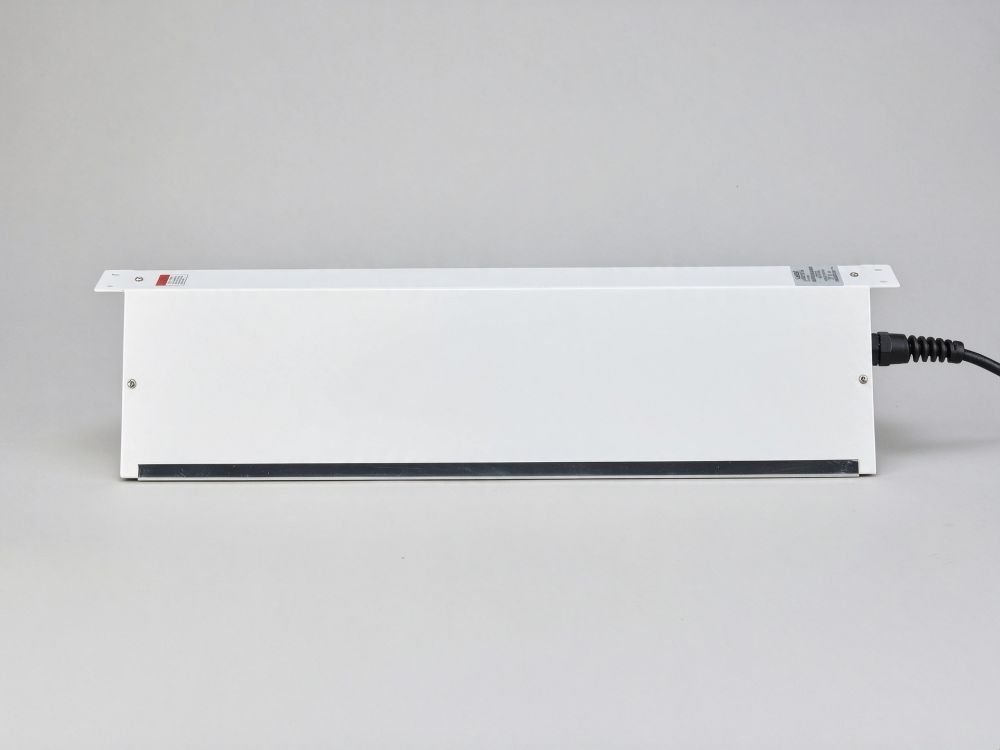
XX-15 and XX-20 tube lamps give 1550-1950 uW/cm2 at 25 cm across 254, 302 or 365 nm, for gel viewing, bench disinfection and even area irradiation.
Laboratory UV sources fall into two broad groups. One is the handheld spot source: a small spot at high intensity, used to find fluorescent indications or to irradiate a small area. The other is the tubular area source: moderate intensity over even coverage, used to irradiate plates, gels, TLC plates, or a bench surface as a whole. XX-15 / XX-20 belongs to the second group.
The construction is straightforward: two UV tubes side by side in an aluminium housing, with a reflector that spreads the light. At 25 cm the irradiance across the whole area falls between 1550 and 1950 μW/cm², and the edges differ little from the centre. For work that requires a whole sample to be lit at once, that evenness matters more than peak intensity at a single point.
The model code carries two variables: tube length (15 / 20) and wavelength (A longwave 365 nm, B midwave 302 nm, C shortwave 254 nm). XX-15C, for example, is the 15 W shortwave version, and XX-20A is the 20 W longwave version.
Two length formats, three wavelengths, six models in total. The table below lists them in two groups by tube length.
| Item | XX-15 series | XX-20 series |
|---|---|---|
| Model | XX-15A / XX-15B / XX-15C | XX-20A / XX-20B / XX-20C |
| Tube configuration | 2 × 15W | 2 × 18W |
| A longwave (365 nm) intensity | 1650 μW/cm² (25 cm) | 1950 μW/cm² (25 cm) |
| B midwave (302 nm) intensity | 1620 μW/cm² (25 cm) | 1910 μW/cm² (25 cm) |
| C shortwave (254 nm) intensity | 1550 μW/cm² (25 cm) | 1950 μW/cm² (25 cm) |
| Dimensions | 50 × 15 × 11 cm | 61 × 15 × 11 cm |
| Weight | Approx. 2.5 kg | Approx. 4.5 kg |
| Housing | Aluminium alloy with powder coating (scratch resistant) | Aluminium alloy with powder coating (scratch resistant) |
| Mounting | Mounting holes in the top end plate: suspension / height-adjustable stand / flat on the bench | Mounting holes in the top end plate: suspension / height-adjustable stand / flat on the bench |
| Tube orientation | Shortwave version flips over (down for bench disinfection, up for sample irradiation) | Shortwave version flips over |
| Power supply | 220 V AC (with matching fixture) | 220 V AC (with matching fixture) |
Intensity figures are measured 25 cm directly below the tube centre, at an ambient temperature of 25℃ with new tubes. Tubes are consumables: output falls gradually after about 1000 hours of accumulated operation, and shortwave tubes lose output faster. Measure irradiance every 12 months or every 1000 hours.
| Wavelength version | Band | Typical use |
|---|---|---|
| A (365 nm) | UV-A longwave | Fluorescence viewing and fluorescent protein screening, mineral and evidence examination, photocatalysis and curing, auxiliary lighting for fluorescent penetrant inspection |
| B (302 nm) | UV-B midwave | Nucleic acid gel viewing, some photobiology and plant research; gentler than 254 nm |
| C (254 nm) | UV-C shortwave | Bench and biosafety cabinet disinfection, nucleic acid crosslinking, TLC plate fluorescence viewing |
XX-15 uses 50 cm tubes and XX-20 uses 61 cm tubes. An 11 cm difference looks small, but it maps to irradiation width: at 25 cm the effective band of an XX-15 is about 40 cm wide, and that of an XX-20 about 50 cm. To light a whole plate rack or a 20×20 cm gel in one pass, choose XX-20; for a single plate, a set of cuvettes, or short gel strips, XX-15 is enough - it is smaller, easier to store, and about half the weight.
For bench surface disinfection, the length also has to match the bench width. A clean bench is commonly 60 to 90 cm wide inside, so an XX-20 (61 cm) laid across covers more than half of it; to cover the full width, run two units side by side or switch to a suspended germicidal luminaire.
254 nm is the band with a pronounced germicidal effect, but it works on surfaces the light reaches directly and has no penetrating power. That single fact dictates how you use it:
Operating note: a common misconception about UV disinfection is that running the lamp counts as disinfecting. What determines the result is the total dose delivered in one session (irradiance × time). Measure at the bench with a UV radiometer and multiply the reading by the irradiation time; that is far more reliable than estimating the time by experience.
| Mounting | How it is done | Suited to |
|---|---|---|
| Suspended | Hanger rods or chains through the mounting holes in the top end plate, fixing the lamp 20 to 30 cm above the work surface | Clean benches, biosafety cabinets, fixed disinfection stations that stay in place |
| Height-adjustable stand | Adjustable stand sets tube height between 20 and 60 cm | Labs where one lamp both irradiates samples and disinfects the bench |
| Flat on the bench | Set directly on the bench, stabilised by the weight of the housing | Temporary work, gel viewing, photographic records |
| Handheld, temporary | The light version can be carried for short scans | Where fixing the lamp is impractical; note that the housing warms up during prolonged handheld use |
Of the three, suspension is the way to get evenness right: the further the tube from the surface, the wider the coverage and the lower the irradiance, and hanging at 20 to 30 cm is the compromise between the two. Where the height changes often, choose the adjustable stand rather than unbolting hanger rods each time.
Two assembly notes. The housing is aluminium, lighter than a steel shell, but it must not be carried by the tubes: hold the housing, not the tube. The tubes plug into their sockets, so when replacing one, align the pins and push gently - do not twist.
| Application | Recommended model | Key practice |
|---|---|---|
| Gel and nucleic acid viewing | XX-15B / XX-20B (302 nm) | Lay the lamp flat on the bench, place the gel above the tubes, add a protective shield, and view bands under darkroom conditions |
| TLC plate fluorescence viewing | XX-15C / XX-20C (254 nm) | Shortwave excitation of the plate with the tube facing up; switch off ambient white light while viewing |
| Clean bench and biosafety cabinet disinfection | XX-15C / XX-20C (254 nm) | Suspend 20 to 30 cm above the work surface, run on a timer when the cabinet is empty, and size the number of units to the surface area |
| Fluorescent protein and fluorescent label screening | XX-15A / XX-20A (365 nm) | Longwave excitation of fluorescent proteins, with LUV-10 series protective glasses, ambient light kept as low as practical |
| Small-scale photocatalysis and UV curing trials | XX-15A (365 nm) | Place the reaction vessel directly below the tube and set the height to control irradiance |
| Fluorescence examination of cultural heritage and evidence | XX-15A (365 nm) | Handheld or low-angle irradiation to see differences in the fluorescence of adhesives and repair marks |
For the selection logic behind this, see the dedicated article on this site: UV lamp wattage misleads you: what different inspections require in μW/cm², which explains why wattage alone is not a guide.
These are all laboratory UV lamps, but the form factor differs, and so does the fitting application:
| Model | Form | Intensity | Suited to |
|---|---|---|---|
| XX-15 / XX-20 | Tubular area source | 1550-1950 μW/cm² (25 cm) | Even area irradiation: gels, plates, bench disinfection |
| LUYOR-3410 | Handheld spotlight | 6000 μW/cm² (38 cm) | Fluorescent protein screening, fluorescence photography, local high-intensity irradiation |
| LUYOR-3109 | Benchtop area source | 9000 μW/cm² (38 cm), 250×250 mm spot | Photocatalysis, photopolymerisation, photodegradation, 24-hour continuous operation |
| LEAC-280L | Handheld dual wavelength | Quartz tube with pure UV filter | Switching between 254 and 365 nm for fluorescence examination and disinfection verification |
In one line: to light an area evenly, choose the XX series; to light a point strongly, choose the 3410; to irradiate a reaction system for hours, choose the 3109; to carry two wavelengths and switch between them, choose the LEAC-280L.
A is longwave 365 nm, B is midwave 302 nm, and C is shortwave 254 nm. The three serve quite different purposes: 365 nm is mainly for fluorescence excitation, 302 nm for nucleic acid gel viewing, and 254 nm for germicidal use and TLC plate viewing. Decide on the application, then the suffix.
The main differences are tube length and power: XX-15 is 2×15W, 50 cm long, 2.5 kg; XX-20 is 2×18W, 61 cm long, 4.5 kg. The power difference carries into intensity: at 25 cm the XX-20 reads about 15% to 26% higher than the XX-15, and its effective irradiation band is roughly 10 cm wider.
Yes. The tubes plug into the sockets: switch off, let the lamp cool, take out the old tube, align the pins, and push it home. After replacement, measure once with a UV radiometer to confirm the output is normal. The replacement tube must match the original in both length and wavelength.
It depends on the dose required and the irradiance you measure; there is no single number of minutes. Measure μW/cm² at the bench, work the time back from the target dose, and record the result in the laboratory disinfection log. Note as well that UV acts on directly exposed surfaces: a shadowed area gains nothing from a longer run.
Not with 254 nm shortwave. It damages the cornea and the skin, and brief exposure can cause photokeratitis. The standard practice is unattended operation on a timer, with a warning sign at the door. If someone has to watch a sample, for instance a gel, they should wear suitable UV protective glasses and keep the time short.
Two items are commonly added: 1. UV protective glasses (worn when viewing gels and fluorescence; the LUV-10 series is available), and 2. a height-adjustable stand (where the lamp height changes often). A UV radiometer is also worth having, to track tube ageing - it is what turns disinfection into a recordable process.
If you are unsure which wavelength and length to take, tell us four things - what the sample is, how large an area you irradiate at one time, whether anything casts a shadow, and how long the exposure runs - and we will check the selection with you.
Send inquiry

Email: info@xinysun.com

Tel: 131-2093-6518

Address: 1525 Minqiang Road, Bldg 26, Songjiang, Shanghai

Copyright 2026 Xinysun Instrument (Shanghai) Co., Ltd. All rights reserved.
ICP:ICP-2026046447




 Products
 Applications
 Previous:
 Back to list

 Industrial Test Instruments


