
Products
PRODUCTS Breadcrumb: Home > Products > Life Science Instruments > Laboratory UV Lamps
 Overview
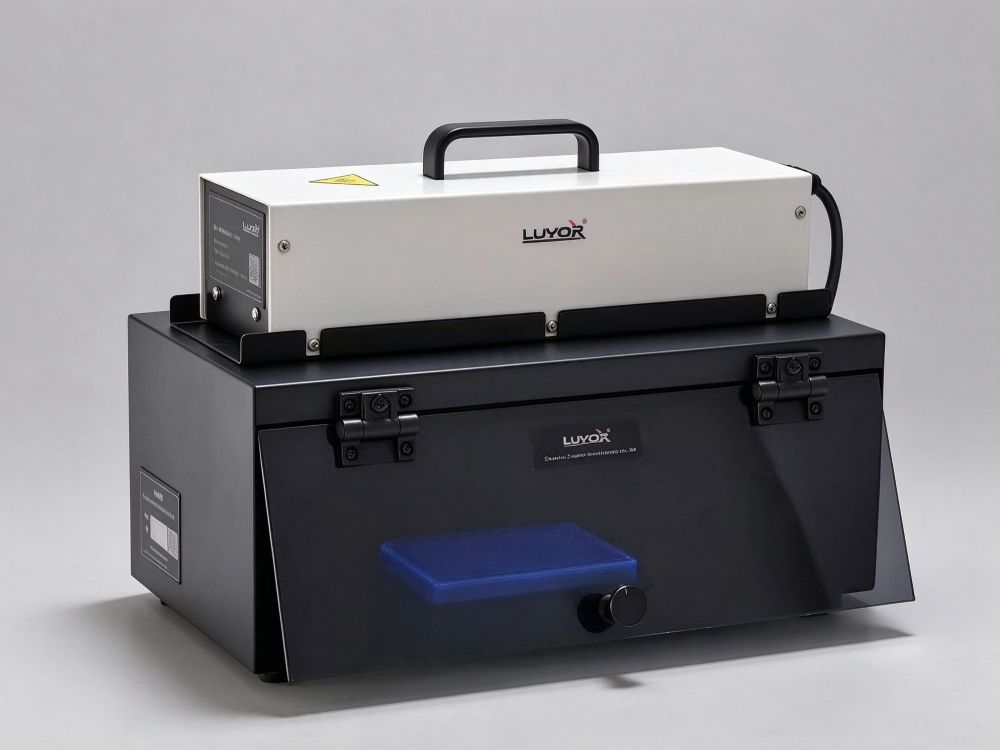
Handheld three-wavelength UV lamp with 254, 302, and 365 nm tubes, 1236 uW/cm2 UVA at 10 cm, for fluorescence viewing, photochemistry, and sterilization.
Laboratory UV sources are usually split by band: 365 nm long wave for fluorescence, 302 nm mid wave for photochemistry and biological irradiation, 254 nm short wave for sterilization and nucleic acid crosslinking. Spread over three lamps, the bench fills up, and every switch means finding the right lamp, positioning it, and resetting the height - one step is easily skipped.
LELMS-38L mounts three 8 W tubes side by side in a 330 mm metal housing, with three rocker switches at the tail, one per circuit. Press for the band you need, or run all three together. An aluminum orange-peel reflector on the inner wall returns light from the back of the tubes to the aperture and evens out the center of the spot; a black UV filter about 20×6 cm covers the aperture, blocking visible light and passing UV only, so the background is cleaner during fluorescence work.
It fits a working rhythm where one batch contains samples for long-wave fluorescence, samples for mid-wave irradiation, and samples for short-wave sterilization, and nobody wants to change lamps in between. One lamp covers three infrequent needs - that is the main value of a three-wavelength model.
| Item | Data |
|---|---|
| Model | LELMS-38L |
| Tubes | 3 × 8 W UV tubes (one each at 254 nm, 302 nm, 365 nm) |
| Bands | UV-A 365 nm / UV-B 302 nm / UV-C 254 nm |
| Center intensity at 10 cm | UVA 1236 μW/cm²; UVB 848 μW/cm²; UVC 1170 μW/cm² |
| Filter | Black UV filter, about 20 × 6 cm |
| Reflector | Aluminum alloy orange-peel reflector |
| Control | Three rocker switches at the tail, one per band |
| Housing | Metal housing, scratch-resistant powder coating |
| Dimensions | 330 mm long × 100 mm wide × 80 mm high |
| Power cord | 2.5 m |
| Supply | 220 V 50 Hz (110 V version optional) |
| Optional | Bench stand |
| Standard | Clear UV safety glasses |
The intensities in the table are factory test conditions: center point directly under the tubes, 10 cm from the aperture, new tubes. At 20 cm, or toward either end of the housing, the reading is lower than this figure, and output also falls as the tubes age. For quantitative records, measure at the working position rather than scaling the factory number.
The three tubes peak at different wavelengths and excite different phenomena. The table below maps band to task; that column alone is enough to choose.
| Band | Peak | Intensity at 10 cm | Main uses | Watch for |
|---|---|---|---|---|
| UV-A | 365 nm | 1236 μW/cm² | Fluorescence excitation: mineral and gemstone identification, document and seal authentication, forensic evidence, coating defects and surface cracks, aid to fluorescent penetrant inspection | Needs a dark room; the darker the ambient, the clearer weak fluorescence |
| UV-B | 302 nm | 848 μW/cm² | Photochemistry and biological irradiation: DNA damage and repair studies, skin phototherapy experiments, plant secondary metabolism and stress response, UV curing | Marked erythemal effect; avoid direct exposure of skin and eyes |
| UV-C | 254 nm | 1170 μW/cm² | Sterilization and nucleic acid crosslinking: surface and instrument disinfection, irradiation inside biosafety cabinets, crosslinking nucleic acids to membranes (Southern / Northern blotting) | Strong corneal irritation; safety glasses required, room ventilated |
Long wave carries less energy but penetrates a little better, and many organics, adhesives, fibers, and minerals luminesce under it. Reading rests on differences in fluorescence color and brightness, so ambient light has to be suppressed.
Mid wave sits between the two, energetic enough to drive photochemistry without breaking biomolecules as hard as short wave, and is used for controlled photo-induced experiments.
Short wave is absorbed strongly by nucleic acids and forms pyrimidine dimers that block replication and transcription. Sterilization, crosslinking, and surface decontamination all rest on this mechanism.
The figure carries three qualifiers: center point, 10 cm, new tubes. Drop any one of them and the intensity you get is different. Understanding these points is more useful than memorizing the number.
| Variable | Effect on the reading | What to do |
|---|---|---|
| Working distance | The tube is a line source, so falloff is slower than from a point source, but 20 cm is already well below 10 cm | Move to 10-15 cm to read fine detail; back off for large-area irradiation |
| Off-center position | Ends and outer long edges read lower than the center, and the drop at the two ends of a 330 mm housing is more pronounced | Sweep the housing along the long edge in steps instead of lighting only the center |
| Tube aging | Output falls with accumulated burn time and is almost invisible to the eye | Keep a burn-hour log, replace on schedule, verify with a UV radiometer |
| Filter contamination | Dust, fingerprints, and reagent residue absorb UV | Wipe with absolute ethanol and lens tissue, not a dry coarse cloth |
| Supply and temperature | Output is low at low voltage and during cold start | Warm up for a few minutes before reading or timing |
For dose calculations there is one formula: dose = intensity × time. The factory figure of 1170 μW/cm² equals 1.17 mW/cm², so a target of 10 mJ/cm² corresponds to about 8.5 seconds. That holds for new tubes, dead center, at 10 cm; in practice substitute the radiometer reading at the working position and keep a margin.
How UV intensity maps to inspection requirements is covered in a separate article: Lamp wattage misleads you: what different inspections require in μW/cm².
The three rocker switches sit at the tail under the thumb and work one-handed. Switch-on order does not change the result, but the sequence below gives better repeatability:
365 nm alone for fluorescence, 302 nm for photo-induced work, 254 nm for sterilization or crosslinking. Add circuits one at a time when you need a comparison, so the spectra do not overlap and leave you unable to say which band produced what.
Keep 10-15 cm for handheld reading; for larger areas fix the housing on a stand and set the height once, so before-and-after comparisons stay valid.
Switch off the room lights, draw the blinds, or surround the sample with a dark cloth or an enclosure. Clarity in fluorescence reading depends largely on this step, not on intensity.
The housing is 330 mm and covers a limited area in one pass. Move in steps of about half the lamp length, stop to observe at each, and light edges and corners separately.
Write band, distance, duration, and whether filter glasses were worn into the record. These conditions are far more useful than "irradiated for a while" when the work is repeated or handed to another operator.
The housing is designed to stand on its end face or side on the bench for temporary hands-free irradiation; for long fixed use, fit the bench stand, which adjusts height and angle and keeps the lamp from being knocked over.
The differences between lamps in this range come down to number of bands, form factor, and intensity, not to the wattage figure alone.
| Model | Bands | Form | Intensity reference | Suited to |
|---|---|---|---|---|
| LELMS-38L | 254 / 302 / 365 nm, three wavelengths | Handheld, 330×100×80 mm | 1236 / 848 / 1170 μW/cm² at 10 cm | Three occasional band requirements covered by one lamp |
| LEAC-280L | 254 + 365 nm, two wavelengths | Handheld, 337×83×64 mm | - (center intensity not stated) | Long and short wave only, with the fluorescence contrast of a filter glass |
| XX-15 / XX-20 | Single wavelength, two tubes (254 or 302 or 365) | Tube form, bench or suspended | 1550-1650 μW/cm² at 25 cm | Petri dishes and gels that need even illumination over a whole surface |
| LUYOR-3410 | 365 nm single-wavelength LED | Handheld / stand | 6000 μW/cm² at 38 cm | Long wave only, but higher intensity and a tighter spot |
| LUYOR-3109 | 365 nm single wavelength, 9 LEDs | Benchtop | 9000 μW/cm² at 38 cm | Photocatalysis and UV curing that need long continuous irradiation |
The rule of thumb fits in two sentences: if you need all three tasks and none of them often, take LELMS-38L; if you need one task with more intensity or uniformity, take the matching single-wavelength model. The first saves bench space and switching; the second is more focused on a single parameter.
| Application | Band | Key point |
|---|---|---|
| Spot viewing on thin-layer chromatography (TLC) plates | 254 nm | Short wave excites the fluorescent plate in a dark room and spots appear dark; plates with a fluorophore can also be viewed at 365 nm |
| Crosslinking nucleic acids to nylon or nitrocellulose membranes | 254 nm | Calculate dose from membrane area, then run Southern or Northern hybridization |
| Biosafety cabinet and bench disinfection | 254 nm | Clean the surface first, since organic residue shadows the light; keep people out during irradiation |
| Mineral, gemstone, and jade identification | 365 nm | Observe fluorescence color and distribution in long wave, then compare absorption at 254 nm |
| Initial screening of documents, receipts, and seals | 365 nm | View at an angle for fluorescent fibers and ink differences; the darker the room, the clearer |
| Coating defects, cracks, and aid to fluorescent penetrant reading | 365 nm | Use with penetrant and view the yellow-green indication in a dark room |
| Photo-induced experiments on plants and microorganisms | 302 nm | Fix height and duration, run a dark control, and avoid mixing bands |
| UV curing of materials and rapid positioning of adhesives | 302 / 365 nm | 365 nm for small spot curing, 302 nm where mid-wave initiation is needed |
Experiments that need quantitative irradiation, long-term stable output, or temperature control are better served by a UV irradiation chamber with closed-loop control; a handheld lamp wins on flexibility and immediate use, and the two do not conflict.
The 254 nm short-wave circuit is the higher-risk channel in this lamp. It irritates the cornea and skin quickly, and a few seconds of direct or reflected view can be uncomfortable. Put on the supplied clear UV safety glasses before switching on and keep the beam facing away from people; for long irradiation, clear the room and post a warning at the door.
Control skin exposure as well. Keep arms and wrists out of the spot under short wave; 302 nm mid wave also has a marked erythemal effect, so do not judge safety by the absence of heat.
Ozone and ventilation. In air, 254 nm reacts with oxygen and produces a small amount of ozone, which is a property of the wavelength, not a defect of the lamp. A short check is not a concern; after long irradiation in a small closed space, ventilate for a few minutes before re-entry.
The filter is a glass part. After a drop or an impact, inspect it against a light even if it looks intact; a crack lets visible light through and noticeably brightens the fluorescence background.
Cleaning matters. Wipe the filter and tubes with absolute ethanol and lens tissue; avoid coarse cloth or abrasive cleaners, since scratches scatter UV and reduce output efficiency.
Replace tubes on a schedule. The factory does not publish a fixed interval; common practice is about 1000 accumulated hours or 12 months, whichever comes first. After replacement, re-measure with a radiometer to confirm all three circuits are back to normal.
Power and cable. Do not trap the 2.5 m cord under a door or route it over sharp edges; the 110 V version must match a 110 V supply, and a mismatch will damage the tube circuit.
Yes. Each of the three rocker switches at the tail drives one circuit, so you can run one, any two, or all three. For fluorescence reading, though, mixing is not advised: overlapping bands add stray light and weak signals become harder to see. Mixing suits work that needs broadband irradiation.
Both sit in UV-B, and the difference in nominal peak comes from the phosphor blend in the tube. Real output is a band, not a single line, so selection can rest on the published peak and intensity. This lamp is rated at 302 nm with 848 μW/cm² at 10 cm. If a protocol specifies 312 nm, run a comparison first and then decide on the substitution.
Yes. In air, 254 nm UV reacts with oxygen and generates a small amount of ozone, a property of the wavelength rather than a quality issue. A short check is not a problem; after long irradiation in a small closed space, ventilate first. Work that is sensitive to ozone is better done in a fume hood.
Whether it is enough depends on the target dose, not on the intensity alone. Dose = intensity × time, so a target of 10 mJ/cm² takes about 8.5 seconds at the center at 10 cm. For real validation, measure the intensity at the working position with a radiometer and multiply by time; also watch shadowed and masked areas and the lower-intensity ends of the housing, which are the usual sources of surviving organisms.
The factory does not specify a fixed interval. Common practice is about 1000 accumulated hours or 12 months, whichever comes first. UV output declines gradually and cannot be judged by eye, so log the burn time and measure intensity before and after replacement for comparison.
Yes. The housing can stand on its end face or side on the bench, which is enough for short irradiation; for long fixed irradiation, fit the bench stand, which adjusts height and angle and keeps the cable from pulling the lamp over.
To choose a three-wavelength handheld lamp, state three things: which tasks you need, how much of each, and whether quantification matters. We can check the band combination and the form factor with you.
Send inquiry

Email: info@xinysun.com

Tel: 131-2093-6518

Address: 1525 Minqiang Road, Bldg 26, Songjiang, Shanghai

Copyright 2026 Xinysun Instrument (Shanghai) Co., Ltd. All rights reserved.
ICP:ICP-2026046447




 Products
 Applications
 Previous:
 Back to list

 Industrial Test Instruments


