Products
PRODUCTS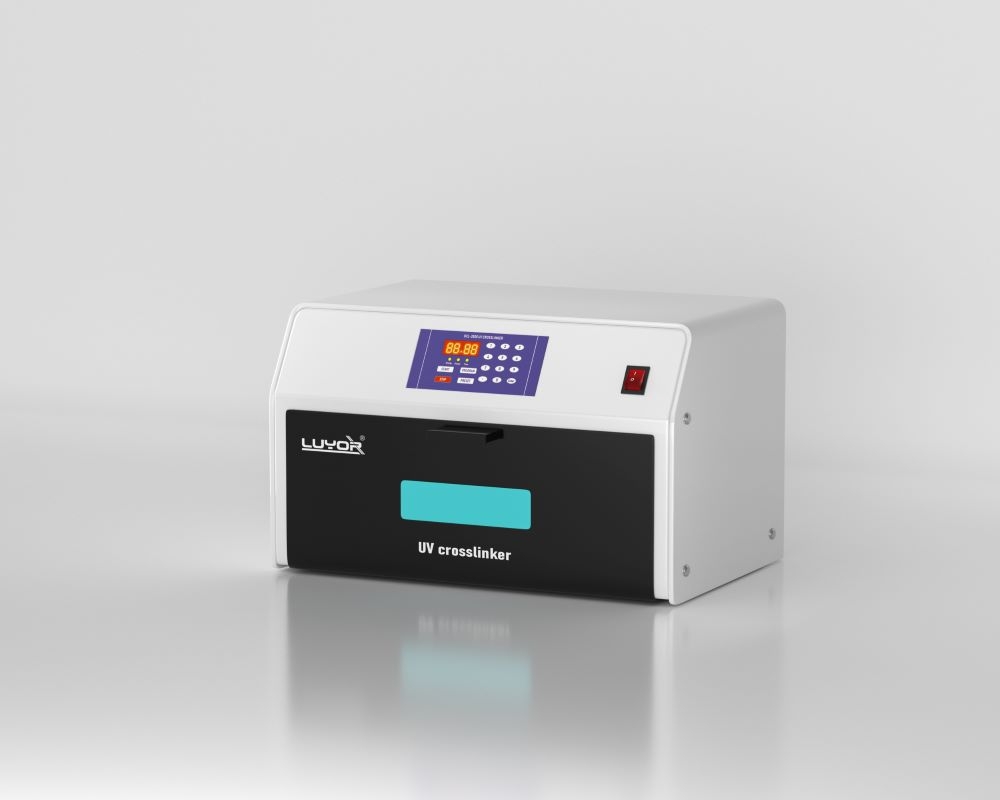
 Overview
Three wavelength UV crosslinker UCL-3500LMS carries a built-in calibration program for each band; switching bands requires fitting the matching UV tubes. 18x15 W tubes and a 44x34x15 cm chamber support large membranes, with energy, time and preset modes plus selection guidance.
Different wavelengths address different photochemical and biological questions. Putting all three in one three wavelength UV crosslinker is not about shining three lights at once; it lets the same batch of samples switch bands by project, without buying a second crosslinker; switching bands requires fitting the UV tubes for the selected band.
| Band | Main use | Typical experiments |
|---|---|---|
| UVC 254 nm | Nucleic acid membrane crosslinking, classic CLIP, UV sterilisation and PCR contamination control | Southern / Northern / Dot blot, EMSA, CLIP-seq |
| UVB 302 nm | DNA damage and repair, UV-induced mutation, UVB photobiology | Mutant library construction, survival assays, UV stress |
| UVA 365 nm | PAR-CLIP, psoralen, pBpa, photoactive group activation and UV curing | Protein-nucleic acid crosslinking, hydrogel and photoresist curing |
All three bands work with energy, time and program-recall modes. For comparison between batches, energy mode is the preferred approach.
| Mode | How it works | Suitable scenario |
|---|---|---|
| Energy (ENERGY) | Accumulates UV dose in J/cm2 and stops automatically at the set value | Batch comparison, reproduction across time, consistent dose after tube ageing |
| Time (TIME) | Irradiates for a set time and stops automatically | Protocols already validated by duration with a fixed workflow |
| Program recall (PRESET) | Recalls a saved energy or time setting | Shared instruments and frequently repeated programs |
The instrument carries a built-in calibration program for each band. Fit the UV tubes for the selected band, then recall that band's program, so you do not need one device per project.
The sensor accumulates UV dose continuously and stops at the target, reducing operator variation. Output drift from tube ageing or ambient temperature no longer translates directly into dose variation.
Set the irradiation time as required and the unit stops at that time, suiting workflows already validated by a fixed duration.
Energy and time settings are stored separately, so common wavelength-dose combinations can be recalled in one step and repeated entries on a shared instrument are reduced.
Each unit is calibrated for irradiance before shipment with a UV radiometer calibrated by a legal metrology body, traceable to a national measurement standard, so doses are comparable between batches.
One three wavelength UV crosslinker covers common UV exposure steps across nucleic acid, protein, microbiology, materials and photostability work.
| Application | Description |
|---|---|
| DNA / nucleic acid membrane crosslinking | Northern, Southern and Dot blot, EMSA and other DNA/RNA membrane fixation workflows |
| CLIP and bimolecular crosslinking | CLIP-seq, iCLIP, PAR-CLIP, psoralen, pBpa and sulfo-SDA experiments |
| UVB mutation and DNA damage | UVB-induced damage, DNA repair, survival assays and UV stress studies |
| Microbial inactivation | UV inactivation of bacteria, fungi and viruses, surface decontamination and PCR contamination control |
| Polymer curing | Hydrogels, photoresists and other materials needing 365 nm UVA excitation |
| Photostability testing | Material UV exposure, photo-ageing, long-term tolerance and wavelength-response evaluation |
| Item | Specification |
|---|---|
| Model | UCL-3500LMS |
| Wavelengths | 365 nm / 302 nm / 254 nm |
| UV tubes | 18 x 15 W |
| Programming | 9 stored preset radiation energy values |
| Energy setting | 0.000 - 9.999 J/cm2, or 0.00 - 99.99 J/cm2 |
| Time setting | 00.00 - 99.59 min, or 000.0 - 599.5 min |
| Operating temperature | 15 - 40 C |
| Operating humidity | 70%, non-condensing |
| External surface temperature | 30 C or lower |
| Start-up time | under 1 second |
| External dimensions | 55 x 36 x 30 cm (L x W x H) |
| Internal dimensions | 44 x 34 x 15 cm (L x W x H) |
| Weight | 12 kg |
| Power | 230 VAC, 50/60 Hz |
| Certification | CE |
| Chamber | Aluminium UV irradiation chamber with aluminium diffuse reflector |
| Warranty | Free replacement for faults within one year; free service within three years |
Compared with the single-band UCL-3500 in the same series, the LMS version brings all three bands onto the same 15 W platform and large chamber with built-in calibration programs for all three bands; switching bands still requires fitting the matching tubes. Large membranes, batch samples and thick-walled vessels depend on higher irradiance that longer time cannot replace, while a three-band instrument also serves CLIP, UVB damage and photocuring projects on one unit. For routine 254 nm small-membrane crosslinking alone, a single-band model is more economical.
| Model | Tubes and bands | Inner chamber |
|---|---|---|
| UCL-3200 | 6 x 8 W, 254 nm main band | 32 x 26 x 15 cm |
| UCL-3200LMS | 18 x 8 W, 254 / 302 / 365 nm | 32 x 26 x 15 cm |
| UCL-3500 | 6 x 15 W, 254 nm main band | 44 x 34 x 15 cm |
| UCL-3500LMS | 18 x 15 W, 254 / 302 / 365 nm | 44 x 34 x 15 cm |
A three wavelength UV crosslinker carries built-in calibration programs for 254 nm, 302 nm and 365 nm. Fit the UV tubes for the band you need, then recall that band's program. A single-band model carries a single tube type and has a simpler structure and price. If all your work is 254 nm nucleic acid membrane crosslinking, a single band is enough; when experiment types vary or a unit is shared, three bands avoid keeping extra instruments; tubes still need to be changed when the band changes.
That is not the intended use. The three bands drive different photochemical reactions, and mixing them removes the meaning of both dose specification and experimental design. The LMS series carries a built-in calibration program for each band. Fit the UV tubes for the required band, recall that program, use one band per exposure, then change tubes to switch to another band.
Start with membrane size and throughput. For regular-size membranes and limited bench space, choose the UCL-3200LMS (18 x 8 W, 32 x 26 x 15 cm inner chamber, 9 kg). For large membranes, batch samples or thick-walled vessels, choose the UCL-3500LMS (18 x 15 W, 44 x 34 x 15 cm inner chamber, 12 kg). The bands and operating modes are the same; the differences are tube power, chamber size and weight.
For comparison between batches, or to keep a result consistent months later, use energy mode: the unit accumulates J/cm2 and stops the lamp at the target, so tube weakening lengthens the run rather than lowering the dose. For a workflow already validated by a fixed duration, time mode is more direct.
1 J/cm2 = 1000 mJ/cm2. Papers often write mJ/cm2 while instrument settings use J/cm2; reading 0.12 J/cm2 as 0.12 mJ/cm2 gives a thousand-fold error. When comparing doses across papers, also watch the J/m2 versus J/cm2 conversion.
Energy and time settings are stored separately, so common wavelength-dose combinations can be recalled in one step and repeated entries on a shared instrument are reduced. Preset counts follow the specification table: the UCL-3200LMS has 9 energy plus 9 time presets, and the UCL-3500LMS has 9 stored preset radiation energy values.
Before shipment, irradiance is calibrated with a UV radiometer calibrated by a legal metrology body, traceable to a national measurement standard. Without that step, two units set to the same J/cm2 need not deliver the same dose.
| What you need | How we help |
|---|---|
| Model and specification confirmation | Send sample type, membrane size, target band and dose; we suggest a model and configuration |
| Demonstration and sample testing | On-site demonstration can be arranged in East China; sample testing by post is available elsewhere |
| Quotation and lead time | Regular models in stock; tax-inclusive quotation and delivery date replied the same day |
| Technical documents | Specification sheets, manuals and calibration and compliance notes supplied on request |
For the compact three-band model, see UCL-3200LMS three wavelength UV crosslinker. For single-band instruments, see LUYOR UCL-3500 and UCL-3200. Browse the full UV crosslinker category for specifications and selection guidance.
Send inquiry

Email: info@xinysun.com

Tel: +86-131-2093-6518

Address: 1525 Minqiang Road, Bldg 26, Songjiang, Shanghai

Copyright 2026 Xinysun Instrument (Shanghai) Co., Ltd. All rights reserved.
ICP:ICP-2026046447




 Products
 Applications
 Previous:
 Back to list

 Industrial Test Instruments


