
Products
PRODUCTS Breadcrumb: Home > Products > Industrial Test Instruments > UV Flashlights
 Overview
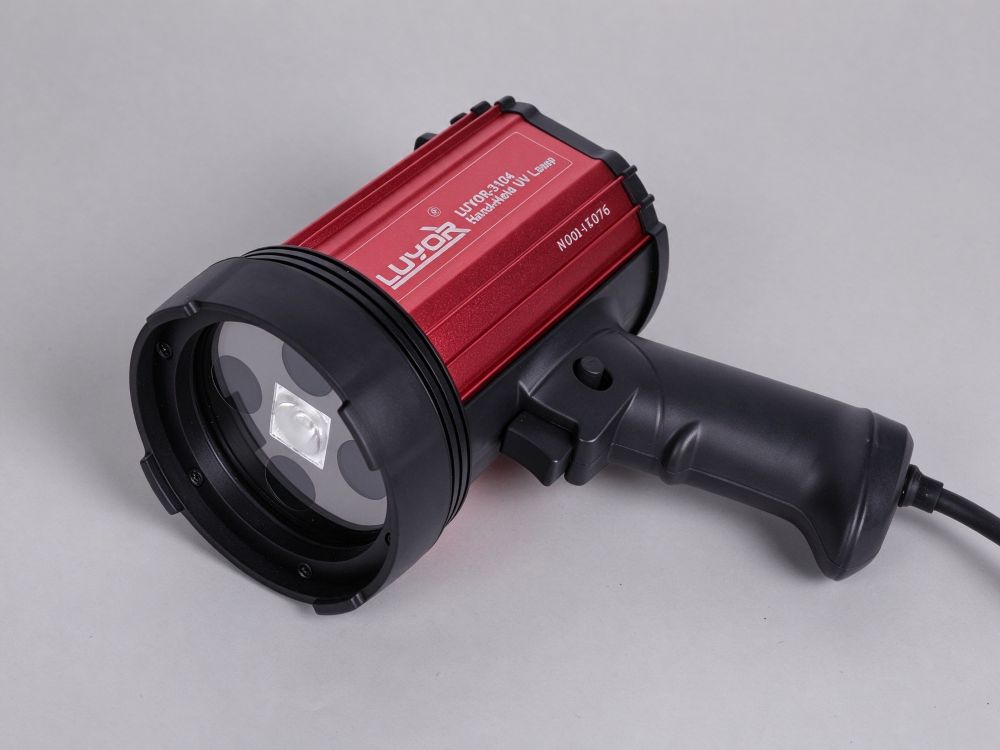
LUYOR-3104 and 3104D pair 4 x 365 nm LEDs at 6000 uW/cm2 with a 3 W white LED, so PT and MT indications are read, marked and photographed with one lamp.
The rhythm of fluorescent penetrant and fluorescent magnetic particle inspection is to read in the dark and record in the light: ambient white light has to be very low while indications are read, and illumination is needed to scribe, photograph, and complete the record. LUYOR-3104 / 3104D put both into one head - 4 × 365 nm high-power UV-A LEDs excite the fluorescent indications and 1 × 3 W white LED (5700 K) lights the work, with the two paths driven and switched independently, usable one at a time or together.
The UV channel spans 360 to 370 nm with a peak at 365 nm and no UVB or UVC. A clear quartz optical lens is fitted at the front as standard. Center intensity at 38 cm is 6000 μW/cm², 6 times the 1000 μW/cm² reading threshold in the ASTM E3022 / ISO 3059 framework, and the effective area at 38 cm is about 150 mm in diameter, which matches the field of view of portable inspection on a flange face, a weld, or a local area of a casting.
In the model naming, the 3104 ships with a 24 V power adapter (100 to 260 V AC, mains operation) and the 3104D with a 24 V lithium battery pack for about 6 hours of continuous work per charge. Choose the 3104 for a fixed station, and the 3104D for field work, tank interiors, work at height, and mobile inspection.
The data below follows LUYOR technical documentation and has been cross-checked against the manufacturer catalog PDF. This is the table to cite in selection, tenders, and process documents.
| Item | Data |
|---|---|
| Model | LUYOR-3104 (mains version) / LUYOR-3104D (battery version) |
| UV source | 4 × high-power UV-A LED (365 nm) |
| White light | 1 × 3 W white LED, 5700 K, separate switch, brightness greater than 3000 lux |
| Peak wavelength | 365 ± 5 nm (360 to 370 nm), no UVB / UVC |
| UV-A output | 6000 μW/cm² (center value at 38 cm) |
| Effective area | Approx. 150 mm (at 38 cm) |
| Visible light level | Below 10 lux with UV on (5.45 lux measured at 38 cm) |
| Power | 3104: 24 V power adapter (100 to 260 V AC); 3104D: 24 V lithium battery pack |
| Battery runtime | 3104D about 6 hours, charging about 6 hours |
| Source life | More than 20000 hours |
| Housing | Aluminum alloy, effective heat dissipation |
| Filter | Clear quartz optical lens standard, black filter available as an option |
| Standard accessories | Main unit, LUV-10 clear safety glasses, LUV-30 fluorescence-enhancing safety glasses, charger (3104D), manual, certificate of conformity, warranty card, aluminum carrying case |
| Warranty | 3 years (excluding user-caused damage) |
| Compliance | ASTM E3022, GB/T 5097-2020 / ISO 3059, GB/T 15822, ASTM E2297, US MIL standards |
Note another common statement in manufacturer material: the white-light figure of "below 18 lux" is a tolerance value measured at 38 cm with a HIOKI 3423 illuminance meter, while the data table gives below 10 lux and 5.45 lux measured. In a process document, state the figure as a limit of 20 lux with 5.45 lux measured, which covers both readings.
The white channel on the 3104 is not a filler feature. Once an indication appears, the inspector has to scribe, photograph, and complete the record, and those actions are hard under black light alone. The 3104 follows the same approach as the 3103, with a 3 W white LED built into the head:
With the UV channel on, visible light leakage is 5.45 lux (measured at 38 cm), which meets the standard requirement of no more than 20 lux in the viewing environment;
Once a defect is found, one press switches to white light at 5320 lux, bright enough to scribe, photograph, and check the record;
White and UV are driven separately, so switching does not change the black light state, and the sweep resumes afterwards without a separate work lamp.
Note that the white light is for marking and recording, not for reading. White light must be off while fluorescent indications are observed, and the lower the ambient white light, the better the contrast.
The 6000 μW/cm² figure is the center value at 38 cm. At closer inspection distances irradiance on the part is higher and the covered area narrows. Intensity, distance, and area have to be worked out together:
| Working condition | Recommendation |
|---|---|
| Confirming an indication point by point | Hold the lamp 150 to 250 mm away for higher center irradiance and coverage of about 100 mm, which suits confirmation of a suspect trace |
| Sweeping area by area | Keep the lamp at about 38 cm, which covers about 150 mm, and work block by block to avoid gaps |
| Wide-area surveys in aerospace | Use the flood version 3104F / 3104DF: wider coverage and 4000 μW/cm² at 38 cm, still above the 1000 threshold |
| Irradiance acceptance | Measure a center point and an edge point at the actual reading position with a UV radiometer and record them in the equipment inspection sheet |
On "why 38 cm is the measuring datum" and "how μW/cm² requirements differ between inspection tasks", the site carries a dedicated article: The wattage on a UV lamp misleads you: μW/cm² requirements across inspection methods.
This generation drops the heavy power box of a conventional blacklight and runs from mains or a battery pack, which makes the unit much lighter. A few site details are worth noting:
Two power options: the 24 V adapter of the 3104 plugs into a 100 to 260 V socket, which suits a fixed reading station; the lithium pack of the 3104D gives about 6 hours and suits tank interiors, work at height, and mobile field work, with about 6 hours to recharge;
Backlit switch: the switch on the 3104 mains version carries a blue backlight, which makes it easy to find in a dark room; the 3104D battery version has no backlight;
Two mounting options: a square mounting hole at the base of the handle fits an equipment support, and a lanyard hole at the top of the body allows the lamp to hang above a magnetic particle bench and leaves both hands free;
Instant start: the LED lights at once with no warm-up wait as with a mercury lamp, which suits an inspection rhythm of frequent switching.
The LUYOR-3104 series meets ASTM E3022 (UV-A LED lamps for fluorescent penetrant testing) and the viewing-condition requirements of GB/T 5097-2020 / ISO 3059, and covers GB/T 15822 (magnetic particle testing), ASTM E2297, and US MIL standards. For audits, prepare the following in advance:
| Audit focus | What to prepare |
|---|---|
| Lamp compliance | ASTM E3022 declaration of conformity and factory inspection report |
| Irradiance verification | On-site UV radiometer records: UV-A intensity and ambient white light at the reading position |
| Operator protection | LUV-10 clear safety glasses (impact protection) and LUV-30 fluorescence-enhancing glasses (higher indication contrast) are standard; check that they are in use |
| Equipment register | Include intensity, wavelength, and filter condition of the 3104 / 3104D in the periodic inspection schedule |
| Model | Configuration and differences |
|---|---|
| LUYOR-3104 | 4 UV LEDs + white light, narrow-beam lens, clear filter, 24 V adapter, 6000 μW/cm² at 38 cm |
| LUYOR-3104D | As above, with a built-in lithium battery pack for sites without power |
| LUYOR-3104F | Flood lens for wider coverage, 4000 μW/cm² at 38 cm, designed for aerospace |
| LUYOR-3104DF | Flood lens plus lithium battery pack, common in aerospace field inspection |
The filter is a choice of two: the clear quartz lens passes UV well with slightly higher visible light, and the data on this page assumes the standard clear lens; the black filter cuts stray light well but blocks about 30% of the UV, so intensity falls accordingly. Order the standard configuration unless a process document requires a black filter fitted at the factory.
It comes down to whether white light is needed. The 3104 carries 1 × 3 W white LED and suits magnetic particle and penetrant inspection that needs on-site scribing, photography, and records; the 3105 drops the white light, moves to 5 LEDs, and raises output to 7000 μW/cm², which suits stations that already have separate lighting and want higher UV output.
A full charge gives about 6 hours of continuous work, and charging takes about 6 hours. On an 8-hour shift, plan a recharge or a spare pack part way through; for heavy use, the mains 3104 is the alternative.
It is well above the 1000 μW/cm² reading threshold for fluorescent penetrant and magnetic particle inspection, and it meets the common process requirement for UV-A between 1000 μW/cm² and 5000 μW/cm². It also suits demanding penetrant work that calls for high intensity.
Yes, though the narrow-beam design is intended for flaw detection reading. For wide-area degreasing acceptance, choose the LUYOR-2130L; for fluorescent leak detection, choose the LUYOR-365L, which give a larger spot and faster coverage.
Three items: 1. each shift, check the filter for cracks and the housing and lens for damage; 2. at set intervals, measure irradiance at a fixed distance with a UV radiometer, record it, and send the lamp for service when the reading falls clearly; 3. wipe the filter and the aluminum heat-dissipating surface with a soft cloth, so that developer powder does not build up on the heat sink.
For portable lamp selection, four details are enough: part size, working position, power availability, and whether white light is needed. Send them to us and we can check the mains or battery choice and the pairing of spot and flood lenses.
Send inquiry

Email: info@xinysun.com

Tel: 131-2093-6518

Address: 1525 Minqiang Road, Bldg 26, Songjiang, Shanghai

Copyright 2026 Xinysun Instrument (Shanghai) Co., Ltd. All rights reserved.
ICP:ICP-2026046447




 Products
 Applications
 Previous:
 Back to list

 Industrial Test Instruments


